Long ago, there lived an elderly fisherman who struggled to provide for his wife and three children. He owned little, and his daily survival depended on what he could catch from the sea.
He followed a strict habit. Each day, he cast his fishing net only four times. Whatever fortune brought him in those four attempts would have to be enough.
One afternoon, he carried his basket to the shore, rolled up his clothes and waded into the water. He cast his net and waited for it to sink. When he began pulling, he discovered that it was unusually heavy. No matter how hard he struggled, he could not bring it ashore.
He tied the ropes to a stake, removed his clothes and plunged into the water to free the net. After considerable effort, he finally dragged it onto the sand.
His excitement quickly disappeared. Instead of fish, the net contained a dead donkey whose body had torn several of its meshes.
Explore more stories from our The Arabian Nights collection.
The fisherman stared at his catch in disappointment. He had worked so hard, yet the sea had given him nothing useful.
Nevertheless, he repaired his net, praised Allah and prepared to try again.
On his second attempt, he caught a large earthen jar filled with mud and sand. He emptied it, cleaned his net and returned to the water.
His third attempt brought him nothing but broken pottery and pieces of glass.
By then, his patience was wearing thin. He looked towards heaven and prayed that his fourth and final attempt would bring him enough to feed his family. He reminded Allah that he never cast his net more than four times in a day and begged for his daily provision.
Then he threw the net into the sea once more.
The Copper Jar and Its Terrible Prisoner
This time, the net became so heavy that the fisherman could hardly move it. It had caught something firmly lodged beneath the water.
He struggled until he managed to bring it ashore. When he opened the net, he discovered a strange copper vessel shaped like a rounded gourd. Its mouth was sealed with a leaden stopper bearing an ancient seal associated with Prophet Sulayman, the son of David.
The fisherman was delighted. Even if the vessel contained nothing valuable, its copper alone could fetch a good price in the market.
He shook it and heard something moving inside. Curious, he took out his knife and worked at the leaden seal until he loosened the stopper.
He turned the vessel upside down, expecting something to fall out.
Nothing came.
Then, to his astonishment, smoke began rising from its mouth. It poured into the air, spread across the ground and gathered into an enormous cloud. The smoke grew thicker until it gradually took the shape of a terrifying giant.
Before the fisherman stood an Ifrit, a mighty and fearsome Jinni. His enormous head seemed to touch the clouds, his feet rested upon the earth, and his eyes glowed like lamps. His mouth was cavernous, his teeth enormous and his appearance so dreadful that the old fisherman trembled with fear.
The Jinni immediately declared his belief in Allah and recognised Sulayman as His prophet. He then begged not to be punished, promising that he would never again disobey.
The fisherman was confused.
Sulayman had been dead for many centuries. Why was this enormous creature speaking as though the prophet were still alive?
He asked the Jinni how he had come to be imprisoned inside the little copper vessel.
The Jinni’s answer was astonishing.
The Jinni’s Long Imprisonment
The Jinni explained that he had once rebelled against Sulayman and refused to obey his commands. Together with another notorious Jinni, he had resisted the prophet’s authority.
Sulayman sent his minister, Asaf ibn Barkhiya, to capture him. When the Jinni was brought before the prophet, Sulayman invited him to embrace the true faith and submit to his authority.
The Jinni refused.
Sulayman ordered that he be imprisoned inside the copper vessel. Its mouth was sealed with lead, and the Most High Name of Allah was impressed upon the stopper to prevent his escape. The vessel was then carried away and thrown into the deepest part of the sea.
The Jinni remained there for centuries.
During the first hundred years, he promised himself that whoever released him would receive everlasting riches. Nobody came.
During the next hundred years, he promised to reveal the treasures hidden beneath the earth. Still, nobody rescued him.
As another four centuries passed, he reduced his promise to granting three wishes to whoever freed him.
But the years continued, and his prison remained unopened.
Eventually, his gratitude turned into bitterness. He became so angry at being abandoned that he made a terrible decision.
From then on, whoever released him would be killed. The unfortunate rescuer could choose the manner of death, but death itself would be unavoidable.
And now, after eighteen hundred years, the fisherman had finally opened the vessel.
The fisherman was horrified. He had expected a reward for his kindness, not a death sentence.
He begged the Jinni to spare him, reminding him that he had done nothing wrong. Indeed, he had rescued the creature from its prison and brought it back into the world.
But the Jinni refused to listen.
How the Fisherman Outsmarted the Jinni
The fisherman pleaded repeatedly, but the Jinni remained determined to kill him.
At last, the old man realised that begging would not save his life. He needed to use his intelligence.
He asked the Jinni whether he truly believed that a creature of his enormous size could have fitted inside the tiny copper jar.
The Jinni was offended by the question. He insisted that he had been entirely contained within it.
The fisherman pretended not to believe him.
He challenged the Jinni to prove his claim by entering the vessel again. The Jinni, eager to demonstrate his power, agreed.
Immediately, his enormous body dissolved into smoke. The smoke gathered together and flowed back through the narrow opening until every part of the Jinni had entered the jar.
The fisherman acted without hesitation.
He seized the leaden stopper and sealed the vessel again, securing it with the very seal that had imprisoned the Jinni for centuries.
The Jinni was trapped.
Now it was the fisherman’s turn to speak. He declared that he would throw the vessel back into the sea and leave its prisoner there until the end of time. He would even warn other fishermen never to rescue whatever they found in those waters.
The Jinni was terrified. He pleaded with the fisherman to release him, insisting that his earlier threat had only been a joke.
The fisherman refused to believe him.
He reminded the Jinni that he had begged for mercy when their positions were reversed, yet the creature had shown him none. Now the Jinni was experiencing the same helplessness he had inflicted upon his rescuer.
The Jinni promised to reward him if he opened the jar.
But the fisherman remained suspicious. To explain his distrust, he began telling the Jinni a story about a ruler who repaid a good physician with cruelty.
The Story of King Yunan and the Sage Duban
Long ago, King Yunan ruled a wealthy kingdom, but he suffered from a terrible illness that covered his body with leprosy. Many physicians had attempted to cure him, yet none had succeeded.
One day, a learned physician named Duban arrived in the kingdom. He possessed extensive knowledge of medicine and had studied the healing properties of plants, herbs and other remedies.
After learning about the King’s condition, Duban devised an unusual treatment.
He prepared a special ball and a playing stick. The King was instructed to hold the stick and play with the ball, allowing his body to sweat as he exercised. Afterwards, he was to bathe and rest.
The treatment worked. The King recovered completely.
Overjoyed, Yunan rewarded Duban generously and welcomed him as a trusted companion.
However, the King’s minister became suspicious of the physician. He feared that Duban might eventually turn against the ruler and persuaded Yunan that the man was dangerous.
To support his argument, the minister told several cautionary stories, including those of a prince who narrowly escaped an ogress, a king who killed his own falcon after misunderstanding its warning, and a husband who destroyed a faithful parrot because he wrongly believed it had accused his wife.
These stories were intended to demonstrate the danger of misplaced trust and the consequences of acting without understanding the truth.
The minister’s warnings succeeded. King Yunan began to suspect that the physician who had healed him might also possess the power to kill him.
He summoned Duban and ordered that he be executed.
The physician was bewildered. He reminded the King that he had cured him when every other doctor had failed. He begged Yunan to spare him, warning that kindness should not be repaid with cruelty.
But the King refused.
Duban then requested permission to return home and settle his affairs. He also offered the King a remarkable book. He explained that after his execution, the King could place his severed head upon a prepared tray, open the book and ask it questions. The head would answer.
The King was fascinated and agreed.
The following day, Duban appeared before the court carrying the book and a small container of powder. He explained that the King should place his severed head upon the powder and then open the book.
The executioner carried out the sentence.
To everyone’s astonishment, the physician’s head remained capable of speech. The King opened the book, but its pages were stuck together. He repeatedly moistened his finger to separate them and turn the leaves.
Unknown to him, the book had been poisoned.
As the poison entered his body, the King began to suffer terribly. Duban’s head spoke once more, condemning rulers who repaid kindness with injustice.
The King soon died.
The fisherman finished his story by explaining that Yunan could have lived if he had spared the physician who saved him. Instead, his fear and ingratitude had brought about his destruction.
The lesson was clear. The Jinni had treated the fisherman with the same cruelty that King Yunan had shown Duban. If the Jinni had spared his rescuer, he might have received kindness in return. Now he was imprisoned again.
The Jinni’s Promise
The Jinni understood the warning but still pleaded for his freedom.
Eventually, he promised that he would never harm the fisherman and would instead help him escape poverty. He swore an oath by Allah and agreed to fulfil his promise.
The fisherman, though cautious, accepted.
He removed the stopper.
Smoke poured out of the vessel and once again formed the enormous Jinni. The creature immediately kicked the copper jar into the sea.
The fisherman was terrified that he had been deceived, but the Jinni did not attack him. Instead, he asked him to follow.
They travelled beyond the city, across open country, until they reached a secluded lake surrounded by mountains.
The water was filled with beautiful fish of four different colours: white, red, blue and yellow.
The Jinni instructed the fisherman to cast his net. When he pulled it out, he discovered four fish, one of each colour.
He was delighted.
The Jinni told him to take the fish to the Sultan, who would reward him generously. He also warned him to fish in that lake only once each day.
Having delivered his instructions, the Jinni disappeared into the earth.
The Four Enchanted Fish
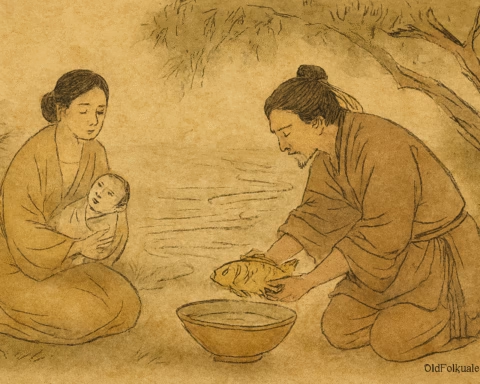
The fisherman returned home with his remarkable catch. He placed the fish in a bowl of water and hurried to the Sultan’s palace.
The Sultan was astonished by their unusual colours and appearance. He ordered that they be taken to the palace kitchen and prepared for his meal.
The cook cleaned the fish and placed them in a frying pan.
As she turned them over, the kitchen wall suddenly opened. A beautiful young woman appeared, holding a slender rod. She approached the pan and asked the fish whether they remained faithful to their ancient agreement.
To everyone’s astonishment, the fish raised their heads and answered that they did.
The woman then overturned the frying pan and disappeared through the wall. The fish were left burnt and blackened.
The cook fainted.
When she recovered, she reported everything to the palace minister. The minister, equally astonished, informed the Sultan.
The Sultan summoned the fisherman and ordered him to bring another four fish.
The fisherman returned to the lake, cast his net and caught four fish of exactly the same colours. The minister supervised their preparation in the kitchen.
Once again, the wall opened and the mysterious woman appeared. She asked the fish the same question, and they repeated their answer. She overturned the pan and disappeared.
This time, the Sultan demanded to witness the strange occurrence himself.
The fisherman brought another four fish. In the Sultan’s presence, the minister placed them in the frying pan.
But instead of the beautiful woman, a terrifying dark figure emerged from the wall, carrying a branch. He addressed the fish, which repeated their mysterious promise. Then he overturned the pan, leaving the fish burnt as before.
The Sultan was determined to discover the truth.
He assembled his men and ordered the fisherman to lead them to the lake.
The Enchanted Kingdom
When they reached the lake, the Sultan discovered that the surrounding landscape was unlike anything he had seen before. The four mountains enclosed a wilderness and a body of water that nobody in his kingdom remembered.
He questioned the oldest inhabitants, but none could explain the lake’s existence.
Determined to uncover its mystery, the Sultan decided to investigate alone.
He travelled through the wilderness until he came upon a magnificent palace. Its doors stood open, but there was no sign of life inside.
As he explored the building, he heard a young man lamenting his misfortune.
The Sultan found him seated upon a couch. He was handsome and richly dressed, but his expression was filled with sorrow.
The young man explained that he was a prince who had been transformed by a terrible enchantment. His lower body had become stone, leaving him unable to stand or move freely.
He then revealed the history of his kingdom.
The prince had married a woman who was secretly in love with an enslaved man. When he discovered their relationship, he became furious and attacked the man with his sword. Although he believed he had killed him, the wounded man survived.
The prince’s wife was a sorceress. Enraged by what her husband had done, she used her magic to transform him into a half-stone creature.
She also enchanted the entire kingdom.
The city disappeared beneath a lake, and its four surrounding islands became mountains. The people were transformed into fish of different colours. In the story’s magical symbolism, their colours represented their four religious communities: white for Muslims, red for Magians, blue for Christians and yellow for Jews.
The prince suffered terribly under his wife’s cruelty. Every morning, she beat him with a whip, inflicting a hundred strokes upon his already helpless body. Afterwards, she visited her wounded lover and cared for him.
This suffering continued for three years.
The Sultan listened with deep sympathy and promised to help the prince.
The Sultan’s Clever Plan
The Sultan decided that the sorceress must be deceived before she could be defeated.
He went to the chamber where the wounded enslaved man lay and killed him with a single stroke. He then concealed the body in a well.
Next, he dressed himself in the dead man’s clothing and lay down in his place, waiting for the sorceress.
As expected, she arrived the following morning.
She first visited her husband, the prince, and beat him mercilessly with her whip. She then went to the chamber where she believed her lover was resting.
The Sultan imitated the man’s voice and pretended to complain that he could not find peace because of the prince’s constant prayers and suffering.
The sorceress was overjoyed to hear what she believed was her lover speaking again.
She asked what she could do to make him comfortable.
The Sultan told her that she must first release the prince from his enchantment.
Without suspecting the deception, she agreed.
She prepared water and recited her magical words over it. Then she sprinkled it upon the prince, and the spell was broken. His body returned to its natural form, and he could stand and move again.
The sorceress warned him never to return, believing that her lover had requested his release.
The prince escaped.
However, the Sultan was not finished. Still pretending to be the wounded man, he told the sorceress that the kingdom’s people remained trapped in their enchanted forms. Their nightly prayers and suffering continued to disturb his peace.
He instructed her to release them as well.
The sorceress immediately went to the lake, took some water and spoke the words of her enchantment.
At once, the fish returned to human form. The submerged city reappeared, its markets and streets were restored, and the four mountains became islands again.
The people were freed from the spell.
When the sorceress returned, she approached the man she believed was her lover and offered to help him rise.
The Sultan drew his hidden sword and struck her down, killing her before she could use her magic again.
The prince was finally free.
The Fisherman’s Reward
The Sultan and the young prince celebrated their victory. The prince was deeply grateful to the ruler who had rescued him from years of suffering.
The Sultan invited him to return to his capital, and the prince agreed. He also promised never to leave the Sultan’s side.
The ruler was so delighted that he adopted the young man as his son, since he had no children of his own.
The two prepared for their journey home. Their return took a full year, and when they finally approached the Sultan’s capital, the royal court and the army came out to welcome their ruler.
The Sultan rewarded the fisherman who had first brought the strange fish to his palace. He learned that the man had a son and two daughters.
He gave one daughter in marriage to the prince and married the other himself. The fisherman’s son was appointed chief treasurer.
The Sultan also granted the fisherman great wealth.
The old man who had once struggled to feed his family became one of the richest men of his age. His daughters entered royal households, and his family enjoyed a prosperous future.
Thus, the fisherman who had begun his day with a dead donkey, a jar of mud and broken pottery eventually became the cause of a kingdom’s restoration and the beneficiary of an extraordinary reward.
Explore our complete Historic Folklore & Fairy-Tale Collections archive.
Moral
Never repay kindness with cruelty. Intelligence and patience can overcome dangers that physical strength cannot, while ingratitude and unjust actions may ultimately bring suffering upon the person who commits them.
The story also reminds us not to lose hope when life becomes difficult. Fortune may arrive after several disappointments, and a seemingly ordinary discovery may lead to extraordinary consequences.
Knowledge Check
1. Why did the fisherman cast his net only four times each day?
He followed this as his daily limit, and the fourth attempt was his final opportunity to obtain food for his family.
2. Why did the Jinni threaten to kill the fisherman?
After centuries of imprisonment, the Jinni had become bitter and had vowed to kill anyone who eventually released him.
3. How did the fisherman escape the Jinni?
He challenged the Jinni to prove that he could fit inside the small copper vessel. When the Jinni turned into smoke and entered it, the fisherman quickly sealed the jar.
4. What happened to King Yunan after he ordered the execution of Sage Duban?
He opened the physician’s poisoned book and died after the poison entered his body.
5. What was the mystery of the four coloured fish?
They were the enchanted inhabitants of a kingdom that had been transformed by the sorceress.
6. How did the Sultan free the prince and the kingdom?
He disguised himself as the wounded lover, persuaded the sorceress to remove the prince’s enchantment and then convinced her to restore the transformed citizens.
7. What reward did the fisherman receive?
He became wealthy, one daughter married the Sultan, the other married the prince, and his son became the chief treasurer.
Source
The Book of the Thousand Nights and a Night, Volume I, translated and annotated by Sir Richard Francis Burton.
Explore More On The Arabian Nights