Once upon a time, in a distant kingdom, there lived a Tsar and his wife, who had one beloved daughter named Márya Tsarévna. The princess was their only child, and her parents cherished her dearly. But happiness did not last forever. Her mother died, and the Tsar eventually married another woman.
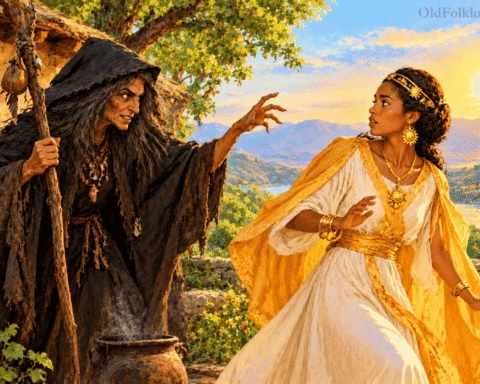
His new wife was a witch, and she brought three daughters of her own into the palace. The eldest had one eye, the second had two, and the youngest had three. The witch loved her own daughters but could not bear the sight of Márya. She grew jealous of the young princess and decided to get rid of her.
One day, she sent Márya away to a lonely heath to look after a dun cow. She gave the girl nothing but a dry piece of bread for food, expecting her to suffer from hunger and hardship.
But the witch did not know that the cow possessed a wonderful secret.
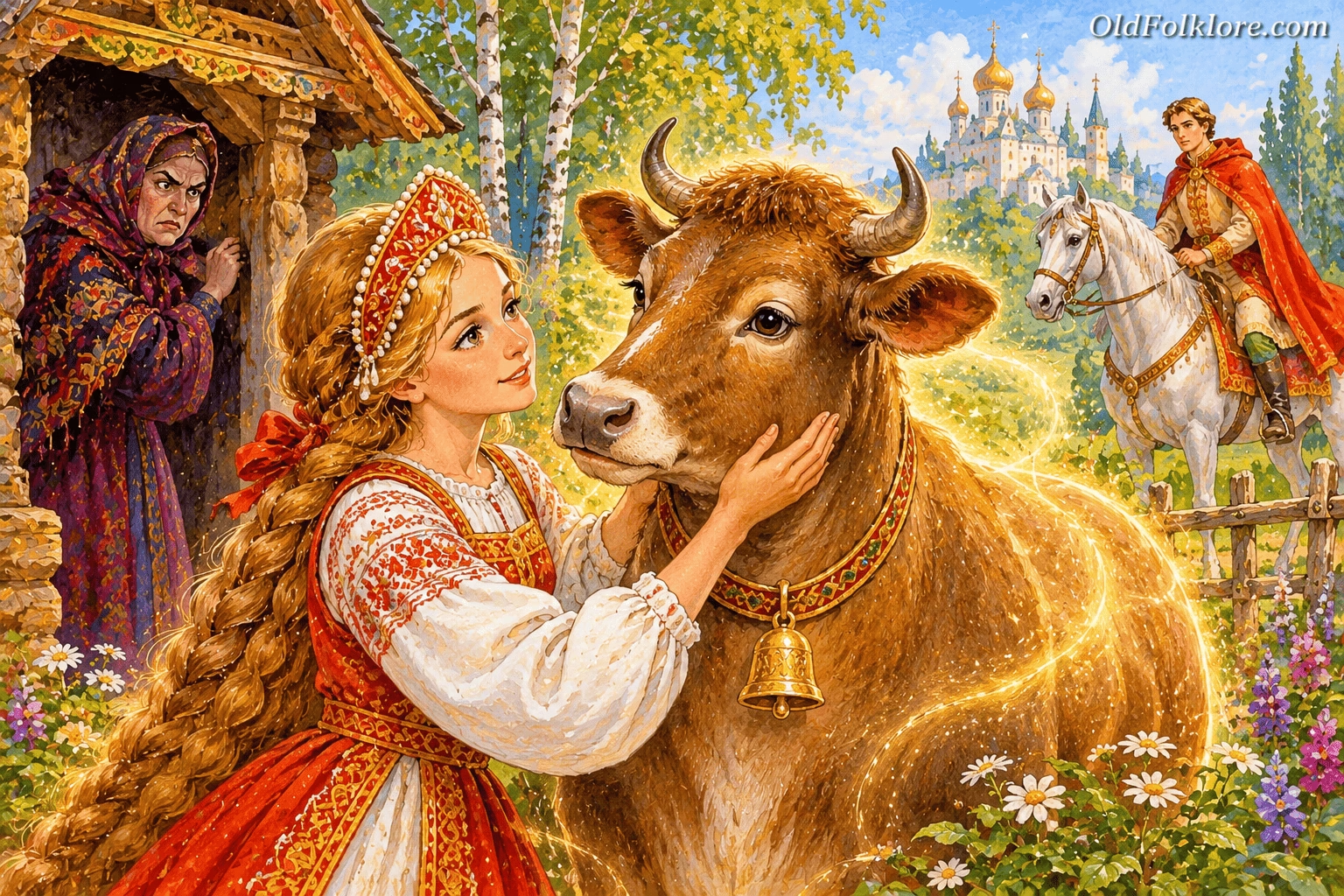
When Márya reached the heath, she approached the animal and bowed before its right foot. At once, her shabby clothes disappeared, replaced by splendid garments fit for a princess. A delicious feast appeared before her, with all the food and drink she could wish for.
Explore more stories from our Afanasyev’s Russian Folk-Tales collection.
She spent the day happily, looking after the cow and enjoying her unexpected good fortune. When evening came, she bowed before the cow’s right foot once more. Her beautiful clothes vanished, and she returned to her poor appearance.
Back at the palace, she placed the dry bread on the table and offered it to her stepmother, just as though she had eaten nothing else.
The witch was puzzled. How could the girl survive on such a tiny piece of bread? Suspecting that Márya was hiding something, she decided to discover the truth.
The Three Sisters and the Sleeping Spell
The next morning, the witch sent her eldest daughter, One-eye, to accompany Márya to the heath. Her instructions were simple: watch the princess carefully and discover what she ate and drank.
When they arrived, Márya pretended to be concerned about her sister’s comfort.
“Come, little sister,” she said sweetly. “Let me find you a soft place to rest your head.”
As she moved away, she quietly sang a magical rhyme:
“Sleep, my sister, sleep,
Sleep, O sister mine;
One eye go to sleep,
Close that eye of thine.”
The spell worked immediately. One-eye fell into a deep sleep, unaware of anything happening around her.
Márya hurried to the dun cow, bowed before its right foot and enjoyed the wonderful feast and beautiful clothes. She spent the entire day like a princess while her stepsister slept.
When evening arrived, she gently woke One-eye and suggested that they return home.
The girl was horrified when she realised that she had slept through the entire day. She had seen nothing and had no answer for her mother.
The witch was furious when One-eye admitted that she knew nothing about Márya’s food.
The following day, she sent her second daughter, Two-eyes, with the same instructions.
Once again, Márya offered to find her sister a comfortable place to rest. Then she sang:
“Sleep, my sister, sleep,
Sleep, O sister mine;
Two-eyes go to sleep,
Close both eyes of thine.”
Two-eyes immediately fell asleep, and Márya enjoyed another splendid day beside her magical cow.
When the girl returned home without discovering anything, the witch’s anger grew.
At last, she sent her youngest daughter, Three-eyes. Surely, with three eyes, she would be clever enough to uncover the princess’s secret.
Márya used her familiar trick and sang her sleeping rhyme. But this time, she made a mistake. She forgot about the third eye.
Although two of Three-eyes’ eyes closed, the remaining one stayed open.
Through that eye, the girl watched everything. She saw Márya bow before the cow’s right foot, become beautifully dressed and enjoy a wonderful meal.
When she returned home, she told her mother the entire story.
The witch had finally discovered the secret.
The Death of the Dun Cow
When Three-eyes revealed the truth, the witch became determined to destroy the animal that had been helping Márya.
She ordered the dun cow to be killed.
The Tsar was unhappy with the decision. He could not understand why his wife wanted such a beautiful, healthy young animal slaughtered. He protested that the cow was still young and had done nothing wrong.
But the witch would not change her mind. Eventually, the Tsar gave in to her demands.
Márya was heartbroken. Before the cow was killed, she begged her father to give her just a tiny piece of it.
The Tsar granted her request.
Márya took the little piece and planted it in the ground. Before long, a wonderful bush sprang up. It bore delicious, sweet berries, and little birds gathered among its branches, singing beautiful songs that delighted everyone who heard them.
The magical cow was gone, but something of its kindness remained.
The Prince and the Wonderful Berries
News of Márya’s beauty and goodness eventually reached Iván Tsarévich, a prince who wished to find a wife.
He visited the palace and placed an empty bowl on the table before the witch and her daughters.
“I shall marry whichever maiden brings me a bowl filled with berries from the wonderful bush,” he announced.
The witch immediately saw an opportunity for one of her own daughters to become a princess. She sent One-eye to gather the berries.
But as soon as the girl approached the bush, the little birds flew at her, driving her away and nearly pecking out her only eye.
The witch tried again with Two-eyes, but the same thing happened. Three-eyes also failed to collect even a single berry.
At last, there was no one left to send except Márya.
The princess approached the bush with her bowl. Unlike her stepsisters, she was welcomed by the little birds. They fluttered among the branches and helped her gather the sweet berries until the bowl was full.
She carried it back to the palace and placed it before Iván. Then she bowed respectfully to the prince.
Iván was delighted. He recognised Márya’s goodness and chose her as his bride. They celebrated a joyful wedding and began their married life together.
For a while, it seemed that the princess’s troubles had finally ended.
The Witch’s Revenge
Some time passed, and Márya gave birth to a baby boy. She was eager to introduce her little son to her father, so she and Iván travelled together to visit the Tsar.
But the wicked stepmother had not forgotten her hatred.
While the visitors were there, the witch used her magic to transform Márya into a goose. She then dressed her eldest daughter as though she were Iván’s real wife.
The prince, deceived by the substitution, returned home with the false bride, leaving Márya behind in her enchanted form.
Back at the palace, an old man was entrusted with looking after the children. Each morning, he rose early, washed himself and carried the baby out into the fields, taking him to the bush where the grey geese gathered.
One morning, as the birds flew overhead, the old man called out:
“Grey geese, grey geese, where is the baby’s mother?”
“She is in the next flock!” the geese answered.
Another flock passed, and the old man repeated his question.
At last, the baby’s mother appeared. She shed her feathers, took her little boy into her arms and fed him. As she held him close, she began to cry.
She explained that she could come to see her child for that day, and perhaps the next, but soon she would have to fly away over the forests and hills.
The old man watched in wonder. He returned home with the child, who slept peacefully throughout the day and did not wake until the following morning.
The false wife became angry when she learned that the old man had taken the baby outside. She complained that the fields were too cold for such a small child.
Nevertheless, the old man repeated his journey the next morning.
This time, Iván grew suspicious. He had noticed something unusual about the child’s behaviour and decided to follow the old man secretly.
He hid among the bushes and waited.
The Princess Returns
Once again, the grey geese appeared in the sky.
The old man called to them, asking where the baby’s mother could be found. The geese answered that she was in the next flock.
When the following flock arrived, Márya appeared. She removed her feathers, gathered her baby into her arms and fed him, weeping as she remembered that she could not remain with him.
She told the child that she would soon have to leave again, flying far away over the woods and hills.
Then she suddenly stopped.
“What is that smell?” she asked.
She looked around, intending to put on her feathers and return to the sky, but they had disappeared.
Iván had taken them and burned them while hiding nearby.
He rushed forward and seized his wife. But the witch’s enchantment was powerful. Márya changed into a frog, then a lizard, then a succession of tiny creatures and insects. Each time Iván tried to hold her, she escaped in another form.
At last, she became a spindle.
Iván seized the spindle and broke it into two pieces. He threw the blunt end behind him and the sharp end before him.
At once, the spell was broken.
Standing before him was his beautiful young wife, Márya Tsarévna, restored to her true form.
Iván embraced her, and together they returned home.
But the witch’s daughter, who had been pretending to be the prince’s wife, saw them approaching and cried out:
“The destroyer and the wicked woman have come!”
Iván was determined to settle the matter once and for all. He summoned the princes and boyárs, the nobles of the kingdom, and asked them which of the two women should remain his wife.
They answered that he should live with the first woman, meaning the one who had originally been presented to him as his bride.
But Iván proposed another test.
“My lords,” he said, “whichever of these women can leap most quickly to the door shall remain my wife.”
The witch’s daughter immediately sprang forward, eager to win. Márya, however, held on and refused to let herself be defeated.
The deception was finally exposed. Iván took his gun and shot the false wife.
With the witch’s daughter gone and the enchantment broken, Márya was once again reunited with her husband and child. The two returned to a happy life together, free at last from the witch’s cruelty.
And so the princess who had once been sent away with nothing but a dry crust of bread became a queen in her own right, surviving every attempt to destroy her happiness.
Explore our complete Historic Folklore & Fairy-Tale Collections archive.
Moral
Cruelty and jealousy can destroy the happiness of an entire family, while kindness and patience can help the innocent endure hardship. The story also reminds readers that appearances can be deceptive and that truth may remain hidden without being destroyed.
Knowledge Check
1. Why did Márya Tsarévna’s stepmother send her to the heath?
Answer: She hated Márya and wanted to remove her from the palace, hoping that hardship would make the girl suffer.
2. How did Márya obtain beautiful clothes and food?
Answer: She bowed before the dun cow’s right foot, which magically provided her with fine clothing and as much food and drink as she wanted.
3. Why did Three-eyes discover Márya’s secret?
Answer: Márya forgot to include the third eye in her sleeping rhyme, leaving it open to watch what she did.
4. What grew from the piece of the dun cow that Márya planted?
Answer: A magical bush bearing sweet berries, with little birds singing among its branches.
5. How did Iván discover that his real wife was still alive?
Answer: He secretly followed the old man who took his child into the fields and witnessed Márya appearing from the flock of grey geese.
6. How was Márya restored to her human form?
Answer: Iván burned her goose feathers and eventually broke the spindle into two pieces, ending the enchantment.
7. What role do the birds play in the story?
Answer: They help Márya gather the berries and form part of the magical world through which she remains connected to her child.
Source
Adapted from “The Dun Cow,” translated by Leonard A. Magnus in Russian Folk-Tales (Translated from the Russian), published by E. P. Dutton & Company, New York, in 1916, pp. 1–5.
Explore More Afanasyev’s Russian Folk-Tales
- Vasilisa the Fair: A Russian Fairy Tale of Magic, Courage and Baba Yaga
- The Sea Tsar and Vasilisa the Wise: Russian Folk Tale