In earlier times, before streetlights and rickshaws became common, the neighbourhood was particularly frightening after sunset. The road grew dark and deserted, and travellers who had business on the other side sometimes preferred to take a much longer route rather than climb the slope alone at night.
There was a reason for their fear. People believed that a strange apparition known as a mujina wandered there.
The last man said to have encountered it was an elderly merchant from the Kyōbashi district. He died about thirty years before his story was recorded, but the strange experience he described remained unforgettable.
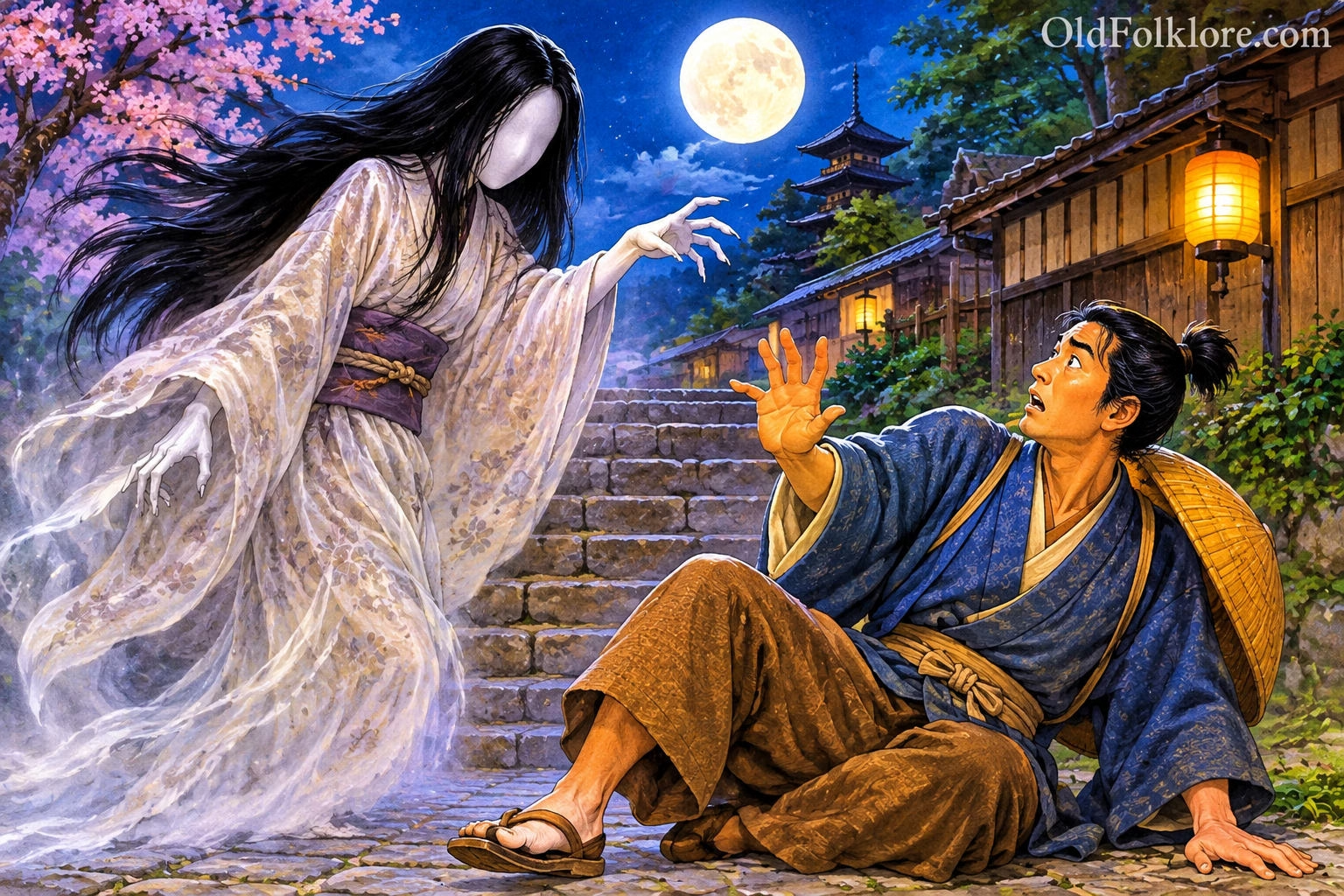
One night, while making his way up Kii-no-kuni-zaka, the merchant noticed a young woman crouching beside the moat. She was alone and weeping bitterly, her face hidden behind the long sleeve of her clothing.
She appeared to be a delicate, well-dressed young lady. Her hair was arranged in the elegant style associated with a girl from a respectable family.
The merchant immediately became concerned. He wondered whether she was thinking of throwing herself into the water.
Approaching carefully, he addressed her with kindness.
“Young lady, why are you crying so bitterly? Please tell me what has happened. If there is anything I can do to help you, I shall gladly do it.”
Explore more stories from our Lafcadio Hearn’s Kwaidan collection.
The woman did not answer. She continued sobbing, keeping her face concealed.
The merchant tried again, speaking as gently as possible.
“This is no place for a young lady to be alone at such a late hour. Please do not remain here crying. Tell me what troubles you. Perhaps I can help.”
Slowly, the woman rose to her feet. Yet she kept her back turned towards him, her quiet sobbing continuing behind the sleeve that covered her face.
The merchant, moved by concern, gently placed a hand on her shoulder.
“Please, young lady. Listen to me for just a moment.”
At last, she turned around.
She lowered her sleeve and passed one hand slowly across her face.
The merchant stared.
There were no eyes. No nose. No mouth. Where the features of a human face should have been, there was only smooth, empty skin.
He let out a terrible scream and fled.
He ran up the slope as fast as his legs could carry him. The road ahead was black and deserted, and he dared not turn around to see whether the apparition was following.
He continued running until, far in the distance, he noticed a small light. It flickered like a firefly against the darkness.
Desperate for company, he hurried towards it.
The light belonged to an itinerant soba seller who had stopped beside the road with his portable food stand. The sight of another human being brought the merchant some relief. He rushed towards the seller and collapsed at his feet, gasping and crying out in terror.
“Here! Here!” the soba seller exclaimed impatiently. “What has happened to you? Has somebody attacked you? Are you injured?”
“No,” the merchant managed to reply. “Nobody hurt me. But…”
He struggled to catch his breath.
“Have you been frightened?” the seller asked. “Was it robbers?”
“No, not robbers!” the merchant gasped. “I saw a woman beside the moat. She turned towards me and showed me…”
He could not finish the sentence. The memory was too terrible to describe.
The soba seller listened, then suddenly asked:
“Was it something like this that she showed you?”
He raised a hand and stroked his own face.
At once, his features disappeared.
His face became as smooth and featureless as an egg.
At that very moment, the light went out.
Explore our complete Historic Folklore & Fairy-Tale Collections archive.
Moral
Appearances can be deceptive, and the world may hold mysteries beyond human understanding. The story also reminds readers that fear can arise when the familiar suddenly becomes strange.
Knowledge Check
1. Where does the story take place?
On Kii-no-kuni-zaka, a slope along the Akasaka Road in Tokyo, Japan.
2. Why does the merchant approach the mysterious woman?
He believes she may be contemplating suicide and wants to offer her assistance.
3. What happens when the woman reveals her face?
The merchant discovers that she has no eyes, nose or mouth, and he runs away in terror.
4. Who does the merchant meet after fleeing?
An itinerant soba seller whose roadside lantern provides a welcome sign of human companionship.
5. What happens at the end of the story?
The soba seller strokes his face, which becomes completely featureless, just like the woman’s. The light then goes out.
6. What makes the ending particularly frightening?
The merchant believes he has escaped the supernatural encounter, only to discover that the person offering him comfort is another manifestation of the same horror.
Source
Kwaidan: Stories and Studies of Strange Things by Lafcadio Hearn, published by Houghton Mifflin Company, Boston and New York, 1904. The assigned narrative appears under the exact title “Mujina” in the section titled Kwaidan.
Explore More Lafcadio Hearn’s Kwaidan Tales