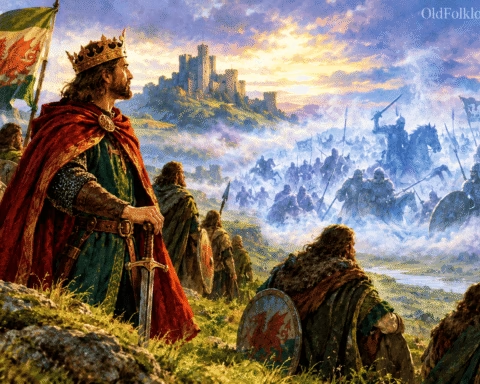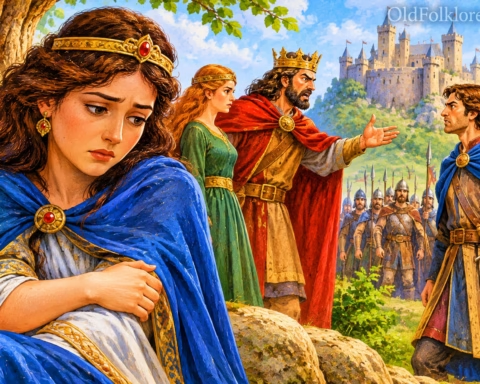
King Arthur was holding his court at Caerlleon upon Usk during the feast of Whitsuntide. His kingdom was filled with visitors, including kings, earls, nobles, and celebrated knights. The great hall was alive with feasting and conversation when a forester named Madawc arrived with remarkable news.
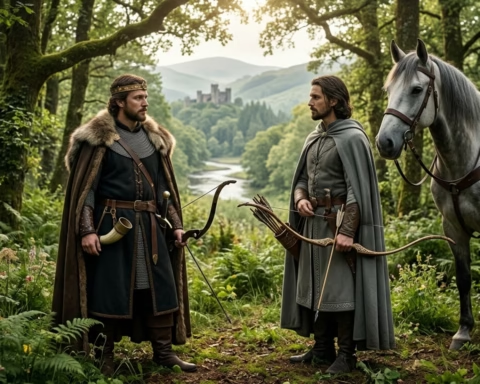
He had discovered a magnificent white stag in the Forest of Dean. Unlike ordinary deer, the animal kept apart from the others and carried itself with an unusual air of pride. Arthur was fascinated by the description and immediately arranged a great hunt for the following morning.
Queen Gwenhwyvar asked permission to accompany the hunting party, and Arthur gladly agreed. Gwalchmai, one of Arthur’s most celebrated knights, also proposed that whoever killed the stag should be allowed to give its head to whichever lady he considered most deserving.
The next morning, Arthur and his companions prepared for the hunt. Believing Gwenhwyvar was still asleep, the king left without disturbing her. But when the queen awoke and discovered that the hunting party had already departed, she quickly dressed and rode out with one of her maidens.
On the road, she encountered Geraint, the son of Erbin, a handsome young knight who had also missed the departure. He joined her, and together they continued towards the forest.
Explore more stories from our The Mabinogion collection.
As they approached its edge, they noticed an extraordinary group of riders. A dwarf carrying a whip rode beside a beautifully dressed lady, while a heavily armoured knight sat upon a powerful warhorse.
Curious about the stranger, Gwenhwyvar sent her maiden to ask the dwarf for his name. The dwarf refused to answer. When the maiden attempted to approach the knight directly, he struck her across the face with his whip, leaving her bleeding.
Geraint was outraged. He approached the dwarf and demanded to know the knight’s identity. The dwarf refused again, declaring that Geraint was not sufficiently honourable to speak with his master. When Geraint tried to ride past him, the dwarf struck him too, staining his scarf with blood.
Geraint reached for his sword but restrained himself. He realised that killing an unarmed dwarf would accomplish little while the heavily armed knight remained untouched. Instead, he returned to Gwenhwyvar and explained that he intended to follow the party until he found somewhere to obtain proper weapons.
The queen approved of his decision and wished him success.
The Tournament of the Sparrow-Hawk
Geraint followed the mysterious knight to a town where the people welcomed the stranger enthusiastically. The streets were crowded with men preparing their horses, polishing their weapons, and repairing their armour.
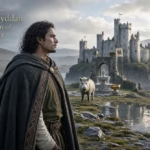
Geraint knew nobody there and could find no one willing to lend him weapons. Eventually, he noticed an old, ruined palace outside the town. Sitting on a marble bridge was an elderly man dressed in worn-out clothes.
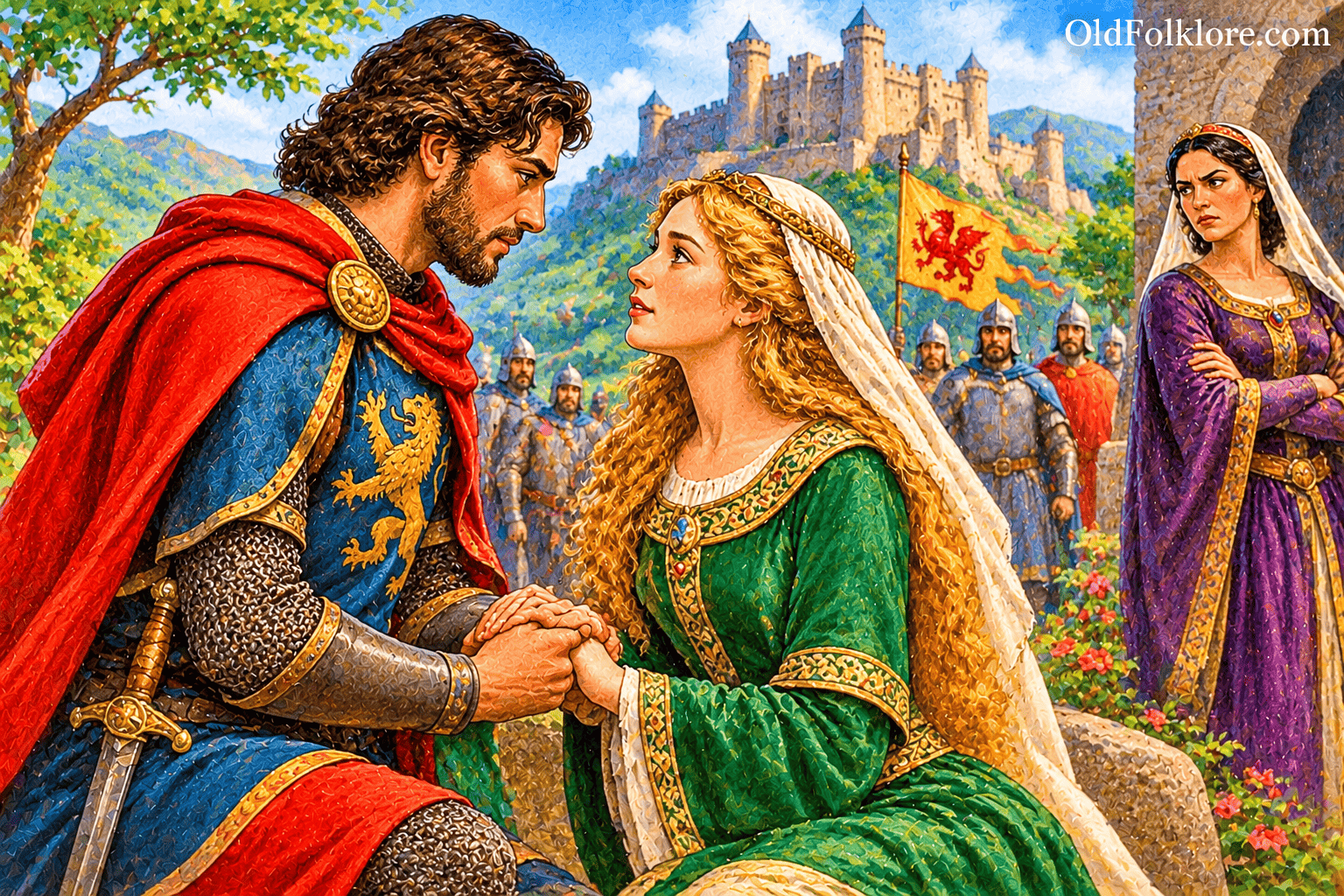
The man welcomed Geraint and invited him inside. There he met the old man’s wife and their beautiful daughter, Enid. Although their clothing was worn and their circumstances appeared miserable, Geraint was struck by the maiden’s extraordinary beauty and graceful manner.
Enid looked after his horse, and her father arranged a meal for their guest. During their conversation, Geraint discovered that the elderly man had once owned the palace, the town, and a great earldom.
He had lost everything because he had unjustly taken his nephew’s inheritance. When the nephew grew strong enough to demand his property, the old man refused. War followed, and the nephew took back the possessions that rightfully belonged to him.
The old man then explained the preparations taking place throughout the town. The young Earl was organising a tournament for a sparrow-hawk, which would be displayed on a silver rod in the middle of a meadow. Knights would compete for the bird, and each had to be accompanied by the lady he loved most.
The mysterious knight had won the sparrow-hawk for two consecutive years. If he won again, he would earn the right to be known as the Knight of the Sparrow-Hawk.
Geraint saw his opportunity. He asked the old man to lend him armour and allow him to compete for Enid. If he survived the contest, he promised to love her faithfully for the rest of his life. If he died, she would remain untouched and free to choose her future.
The old man gladly agreed.
At dawn, Geraint entered the tournament wearing heavy, rusty armour. The Knight of the Sparrow-Hawk confidently announced that his beloved should collect the bird, as she had done in the previous two years.
Geraint challenged him, declaring that another maiden deserved it more.
The two knights began their contest. They broke lance after lance, and the Knight of the Sparrow-Hawk initially appeared to have the advantage. The young Earl and his supporters cheered enthusiastically, while Enid, her mother, and her father watched anxiously.
Eventually, the old man offered Geraint a lance he had kept since his own knighthood. With renewed determination, Geraint charged his opponent, shattered his shield, and brought him crashing from his horse.
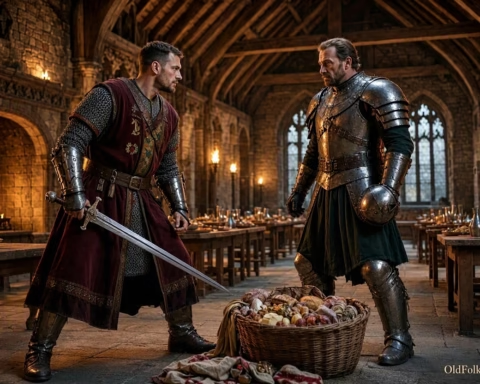
The battle continued on foot with swords. Their weapons struck against each other until sparks flew, and both men became exhausted and wounded.
At one point, the old man reminded Geraint of the insults inflicted upon him and Gwenhwyvar’s maiden. Encouraged by the reminder, Geraint summoned his remaining strength and delivered a tremendous blow to the knight’s head.
The defeated knight fell to his knees and begged for mercy.
Geraint agreed to spare his life on one condition: he must immediately travel to Arthur’s court and make amends to Gwenhwyvar for the injury inflicted upon her maiden. He identified himself as Geraint, the son of Erbin, and demanded to know the stranger’s name.
The knight revealed that he was Edeyrn, the son of Nudd.
Enid’s Restoration and Her Marriage to Geraint
After the tournament, the young Earl invited Geraint to his castle, but Geraint preferred to return to the ruined palace where he had spent the previous night.
The Earl nevertheless provided food, gifts, and ointment to help him recover from his injuries.
Geraint insisted that Enid should not receive new clothing until she reached Arthur’s court, where Gwenhwyvar could dress her appropriately.
During their meal, Geraint confronted the young Earl about the injustice suffered by Enid’s father. He demanded that the Earl restore everything that had been taken from the old man, including his castle, town, possessions, and the rights of those who owed him homage.
The Earl agreed. The men who owed allegiance to Ynywl came forward and renewed their homage, and every possession was restored to him.
Grateful for Geraint’s kindness, Ynywl offered his daughter to him. Geraint accepted but insisted that she accompany him to Arthur’s court.
Meanwhile, Arthur’s hunt had finally reached its conclusion. His favourite dog, Cavall, had pursued the white stag and driven it towards the king. Arthur struck the animal down and claimed its head.
When Gwenhwyvar returned, the members of the court began arguing about who should receive the prize. Remembering Geraint’s promise and the maiden for whom he had entered the tournament, she persuaded Arthur to keep the stag’s head until Geraint returned.
The following day, Edeyrn arrived at the court in broken armour, accompanied by his dwarf and the lady he loved. He explained what had happened and acknowledged that his own arrogance had brought about his defeat.
Gwenhwyvar accepted his apology and agreed that he should receive medical treatment. Arthur ordered his chief physician, Morgan Tud, to care for him and arranged for the dwarf’s victim, the maiden who had accompanied Geraint, to be received by the queen.
The next day, Geraint arrived with Enid.
Gwenhwyvar welcomed them warmly and praised Geraint for obtaining justice on her behalf. Arthur was equally pleased to see his young knight return victorious.
When Enid appeared before the court, everyone was amazed by her beauty. Gwenhwyvar provided her with fine garments, and Arthur formally gave her to Geraint in marriage.
The wedding was celebrated with music, feasting, gifts, and games. Enid became one of the most admired women in Arthur’s court.
At last, Gwenhwyvar remembered the white stag’s head. She declared that Enid deserved the prize, and everyone agreed. The head was presented to her amid general applause.
Geraint continued to distinguish himself in tournaments and battles. For three years, his fame and reputation grew throughout the kingdom.
Geraint Returns to Cornwall
One Whitsuntide, ambassadors arrived at Arthur’s court from Cornwall. They brought a message from Erbin, Geraint’s ageing father, who was becoming too weak to protect his lands.
Neighbouring chiefs had begun to threaten his possessions, hoping to take advantage of his declining strength. Erbin therefore requested that his son return home to defend the family territories and take responsibility for their protection.
Arthur was reluctant to lose Geraint’s companionship, but he understood that his cousin had a duty towards his father and his inheritance.
He advised Geraint to return to Cornwall and invited him to take whichever knights and companions he wished.
Geraint accepted. Gwenhwyvar also made arrangements for Enid’s departure, although she and the other women were saddened by the thought of losing her company.
Geraint travelled towards Cornwall with a distinguished company of knights, including Gwalchmai, Peredur, Bedwyr, Kai, and Edeyrn, whose reconciliation with Gwenhwyvar had now been achieved.
His father’s household received him with great joy. The nobles welcomed him, and Enid was greeted warmly by the women of the court.
Erbin soon summoned his son and explained that he could no longer govern as he once had. He wished Geraint to assume responsibility for the dominions and receive the homage of his subjects.
Geraint initially resisted, but eventually accepted his father’s wishes.
He first settled the requests of those who came seeking assistance. The people of Cornwall were generous with their gifts, and nobody who approached the new ruler left dissatisfied.
After receiving the homage of his subjects, Geraint travelled throughout his territories to inspect the boundaries and secure his possessions.
He continued participating in tournaments and became famous for his courage. He rewarded his companions with excellent horses, weapons, and valuable gifts.
But as his power and reputation increased, his habits began to change.
The Misunderstanding Between Geraint and Enid
Having defeated every worthy opponent, Geraint gradually lost interest in the activities that had once occupied him. He began spending most of his time in the palace with Enid.
At first, this seemed harmless. He loved his wife and enjoyed her company. However, his affection gradually became excessive. He abandoned his friendships with the nobles, neglected hunting and tournaments, and withdrew almost entirely into his wife’s private chambers.
His companions began to complain that he had forgotten his responsibilities.
Eventually, these complaints reached Erbin. Concerned about his son’s behaviour, the old man spoke privately with Enid and asked whether she was responsible for Geraint’s withdrawal from public life.
Enid denied it. She was deeply unhappy about the situation but feared that confronting her husband might make matters worse.
One summer morning, while Geraint slept beside her, she looked at his arms and chest and remembered the strength and glory he had once displayed in battle.
With tears in her eyes, she wondered aloud whether she had become the reason he had abandoned his former life.
Her tears fell upon his body and awakened him.
Unfortunately, Geraint misunderstood her words. Rather than recognising her concern, he imagined that she was thinking of another man and longing for different companionship.
His jealousy quickly turned into anger.
He ordered his horse and armour to be prepared and instructed Enid to dress in her poorest riding clothes. He told her that she must accompany him on a journey and should not return home until he had proved whether he had truly lost the strength she believed he had abandoned.
He also ordered her to ride ahead of him, remain silent, and never turn back, regardless of what she saw or heard.
Enid obeyed, although she did not understand the reason for his sudden hostility.
The Dangerous Journey
Geraint deliberately chose a difficult road through forests and dangerous countryside. He wanted to test himself, but he also intended to punish Enid for what he believed she had said.
Before long, four armed horsemen emerged from a forest. They saw Geraint riding behind Enid and believed they could easily overpower him.
Enid overheard their conversation. Despite her husband’s command to remain silent, she warned him that the men intended to attack.
Geraint rebuked her for speaking, insisting that he had no need of her warnings.
When the first horseman charged, Geraint met him with his lance and killed him. He defeated the remaining three in the same manner.
He collected their horses and armour and ordered Enid to lead the animals ahead of him.
They continued until three more armed men approached. Again, Enid overheard their intentions and warned Geraint.
Again, he became angry.
He defeated all three attackers and added their horses and weapons to the growing collection that Enid had to manage.
The same pattern repeated when five more horsemen emerged from another forest. Enid warned her husband, and Geraint rebuked her once more before defeating the attackers.
By then, Enid was struggling to manage the many horses and pieces of armour. Geraint noticed her difficulties but continued to insist that she remain silent.
Night eventually overtook them in a vast forest. Exhausted, Geraint dismounted and ordered Enid to watch the horses while he slept.
She remained awake until morning, and when he rose, they continued their journey.
They soon encountered a young man carrying food intended for workers mowing the meadows. Seeing their tired condition, he offered them bread, meat, and wine.
Geraint accepted the kindness and rewarded the young man with one of the captured horses and its armour. He also instructed him to arrange comfortable lodgings in the nearby town.
The young man went ahead and secured suitable accommodation.
The Earl’s Attempt to Take Enid
When Geraint and Enid arrived, the local Earl, Dwnn, heard about the unusual travellers and decided to visit them.
He was immediately captivated by Enid’s beauty.
After speaking with her, he offered to give her his entire earldom if she would leave Geraint and become his wife.
Enid firmly refused. She reminded him that Geraint was the first man to whom she had pledged her love and that she would not betray him.
The Earl then threatened that he could kill Geraint and take her by force. Enid realised that arguing with him would put her husband in danger.
She therefore pretended to consider his proposal and arranged for him to return the following morning, when he could take her away without her appearing to resist.
That night, however, she told Geraint everything.
Although angry that she had concealed the conversation until then, Geraint understood the danger and prepared to leave immediately.
He rewarded their host by giving him the eleven remaining horses and suits of armour. The host then guided them out of the town by another road.
The Earl soon discovered that they had escaped. He gathered eighty knights and pursued them.
When Enid noticed the approaching riders, she warned Geraint.
He was angry that she had broken his command once again, but he turned to face the pursuing army.
One by one, the knights attacked him. Geraint defeated them all, including Earl Dwnn, whom he spared after the man begged for mercy.
The force of the fighting left every knight severely injured.
Geraint and Enid continued their journey until they reached a beautiful valley with a river, a bridge, and a fortified town.
Geraint and the Little King
Near the bridge, Geraint encountered a knight who explained that the valley belonged to Gwiffert Petit, known among the Welsh as the Little King.
The Little King had a strict custom: every knight who entered his territory had to fight him.
Geraint refused to change his route.
The Little King soon appeared and challenged him for disregarding his authority. Their battle was fierce, and Geraint found it difficult to strike his opponent because of his unusually small stature.
Eventually, Geraint defeated him and demanded that he become an ally who would assist him whenever he needed help.
The Little King agreed. He also urged Geraint to rest, noticing how distressed Enid had become.
Geraint initially refused, but the Little King continued to offer assistance. Their encounter eventually developed into a friendship, and Gwiffert became one of Geraint’s supporters.
Geraint’s Final Trials
As Geraint continued his journey, he encountered further adventures.
He eventually came upon a group of men whose treatment of a wounded knight revealed the danger that still surrounded the countryside. Despite his exhaustion, he continued to fight those who challenged him.
During one encounter, Gwalchmai, one of Arthur’s closest companions, came upon him. Gwalchmai did not initially recognise the wounded and battered knight.
Geraint refused to identify himself or accept an invitation to visit Arthur. But Gwalchmai eventually recognised him and was distressed by his condition.
He secretly arranged for Arthur’s tent to be moved closer to the road, knowing that Geraint might refuse to approach the king if he had to make a special journey.
When they met, Arthur was shocked by Geraint’s appearance. He insisted that the knight receive medical attention before attempting to continue.
Geraint was treated by Morgan Tud and his physicians for nearly a month. Enid was welcomed by Gwenhwyvar and the queen’s attendants.
Once fully recovered, Geraint asked permission to continue his journey.
Not long afterwards, he heard a woman crying beside the road. He discovered that her husband had been killed by three enormous giants.
Geraint pursued the giants and fought them. He killed two with his lance, while the third struck him so violently that his shield was shattered and his shoulder crushed.
Despite his injuries, Geraint drew his sword and killed the final giant.
But the effort proved too much. As he returned to Enid, he fell from his horse, apparently lifeless.
Enid rushed towards him, crying out in grief.
An Earl named Limours heard her cries and stopped with his company. He discovered the dead knight and the wounded Geraint, whom he believed might still be alive.
He ordered Geraint to be carried to his hall.
There, the Earl attempted to comfort Enid and offered her wealth and marriage, believing she was now free of her husband.
Enid rejected him. She refused to eat or drink while Geraint lay motionless on the bier.
The Earl became impatient and struck her across the face.
Her cry awakened Geraint from his swoon.
He rose from the bier, seized his sword, and attacked the Earl, killing him with a powerful blow.
The people in the hall fled in terror, believing that a dead man had risen to take revenge.
Geraint then looked at Enid and realised that she had been right to remain faithful and that his suspicions had been unjust.
He found his horse, lifted Enid onto it, and they continued their journey together.
Soon afterwards, they heard the sound of approaching horses. Geraint feared another attack and placed Enid on the other side of a hedge.
A knight suddenly charged towards him, but Enid called out that there was no glory in killing a man who was already dead.
The knight recognised Geraint and revealed himself as the Little King, who had come to help him.
Gwiffert arranged for Geraint to receive medical treatment at a nearby palace. He remained there until his wounds had healed, while the Little King ensured that his armour was repaired.
After some time, Geraint decided to continue travelling.
The Enchanted Hedge of Mist
On their journey, Geraint and his companions reached a place where the road divided. A traveller warned them that one route led towards a mysterious hedge of mist containing enchanted games.
No knight who had entered the place had ever returned.
The enchanted territory belonged to Earl Owain, who required all visitors of noble birth to stay at his court.
Rather than avoid the danger, Geraint chose the mysterious road.
Earl Owain welcomed him and his companions. During their stay, Geraint learned more about the games beyond the mist and expressed his determination to take part.
The following day, the company travelled to the enormous hedge. It stretched so high that its top could not be seen, and countless stakes stood along it. Almost every stake carried the head of a man who had failed to return from the enchanted games.
Geraint’s companions were troubled by the sight, but he refused to retreat.
He entered the mist alone.
On the other side, he discovered a beautiful orchard. In its centre stood a red satin tent, with a great hunting horn hanging from a nearby apple tree.
Inside the tent sat a maiden in a golden chair. Opposite her was another chair, which Geraint occupied.
The maiden warned him that the chair belonged to a knight who would not tolerate another person sitting in it.
Geraint remained where he was.
A moment later, a powerful knight arrived and demanded an explanation for the insult. Geraint refused to apologise, and the two men began fighting.
They broke several lances before Geraint finally gained the advantage. With one tremendous charge, he shattered his opponent’s shield and armour and threw him from his horse.
Defeated, the knight begged for mercy.
Geraint granted it on the condition that the enchanted games should end, the hedge of mist should disappear, and the magic surrounding the place should be abolished.
The knight agreed but explained that the mist could only be removed by sounding the hunting horn, and that only the victorious knight could blow it.
Geraint took the horn and sounded it.
At the first blast, the mist vanished.
The people who had been trapped within the enchantment were reunited, and former enemies became reconciled.
Geraint and his companions were invited to remain at the Earl’s court for the night. The following morning, they continued towards their own dominions.
From that time forward, Geraint ruled prosperously. His courage, reputation, and honour endured, and Enid shared in the happiness and renown that followed.
Explore our complete Historic Folklore & Fairy-Tale Collections archive.
Moral
True love requires more than loyalty; it also requires trust, understanding, and the willingness to listen. Pride and suspicion can damage even the strongest relationships, while courage, patience, and faithfulness can help restore what has been broken.
Knowledge Check
1. Why did Geraint pursue the mysterious knight?
Because the knight’s dwarf had struck Gwenhwyvar’s maiden and Geraint, insulting them both.
2. What was the Sparrow-Hawk tournament?
It was a competition in which knights fought for the right to claim a sparrow-hawk for the lady they loved most.
3. Who was Enid’s father?
Earl Ynywl, an elderly nobleman who had lost his possessions after an unjust dispute with his nephew.
4. Why did Geraint leave Arthur’s court for Cornwall?
His ageing father, Erbin, needed him to protect the family lands and assume responsibility for the territories.
5. Why did Geraint become angry with Enid?
He misunderstood her sorrowful remarks about his declining reputation and wrongly believed she desired another man’s company.
6. How did Enid demonstrate her loyalty during their journey?
She repeatedly warned Geraint about approaching attackers, even when he had ordered her to remain silent.
7. Who was the Little King?
Gwiffert Petit, a ruler who challenged knights entering his territory but eventually became Geraint’s ally.
8. How did Geraint end the enchantment of the mist?
He defeated the knight responsible for the enchanted games and sounded the hunting horn, causing the mist to disappear.
Source
The retelling is based on “Geraint the Son of Erbin,” in The Mabinogion, translated from Welsh and supplied with notes by Lady Charlotte Guest. The edition consulted is the 1877 London edition published by Bernard Quaritch, with the tale appearing on printed pages 136–141 in the volume’s contents listing.
Explore More On The Mabinogion
- The Dream of Rhonabwy
- The Story of Lludd and Llevelys
- Pwyll Prince of Dyved
- Manawyddan the Son of Llyr