In a Dahomean folktale about the creation of humanity, Mawu gives the animals an important task. She asks them to prepare clay for her, promising that their efforts will help determine their place in the world. Among the animals is Monkey, whose five fingers make him especially noticeable to the goddess.
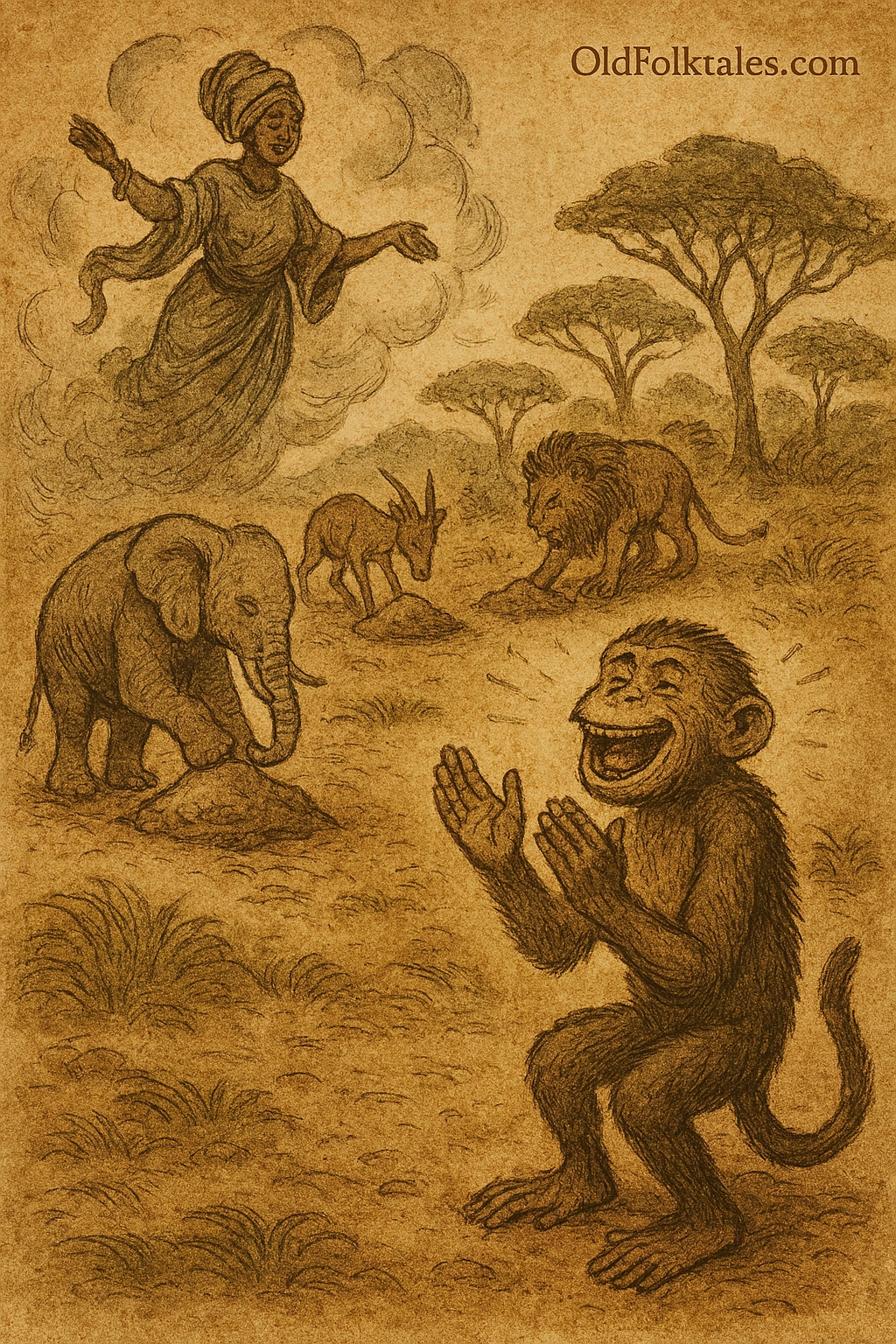
Mawu offers Monkey an unusual opportunity. If he works diligently, she will allow him to join human beings. Excited by the promise, however, Monkey becomes more interested in announcing his future than completing the work assigned to him. While the other animals prepare the clay, he spends his time celebrating.
His failure to carry out the task brings the opportunity to an end. The story explains, through Monkey’s experience, why he did not become human and why monkeys remain animals.
Mawu’s Work of Creation
In the beginning, Mawu was occupied with the work of creation. She had brought different animals into existence, but her work was not yet complete. She still needed to prepare the clay from which other beings would be formed.
To accomplish this, she gathered the animals and instructed them to knead and prepare the clay. Each animal was expected to contribute to the task, using whatever physical abilities it possessed.
The work required patience and effort. The animals had to concentrate on preparing the material for Mawu rather than simply waiting for her to finish creating the world.
Mawu intended to observe their efforts. Their willingness to work would reveal something about their character and their suitability for the responsibilities she had in mind.
Monkey Receives a Special Promise
Among the animals, Monkey attracted Mawu’s attention because of his hands. Unlike the other creatures, he had five fingers on each hand, just as Mawu did.
Explore more stories from our Beninese Folktales Collections archive.
His fingers gave him the ability to handle and knead the clay with particular skill. Mawu recognised this quality and offered him a special opportunity.
She told Monkey that if he worked well and proved himself diligent, she would place him among human beings. Instead of remaining an animal, he would be given the opportunity to become a man.
The promise filled Monkey with excitement. He had been offered something that the other animals had not received in the same way. He imagined the difference this transformation would make and became eager to tell everyone about it.
However, Mawu’s promise depended on his actions. He still had to complete the work she had assigned.
Monkey Announces His Future
Overwhelmed by excitement, Monkey began telling the other animals about Mawu’s promise.
He approached them one after another, announcing that he would soon become a human being. He was particularly proud that Mawu had noticed his five fingers and selected him for such an important opportunity.
Instead of keeping his attention on the task, Monkey allowed his excitement to take control. He spent his time talking about the future rather than working towards it.
The other animals continued preparing the clay. They understood that Mawu had given them work to complete, so they concentrated on their responsibilities.
Monkey, however, became increasingly distracted by his announcement. He celebrated the transformation he expected to receive without first fulfilling the condition attached to it.
The Other Animals Continue Working
While Monkey went around sharing his news, the other animals remained occupied with the clay.
Each creature contributed according to its abilities. They continued kneading and preparing the material as Mawu had instructed.
Their work represented the effort required to fulfil the task. They did not abandon it simply because another animal had received a special promise.
Monkey’s behaviour was different. Although his hands had attracted Mawu’s attention, he failed to use them for the very work that had made him appear suitable for the opportunity.
He had become so concerned with the reward that he neglected the responsibility that came before it.
Mawu Discovers Monkey’s Neglect
After some time, Mawu came to inspect the animals’ work.
She found the other creatures carrying out their assigned task, but Monkey was not among those diligently preparing the clay. Instead, he was still celebrating the promise she had made to him.
The discovery disappointed Mawu. She had recognised Monkey’s special ability and offered him a chance to become human, but he had failed to demonstrate the diligence required.
His five fingers had given him an advantage, yet he had not used that advantage to complete the work. He had chosen to boast about the reward instead of making an effort to earn it.
Mawu summoned him and made her judgment.
Monkey Loses His Opportunity
Mawu declared that Monkey would not become a human being. His failure to complete the assigned work had cost him the opportunity she had offered.
In the recorded tale, Mawu’s judgment is expressed through a kick that determines Monkey’s fate. He remains an animal rather than joining humanity.
The opportunity that had excited him so greatly was no longer available. While the other animals had continued working, Monkey had allowed pride and celebration to distract him from his responsibility.
From then on, monkeys would remain unable to walk upright like human beings. The story connects their physical form with Monkey’s failure to become human.
Why Monkeys Cannot Walk Upright
The tale offers a traditional explanation for the difference between human beings and monkeys. It presents Monkey as a creature that once had the opportunity to join humanity but lost it through his own behaviour.
His five fingers had made him suitable for the work Mawu required. However, possessing an ability was not enough. He also needed to use it properly.
The other animals continued with their task, while Monkey spent his time announcing a future that had not yet been earned. His failure became the explanation for why he remained an animal.
As a traditional origin story, the account connects a familiar feature of the natural world with a lesson about responsibility. It explains the monkey’s inability to walk upright through the consequences of neglecting an important task.
The story also reflects the way traditional narratives can use animals to explore human behaviour. Monkey’s excitement, pride and failure to concentrate on his responsibilities make the tale understandable beyond its explanation of animal origins.
Explore our complete Africa Folktales collection.
Moral of the Story
The story teaches that an opportunity must be supported by effort and responsibility. Monkey received a special promise because of his abilities, but he became so proud of the reward that he neglected the work required of him. His experience reminds us that celebrating success before making the necessary effort can lead to disappointment.
Knowledge Check
- Who was the creator in the story?
Mawu was the creator who instructed the animals to prepare clay for her work. - What made Monkey different from the other animals?
He had five fingers on each hand, like Mawu, which made him particularly suited to kneading the clay. - What opportunity did Mawu offer Monkey?
She promised that he could join human beings if he worked diligently and completed the assigned task. - Why did Monkey fail to complete the work?
He became distracted by excitement and spent his time telling the other animals about his promised transformation. - What did Mawu decide after discovering Monkey’s neglect?
She decided that he would not become human and would remain an animal. - What does the story teach about opportunity and responsibility?
It teaches that having ability or receiving an opportunity is not enough; one must also demonstrate effort and responsibility.
Source
Source: Adapted from “Why Monkey Did Not Become Man,” a Dahomean narrative recorded in Melville J. Herskovits and Frances S. Herskovits, Dahomean Narrative: A Cross-Cultural Analysis (1958), Narrative 14, p. 151.
Explore More Beninese Folktales
- The Princess and the Dangerous Lion
- The Orphan Girl and Her Stepmother
- The Truth Behind the King’s First Wife
- Turtle’s Revenge on the Lion
- The King and the Magic Stone
- Why Death Came to the World
- The Talking Drum’s Warning