Long ago, in the mountains near Delphi, a young Greek boy lived with his parents in a humble house built of clay. Its roof was made from branches of olive and laurel, while two fluted marble columns stood at the entrance, remnants of a more ancient time.
Their home stood in a narrow gorge surrounded by dark, towering rocks. Above them rose the snow-covered mountains, including Parnassus, whose summit glowed in the evening sunlight. A stream flowed down from the mountain, passing close to their dwelling.
Life there was difficult, but the boy remembered the place with affection. During winter, when snow covered the mountains and almost buried their little house, his mother became especially cheerful. She would hold him close and sing songs that she dared not sing openly while their country remained under Turkish rule.
Explore more stories from our Hans Christian Andersen Tales collection.
One song told of an old stag who wept blue and red tears because Turkish soldiers had invaded his land. A young roebuck promised to drive the invaders across the islands and into the sea. But before the evening ended, the young roebuck had been killed, and before nightfall, the stag too had been hunted down.
Whenever his mother sang those words, tears filled her eyes. The boy, too young to understand the full meaning of the song, would clench his fists and declare that they would one day defeat the Turks.
His mother would gently repeat the song’s tragic ending, reminding him that those who rose against their oppressors often paid for their courage with their lives.
A Sister Given by an Old Promise
One day, after several lonely nights, the boy’s father returned home carrying a little girl beneath his sheepskin cloak.
The child was almost naked, and when she was placed in his mother’s arms, they discovered three silver coins fastened in her dark hair. Her name was Anastasia.
The father explained that her parents had been killed by Turkish soldiers. He had found her during his travels and brought her home, although he himself had suffered a serious wound.
But Anastasia was not to remain merely a child under their protection. She was to become the boy’s sister.
Her father and the boy’s father had been united years earlier through an old Greek custom. As young men, they had sworn a solemn bond of brotherhood, with a beautiful and virtuous young woman chosen to consecrate their friendship. Their promise meant that each man’s family would be bound to the other as one.
Now that Anastasia had lost her parents, the surviving family would honour that bond by raising her as their own.
The boy welcomed her with affection. She sat in his lap, rode on his back wrapped in a goatskin, and accompanied him wherever he went. He brought her flowers and the feathers of mountain birds, and together they drank from the streams flowing down from Parnassus.
For years, they lived happily beneath their laurel-covered roof. His mother continued singing the sorrowful song of the stag each winter, although the boy still did not fully understand that its tears represented the suffering of his own people.
The Strangers and the Death of His Father
One day, three foreign travellers arrived in the mountains. They were Franks, dressed differently from the local people, and had come to explore Parnassus and the remarkable rocky landscape around Delphi.
More than twenty armed Turkish soldiers accompanied them, for the travellers were friends of the pasha and had been given an escort.
Finding the family’s small dwelling unsuitable for their needs, the visitors pitched their tents outside. They roasted lamb and birds and drank sweet wine, while the Turkish soldiers were not permitted to share in the drink.
When the travellers departed, the boy followed them for a short distance, carrying Anastasia on his back. One of the foreigners stopped to sketch the children standing together before a rock. In the drawing, they appeared almost like a single creature, so closely were they joined.
Two nights later, another group of armed men arrived. They were Albanians, whom the boy’s mother described as brave men. They stayed briefly, and one of them held Anastasia on his knee. When they left, the three silver coins in her hair had become two.
The men seemed uncertain about which road to take. Eventually, they chose their direction, and the boy’s father went with them.
Not long afterwards, gunshots echoed through the mountains.
Soldiers soon stormed into the family’s dwelling and arrested the mother, the boy, and Anastasia. They accused the family of sheltering armed robbers and claimed that the boy’s father had guided the men through the mountains.
Then the boy saw the bodies of the dead men brought before them.
His father’s body was among them.
Overwhelmed by grief, he cried until exhaustion carried him into sleep. When he awoke, he was in prison with his mother and Anastasia. Their surroundings were poor, and the food consisted of onions and unpleasant wine, but the boy remembered that their prison room was hardly worse than the home they had left behind.
He did not know how many days passed before they were released. By the time they regained their freedom, Easter had arrived.
A New Friend at Easter
The family made their way towards the Gulf of Lepanto. The mother was weak and could barely walk, so the boy carried Anastasia on his back throughout much of the journey.
They eventually reached a church decorated with beautiful religious pictures painted against golden backgrounds. In the middle of the church stood a coffin filled with roses.
His mother explained that Christ was represented there in the form of a beautiful rose.
Then the priest announced the resurrection of Christ.
The congregation greeted one another with kisses, each person holding a burning candle. The boy received one, and Anastasia received another. Outside, bagpipes played, men danced together, and women prepared the Easter lamb over the fire.
The family was invited to join the celebration.
As the boy sat beside the fire, an older boy approached, put his arms around his neck, kissed him, and greeted him with the words, “Christ is risen!”
That was how he first met Aphtanides.
His mother earned a living by making fishing nets, which were in demand among the fishermen of the bay. They remained near the sea for a long time, and the boy grew fond of its changing colours. Sometimes its waters appeared red, sometimes green, and sometimes blue. They reminded him of the strange tears in his mother’s song.
Aphtanides became a close companion. He knew how to handle a boat, and the boys often went out together with Anastasia. The boat glided across the water while the mountains rose in layers of blue behind them, with snow-covered Parnassus shining in the distance.
One evening, as they sailed beneath the stars, disaster nearly struck. Anastasia suddenly fell into the water, and the boat rocked violently.
The boy cried out in terror, but Aphtanides immediately leapt into the sea and rescued her.
They managed to dry their clothes before returning home. Neither wanted anyone to know how frightened they had been for their little sister.
From that moment, Aphtanides became even more deeply connected to their family.
The Return to Delphi
When summer arrived, the heat became unbearable. The trees began to lose their leaves, and the boy’s mother longed to return to the cooler mountains. The family eventually left the coast and made their way back towards Delphi.
The journey was quiet. They walked through fields of fragrant thyme, past deserted huts and empty hillsides. At night, a shooting star crossed the sky, and the mother made a small fire to roast the roots she had brought along. The boy and Anastasia slept among the thyme, protected by their mother’s presence.
When they reached their former home, they found the hut in ruins. With help from neighbouring women, his mother rebuilt it, covering the new walls with olive branches.
Life gradually returned to normal. His mother made bottle cases from bark and animal skins, while the boy looked after a small flock belonging to the priests. Anastasia became his constant companion, and their days were filled with the simple pleasures of mountain life.
Aphtanides visited them and stayed for two happy days. A month later, he returned to announce that he would be travelling by ship to Corfu and Patras. Before leaving, he brought a large fish for the boy’s mother and shared stories about the fishermen of the Gulf of Lepanto and the ancient kings and heroes who had once ruled Greece.
Time passed, and the children grew older.
Anastasia gradually blossomed into a beautiful young woman, while the boy became a strong young man. He had learned to hunt and had brought home the wolf skins that covered his mother’s and Anastasia’s beds.
Years later, Aphtanides returned once more. He had travelled widely and had fascinating stories about the great ocean, the fortifications of Malta and the ancient tombs of Egypt. The young man listened with admiration, amazed by everything his friend had experienced.
But Aphtanides had not returned merely to tell stories. Something from their childhood had remained in his thoughts.
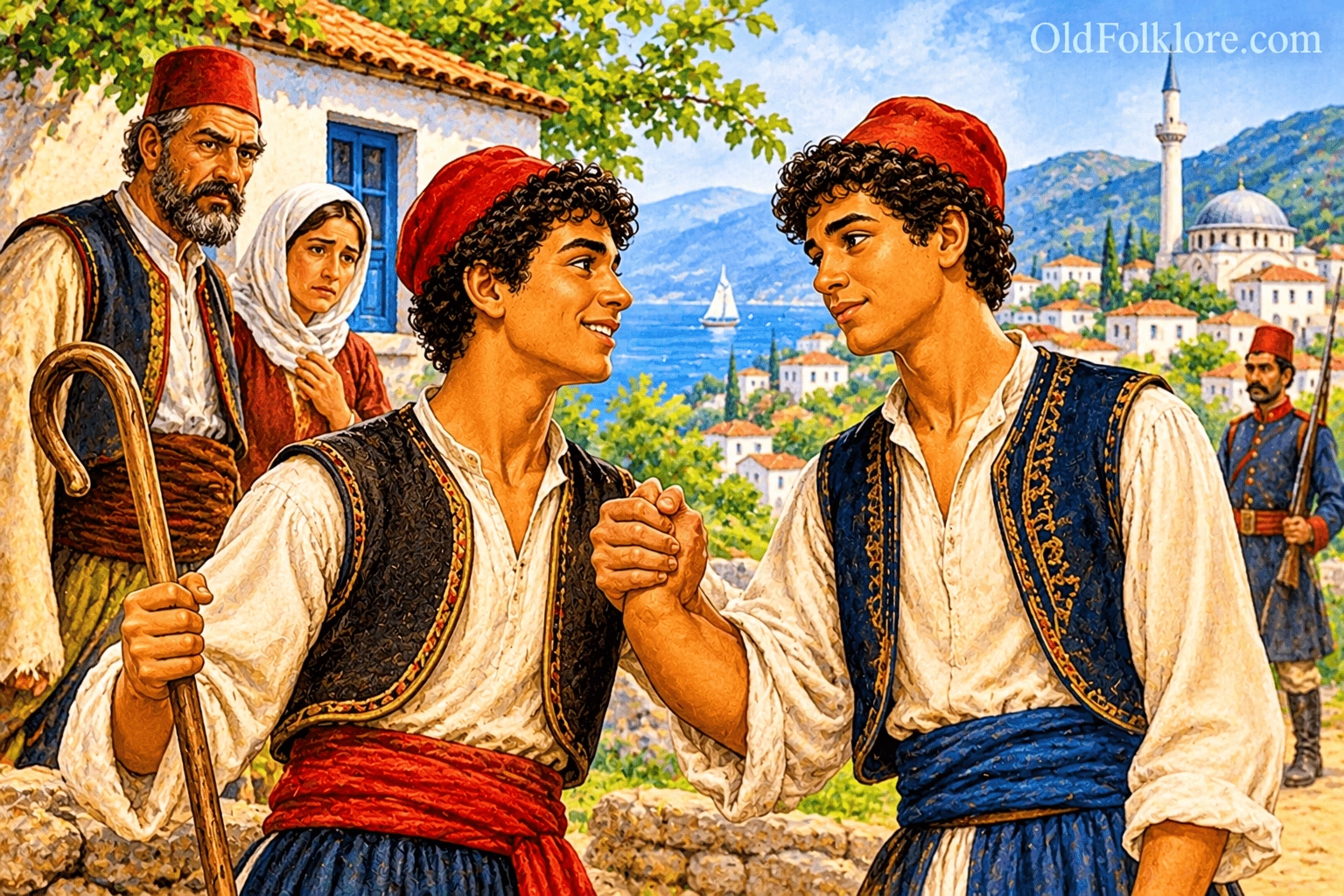
He remembered the old custom of sworn brotherhood that the young man’s father and Anastasia’s father had once observed. He wanted them to establish the same bond.
He proposed that they go to church and become brothers through a solemn ceremony. Anastasia, whom he described as the most beautiful and innocent of girls, would consecrate their friendship.
The young man welcomed the suggestion, and his mother was delighted. Anastasia blushed at the proposal.
The Sacred Promise
A short distance from their home stood a small church on a hillside, sheltered by a few scattered trees. A silver lamp hung before its altar.
On the appointed day, the two young men dressed in their finest clothes.
The young man wore a white fustanella, a close-fitting red jacket and a silver-tasseled fez. His knife and pistols rested in his belt. Aphtanides wore the blue clothing of Greek sailors, with a silver image of the Virgin Mary hanging from his chest.
Anastasia also dressed beautifully. She wore a long white garment, while a necklace of old and new coins adorned her neck. Her dark hair was gathered beneath a headpiece decorated with silver and gold coins.
The three entered the little church and knelt before the altar. They prayed silently before Anastasia addressed them.
She asked whether they would remain friends throughout life and even in death.
Both answered yes.
Then she reminded them of the responsibilities that their promise demanded. Each was to regard the other as part of himself. One brother’s secrets would belong to the other, and his happiness would be shared. Patience, self-sacrifice and loyalty were to bind them together.
Again, they agreed.
Anastasia joined their hands and kissed their foreheads. The priest approached, blessed all three, and the other religious men sang from behind the altar screen. Their bond of eternal friendship was formally established.
When the ceremony ended, the young man noticed his mother standing at the church entrance, crying with emotion.
Their home seemed happier after that day. The two friends had made a promise that neither expected to break.
The Test of Friendship
The evening before Aphtanides was due to leave, the two friends sat together on a mountainside. With their arms around each other, they spoke about the suffering of Greece and the people their country could trust.
The young man felt that there was nothing left to hide between them. Their friendship was so deep that every thought seemed safe in the other’s presence.
Then he remembered something he had never confessed.
He told Aphtanides that his heart was filled with a love greater than the affection he felt for his mother or even for his sworn brother.
Aphtanides asked whom he loved.
The young man answered without hesitation.
“Anastasia.”
The effect on Aphtanides was immediate. His face turned pale, and his hand trembled. The young man understood what had happened. His friend loved Anastasia too.
For a moment, neither knew what to say.
The young man explained that Anastasia had grown up beside him. They had shared almost every moment of their lives, and she had become part of his very being. Yet he had never told her how he felt and did not even know whether she returned his affection.
Aphtanides listened to him.
Then, despite the pain of his own feelings, he made his decision.
“She shall be yours,” he declared. He confessed that he loved Anastasia as well, but he would not deceive his sworn brother or stand in the way of his happiness. He was leaving the following day, and suggested that when they met again in a year, the young man should already be married to her.
He also offered him the little gold he had saved, insisting that it should help the couple begin their life together.
They walked home in silence.
When they arrived, Anastasia held up a lamp to welcome them. His mother was absent, and the young woman looked sadly at Aphtanides.
She told him how sorry she was that he would be leaving the next morning.
Aphtanides repeated her words with visible emotion. Then he turned to Anastasia and told her that their brother loved her and that she must surely hold him dear.
Anastasia trembled and burst into tears.
At that moment, the young man forgot everything except the woman he loved. He stepped towards her, embraced her and finally confessed his feelings.
“I love you!”
Anastasia returned his embrace and kissed him.
But in their excitement, the lamp fell to the ground, plunging the room into darkness. The narrator could think only of Anastasia, but the darkness also reflected the sorrow in Aphtanides’s heart.
Before sunrise, Aphtanides rose quietly. He kissed everyone goodbye and departed.
He had given all his money to the young man’s mother for the family’s benefit.
Anastasia was now the young man’s betrothed, and within a few days they were married.
Thus, the friendship between the two young men survived a painful test, although it came at a great personal cost to Aphtanides.
Explore our complete Historic Folklore & Fairy-Tale Collections archive.
Moral
True friendship is demonstrated through actions, especially when loyalty demands personal sacrifice. A genuine friend does not deliberately destroy another person’s happiness for personal gain.
However, the story also reminds readers that sacrifice can carry deep emotional pain. Aphtanides honours his promise, even though doing so means surrendering the woman he loves.
Knowledge Check
1. Where did the young boy and his family live?
They lived in a humble dwelling in a narrow mountain gorge near Delphi, beneath the slopes of Mount Parnassus.
2. Why did Anastasia become the boy’s sister?
Their fathers had sworn brotherhood when they were young. Under the bond established between the families, Anastasia was welcomed into the boy’s household after her parents were killed.
3. How did the boy first meet Aphtanides?
They met during the Easter celebration at a church near the Gulf of Lepanto, when Aphtanides greeted him with a kiss and the words, “Christ is risen!”
4. What was the purpose of the ceremony in the church?
It formally established a lifelong bond of brotherhood between the two young men, with Anastasia acting as the person who consecrated their promise.
5. Why was Aphtanides heartbroken?
He secretly loved Anastasia, just as his sworn brother did. When he discovered that his friend loved her too, he chose to surrender his own hopes rather than betray their friendship.
6. What does Aphtanides’s final decision reveal about his character?
It reveals his loyalty, generosity and willingness to put another person’s happiness before his own desires.
Source
Hans Christian Andersen, “The Bond of Friendship,” in What the Moon Saw: and Other Tales, translated by H. W. Dulcken, illustrated by Alfred Walter Bayes, published by George Routledge and Sons, London, 1866, pp. 73–81.
Explore More Hans Christian Andersen Tales