Long ago, a terrible drought struck Burundi, bringing hunger and hardship to communities across the land. Rivers and small springs began to dry up, crops withered beneath the scorching sun, and once-thriving cattle herds grew weak from the shortage of grass and water. Families who had depended on farming and livestock struggled to survive, while many people began abandoning their homes in search of better conditions.
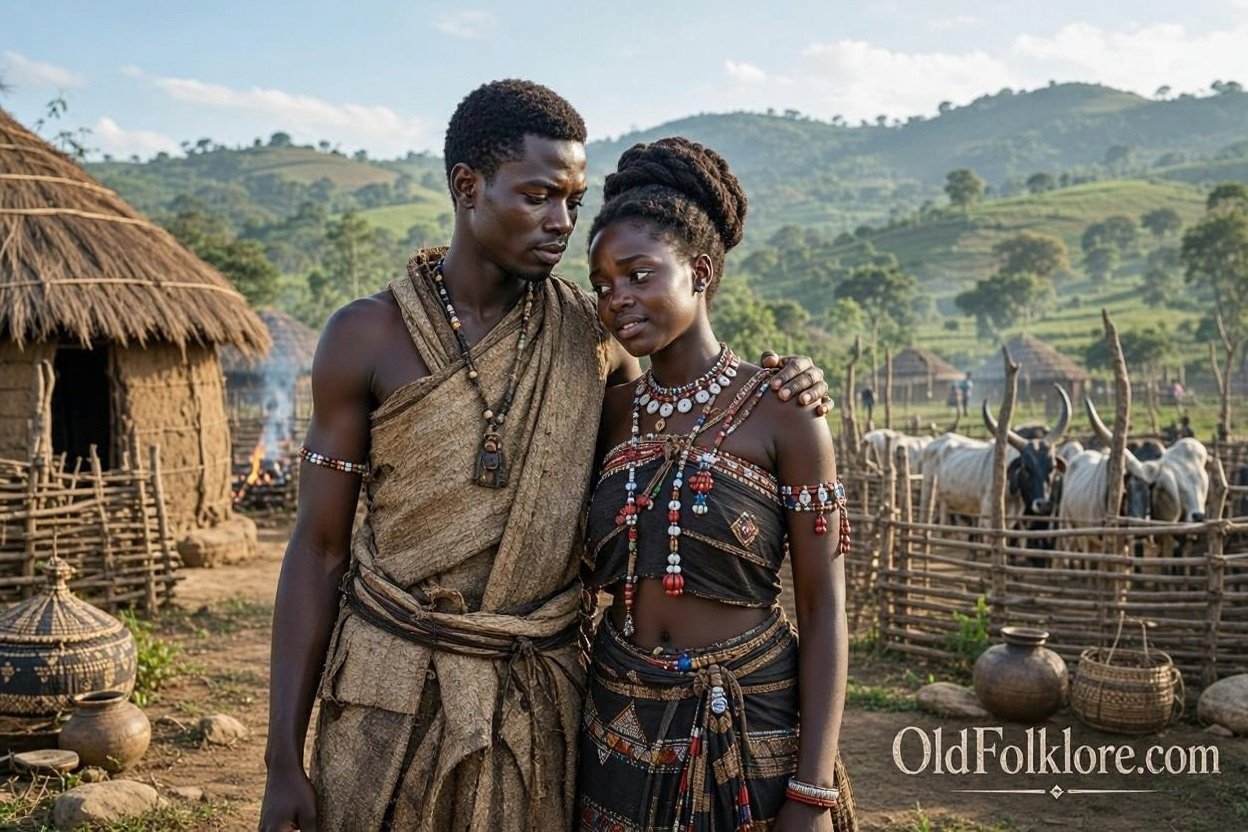
Among those affected were two orphaned twins, Rusamindengo and his sister Sankima. They lived in their family home, known as a rugo, while their father, Rutankabandi, had travelled west with his cattle in search of greener pastures. Their mother had died when they were young, leaving the twins deeply attached to one another.
Although they had once enjoyed a comfortable life, the drought gradually destroyed everything they depended upon. Their stores of sorghum flour were nearly exhausted, and the land offered little hope of an immediate harvest.
Rusamindengo was a skilled craftsman who made beautiful clothes, while Sankima earned her living weaving sleeping mats. They had once worked happily beside each other, sharing conversations and enjoying the peaceful life of their home.
Now, however, hunger threatened them both.
The Twins Escape the Great Drought
As the drought continued, Rusamindengo became increasingly worried about their survival. He feared that they would soon have nothing left to eat. He considered travelling to Manamba to search for food, but Sankima strongly opposed the idea.
She feared that the roads had become dangerous because hungry travellers were vulnerable to robbery and murder. She refused to allow her brother to undertake such a journey alone.
Sankima reminded him that they had already lost their mother and that they should not allow hunger to separate them.
She preferred that they face their difficulties together rather than risk losing one another.
The situation became worse as the drought spread. Other families began leaving their homes, taking whatever remained of their livestock towards the western regions in search of pasture.
Rusamindengo eventually suggested that they should also leave.
He proposed travelling to Bushi, a neighbouring region where the land was believed to be more fertile and rainfall more reliable. They would seek temporary shelter, survive the difficult period and return to Burundi when the rains came back.
Sankima agreed.
The twins packed what they could carry and began their journey. They travelled for several days, passing abandoned enclosures and dry landscapes. The journey was exhausting, but they continued until they finally reached Bushi.
Explore more stories from our Burundian Folktales Collections archive.
There, they approached a powerful local chief named Mitaka and requested hospitality.
Mitaka welcomed them into his household. Rusamindengo was assigned accommodation with the warriors behind the palace, while Sankima was given responsibilities within the palace household.
The chief was immediately attracted to Sankima.
Mitaka Falls in Love with Sankima
Life in Bushi gradually became more comfortable for the twins.
Rusamindengo continued practising his craft, making clothes for people associated with the palace. His skills were valued, and he spent much of his time searching for suitable ficus bark and other materials needed for his work.
Sankima also received favourable treatment from Mitaka. The chief admired her beauty and began providing her with fine clothing and valuable ornaments.
He gave her beautiful garments and rare beads, treating her with special attention.
As time passed, Sankima developed feelings for Mitaka. She appreciated his generosity and the comfortable life she enjoyed in his palace.
However, she did not tell her brother about her feelings.
Rusamindengo remained unaware of the emotional struggle taking place within his sister. He believed that their stay in Bushi was temporary and that they would eventually return to their homeland.
After three months, news arrived that the rains had returned to Burundi.
The people who had fled the drought began preparing to return home. For Rusamindengo, this was welcome news. He immediately decided that he and his sister should leave Bushi and return to their father’s home.
He and Sankima approached Mitaka to express their gratitude and announce their departure.
The chief was disappointed.
He asked whether they could remain in Bushi, but Rusamindengo explained that their father would be distressed if they failed to return. He believed they had a responsibility to return to their ancestral home.
Mitaka then made another request.
He confessed his love for Sankima and asked whether she could remain behind as his wife.
Sankima lowered her eyes. She also loved Mitaka, but she had not revealed her feelings to her brother.
Rusamindengo refused to return home without his sister. He explained that leaving her behind would be unacceptable to their father.
Mitaka realised that Rusamindengo would not change his decision. Although saddened, he wished them a safe journey.
The following day, the twins departed for Burundi.
A Painful Homecoming
During their journey home, Sankima became unusually quiet.
Rusamindengo noticed her sadness but did not understand its cause. He believed she was simply tired from travelling.
He looked forward to seeing their father and returning to the familiar hills of their homeland.
However, their happiness disappeared when they finally reached home.
The family enclosure was silent. There were no cattle in the compound, and the surroundings showed signs of abandonment.
Sankima immediately became worried and asked whether their father had returned.
Rusamindengo was equally confused. He remembered that their father had travelled west with the cattle, accompanied by their neighbour, Ndakoraniwe.
The twins decided to visit their neighbour to find out what had happened.
Ndakoraniwe was surprised and delighted to see them alive. He welcomed them warmly and asked how they had survived the difficult period.
Rusamindengo explained that they had escaped to Bushi.
Sankima then asked about their father.
Ndakoraniwe explained that the situation in the western region had also become difficult. Even there, the grass had dried up, and cattle were dying from hunger and thirst.
His own herd had been severely reduced.
Unfortunately, their father had suffered an even worse fate. His cattle had perished, and he had contracted a fever associated with the plains. He eventually died, overcome by illness and the sorrow of losing his herd.
The twins were devastated.
They returned to their home mourning the father they had hoped to find waiting for them.
Poverty Separates the Twins
After their father’s death, Rusamindengo and Sankima struggled to rebuild their lives.
They began cultivating their abandoned fields, hoping to restore their livelihood. However, poverty had already taken hold of the household.
Their home was deteriorating, and there was little money or food. The community was also struggling to recover from the drought, leaving few people able to purchase the clothes Rusamindengo made.
His craft had once provided a comfortable living, but the economic hardship meant that people could no longer afford his products.
The ficus trees he depended upon had also become scarce after the drought.
Rusamindengo was not particularly skilled at farming, having spent most of his life making clothes. Sankima, meanwhile, had become increasingly melancholy.
Their circumstances continued to worsen.
Rusamindengo believed that his sister’s sadness came from the death of their father. He did not realise that she was still thinking about Mitaka and the comfortable life she had left behind.
Eventually, Sankima suggested that they should return to Bushi.
She reminded her brother that Mitaka loved her and could provide them with wealth, security and honour.
Rusamindengo refused.
He explained that he could not abandon the land inherited from their ancestors. Even if he became related to Mitaka through marriage, Bushi would remain a foreign land to him.
He also reminded Sankima that he had children in mind for the future and wanted them to inherit their ancestral home.
Sankima appeared to accept his decision, assuring him that she would remain with him.
However, her heart was elsewhere.
The following morning, she secretly left for Bushi without saying goodbye.
When Rusamindengo discovered that his sister had disappeared, he searched for her but found no trace.
He remembered a song Sankima used to sing to comfort him whenever he was sad. In the song, she had promised to become a queen, provide him with beautiful cattle and never abandon him until death.
Those memories made her departure even more painful.
He felt that everything he loved had gradually been taken away from him. His mother had died when he was young, his father had perished during the drought, and now his beloved sister had abandoned him.
Sankima Becomes Princess of Bushi
When Sankima returned to Bushi, Mitaka welcomed her warmly.
He was delighted that she had finally chosen to return. Without delay, he married her in a grand ceremony.
Sankima became his wife and enjoyed the privileges associated with her new position.
Mitaka provided her with beautiful clothing, ornaments and everything she needed.
Nevertheless, she could not completely forget her brother.
Although she was now living comfortably in the palace, memories of Rusamindengo continued to trouble her.
She occasionally wondered whether he was alive and what he thought of her sudden departure.
One day, Mitaka noticed the sadness in her expression and asked why she sometimes appeared unhappy.
Sankima explained that she regretted leaving without saying goodbye to her brother.
Her answer made Mitaka suspicious.
He began to fear that Rusamindengo might eventually travel to Bushi to take his sister away from him.
Rather than trusting Sankima and allowing her to resolve the matter peacefully, Mitaka made a cruel decision.
He ordered his men to kill Rusamindengo if they ever found him coming towards the palace.
Sankima knew nothing about this order.
Mitaka’s Betrayal
Meanwhile, Rusamindengo continued struggling with his life in Burundi.
The loss of his sister had left him deeply unhappy. He eventually began questioning whether he had been fair to her.
He realised that Sankima had been free to choose the man she loved and that he might have allowed his attachment to their ancestral home to overshadow her wishes.
He decided that he should travel to Bushi, apologise to his sister and make peace with Mitaka.
He wanted to explain that he had never intended to stand between them.
His decision was sincere. He hoped to restore their relationship and remain close to the only immediate family he had left.
Unfortunately, he did not know that Mitaka had already ordered his death.
When Rusamindengo reached Bushi, he entered the forest of Saso.
A palace messenger informed Mitaka that the brother of his wife had arrived and was somewhere in the forest.
Mitaka immediately repeated his earlier order.
His men found Rusamindengo and murdered him in the forest, piercing his body with spears.
The young craftsman who had once made beautiful clothes for princes died without seeing his sister again.
At the palace, life continued as though nothing had happened.
Sankima remained unaware of her brother’s fate.
The Terrible Truth Is Revealed
Some time later, a rebellion broke out in Mitaka’s palace.
The disturbance was eventually suppressed, and the authorities identified Wana, the royal treasurer, as the leader of the revolt.
The palace officials decided that Wana should be executed by beheading.
Mitaka insisted that Sankima attend the execution.
She agreed, although she had no desire to watch a man lose his life.
On the day of the execution, Wana was brought before the executioner.
Before his death, he turned towards Mitaka and asked the chief to spare his life. He warned that he knew something that could make Mitaka miserable for the rest of his days.
Mitaka refused to intervene.
Realising that he was about to die, Wana decided to reveal the secret.
He turned towards Sankima and shouted that her husband had ordered the murder of her brother.
He told her that Rusamindengo had been killed in the forest of Saso, between two large ficus trees.
Before he could finish speaking, the executioner’s axe struck his neck.
Sankima immediately ran towards the forest.
She hoped that Wana’s words were untrue, that perhaps the condemned man had spoken out of desperation.
But when she reached the two ficus trees, she discovered her brother’s lifeless body.
Rusamindengo lay on the ground, his body pierced by spears.
Sankima threw herself upon him, crying and mourning the brother she had abandoned.
She finally understood that Mitaka, the man she had chosen over her family, was responsible for her brother’s death.
There was no possibility of returning to the palace and continuing her life as though nothing had happened.
She turned away from Mitaka and began walking towards Burundi.
The Princess Without a Name
Sankima travelled towards the southwestern region of Burundi until she reached Ryansoro.
She was overwhelmed by sorrow and guilt. She believed that abandoning her brother had contributed to the tragedy that had destroyed their family.
The people of Ryansoro noticed the strange woman who had arrived in their community.
Although she rarely spoke, they treated her kindly. They built a small house for her, allowing her to settle among them.
Sankima lived quietly, avoiding conversations and keeping her past to herself.
The villagers liked her, although they sometimes thought she was mentally troubled because of her unusual silence and profound sadness.
Nobody knew her real identity.
Her sorrow was so deep that even the people around her seemed to become quiet whenever she passed.
She never recovered from the loss of Rusamindengo.
One day, the villagers noticed that she had not come outside. Concerned, they entered her house to check on her.
They found Sankima lying on her bed, lifeless.
She was dressed in beautiful royal clothing made from brightly coloured ficus bark. The garments had been made for her by her brother, and she had never stopped wearing them.
She also wore her royal headpiece.
Only then did the villagers realise that the quiet woman they had sheltered was not an ordinary stranger.
She was a princess of Bushi.
Her name was Ntazina, meaning the princess without a name.
The people finally understood the identity of the woman who had lived among them in silence.
Thus ended the tragic story of Rusamindengo, who was murdered in the forest of Saso, and his sister Sankima, Princess Ntazina, who died of grief in Ryansoro.
Explore our complete Africa Folktales collection.
Moral Lesson
The story of Rusamindengo and Princess Ntazina teaches important lessons about family relationships, loyalty, love and the consequences of betrayal.
Rusamindengo’s attachment to his ancestral home demonstrates the importance of belonging and preserving one’s heritage. However, his story also reminds us that love for family requires understanding and respect for the choices of others. Although he wanted to protect his relationship with his sister, he initially struggled to recognise her personal desires.
Sankima’s experience shows how difficult decisions can affect the people we love. Her decision to leave without telling her brother caused lasting emotional pain, while her failure to resolve the separation eventually left her overwhelmed by guilt.
Mitaka’s actions provide another important lesson. His jealousy and fear led him to commit a terrible crime against an innocent man. Instead of trusting his wife and welcoming reconciliation, he chose violence and deception.
Ultimately, the story reminds us that wealth, social position and material comfort cannot replace genuine family relationships. Love should be accompanied by honesty, understanding and respect. Betrayal and selfishness can destroy relationships in ways that wealth and power cannot repair.
Knowledge Check
1. Who were Rusamindengo and Sankima?
They were orphaned twins who lived together in Burundi after their mother died.
2. Why did the twins leave their home in Burundi?
They left because a severe drought caused hunger and destroyed their livelihood, forcing them to seek better living conditions in Bushi.
3. Who was Mitaka, and why did he welcome the twins?
Mitaka was a powerful chief in Bushi who offered them hospitality. He later fell in love with Sankima.
4. Why did Sankima secretly return to Bushi?
She loved Mitaka and wanted to enjoy the comfortable life he could provide, despite her brother’s refusal to relocate.
5. How did Rusamindengo die?
Mitaka ordered his men to murder Rusamindengo in the forest of Saso because he feared that he would come to take Sankima away.
6. What does the name Princess Ntazina mean, and how did Sankima receive it?
Ntazina means “the princess without a name.” The villagers discovered her royal identity from her clothing and ornaments after she died in Ryansoro.
Source
This story is adapted from “Rusamindengo”, published in Contes du Burundi (Bujumbura, B.E.P.S., 1986, pp. 53–62), and reproduced in the appendix of Rémy Ndikumagenge’s 2010 University of Burundi dissertation, Les contes burundais comment support didactique dans l’enseignement du français langue étrangère au premier cycle de l’enseignement secondaire au Burundi
Explore More Burundian Folktales
- The King’s Lost Shadow
- The River That Refused to Sleep
- The Woman Who Carried the Mountain
- The Clever Hare and the Greedy Hyena
- The Girl Who Married the Rain
- The Boy Who Understood Animals