A mysterious glass hill stood near the palace of a king who had promised his daughter in marriage to the man capable of reaching its summit on horseback. The challenge attracted princes and knights from far and wide, but the smooth, steep surface defeated every rider who attempted the climb.
In the same kingdom lived a farmer and his three sons. The youngest, known as Boots, was regarded as the least important member of the family. His brothers constantly ridiculed him for spending his time among the ashes, believing he had neither the appearance nor the ability to achieve anything remarkable. Yet a strange occurrence on the family meadow would give Boots an opportunity to prove them wrong.
The Farmer’s Disappearing Grass
A farmer owned a meadow on a hillside. He had built a barn in the field to keep his hay, but for two successive years, something had ruined his grass on St John’s Eve. The meadow would be covered in rich green growth before nightfall, only for the grass to be eaten down by morning.
The farmer could not explain how such a large quantity of grass disappeared. He suspected that an animal or some other creature was entering the field during the night. After suffering the same loss twice, he decided that someone must keep watch.
He had three sons, so he instructed them to take turns sleeping in the barn on St John’s Eve. Whoever went was expected to remain awake and discover what was destroying the meadow.
The eldest son agreed to go first. He was confident that he could protect the grass from any intruder. When darkness came, he made his way to the barn and settled down for the night.
Before long, a violent disturbance began. The building shook so badly that its walls and roof groaned. Frightened by the noise and trembling ground, the young man abandoned his watch and ran home as quickly as he could.
The following morning, the meadow had suffered the same fate. The grass had disappeared.
The next year, the farmer sent his second son. He also entered the barn with confidence, but the disturbance that came during the night was even more frightening. The ground rumbled, the building shook, and he fled without discovering the cause of the trouble.
Once again, the meadow was left bare.
Boots Keeps Watch
When the third St John’s Eve approached, the farmer turned to his youngest son. Boots’s older brothers immediately began making fun of him. They thought it ridiculous that someone who spent so much time sitting among the ashes should be expected to guard a field.
Boots did not allow their comments to discourage him. He went up the hillside, entered the barn and prepared to wait.
About an hour later, the building began to shake. The noise was frightening, but Boots remained inside. He reasoned that he could endure the disturbance if it did not become any worse.
Explore more stories from our Asbjørnsen & Moe’s Norwegian Folk Tales collection.
Another violent rumble followed, sending the loose straw and litter flying around him. Boots stayed where he was. Then a third disturbance struck, making the walls and roof seem close to collapsing.
When it finally ended, the barn became completely quiet.
Boots waited for another attack, but none came. After some time, he heard an animal feeding just outside the entrance. He approached carefully and looked through a small opening in the door.
A magnificent horse was grazing beside the barn. Boots had never seen an animal so impressive. Its saddle and bridle lay nearby, together with a complete set of a knight’s armour made of shining brass.
He realised that the horse was probably responsible for eating the meadow grass. Wanting to prevent it from escaping, Boots took the steel from his tinder-box and cast it over the animal. The horse immediately became still and docile. Boots was then able to handle it without difficulty.
He mounted the horse and rode it to a place where nobody else knew it was being kept. Having secured his discovery, he returned home.
His brothers were waiting to ridicule him. They questioned whether he had actually spent the night in the barn or had hurried home like they had done.
Boots insisted that he had remained there until sunrise. He also claimed that he had neither seen nor heard anything unusual.
His brothers doubted his account and went to inspect the meadow. To their surprise, the grass was growing as thickly as before.
The Horse in Silver
Another year passed, and St John’s Eve came around again. Boots’s brothers had no desire to repeat their earlier experiences. Neither was willing to spend another night in the barn, but Boots was prepared to take his turn.
The night unfolded much as it had before. The barn shook repeatedly as powerful disturbances passed through the ground. Each one was more severe than the last. Once the final tremor had ended, the surroundings became quiet.
Boots soon heard another animal feeding outside. He approached the door and peered through the opening.
A second horse stood beside the barn. It was even more splendid than the first, and its equipment was finer. A saddle and bridle had been provided, while a complete suit of a knight’s armour made of silver lay beside it.
Boots understood that he had found another of the mysterious animals responsible for the disappearing grass. He used the steel from his tinder-box again, casting it over the horse and making it completely manageable.
He then rode the new horse to the secret place where he had left the first one. After securing it there, he returned home.
His brothers greeted him with their usual mockery. One suggested that he would probably claim the meadow had remained untouched again. Boots simply confirmed that the grass was still there and allowed them to see for themselves.
When they reached the field, they found it in excellent condition. Despite the discovery, they continued to treat their younger brother with contempt.
The Third Horse in Gold
By the third year, the older brothers were too frightened to volunteer for the watch. Their previous experiences had left them unwilling to approach the barn at night. Boots, however, went without hesitation.
The familiar disturbances began again. Three powerful shocks shook the building, each more violent than the one before. The final tremor was so forceful that Boots was thrown from one side of the barn to the other.
Then the noise stopped.
After waiting for a while, Boots heard something feeding outside. He looked through the door and saw a third horse. It was considerably larger and more impressive than the two he had already found.
As before, the saddle, bridle and a complete suit of knight’s armour lay beside the animal. This time, everything was made of gold.
Boots took the steel from his tinder-box and cast it over the horse. It immediately became still, allowing him to approach and take control of it.
He rode the third horse to the hiding place where the other two were kept. Once again, he returned home without revealing what he had discovered.
His brothers made fun of him as soon as he appeared. They remarked that he looked as though he had been wandering about in his sleep. Boots ignored their insults and suggested that they inspect the meadow.
They went to the field and found the grass growing abundantly. For the third time, Boots had succeeded where his brothers had failed.
The King’s Announcement
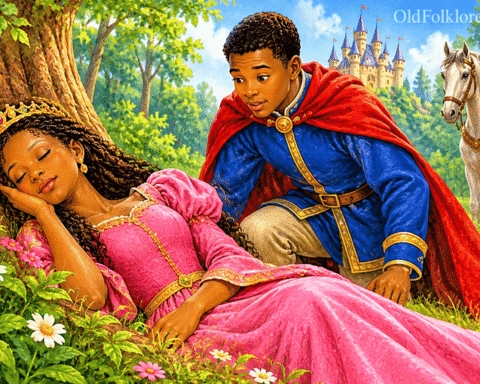
The king of the country had a beautiful daughter. Near his palace stood a remarkable hill made entirely of glass. It was extremely high and steep, with a surface so smooth that horses could scarcely gain a foothold.
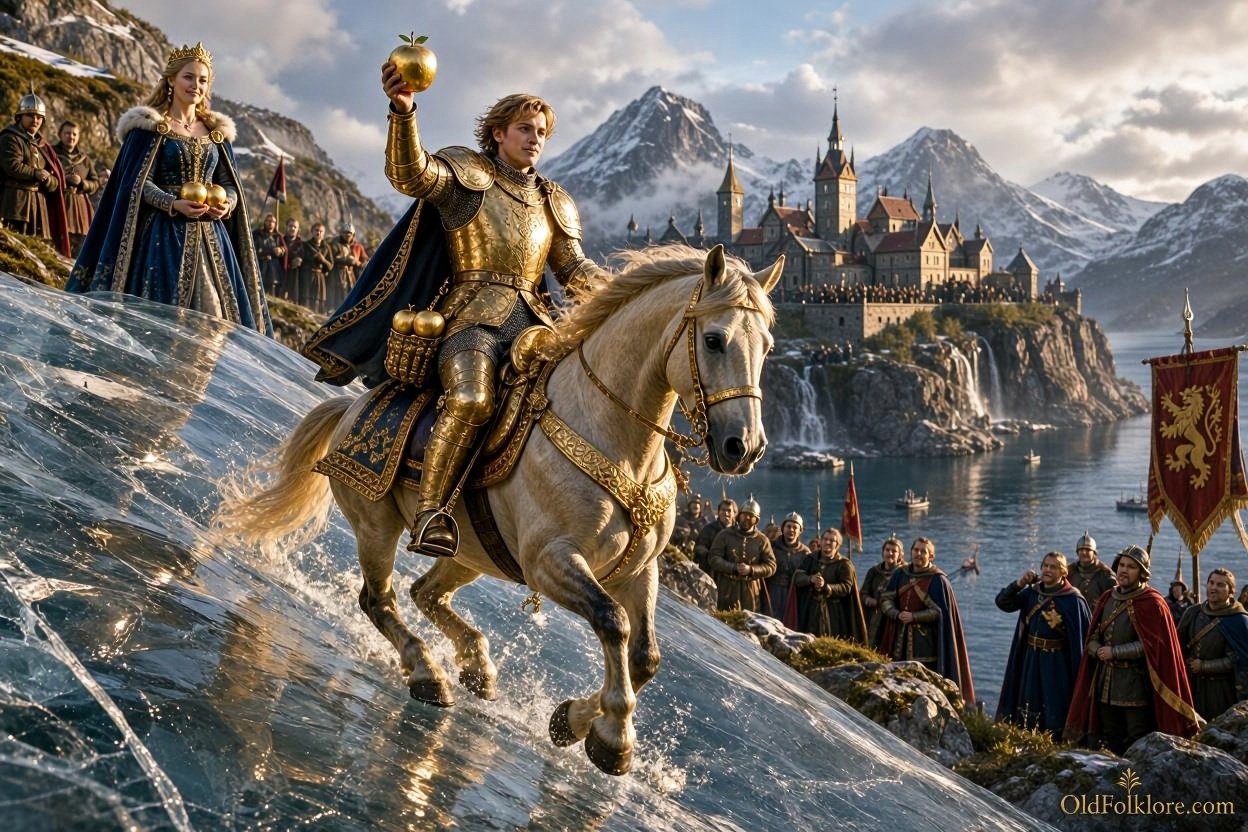
The king placed his daughter at the summit with three golden apples in her lap. He announced that the man who could ride up the hill and take the apples would marry the Princess and receive half the kingdom.
The challenge was announced throughout the king’s realm and made known in other kingdoms. The Princess was renowned for her beauty, and many men wished to marry her. Princes and knights therefore travelled from different places, bringing their finest horses and wearing their most impressive clothes.
When the appointed day arrived, a great crowd assembled beneath the glass hill. People from across the country came to witness the contest, eager to discover whether anyone could accomplish what the king had demanded.
Boots’s older brothers also prepared to attend. They refused to take him along, however, because they were ashamed of his dirty appearance. They believed that people would laugh at them if they arrived with a brother who spent his days among the ashes and cinders.
Boots did not quarrel with them. He decided that he could attend on his own.
The First Golden Apple
The competition began with the assembled princes and knights attempting to ride up the glass hill. Their horses struggled to find a foothold. Whenever they stepped onto the slippery surface, they slid backwards.
The riders made repeated attempts, but the hill defeated them all. Their horses became exhausted, and the animals were soon covered in sweat. Eventually, the competitors had to stop.
The king was considering announcing another trial for the following day when an unfamiliar knight appeared. He rode a splendid horse and wore shining brass armour. His horse was also fitted with a brass saddle and bridle.
The other competitors warned him that the hill was too difficult to climb. Their own horses had failed, and they believed his attempt would end in the same way.
The knight paid no attention to their warnings. He directed his horse towards the slope and began climbing. To everyone’s amazement, he reached about one-third of the hill before turning around and descending.
The Princess was greatly impressed by the stranger. She hoped he would continue to the summit, but when she saw him coming back, she threw one of the golden apples after him. It rolled down the slope and landed in his shoe.
The knight immediately rode away, disappearing before anyone could discover who he was.
That evening, the competitors were expected to appear before the king and show the apple. However, none of the princes or knights could produce it.
When Boots’s brothers returned home, they described the remarkable rider. They spoke about his brass armour and the distance he had managed to climb.
Boots listened with interest and said that he wished he had seen the knight. His brothers mocked him again, suggesting that he could never belong among such distinguished riders.
The Second Golden Apple
The following day, the brothers prepared to attend the contest again. Boots asked to accompany them, hoping to see the riders for himself, but they refused.
He went to the glass hill alone.
The competition resumed, and the horses again struggled against the slippery surface. Despite the riders’ efforts, none could make meaningful progress. Their animals eventually became too tired to continue.
The king considered ending the day’s contest, but he decided to wait a little longer.
Before long, another impressive knight appeared. His horse was finer than the one ridden by the previous stranger, and both the rider and his equipment shone with silver. He wore silver armour and rode with a silver saddle and bridle.
The spectators warned him against attempting the climb, but he ignored them. He urged his horse forward and managed to reach approximately two-thirds of the hill.
He then turned around and rode back down.
The Princess admired this knight even more than the first. She hoped he would reach the summit, but when he began his descent, she threw the second golden apple after him. It rolled into his shoe.
As soon as the knight reached level ground, he galloped away and vanished from view.
That evening, the competitors again appeared before the king. Nobody presented the apple.
Boots’s brothers returned home and described the silver knight. They explained how far he had climbed and how the Princess had rewarded him with the second apple.
Boots repeated that he would have liked to see such a rider. His brothers responded with more insults, comparing the knight’s shining armour with the ashes Boots was accustomed to handling.
The Third Golden Apple
On the third day, Boots again asked his brothers to let him accompany them. They refused, so he made his own way to the glass hill.
The princes and knights tried once more, but their horses could not climb even a short distance. Everyone waited to see whether the silver knight would return, but he did not appear.
Instead, a third stranger arrived on a horse of extraordinary beauty. This rider wore golden armour, and his horse carried a golden saddle and bridle. The brilliance of his equipment astonished the crowd.
The other competitors were so impressed that they had little opportunity to warn him against the attempt.
The golden knight rode straight towards the glass hill. His horse climbed with remarkable ease, passing the points where the earlier riders had turned back. Before the Princess could even finish wishing him success, he had reached the summit.
He took the third golden apple from her lap, turned his horse and descended safely.
Once he reached the bottom, he rode away at great speed and soon disappeared.
When Boots’s brothers returned home, they could hardly stop talking about the golden knight. They declared that he was an exceptional rider and that they had never seen anyone so splendid.
Boots said that he wished he had seen him too. His brothers laughed and reminded him that the knight’s armour was far brighter than the coals he spent his time stirring.
Boots Reveals His Identity
The next day, the king ordered the princes and knights to appear before him and the Princess. The person who had taken the golden apple was expected to show it.
One after another, the competitors came forward, but none possessed the apple. The king knew that someone had succeeded because he and the assembled crowd had witnessed the golden knight ride to the summit and take it.
He therefore ordered everyone in the kingdom to come to the palace. No one was to be excluded from the search.
People arrived in large numbers. After a long time, Boots’s two older brothers appeared. They were among the last to come before the king.
The king asked whether anyone else remained who had not yet presented himself.
The brothers admitted that they had a younger brother, but insisted that he could not possibly be the successful rider. They explained that he had remained in his usual place among the ashes throughout all three days of the contest.
The king nevertheless ordered that Boots should be brought to the palace.
When Boots arrived, the king asked him directly whether he had the golden apple.
Boots answered that he had all three. He reached into his pocket and produced the first, the second and the third golden apple.
He then removed his sooty clothes. Beneath them was the gleaming golden armour worn by the mysterious knight who had conquered the hill on the final day.
The king and everyone present could now see that Boots was the rider they had been searching for. The young man whom his brothers had dismissed as dirty and incapable had accomplished the challenge that had defeated the finest princes and knights.
The king honoured his promise. Boots was given the Princess in marriage and half the kingdom.
Preparations were made for the wedding, and a great celebration followed. The people rejoiced at the marriage, while the unsuccessful competitors had to accept that none of them had managed to reach the summit of the glass hill.
Boots, once treated as an embarrassment by his own brothers, became the Princess’s husband and received the reward he had won.
Explore our complete Historic Folklore & Fairy-Tale Collections archive.
Moral Lessons
The story reminds readers that a person’s appearance does not determine their ability. Boots’s brothers judged him by his dirty clothes and his habit of sitting among the ashes. They never considered that he might possess qualities that they themselves lacked. His success showed that outward appearance can conceal courage, resourcefulness and determination.
It also demonstrates the importance of persistence. Boots faced the frightening disturbances in the barn three times, while his brothers abandoned the task after their first experiences. His willingness to return allowed him to discover the horses that later helped him succeed.
Another lesson concerns the danger of underestimating others. The brothers repeatedly mocked Boots and excluded him from their company because they believed he was beneath them. Their judgement proved mistaken when the king’s challenge revealed his true abilities.
The tale also shows that actions can be more convincing than claims. Boots did not spend his time arguing with his brothers or demanding their respect. He quietly carried out what he believed was necessary, and his achievements eventually spoke for themselves.
Knowledge Check
1. Why did the farmer ask his sons to watch the meadow on St John’s Eve?
Answer: The grass in his meadow repeatedly disappeared overnight, and he wanted to discover what was eating it.
2. What did Boots find outside the barn during his first successful night?
Answer: He found a magnificent horse with a saddle, bridle and a complete set of brass knight’s armour.
3. What did Boots use to make the three horses tame?
Answer: He used the steel from his tinder-box, casting it over each horse.
4. What reward did the king promise to the man who conquered the glass hill?
Answer: The successful rider would marry the Princess and receive half the kingdom.
5. How far did the three mysterious knights climb during the competition?
Answer: The knight in brass reached about one-third of the hill, the knight in silver reached two-thirds, and the knight in gold reached the summit.
6. How did Boots prove that he was the successful rider?
Answer: He produced all three golden apples and removed his sooty clothes, revealing the golden armour beneath.
Source
This retelling is based on “Princess on the Glass Hill”, Tale XIII in Popular Tales from the Norse, collected by Peter Christen Asbjørnsen and Jørgen Engebretsen Moe and translated into English by Sir George Webbe Dasent.
Explore More Asbjørnsen & Moe’s Norwegian Folk Tales
- East of the Sun and West of the Moon
- The Giant Who Had No Heart in His Body
- True and Untrue: A Norwegian Folk Tale
- The Cat on the Dovrefell: A Strange Christmas Eve Encounter