Vardiello is a Neapolitan literary fairy tale about a foolish young man whose careless actions repeatedly create trouble for his mother. Although Grannonia of Aprano is a woman of good sense and judgement, her son seems incapable of carrying out even the simplest instructions. His mistakes begin with a hen sitting on eggs and eventually lead to lost wine, stolen merchandise and an unexpected discovery of gold.
Grannonia loves her son deeply despite his foolishness. She repeatedly attempts to protect him from the consequences of his behaviour, using patience and cleverness to manage situations that would otherwise bring greater trouble. Vardiello, however, rarely understands the seriousness of his mistakes.
His story is filled with comic misunderstandings, exaggerated foolishness and unexpected fortune. What makes the tale particularly interesting is the contrast between the son’s stupidity and the mother’s intelligence. Although Vardiello repeatedly creates problems, Grannonia’s clever interventions turn some of his misfortunes into advantages.
Grannonia and Her Foolish Son
Grannonia of Aprano was a woman known for her good sense and judgement. She had a son named Vardiello, who was regarded as the greatest simpleton in the surrounding country.
Despite his foolishness, Grannonia loved him dearly. Like many mothers who see only the best in their children, she continued to admire and pamper him. She treated him with affection, even when his behaviour gave her every reason to be concerned.
One of Grannonia’s possessions was a brood-hen sitting on a nest of eggs. She expected the eggs to hatch into healthy chickens, which she hoped to sell for a good profit. The hen represented an important opportunity for the household.
One day, Grannonia needed to leave home to attend to some business. Before departing, she called Vardiello and instructed him to watch the hen carefully. If the bird left the nest to scratch and search for food, he was to drive it back immediately. Otherwise, the eggs might grow cold and fail to hatch.
Vardiello confidently assured his mother that he understood.
Before leaving, Grannonia gave him another warning. She pointed out a cupboard containing a pot of poisonous substances and told him not to touch anything inside it. She explained that eating the contents could kill him.
Vardiello promised to obey, although his reply revealed just how little sense he possessed. He admitted that if she had not warned him, he might have eaten everything in the pot.
Satisfied that she had given her son clear instructions, Grannonia left the house.
The Hen and the Broken Eggs
After his mother departed, Vardiello decided to occupy himself in the garden. He began digging holes and covering them with branches and earth to catch people who might steal fruit.
While working, he noticed that the hen had left the room.
He immediately began shouting and trying to drive the bird back towards its nest. However, the hen refused to move in the direction he wanted.
Vardiello became increasingly frustrated. He stamped his feet, threw his cap at the bird and eventually picked up a cudgel. He threw it at the hen, striking the animal on the head.
The blow killed it.
Vardiello was troubled by the accident and tried to think of a way to repair the damage. Remembering his mother’s warning about the eggs becoming cold, he decided that he could keep them warm himself.
He sat directly on the nest.
Unfortunately, his attempt to protect the eggs ended in another disaster. His weight crushed them, leaving him with neither a living hen nor the expected brood of chickens.
Explore more stories from our Basile’s lPentamerone collection.
With the eggs destroyed and the hen dead, Vardiello decided to make use of what remained. He plucked the bird, placed it on a spit and roasted it over a large fire.
He appeared satisfied with this new plan. After cooking the hen, he spread a clean cloth over an old chest and prepared to eat. He then took a flagon and went down into the cellar to draw some wine.
The Stolen Hen and the Empty Wine Barrel
While Vardiello was drawing wine, he heard a sudden commotion in the house. The noise sounded like the clattering of horses’ hooves.
He turned towards the disturbance and discovered that a large tom-cat had stolen the roasted hen, carrying it away with the spit still attached. Another cat followed behind, mewing and crying as though demanding a share of the stolen food.
Vardiello immediately abandoned the wine and rushed after the animals.
He chased the cats through the different corners of the house until he managed to recover the hen. However, his hurried pursuit had caused another serious problem.
He had left the wine barrel’s tap running.
By the time he returned, all the wine had flowed out of the cask and spread across the floor. The loss overwhelmed him, and he began to cry.
After some thought, he came up with a plan to hide the damage. He took a sack of flour and scattered its contents over the spilled wine, hoping that his mother would not discover what had happened.
He then counted his misfortunes and became convinced that he had destroyed every chance of remaining in his mother’s good graces.
Believing that he could no longer face her, Vardiello decided that he would rather die than return to his usual life.
The Pickled Walnuts and the Oven
Vardiello remembered the warning his mother had given him about the poisonous contents of the cupboard.
He went to the jar and began eating the pickled walnuts. He continued until he had eaten everything inside.
Having filled his stomach, he went into the oven and hid himself.
Meanwhile, Grannonia returned home. She knocked repeatedly, but nobody answered. Eventually, she forced the door open and entered the house.
She called for Vardiello, but he remained hidden.
Worried and increasingly frustrated, she continued calling his name. She complained about his failure to answer and wondered where he could have disappeared to.
At last, Vardiello responded from inside the oven. He told his mother that he was hiding there and that she would never see him again because he had poisoned himself.
Grannonia was horrified. She demanded to know why he had eaten poison and what had happened.
Vardiello then explained everything, beginning with the hen and the broken eggs. He continued with the stolen roasted bird, the spilled wine and the flour he had scattered over the floor. Finally, he confessed that he had eaten the contents of the jar.
Grannonia realised that her son had mistaken the pickled walnuts for poison. Rather than allow his fear to overwhelm him, she reassured him that the food was not poisonous.
She gave him sweetmeats, comforted him and explained that the walnuts were perfectly safe to eat. After calming him with affectionate words, she persuaded him to leave the oven.
Vardiello Loses His Mother’s Cloth
Once the immediate crisis had passed, Grannonia gave Vardiello a fine piece of cloth and instructed him to sell it.
She warned him not to conduct business with people who talked too much. Her intention was to prevent him from becoming confused by unnecessary conversation.
Vardiello confidently accepted the responsibility and set out through the streets of Naples, calling out that he had cloth for sale.
Whenever someone asked him about the cloth, he remembered his mother’s warning and immediately accused the person of talking too much. If anyone asked about the price, he treated the question as evidence that the person was a chatterbox.
As a result, he rejected everyone who showed an interest in buying the merchandise.
After walking around for some time, Vardiello became tired. He eventually reached the courtyard of a deserted house. The house had been abandoned because of the Monaciello, a supernatural figure associated with Neapolitan folklore.
Inside the courtyard, he noticed a plaster statue.
Seeing that nobody appeared to be around, he sat on a nearby bench. He then addressed the statue and asked whether anyone lived in the house.
The statue remained silent.
Vardiello concluded that he had finally found someone who did not talk too much. He offered to sell the statue his cloth at a cheap price.
When it still failed to respond, he became convinced that he had found the perfect customer.
He placed the cloth beside the statue and told it to examine the material. He also promised to return the following day to collect payment.
Having completed what he believed was a successful sale, Vardiello left the courtyard.
Unfortunately, the statue had not bought anything. The first person who passed through the courtyard simply took the cloth away.
The Statue and the Hidden Treasure
When Vardiello returned home without the cloth, he explained what had happened to his mother.
Grannonia was deeply disappointed. She could hardly believe that her son had managed to lose another valuable possession.
She rebuked him for his behaviour and admitted that her excessive tenderness might have contributed to his lack of discipline.
Vardiello, however, did not appear troubled. He assured his mother that matters were not as bad as they seemed and promised that she would soon discover what he had accomplished.
The following morning, he returned to the courtyard where he had left the cloth.
He greeted the plaster statue and demanded the money it owed him. When the statue remained silent, Vardiello became angry.
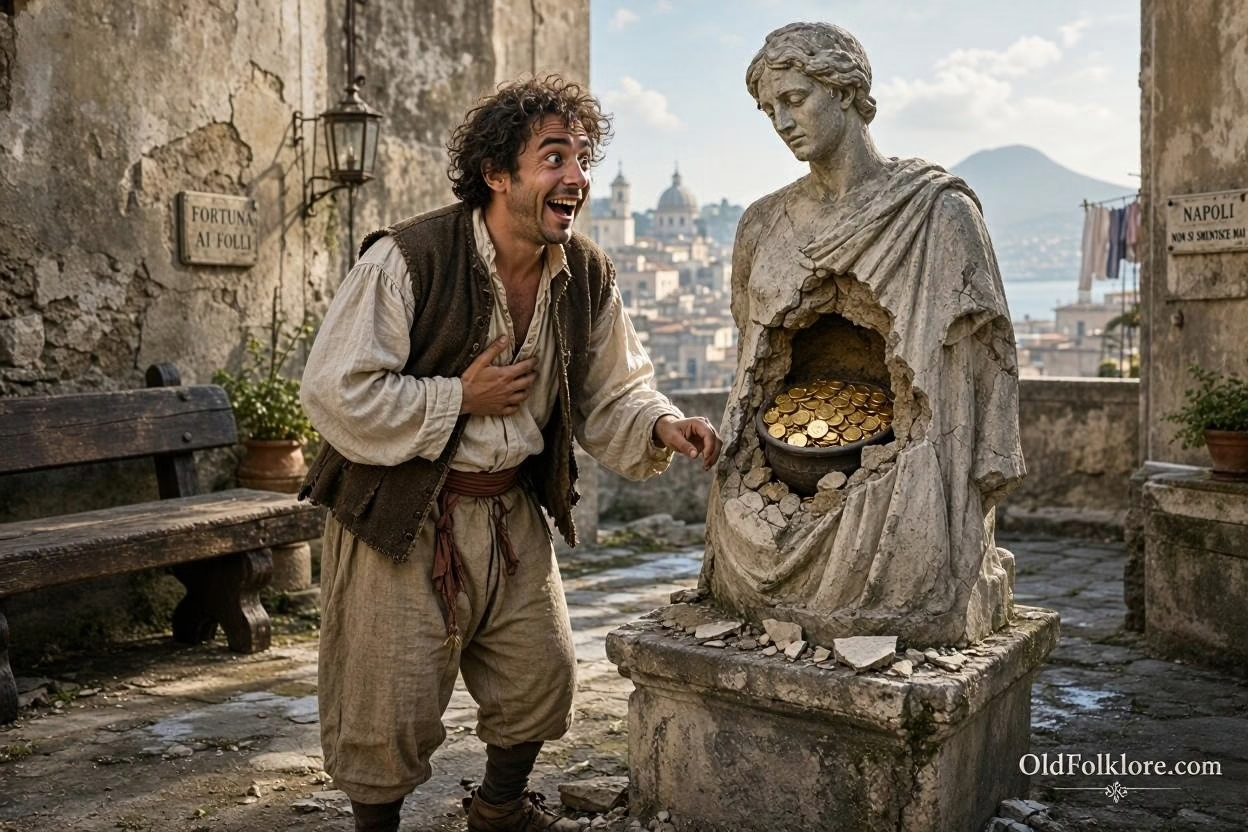
He picked up a stone and threw it forcefully at the statue’s chest.
The impact broke part of the plaster. As pieces fell away, Vardiello noticed something hidden inside.
There was a pot filled with golden crown-pieces.
He quickly gathered the treasure and ran home, excitedly announcing that he had discovered a large quantity of red lupins.
Grannonia immediately recognised the coins for what they were. She also understood that her foolish son might reveal the discovery to everyone if she did not distract him.
Grannonia’s Clever Trick
Grannonia needed a way to keep Vardiello occupied while she considered what to do with the treasure.
She told him to sit outside the house and wait for the man who sold milk and freshly made cheese. She explained that she wanted to buy a small quantity of milk.
Vardiello obeyed because he was always interested in food.
While he sat at the door, Grannonia went upstairs and began throwing raisins and dried figs down from a window.
The dried fruits fell continuously for more than half an hour.
Vardiello became delighted. He hurried to collect as many as he could, shouting for his mother to bring baskets, bowls, tubs and buckets. He believed that if the shower continued, the family would become rich.
He gathered the fruits and ate until he was satisfied.
Having successfully distracted her son, Grannonia prevented him from immediately announcing the discovery of the gold to the neighbourhood.
Her quick thinking once again demonstrated the difference between her judgement and Vardiello’s foolishness.
Vardiello Reveals the Treasure to a Judge
Despite his mother’s efforts, Vardiello eventually revealed the secret.
One day, two countrymen had an argument over a gold crown-piece they had found on the ground. Their disagreement became a legal dispute, and they went before a judge to settle the matter.
Vardiello happened to pass by while they were arguing.
He laughed at the men for quarrelling over what he considered a worthless red lupin. He then boasted that he had discovered an entire pot filled with similar objects.
The judge immediately became interested in his statement.
He questioned Vardiello closely, asking how, when and where he had discovered the supposed treasure.
Vardiello answered in his usual confused manner. He claimed that he had found the coins inside a dumb man in a palace, during a time when raisins and dried figs were raining from the sky.
The judge listened with astonishment and quickly understood that Vardiello was not speaking sensibly.
He therefore ordered that the young man be sent to a madhouse, believing it to be the most appropriate place for him.
The Mother’s Wit and the Son’s Fortune
Vardiello’s story ends with a striking contrast between his foolishness and his mother’s intelligence.
Although he repeatedly made mistakes, his actions unexpectedly led to the discovery of valuable treasure. Grannonia, meanwhile, used her good judgement to prevent his behaviour from ruining the family’s opportunity.
The discovery of the gold made the mother wealthy, while her cleverness helped her manage a son whose foolishness seemed impossible to correct.
The tale closes with the observation that the son’s stupidity made his mother rich, while the mother’s wit found a remedy for his foolishness.
It concludes with a proverb comparing life to a ship. A vessel guided by a skilful hand is unlikely to strike against rocks or sand.
The lesson is clear. Good judgement can guide a person through difficulties that foolishness alone would make worse.
Explore our complete Historic Folklore & Fairy-Tale Collections archive.
Moral Lessons
Vardiello teaches that intelligence and good judgement are important in managing everyday responsibilities. The young man’s repeated mistakes show how carelessness and failure to think before acting can turn simple tasks into serious problems. His mother’s ability to assess situations and respond wisely demonstrates the value of practical sense.
The story also highlights the importance of patience and responsible guidance. Grannonia loves her son, but her affection does not prevent her from recognising his weaknesses. She repeatedly finds ways to manage the consequences of his actions, showing that wisdom and careful judgement can sometimes turn an unfortunate situation into an unexpected opportunity.
Knowledge Check
1. Identify Vardiello’s mother.
His mother was Grannonia of Aprano, a woman known for her good sense and judgement.
2. What responsibility did Grannonia first give Vardiello.
She instructed him to watch a hen sitting on a nest of eggs and prevent it from leaving the nest for too long.
3. How did Vardiello destroy the hen and its eggs.
He killed the hen with a cudgel and later crushed the eggs when he sat on the nest to keep them warm.
4. What happened to the roasted hen and the wine.
A large tom-cat stole the roasted hen, and Vardiello left the wine barrel’s tap running while chasing the cats, causing the wine to spill.
5. How did Vardiello discover the golden crown-pieces.
He threw a stone at a plaster statue after it failed to pay for the cloth he had left with it. The broken plaster revealed a pot filled with gold coins.
6. How did Grannonia prevent Vardiello from immediately revealing the treasure.
She distracted him by throwing raisins and dried figs from an upstairs window, keeping him occupied while she dealt with the discovery.
Source
This retelling is based on “Vardiello,” a Neapolitan literary fairy tale by Giambattista Basile, translated by John Edward Taylor and included in The Pentamerone, or The Story of Stories. The story appears under the heading “VARDIELLO” in the First Day section.
Explore More Basile’s Pentamerone Tales
- The Flea: Basile’s Italian Fairy Tale
- The Enchanted Doe
- Peruonto: The Foolish Woodcutter Who Won a Princess Through Kindness