Death is one of the few certainties shared by every living creature. Although people may fear it, speak about it or try to understand it, no one can escape its arrival forever. In many traditional stories, Death is portrayed as a mysterious force that humans cannot command or overcome.
This tale follows a group of men whose confidence leads them to undertake an extraordinary journey. Dissatisfied with merely hearing about Death, they decide to search for him and discover his true nature. Their determination soon gives way to fear, and their experience teaches them a lesson about human limitations, humility and the importance of appreciating life.
The Men Who Sought for Death
In a village surrounded by forests and winding paths, there lived a group of men who were known for their strength and boldness. They were never satisfied with ordinary conversations. Whenever they gathered in the evenings, they searched for subjects that would challenge their imagination and give them something extraordinary to discuss.
Among the matters that frequently occupied their conversations was Death.
The elders and storytellers spoke of Death as an unavoidable presence. They explained that every living creature would eventually meet him, regardless of wealth, strength or position. Yet the men had never seen Death with their own eyes. As the years passed, their unfamiliarity with this mysterious force gradually turned into confidence.
One evening, while the men sat together, one of them questioned why they should be afraid of something they had never encountered.
His companions agreed. They began to wonder whether Death was truly as powerful as people claimed. Perhaps, they argued, he was simply another being who could be challenged through courage and determination.
Another man suggested that they should search for Death themselves. If they found him, they could confront him and discover whether he was as frightening as the elders described. Some even imagined that they might negotiate with him, offering their services in exchange for eternal life. Others believed they could defeat him through strength.
Their discussion became increasingly boastful. Instead of considering the danger of their undertaking, they encouraged one another and treated the proposed journey as an opportunity to demonstrate their courage.
Explore more stories from our Cameroonian Folktales Collections archive.
The village elders were troubled by their attitude. Having experienced the hardships and uncertainties of life, they understood that human strength had limits. They knew that some matters could not be settled through physical courage or stubborn determination.
The oldest among them therefore called the men together and advised them to abandon their plan.
He reminded them that Death was not an ordinary opponent. He warned that seeking such a force could bring consequences they did not understand. Rather than disturbing matters beyond their control, the men should live responsibly, respect the wisdom of their ancestors and appreciate the time available to them.
But the men refused to listen.
They had become so convinced of their own bravery that the elders’ warnings sounded like unnecessary expressions of fear. They believed that only a direct encounter could answer their questions.
At dawn, they prepared for the journey. They filled their gourds with water, packed food for the road and gathered their walking sticks. With confidence and determination, they left the village and entered the forest in search of Death.
For several days, they travelled through unfamiliar surroundings. They crossed paths surrounded by thick vegetation and passed streams that wound between the trees. Whenever they encountered an animal or another living creature, they asked whether it knew where Death lived.
They questioned the birds and called out to the creatures of the forest, hoping that one of them would reveal the place they sought. Yet none provided the answer they wanted.
As the journey continued, their confidence began to weaken. The distance they had travelled and the uncertainty of their destination made them increasingly tired. The forest offered no clear direction, and the men began to realise that finding Death might not be as simple as they had imagined.
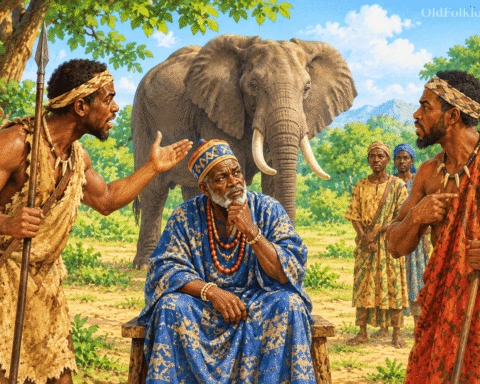
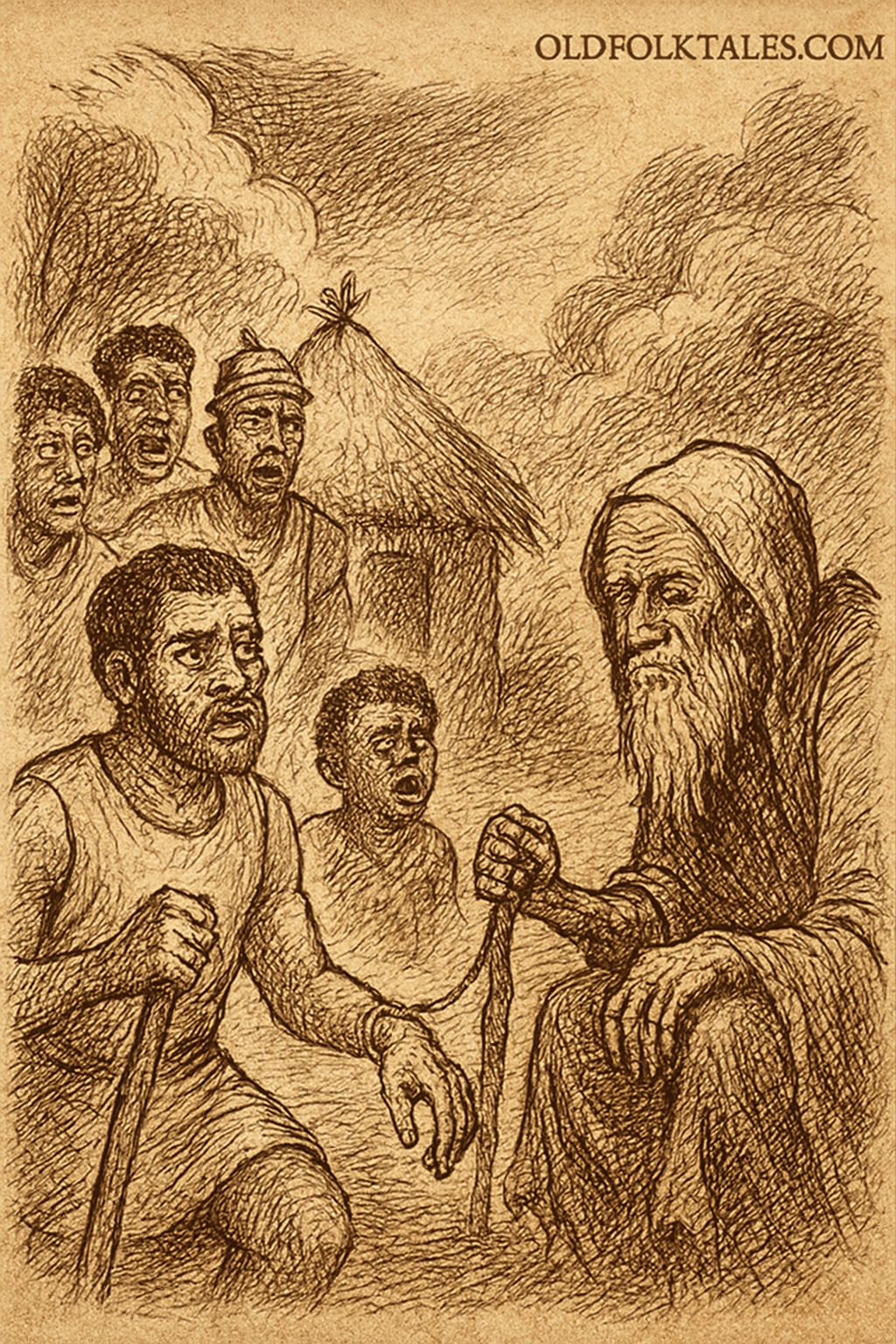
On the eighth day, they came across an elderly man sitting beside the path.
His appearance was striking. His body was thin and bent, and his face carried the marks of great age. He seemed unusually calm as the travellers approached him.
The old man looked at them and asked what they were searching for in such a distant part of the forest.
The men explained that they had left their village to find Death. They wanted to meet him face to face and discover whether he was truly as powerful as people believed.
The old man listened without appearing surprised. Then he told them that they had already found the one they were looking for.
He was Death himself.
The revelation destroyed the confidence that had sustained the men throughout their journey. They had imagined that Death would appear as a powerful warrior or a fearsome creature they could challenge. Instead, they had encountered an old man whose appearance gave no indication of the power he claimed to possess.
The travellers were overcome with fear. Their bold declarations suddenly seemed foolish, and the courage they had displayed in the village disappeared.
Some dropped the provisions they had carried. Others struggled to remain standing. The man they had spent days searching for was now before them, and they had no idea what to do.
They had wanted to challenge Death, but the encounter forced them to confront their own vulnerability. Their strength, which had seemed so impressive among their companions, offered no assurance against the force they had come to meet.
The men were no longer eager to bargain with Death or defeat him. They understood that their journey had brought them face to face with something they could not control.
Overwhelmed by terror, some collapsed while others attempted to flee. Only a few managed to find their way back towards the village.
The survivors returned as different men. Their earlier boasting had disappeared, replaced by a seriousness that the villagers had never seen in them before. They no longer spoke of conquering Death or proving themselves stronger than the powers governing human existence.
Instead, they devoted themselves to their daily responsibilities. They valued their families, respected the advice of the elders and approached each new day with gratitude.
When other villagers asked about their journey, the survivors were reluctant to describe everything they had experienced. They simply advised people not to waste their lives searching for Death.
They explained that Death would come to everyone eventually. Until that time arrived, people should make good use of their days, care for those around them and avoid allowing pride to distract them from the value of being alive.
Their experience became a reminder that human beings cannot control every force in the world. Some things must be accepted with humility rather than challenged through arrogance.
Explore our complete Africa Folktales collection.
Moral Lesson
The story teaches that human strength and confidence have limits. Pride can make people underestimate dangers and ignore the wisdom of those who have gained experience through life. The men believed they could challenge Death because they had never encountered him, but their journey exposed the weakness of their assumptions.
It also encourages people to appreciate life rather than become consumed by the fear of its end. Time with family, meaningful work and relationships with others are valuable gifts that should not be taken for granted. Wisdom lies in recognising what is beyond human control and using the time available to live responsibly.
Knowledge Check
Q1: Who were the main characters in the story?
The main characters were a group of confident men who decided to search for Death, the village elders who warned them against the journey and the old man who revealed himself as Death.
Q2: Why did the men decide to search for Death?
Their pride and curiosity led them to believe they could confront Death, negotiate with him or possibly defeat him.
Q3: What did the village elders advise the men?
The elders warned them that Death was not an ordinary opponent and advised them to abandon their dangerous plan and live wisely.
Q4: How did the men discover Death’s identity?
During their journey, they encountered an elderly man sitting beside a forest path. When they explained that they were searching for Death, he revealed that he was the one they sought.
Q5: How did the encounter change the surviving men?
They returned to their village humbled and no longer boasted about challenging Death. They began to appreciate their families, responsibilities and everyday lives.
Q6: What is the central lesson of the story?
The central lesson is that human beings must recognise their limitations, respect wisdom and avoid allowing pride to make them challenge forces beyond their control.
Source
Patrick Mbunwe-Samba, Shadows in the Firelight: A Selection of Cameroon Folk Tales (Bamenda, Cameroon, 1996; also catalogued by the Smithsonian in 1998), Story 8, “The Men Who Sought for Death”. The collection’s contents identify the tale as Nooni, Nso’, Cameroon.
Explore More Cameroonian Folktales
- Ngwarem: The Bamun Story of the Father Who Abandoned His Daughter
- The Mother Who Sold Her Son to a Spirit
- Moto and the Contest of the Four Companions
- The Squirrel That Outsmarted a Lion and a Panther
- Samari’s Journey: The Search for His Missing Sister
- How Jengi Came to Live in the Baka Forest
- The Tortoise and the Feast in the Sky
- Sense-Pass-King: How Pride Destroyed a Kingdom