Among the Bakweri people of western Cameroon, traditional beliefs include stories about the relationship between human beings, animals and supernatural beings. One such myth explains how different creatures came to occupy different places in the world.
The story centres on four figures: Moto, Ewaki, Eto and Mojili. They once lived in a time when their paths had not yet been separated. However, their constant disagreements eventually led them to organise a contest that would determine who remained in the settlement and who had to live elsewhere.
The contest depended on something familiar to everyone: the ability to keep a fire burning.
The Four Companions
Long ago, Moto, Ewaki, Eto and Mojili were constantly quarrelling.
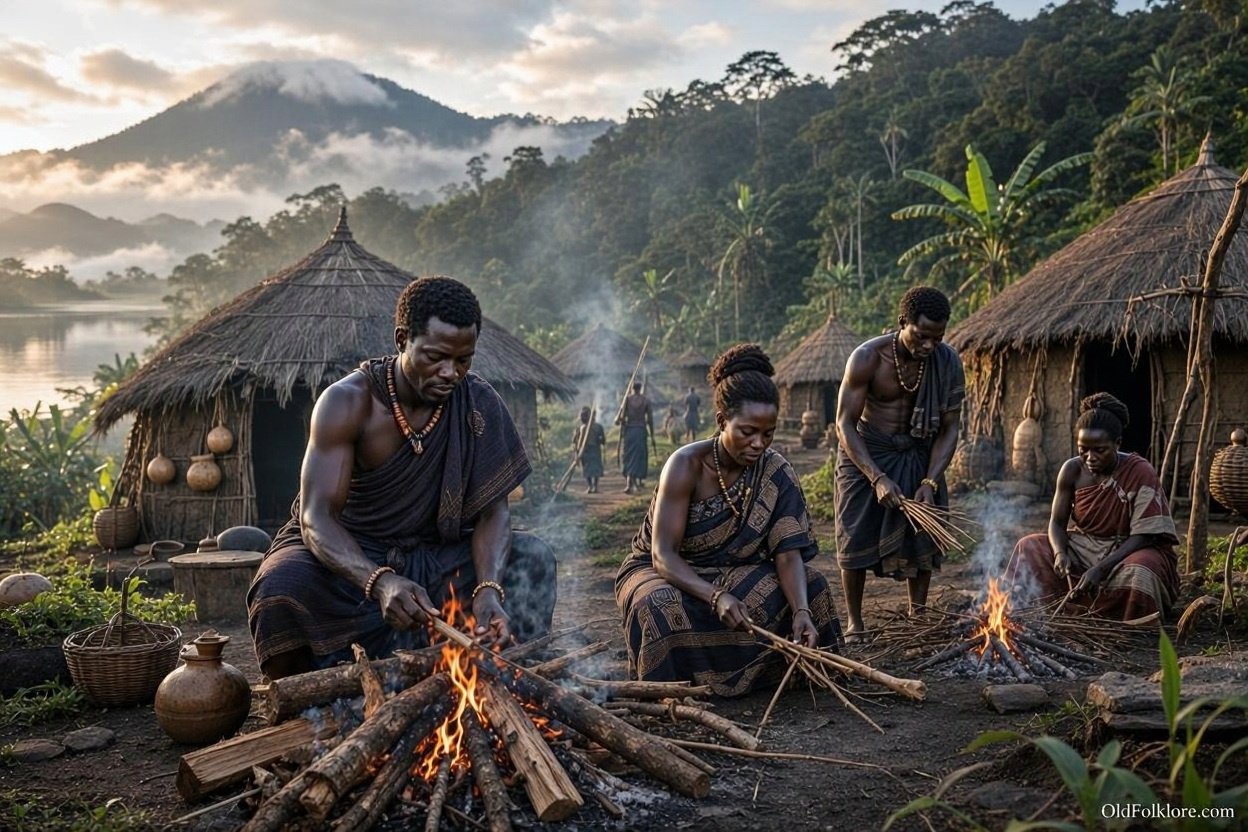
Their disagreements became so frequent that they decided to settle the matter through a contest. They would each build a fire in their own house before going to work on the farms.
At the end of the day, they would return and examine the fires.
Whoever still had a burning fire would win the contest and remain in the town. The others would have to leave and live outside the settlement.
Explore more stories from our Cameroonian Folktales Collections archive.
The four companions agreed to the arrangement.
The Contest of the Fires
On the morning of the contest, each participant prepared a fire before leaving for the farms.
Moto approached the task differently from the others. He carefully arranged large pieces of wood, making sure that the fire had enough fuel to continue burning for a long time.
The others used small, dry sticks to build their fires.
When the preparations were complete, they left for the farms.
Throughout the day, the fires continued burning in their respective houses. However, the different materials used in building them would determine what happened when the companions returned.
By evening, the four came back to inspect the fires.
They discovered that Moto’s fire was still burning. The fires belonging to the others had gone out.
Moto had won.
The Separation of Their Worlds
Because Moto’s fire remained alight, he earned the right to stay in the town.
He became associated with humanity, and his name, Moto, came to represent a human being.
The others were not permitted to remain with him.
Ewaki and Eto went into the bush. Ewaki became associated with the ape, while Eto became associated with the mouse or rat.
Mojili was driven into the water and became a water spirit.
Thus, the contest established the different places associated with the four figures: the human settlement, the forest and the water.
The Meaning of the Myth
The Bakweri account does more than explain the separation of these figures. It also reflects traditional ideas about the boundaries between human society and the natural world.
In Edwin Ardener’s discussion, the myth is presented as a male account of how the human world became distinguished from the forest and water. The figures outside Moto’s settlement were associated with women and children, while Mojili became connected with the water spirits known as liengu or maengu.
The account also reveals that Bakweri women’s understanding of their relationship with the natural and spiritual worlds was not necessarily the same as the men’s interpretation.
The myth therefore preserves an important traditional explanation while also offering insight into different perspectives within Bakweri society.
Explore our complete Africa Folktales collection.
Moral Lesson
The myth illustrates the importance of preparation and careful judgement. Moto succeeded because he understood what was needed to keep his fire burning and selected suitable materials.
It also shows how decisions can establish boundaries and shape the relationships between different groups. Through the contest, the four companions became associated with separate parts of the world.
Knowledge Check
1. Which four figures appear in the Bakweri myth?
Moto, Ewaki, Eto and Mojili.
2. Why did the four companions organise a contest?
They wanted to settle their disagreements and determine who would remain in the town.
3. What was the contest based on?
Each participant had to build a fire that would remain burning until they returned from the farms.
4. How did Moto prepare his fire?
He arranged large pieces of wood so that the fire would continue burning for a long time.
5. What happened to the other three figures?
Ewaki and Eto went into the bush and became associated with the ape and mouse, while Mojili was driven into the water and became a water spirit.
6. What does the myth explain?
It explains the traditional separation between the human settlement, the forest and the water world.
Source
Adapted from “Man, Mouse, Ape and Water Spirit”, a Bakweri myth recorded in 1929 by Charles Steane and reproduced by Edwin Ardener in “Belief and the Problem of Women” (1975), in Perceiving Women, edited by Shirley Ardener.
Explore More Cameroonian Folktales
- Ngoe and Sumediang: The Origin of the Bakossi People
- The Ngondo Water Ceremony
- The Keeper of the Royal Drum of Bafut
- The Great Canoes of the Wouri
- The Leper’s Revenge: A Cameroonian Folktale of Betrayal
- Autan and the Monster: The Boy Who Defeated a Lion
- The Disobedient Girl: A Moloko Fable from Cameroon