In traditional stories from northern Cameroon, spirits sometimes appear in the affairs of ordinary people, offering assistance in exchange for something precious. Such encounters often carry warnings about promises made carelessly and the dangers of trusting someone whose intentions are not understood.
Among the Guidar people, a folktale tells of a mother who made a terrible promise to a spirit while struggling with a household task. She offered her eldest son in exchange for help, believing she could settle the matter without considering the consequences. But her daughter discovered what had happened and warned her brother before the spirit could claim him.
The story follows the young man’s escape and the very different treatment he later gives his sister and mother.
The Mother’s Encounter with a Spirit
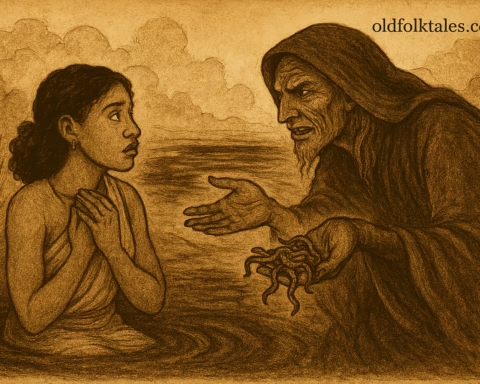
Long ago, a woman went to fetch water. While carrying out the task, she encountered a difficulty with her water pot.
A spirit appeared and offered to help her. The woman accepted the assistance, but the help came with a price.
In exchange for the spirit’s intervention, she promised to give it her eldest son.
The woman made the promise, placing her child’s future in the hands of a supernatural being. She returned home without properly considering what the agreement meant for her son.
Explore more stories from our Cameroonian Folktales Collections archive.
Her eldest son knew nothing about the arrangement. He continued his ordinary life, unaware that his mother had promised him to a spirit.
The Daughter Warns Her Brother
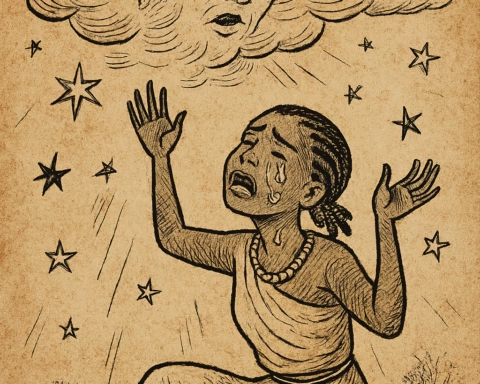
The woman’s younger daughter discovered what her mother had done.
She understood the danger facing her elder brother and decided to warn him. She told him about the promise their mother had made to the spirit and explained that he was the person offered in exchange for the assistance.
The young man realised that remaining at home could expose him to the spirit’s claim.
He therefore decided to escape.
He did not want to become the victim of an agreement he had never made. With the warning from his sister, he left the place where he had lived and sought a way to secure his future.
The Young Man’s Escape
The young man managed to escape the danger awaiting him.
During his journey, he transformed a forest into a desert. He then established a settlement and eventually became its chief.
His circumstances changed completely. The young man who had once been promised away by his mother became a person of authority in his new home.
He was no longer living under the threat of the spirit’s claim. He had established a new place for himself and gained a position of importance.
Meanwhile, his sister remained connected to him through the warning that had helped him escape.
The Sister’s Visit
After some time, the young man’s sister came to visit him.
He received her generously. Remembering that she had warned him about their mother’s promise, he welcomed her warmly and treated her with great hospitality.
Her visit was an occasion for a favourable reception. She had helped him avoid the danger that had threatened his life, and he did not forget her role in his escape.
The contrast between her reception and what happened later became central to the story.
The Mother’s Visit
Eventually, the young man’s mother also came to visit him.
She might have expected to receive the same generous welcome that her daughter had enjoyed. After all, she was his mother and had given birth to him.
However, the reception she received was very different.
Instead of the generous treatment given to his sister, the young man provided his mother with a poorly nourished goat.
The difference was significant. The sister who had warned him was welcomed warmly, while the mother who had promised him to a spirit received an inferior gift.
The story ends by contrasting the two visits. The young man remembered who had protected him and who had placed him in danger.
Explore our complete Africa Folktales collection.
Moral Lesson
The story warns against making promises that involve the lives and welfare of other people. The mother offered her eldest son to a spirit without his knowledge or consent, treating his life as something she could exchange for personal assistance.
It also highlights the importance of loyalty and gratitude. The young man remembered his sister’s warning and rewarded her kindness with a generous welcome. His treatment of his mother, however, reflected the consequences of her betrayal.
The tale reminds listeners that actions within a family can have lasting consequences. Trust should be protected, and no parent should sacrifice a child’s safety for personal gain.
Knowledge Check
1. Which people does this folktale belong to?
The Guidar people of northern Cameroon.
2. What did the mother promise the spirit?
She promised to give it her eldest son in exchange for its assistance.
3. Who discovered the mother’s agreement?
The young man’s younger sister discovered the promise and warned him.
4. What did the young man do after learning about the promise?
He escaped, transformed a forest into a desert, established a settlement and eventually became its chief.
5. How did the young man receive his sister when she visited him?
He welcomed her generously because she had warned him about the danger.
6. How was his mother’s reception different?
He gave her a poorly nourished goat instead of the generous welcome his sister had received.
Source
Adapted from “La madre que vendió a su hijo a un espíritu” (“The Mother Who Sold Her Son to a Spirit”), a Guidar tale recorded from Guéli Deba Pascal in Kong-Kong, northern Cameroon, on 9 July 2007. Published by Patrick Toumba Haman and José Manuel Pedrosa in “Una colección de cuentos tradicionales de los guidar del norte de Camerún”, Culturas Populares, no. 6 (2008), pp. 5–8.
Explore More Cameroonian Folktales
- Ngoe and Sumediang: The Origin of the Bakossi People
- The Ngondo Water Ceremony
- The Keeper of the Royal Drum of Bafut
- The Great Canoes of the Wouri
- The Leper’s Revenge: A Cameroonian Folktale of Betrayal
- Autan and the Monster: The Boy Who Defeated a Lion