What happens when people become so worried about something that has not happened that they forget to deal with what is happening before them? In The Three Sillies, an English fairy tale collected by Joseph Jacobs, an ordinary household becomes overwhelmed by an imaginary disaster. Their unnecessary tears cost a young woman her sweetheart, who decides to travel the world in search of people even more foolish than the family he has left behind.
His journey takes him to a cottage where a woman has an extraordinary plan for feeding her cow, an inn where a traveller cannot work out how to put on his trousers, and a village where people attempt to rescue the moon from a pond. Each encounter adds another example to his growing collection of silliness.
The story uses exaggerated situations and comic misunderstandings to entertain readers. Its humour comes from the difference between what the characters believe and what a little common sense could have shown them.
The Three Sillies: The Complete Fairy Tale
The Mallet in the Cellar
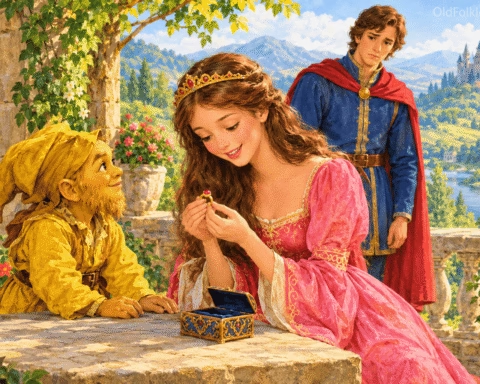
Once upon a time, a farmer and his wife lived with their only daughter. A gentleman was courting the young woman and visited the farmhouse every evening. He usually stayed for supper, and the daughter would go down into the cellar to draw beer for the meal.
One evening, as she filled the jug, she looked towards the ceiling and noticed a mallet lodged in one of the beams. It had probably been there for a long time, but she had never paid attention to it before.
Suddenly, she began to imagine a terrible possibility.
She thought about what might happen if she married her sweetheart and they had a son. Their child would eventually grow into a man and might one day enter the cellar to draw beer, just as she was doing. What if the mallet fell from the beam and killed him?
The young woman became so distressed by this imagined tragedy that she put down her candle and jug, sat on a seat in the cellar, and began to cry.
Upstairs, her parents wondered why she was taking so long. Her mother eventually went down to investigate and found her daughter weeping while the beer spilled across the floor.
When her mother asked what was wrong, the girl pointed towards the mallet and explained her fears. She imagined that she would marry her sweetheart, have a son, and one day lose him because the mallet fell on his head.
Instead of reassuring her daughter or removing the dangerous object, the mother joined her in crying.
After a while, the farmer also became concerned. He went down into the cellar and discovered his wife and daughter sitting together in tears, with beer running over the floor.
His wife explained the imagined tragedy. The farmer immediately understood their fear in exactly the same way they did. He sat beside them and began to cry too.
The Gentleman Ends Their Sorrow
Meanwhile, the gentleman was waiting upstairs. When he grew tired of sitting alone, he went down into the cellar to find out what had happened.
There he discovered all three members of the family crying together. The beer continued to spill across the floor because nobody had bothered to turn off the tap.
The gentleman was astonished. He asked them why they were sitting there weeping and allowing the beer to run everywhere.
Explore more stories from our Joseph Jacobs’ English Fairy Tales collection.
The farmer explained their concern about the mallet. If he allowed his daughter to marry the gentleman, they might have a son. That son might grow up, enter the cellar, and be killed by the falling mallet.
The family became even more upset as they described the disaster they feared.
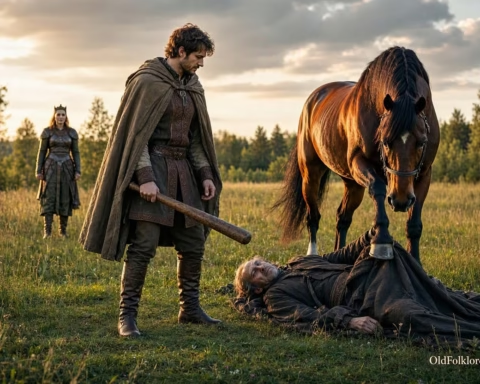
The gentleman could hardly believe what he was hearing. He burst out laughing, reached up, and removed the mallet from the beam.
The danger they had imagined was easily dealt with, yet the family had spent their time mourning an event that had not occurred.
The gentleman decided that he had seen enough foolishness in one place. He told them that he had travelled many miles but had never met three people as silly as they were.
He then announced that he would resume his travels. When he found three people sillier than the farmer, his wife, and their daughter, he promised to return and marry the young woman.
With that, he said goodbye and set off.
The family remained behind, crying because the daughter had lost her sweetheart. They had allowed an imaginary tragedy to bring about a real disappointment.
The Woman and Her Cow
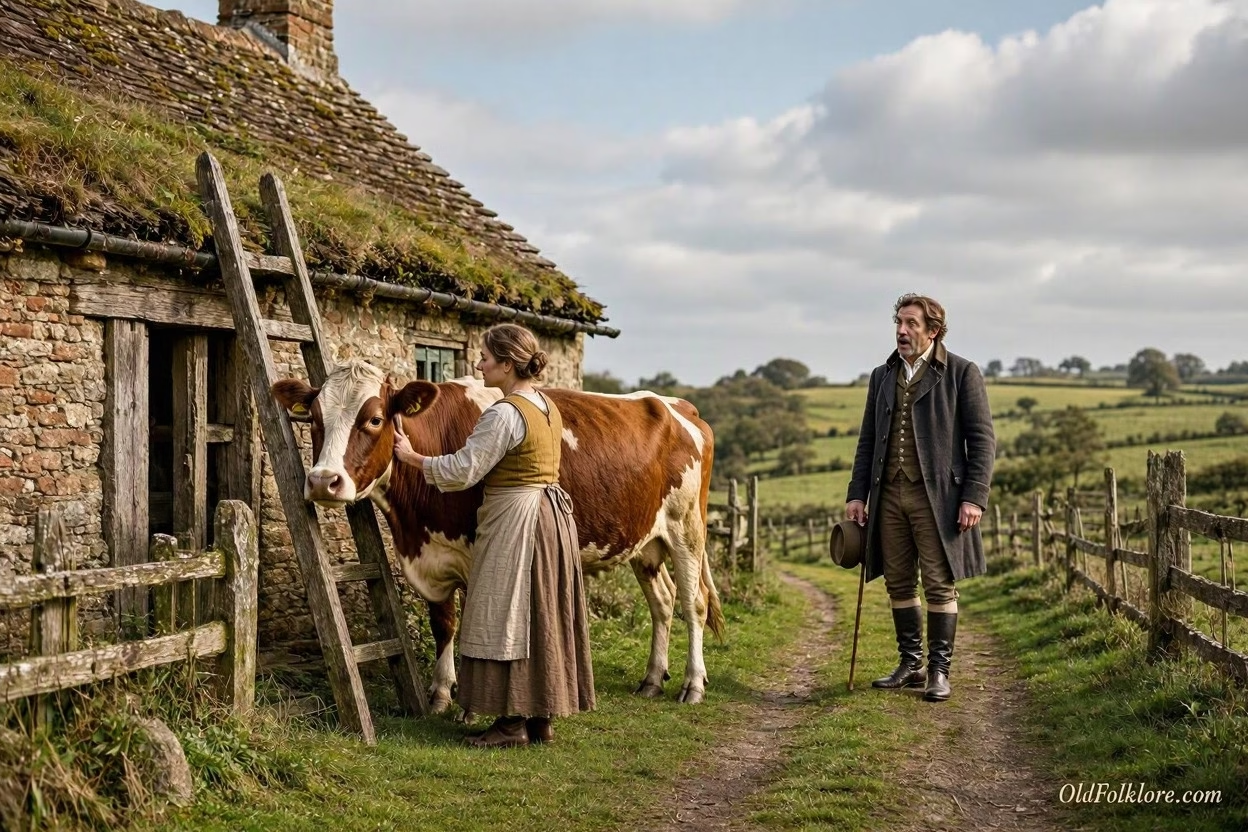
The gentleman travelled a long way before arriving at a cottage with grass growing on its roof.
Outside, he found a woman attempting to persuade her cow to climb a ladder. The animal was reluctant to go up, but the woman continued trying to coax it towards the roof.
Curious about her actions, the gentleman asked what she intended to do.
The woman explained that the roof was covered with lovely grass, and she wanted her cow to eat it. She planned to tie a string around the cow’s neck, pass the other end down the chimney, and fasten it to her wrist. That way, she believed, she would know if the cow fell.
The gentleman immediately recognised the foolishness of her plan.
Why struggle to get a cow onto a roof when she could simply cut the grass and throw it down for the animal to eat?
The woman, however, believed that getting the cow up the ladder would be easier than bringing the grass down. She continued with her plan, eventually getting the cow onto the roof and tying the string around its neck.
The gentleman left the cottage and continued his journey.
Before he had gone far, the cow fell from the roof. The string tightened around its neck, strangling the animal. Because the other end was tied to the woman’s wrist, the cow’s weight pulled her towards the chimney. She became trapped inside and was smothered by the soot.
The woman’s attempt to solve a simple problem had resulted in a terrible outcome.
The gentleman counted her as the first person he had found who was sillier than the three people at the farmhouse.
The Traveller Who Could Not Put on His Trousers
The gentleman continued travelling until he reached an inn where he intended to spend the night.
The inn was crowded, so he had to share a room with another traveller. The two men got along well, and nothing seemed unusual about their arrangement.
The following morning, however, the gentleman witnessed something remarkable.
As they prepared to leave, the other man hung his trousers on the knobs of a chest of drawers. He then ran across the room and tried to jump into them.
He failed.
He tried again and again, but he could not get his legs into the trousers. After several unsuccessful attempts, he stopped and wiped his face with a handkerchief.
The frustrated traveller complained that trousers were the most awkward clothes imaginable. He wondered who had invented them and explained that putting them on took him almost an hour every morning. The effort also made him hot and uncomfortable.
He then asked the gentleman how he managed to wear his trousers.
The gentleman burst out laughing. Instead of jumping towards the trousers hanging on the furniture, he showed the man the ordinary way to put them on.
The traveller was grateful for the demonstration. He admitted that he would never have thought of doing it that way.
Once again, the gentleman had encountered someone whose difficulty could have been avoided with a little practical thought.
He counted the traveller as the second person sillier than the family at home and continued his journey.
The Village That Tried to Rescue the Moon
After travelling farther, the gentleman arrived at a village. Outside it stood a pond surrounded by a crowd of people.
The villagers carried rakes, brooms, and pitchforks. They stretched their tools into the water as though they were trying to retrieve something trapped beneath the surface.
The gentleman stopped and asked what was happening.
The villagers explained that the moon had fallen into the pond. They had gathered their tools in an attempt to rake it out, but their efforts had achieved nothing.
The gentleman immediately understood their mistake.
What they could see in the water was the moon’s reflection, not the moon itself. He told them to look up at the sky, where the moon could still be seen.
The villagers refused to accept his explanation. Instead of recognising their mistake, they abused him for his advice.
Realising that they would not listen, the gentleman made his escape and continued on his way.
He had now found a whole village behaving foolishly over something that could have been understood by simply looking upwards.
The Gentleman Returns Home
At last, the gentleman decided that his search had been successful. He had encountered people whose foolish actions surpassed those of the farmer, his wife, and their daughter.
He turned around and travelled back to the farmhouse.
This time, he kept his promise. He married the farmer’s daughter, and the tale ends with the familiar wish that they lived happily ever after.
The gentleman’s journey had begun because three people allowed fear over an imaginary tragedy to overwhelm their judgement. Along the way, he discovered that the same kind of foolishness could appear in many forms: a woman making a dangerous task out of a simple one, a man struggling with an everyday activity, and villagers mistaking a reflection for the real moon.
The story closes without a long explanation of its lesson. Its chain of comic encounters makes the point through the characters’ own actions.
Explore our complete Historic Folklore & Fairy-Tale Collections archive
Moral of the Story
The story encourages people to think carefully before allowing fear or confusion to control their actions. The farmer’s family could have solved its problem by removing the mallet, while the other characters made simple situations unnecessarily difficult. Clear thinking and practical solutions can prevent needless trouble.
Knowledge Check: Questions and Answers
1. Why did the farmer’s daughter begin to cry in the cellar?
She saw a mallet in a ceiling beam and imagined that it might fall on her future son and kill him.
2. Why did the farmer and his wife also begin to cry?
They accepted their daughter’s imagined tragedy as a reason to grieve instead of addressing the problem.
3. What did the gentleman do to solve the family’s concern?
He reached up and removed the mallet from the beam.
4. Why was the woman trying to get her cow onto the roof?
She wanted the cow to eat the grass growing there and believed that tying a string around its neck would keep it safe.
5. What difficulty did the gentleman’s fellow traveller have at the inn?
He could not work out how to put on his trousers and repeatedly tried to jump into them while they hung on a chest of drawers.
6. Why were the villagers using tools in the pond?
They mistakenly believed that the moon had fallen into the water, not realising that they were seeing its reflection.
Source
English Fairy Tales, collected by Joseph Jacobs and first published in 1890. “The Three Sillies,” a comic English folk tale. Jacobs’ notes identify its source as a version communicated by Miss C. Burne to the Folk-Lore Journal and mention related versions from England, Ireland, and other traditions
Explore More Joseph Jacobs’ English Fairy Tales
- The Three Little Pigs: The Tale of Cleverness and Survival
- The Horned Women: An Irish Folktale of Twelve Witches