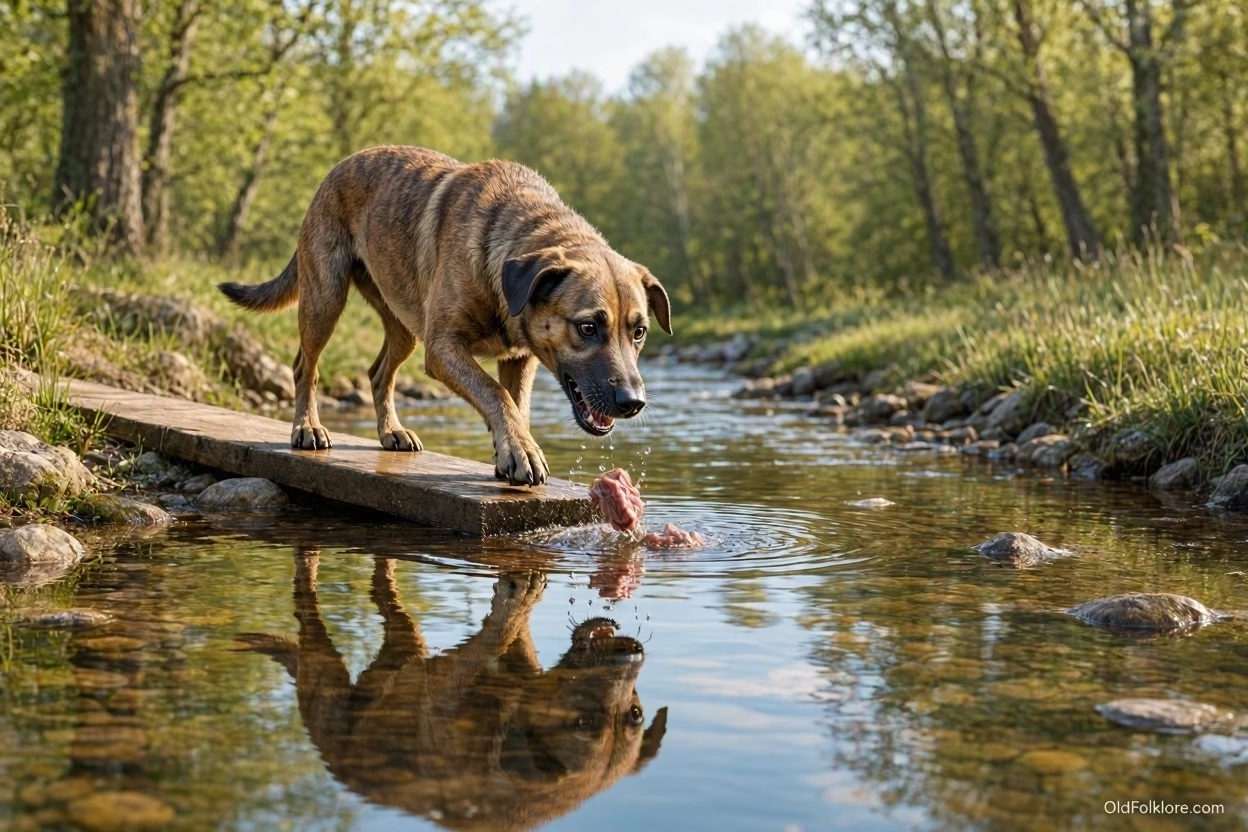
A dog finds a piece of meat and carries it in his mouth as he makes his way home. He has already secured a meal, and all he needs to do is protect it until he can eat in peace. However, his journey takes an unexpected turn when he crosses a plank over a running stream and looks down into the water.
There, he sees what appears to be another dog carrying a piece of meat. Believing that he has discovered an opportunity to gain more food, he abandons caution and tries to seize the apparent prize. His decision costs him the meal he already possesses.
The Dog and the Shadow is a short fable about greed and mistaken appearances. Its simple action carries a lasting lesson about the danger of risking something real in pursuit of something that only seems desirable.
A Lucky Find
One day, a dog obtained a piece of meat. It was a welcome find, and he carried it firmly in his mouth as he began his journey home.
The dog wanted to enjoy his food in peace. He had no need to search for another meal, and he had already done the difficult part by obtaining something to eat. His task was simply to carry the meat safely to a place where he could enjoy it.
As he travelled, the dog continued holding the meat in his jaws. The road eventually brought him to a running brook. A plank lay across the water, providing a narrow crossing from one side to the other.
The dog approached the plank and stepped onto it. With the meat still in his mouth, he began to cross the stream.
The Image in the Brook
As the dog crossed the plank, he looked down into the water beneath him. There, on the surface of the brook, he saw an image that appeared to be another dog.
The apparent dog seemed to possess a piece of meat as well.
Explore more stories from our Aesop’s Fables collection.
The sight immediately caught his attention. Instead of recognising the image as his own reflection, the dog believed that another animal was carrying food. He began to think about the possibility of taking that piece for himself.
He already had a meal, but the prospect of gaining another distracted him from the food in his own mouth. His attention shifted from protecting what he possessed to trying to acquire what he believed belonged to someone else.
The dog did not stop to question what he was seeing. The moving water reflected his image, but he interpreted that reflection as a separate animal. His mistaken belief shaped the decision that followed.
The Temptation to Take More
The dog wanted the apparent second piece of meat. He could have continued across the plank and carried his own food home, but greed made that simple choice seem less attractive.
He imagined that he could have both pieces. To obtain the second one, he needed to snap at the dog he saw in the water.
The reflection, of course, could not be caught. It was only an image created by the dog’s own presence above the stream. There was no second animal waiting beneath the plank, and no extra piece of meat for him to take.
The dog did not understand this. Focused on the apparent reward, he opened his mouth and snapped at the reflection.
In that moment, he let go of the only piece of meat he truly had.
The Loss in the Water
As the dog opened his jaws, the meat fell from his mouth. It dropped into the running stream and disappeared beneath the water.
The dog had gained nothing from his attempt to take the apparent stranger’s food. The second piece was never real, and his action had caused him to lose the first.
The stream continued to flow, carrying away the meat he had been taking home. The dog could not recover his meal simply by snapping at the water again. His opportunity had passed.
What made the loss especially unfortunate was that it had been unnecessary. The dog had already obtained food and had been close to carrying it safely home. He lost it because he wanted something more, without recognising that the supposed prize was only his reflection.
The fable ends with this loss. The dog receives no replacement meal, and the imagined second dog offers him nothing. His greed has left him worse off than before.
The Lesson of the Dog’s Mistake
The dog’s experience illustrates the difference between what a person truly possesses and what merely appears desirable. He had a real piece of meat in his mouth, but he allowed the image in the water to distract him from it.
His mistake was not simply that he misunderstood the reflection. It was also that he acted on that misunderstanding without considering what he stood to lose.
Had he continued across the plank, he could have kept the food he had already found. Instead, he risked his existing meal for an imaginary reward.
The fable therefore warns readers not to let greed overcome good judgement. Wanting more is not always a path to greater gain. Sometimes, the attempt to acquire something extra causes a person to lose what was already secure.
Explore our complete Historic Folklore & Fairy-Tale Collections archive
Moral of the Story
The fable teaches us to appreciate what we have rather than risk it through greed. The dog loses his real piece of meat because he tries to take an imaginary one. It reminds readers to think carefully before sacrificing something certain for a reward that may not exist.
Knowledge Check
1. What did the dog carry in his mouth?
He carried a piece of meat that he intended to take home and eat in peace.
2. What did the dog cross on his way home?
He crossed a plank lying over a running brook.
3. What did the dog see in the water?
He saw his own reflection, which he mistakenly believed was another dog carrying meat.
4. Why did the dog snap at the image?
He wanted to take what he thought was a second piece of meat.
5. How did the dog lose his food?
When he opened his mouth to snap at the reflection, his own piece of meat fell into the stream.
6. What lesson does the fable teach?
It warns against greed and teaches that people can lose what they already possess by pursuing something that only appears better.
Source
The Fables of Aesop, selected, retold, and discussed by Joseph Jacobs, with illustrations by Richard Heighway, first published in 1894. “The Dog and the Shadow.”