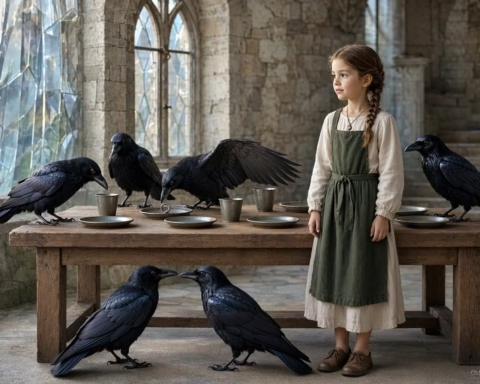
In the Cap o’ Rushes fairy tale, a wealthy father asks his three daughters to explain how much they love him. The youngest gives an answer that sounds insulting, although she means it as a declaration of deep affection. Angered by her words, her father sends her away from home.
Forced to survive without her family’s wealth or protection, the young woman disguises herself in a cloak made from rushes and finds work in a great house. There, a chance encounter with the master’s son changes her life. Yet the truth about her identity remains hidden until a simple meal reveals the meaning of the words that caused her exile.
A Father’s Question
Once upon a time, there lived a very rich gentleman who had three daughters. One day, he decided to discover how much each daughter loved him.
He called his eldest daughter and asked, “How much do you love me, my dear?”
She replied that she loved him as she loved her life. Pleased with her answer, he turned to his second daughter and asked the same question.
She told him that she loved him more than all the world. Her father was satisfied once again.
Finally, he questioned his youngest daughter.
She answered, “I love you as fresh meat loves salt.”
Her father was furious. He believed that she had compared his worth to something ordinary and insignificant. Instead of asking what she meant, he accused her of having no real love for him.
“You do not love me at all,” he declared. “You shall stay in my house no more!”
He drove her out and shut the door behind her.
The Cloak of Rushes
The young woman left home with nowhere to go. She walked a long way until she reached a fen, where rushes grew in abundance.
There, she gathered the rushes and fashioned them into a rough cloak with a hood. She pulled it over herself to hide her fine clothes and conceal her identity.
Still wearing her disguise, she continued her journey until she came to a great house.
Explore more stories from our Joseph Jacobs’ English Fairy Tales collection.
“Do you want a maid?” she asked the people there.
At first, they refused. However, she explained that she had nowhere else to go, would ask for no wages, and was willing to do any work they gave her.
The household eventually agreed to let her wash the pots and scrape the saucepans.
She performed these humble duties, and because she gave no name, the servants called her Cap o’ Rushes, after the cloak she wore.
Although she had once lived in comfort, she accepted her new circumstances and continued working.
The First Dance
One day, a grand dance was to take place nearby. The servants were allowed to attend and watch the important guests.
Cap o’ Rushes said she was too tired to go, so she remained behind.
Once the other servants had left, however, she removed her cloak of rushes, cleaned herself, and dressed in her beautiful clothes. She then went to the dance.
The master’s son was among the guests. The moment he saw her, he fell in love with her and refused to dance with anyone else.
Cap o’ Rushes enjoyed the evening but left before the dance ended. She returned to the house, put on her rough disguise, and pretended to be asleep when the other maids came home.
The following morning, the servants spoke excitedly about the beautiful lady they had seen. They told Cap o’ Rushes how finely she had dressed and how the young master had watched her throughout the evening.
She listened quietly and said she would have liked to see the lady herself.
Three Evenings of Mystery
Another dance was arranged for the following evening. Once again, Cap o’ Rushes claimed she was too tired to attend.
As soon as the servants departed, she changed into her fine clothes and went to the dance. The master’s son was delighted to see her. He danced with her and kept his eyes fixed on her throughout the evening.
Yet she slipped away before the dance ended, leaving him without knowing who she was or where she lived.
A third dance followed. Cap o’ Rushes repeated her familiar excuse, waited until the servants had gone, and dressed for the occasion.
The young man was overjoyed when she appeared. He danced with no one else and begged her to reveal her name and tell him where she came from.
She refused to answer his questions.
Knowing that she might disappear again, he gave her a ring and told her that he would die if he never saw her again.
Before the evening ended, she slipped away once more. When the servants returned, they found her in her usual disguise, pretending to sleep.
The dances were over, and the mysterious lady did not appear again.
The Young Master Falls Ill
The master’s son searched for the beautiful stranger and questioned people in the hope of discovering her identity. His efforts brought him no answers.
Unable to find her, he grew more distressed until he became so ill that he had to remain in bed.
The household worried about him. Someone instructed the cook to prepare gruel for the young master.
Cap o’ Rushes offered to make it herself. While preparing the food, she placed the ring he had given her into the gruel.
When the young man received the dish, he discovered the ring. He immediately wondered how it had come into his food and who had placed it there.
He asked for the person responsible to be brought before him.
Cap o’ Rushes was summoned. Standing before the young master, she removed her cloak of rushes and revealed the beautiful clothes she had worn at the dances.
He recognised her at once. The woman he had searched for was the servant who had been working quietly in the household all along.
The mystery was finally solved, and the two were able to be together.
A Wedding Without Salt
In time, Cap o’ Rushes and the master’s son were to be married. Her father was invited to the wedding feast.
Before the meal, Cap o’ Rushes arranged for the meat to be served without salt.
When her father tasted it, he found it unpleasant. He tried another dish, but that too lacked salt. As he continued eating, his distress grew until he burst into tears.
He explained that he had once had a daughter who told him she loved him as fresh meat loves salt. Believing her words meant she did not love him, he had driven her away.
Now, faced with food that had no salt, he finally understood what she had meant. Salt was essential to the flavour of meat, just as his daughter’s love was important to her.
He realised that she had loved him deeply, perhaps more than her sisters had, but he had misunderstood her answer and punished her unfairly.
At that moment, Cap o’ Rushes revealed herself to her father.
“No, father,” she told him. “Here she is!”
He discovered that the daughter he had banished was the very young woman whose wedding he had attended. He finally understood the truth behind her words and the mistake he had made.
Cap o’ Rushes, her husband, and her father were reconciled, and the story ends with the family happy at last.
Explore our complete Historic Folklore & Fairy-Tale Collections archive.
Moral Lesson
Do not judge another person’s love or intentions by words alone. A statement that seems unkind may carry a deeper meaning, so patience and understanding are important before making a judgement.
The tale also reminds us that pride and anger can damage family relationships, while humility and understanding can help heal them.
Knowledge Check
1. How many daughters did the wealthy gentleman have?
He had three daughters.
2. What did the youngest daughter say about her love for her father?
She said she loved him as fresh meat loves salt.
3. Why did her father send her away?
He misunderstood her answer and believed it meant she did not love him.
4. Why was the young woman called Cap o’ Rushes?
She wore a cloak made from rushes and did not reveal her name.
5. How did the master’s son recognise the mysterious woman?
She revealed her identity by removing her cloak of rushes and showing the fine clothes she had worn at the dances.
6. How did her father finally understand her words?
At the wedding feast, the meat was served without salt. Its lack of flavour helped him understand how important salt was and what his daughter had meant.
Source
“Cap o’ Rushes” appears in English Fairy Tales (1890), collected and retold by Joseph Jacobs. Jacobs’ notes identify Edward Clodd as the person who discovered the tale in Suffolk Notes and Queries of the Ipswich Journal.
Explore More Joseph Jacobs’ English Fairy Tales
- The Three Little Pigs: The Tale of Cleverness and Survival
- The Horned Women: An Irish Folktale of Twelve Witches
- The Three Sillies: An English Fairy Tale