Pre Scarpafico, a wealthy but miserly priest living near Imola in Italy, believes he has bought a suitable mule for his journey home from the market. Three robbers have other plans. By convincing him that his mule is merely an ass, they trick him into giving it away. With help from his sharp-witted housekeeper, Nina, the priest prepares a series of deceptions designed to make the robbers regret their first victory. Yet each trick leads to another, and the three men repeatedly mistake their greed for good judgement.
The Priest and His Housekeeper
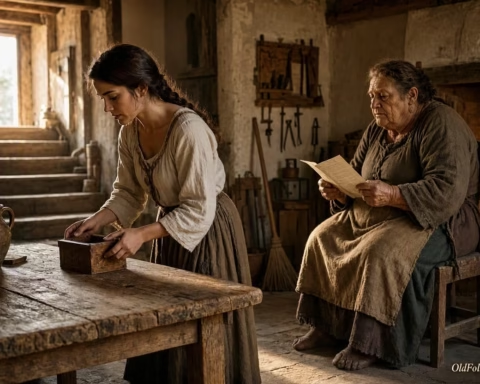
Near the Italian city of Imola stood the village of Postema, where Pre Scarpafico served as priest. He possessed considerable wealth but was known for his miserly habits. His housekeeper, Nina, managed his household and affairs with care. She was clever, outspoken and alert to the intentions of others, which made her a valuable companion.
In his younger days, Scarpafico had been more energetic. As he grew older, however, walking became tiresome. Nina repeatedly urged him to buy a horse or another suitable riding animal so that he would not exhaust himself on the road.
Eventually, the priest followed her advice and visited the market. There he found a mule that appeared to meet his needs. He paid seven golden florins for the animal and set off towards home, pleased with his purchase.
Three rogues were watching the market that day. They preferred living by the property of others rather than earning their own living. When they saw Scarpafico riding away with his new mule, one of them proposed a plan to take it from him.
The men would station themselves along the road, separated by some distance. Each would tell the priest that his animal was not a mule but an ass. If they repeated the claim confidently enough, they believed they could make him doubt what he had bought.
The other two agreed, and the robbers took up their positions.
The Robbers Take the Mule
Scarpafico had not travelled far when he met the first robber. After exchanging greetings, the man asked where he had been and what he had purchased.
The priest proudly explained that he had bought the mule he was riding. The robber looked at the animal and declared that it was an ass, not a mule.
Scarpafico was surprised by the remark but continued along the road. Soon he encountered the second man, who asked similar questions. When the priest described his purchase, the robber also insisted that the animal was an ass. He suggested that the priest had been cheated at the market.
Explore more stories from our Straparola’s Nights collection.
The repeated accusation began to trouble Scarpafico. Nevertheless, he continued towards home until the third robber approached him.
Once again, the priest explained that he had bought a mule. The third man confidently contradicted him, declaring that the animal was plainly an ass.
By then, Scarpafico had heard the same claim from three separate men. He began to believe that he had mistaken the animal’s identity. Since the last man appeared to confirm what the others had said, the priest dismounted and handed him the beast.
The robber thanked him and departed to join his companions. The three men had succeeded without using force or paying a single coin. Scarpafico, meanwhile, had to finish his journey on foot.
When he arrived home, he told Nina what had happened. He explained that he had purchased what he thought was a mule but had surrendered it after several people identified it as an ass.
Nina was astonished at his credulity. She told him that the men had tricked him and remarked that she would never have been deceived so easily.
Scarpafico accepted that he had been outwitted, but he did not intend to let the matter end there. He suspected that the robbers would attempt another scheme if they believed him an easy target. Rather than waste time grieving over the lost mule, he resolved to turn their dishonesty against them.
The Goat That Could Carry Messages
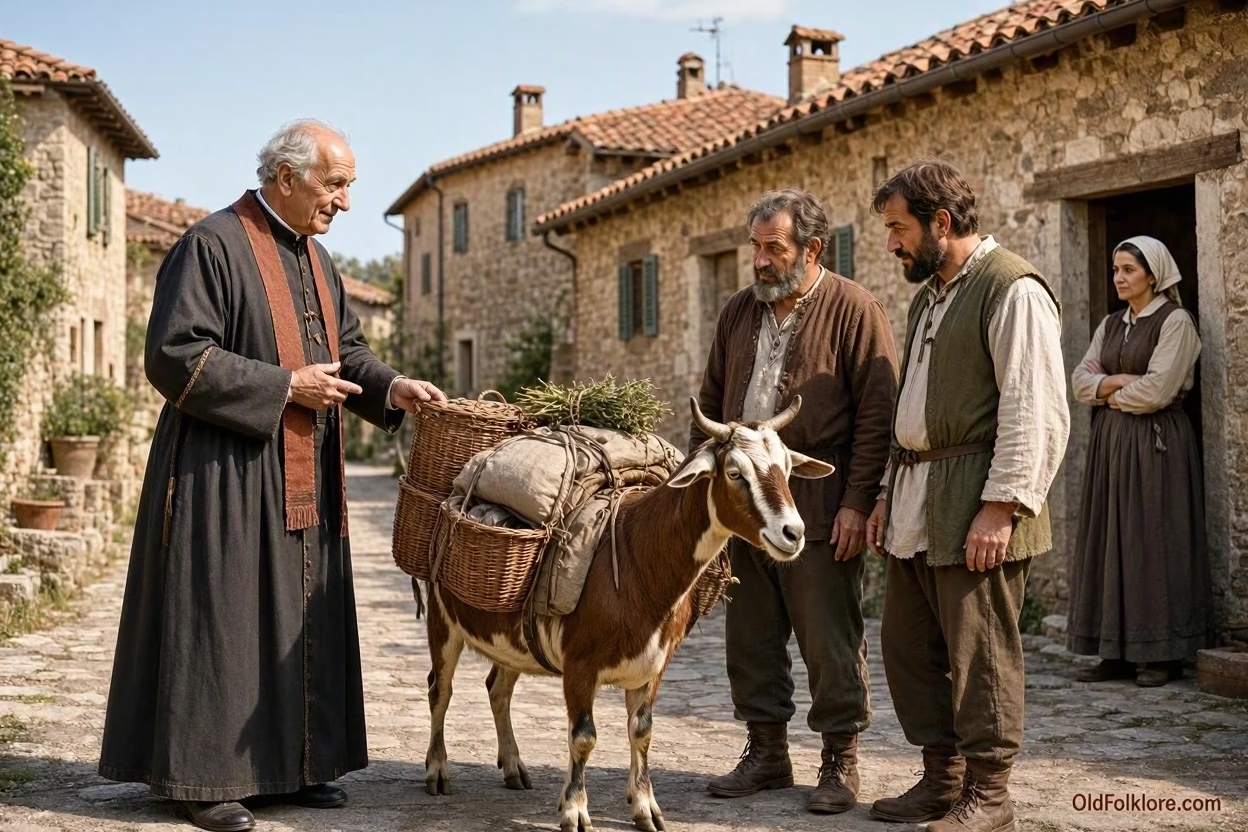
Not far from the priest’s home lived a peasant who owned two goats so alike that they were difficult to distinguish. Scarpafico bought both animals and began preparing his next trick.
He instructed Nina to prepare a substantial dinner for himself and several guests. The meal would include boiled veal, roast fowls, other meat, savoury sauces and a tart.
Scarpafico tied one goat to a hedge in his garden. He then loaded the other with provisions purchased at the market and led it out towards the place where he expected to meet the three robbers.
The men soon approached him. Remembering their earlier success, they greeted him warmly and asked whether he had come to the market to make another purchase.
Scarpafico explained that he was buying provisions for a dinner and invited them to join him. The robbers readily accepted.
After arranging the food on the goat’s back, the priest addressed the animal as though it understood his instructions. He told it to go home, deliver the provisions to Nina and explain how everything should be cooked. He then released it and allowed it to wander away.
The goat disappeared into the countryside. Scarpafico did not attempt to recover it. Instead, he continued spending time at the market with the robbers and his other companions until the hour for dinner arrived.
When the guests reached the priest’s house, they saw a goat tied to a hedge in the garden. It looked exactly like the animal that had carried away the provisions. Because the two goats were so alike, the robbers assumed that the messenger had returned after completing its errand.
Inside the house, Scarpafico asked Nina whether she had prepared the meal according to the goat’s instructions. She played her part and confirmed that the dishes were nearly ready.
The robbers were amazed. They watched as the food was served and heard Nina speak as though the goat had genuinely delivered its message. They became convinced that the animal possessed a remarkable ability.
After dinner, the three men asked Scarpafico to sell it to them. At first, he refused, claiming that the goat was too valuable to part with. Eventually, he agreed to accept fifty golden florins.
He warned them that the goat might not obey them as it obeyed him because it did not know their ways. The robbers dismissed the warning, paid the money and took the animal home.
The next day, they bought provisions and loaded them onto the goat. They ordered it to carry the food home and tell their wives how to prepare it.
Once released, the goat ran off into the countryside and never returned.
When the robbers arrived home, they discovered that no meal had been prepared. Their wives could not understand why the men had expected an ordinary animal to carry out their instructions. The robbers realised that Scarpafico had deceived them, taking their money in exchange for a goat that could do nothing of the sort.
Their anger grew, and they set out for the priest’s house, determined to take revenge.
Nina and the Miraculous Bagpipe
Scarpafico had anticipated that the robbers would return once they discovered the truth about the goat. Before they arrived, he discussed another plan with Nina.
He gave her a bladder filled with blood and instructed her to hide it beneath her clothing. When the robbers came, he would pretend to attack her in anger. He would thrust his knife into the bladder, while Nina would fall to the ground and act as though she had been killed.
The robbers soon appeared, carrying weapons and threatening the priest. Scarpafico insisted that they had blamed the wrong person. He claimed that Nina was responsible for their misfortune and turned towards her as though overcome by rage.
He struck the knife into the hidden bladder. Blood spread around Nina as she fell, motionless, to the ground.
Scarpafico immediately began lamenting what he had supposedly done. He cried out that he had killed the woman who had supported him in his old age and wondered how he could continue without her.
After making a great show of grief, he took out a specially made bagpipe and played a tune. Nina then rose to her feet, apparently restored to life.
The robbers were astonished. They had witnessed what looked like a death followed by a miraculous recovery, and they wanted to possess the instrument responsible.
After bargaining with Scarpafico, they bought the bagpipe for two hundred florins and returned home delighted with their purchase.
Their delight soon turned to disaster.
One of the robbers quarrelled with his wife and, in a fit of anger, stabbed her to death. Believing that the bagpipe could restore her life, he played it as Scarpafico had done. Nothing happened.
A second robber watched the failure and decided that his companion had performed the trick incorrectly. He seized his own wife by the hair and cut her throat with a razor. He then played the bagpipe, but it could not bring her back to life.
The third robber followed the same course, killing his wife and trying the instrument. His efforts also failed.
The three men had paid dearly for their belief in a false miracle. Instead of gaining the power to revive the dead, they had committed terrible acts because they trusted the priest’s deception.
Their fury against Scarpafico now surpassed anything they had felt before. They returned to his house determined to make certain that he could not trick them again.
The Sack by the Roadside
This time, the robbers seized Scarpafico and forced him into a sack. They intended to carry him to a nearby river and drown him.
While transporting their prisoner, however, the men became alarmed by something they noticed along the way. They hurried off to hide, leaving the sack beside the road.
A shepherd passed by with his flock and heard a voice coming from the sack. Scarpafico was repeating words that suggested someone wanted him to marry a woman against his wishes. The shepherd could not understand what was happening and searched for the source of the voice.
When he found the sack, he opened it and released the priest. He asked Scarpafico why anyone had tied him up and what he meant by his strange words.
The priest invented another story. He claimed that the local lord wanted him to marry one of his daughters, but that he was unwilling to accept because he was a priest and too old to take a wife.
The shepherd believed him. He imagined that such a marriage would be a wonderful opportunity and asked whether the lord might choose him instead.
Scarpafico claimed that this could be arranged. He instructed the shepherd to climb into the sack so that he could be presented in the priest’s place.
The shepherd agreed without suspicion. Once he was inside, Scarpafico tied the sack securely, took control of the flock and hurried away.
After some time, the three robbers returned from their hiding place. Without checking who was inside, they lifted the sack and carried it to the river. They threw it into the water, believing that they had finally disposed of their enemy.
The shepherd suffered the fate they had intended for Scarpafico.
The Final Trick
The robbers continued along their way, convinced that the priest was dead. Before long, they noticed a flock of sheep grazing nearby and began considering how they might steal a few lambs.
As they approached, however, they saw a familiar figure tending the flock. It was Pre Scarpafico, the man they believed they had just drowned.
They could scarcely believe their eyes. They demanded to know how he had escaped the river and reached the place before them.
Scarpafico answered with another lie. He mocked their lack of sense and claimed that the river had been a fortunate place to visit. Had they thrown him farther into the stream, he said, he would have returned with ten times as many sheep.
The robbers immediately saw an opportunity. They asked him to put them into sacks and throw them into the river so that they, too, could return with flocks and abandon their criminal lives.
Scarpafico readily agreed to help. He obtained three strong canvas sacks and tied each robber securely inside one. They had no chance of escaping.
He then threw the three men into the river, where they met the fate they had intended for him.
With the robbers gone, Scarpafico returned to Nina. He had recovered his advantage through a succession of deceptions and ended the conflict with a flock of sheep and considerable wealth. The tale concludes by describing how he and Nina lived happily and prospered for many years.
Explore our complete Historic Folklore & Fairy-Tale Collections archive.
Moral Lesson
Greed and overconfidence can make people easy to deceive. The three robbers succeeded at first because they exploited Scarpafico’s trust, but their desire for effortless gain later made them believe increasingly absurd claims. Their downfall shows how dishonesty can turn against those who rely on it.
The tale also presents cunning as a means of survival and revenge. Scarpafico answers deception with deception, using the robbers’ own expectations to trap them. His victory, however, comes through dangerous and morally troubling acts, especially the deaths of the shepherd and the robbers’ wives. The story is therefore not a simple lesson in honesty; it is a comic but harsh tale in which greed, manipulation and revenge lead to disastrous consequences.
Knowledge Check
1. Where did Pre Scarpafico serve as a priest?
He served the village church of Postema, near the Italian city of Imola.
2. How did the three robbers steal Scarpafico’s mule?
They positioned themselves along the road and each insisted that the mule was an ass until Scarpafico doubted his own judgement and gave it away.
3. How did Scarpafico trick the robbers with the goat?
He used two nearly identical goats. One carried provisions away and disappeared, while the other remained in his garden, making the robbers believe the messenger had returned.
4. Why did the robbers buy Scarpafico’s bagpipe?
They believed it had brought Nina back to life after Scarpafico appeared to kill her.
5. How did Scarpafico escape the sack intended to drown him?
He persuaded a shepherd to exchange places with him by falsely claiming that a local lord wanted him to marry one of his daughters.
6. What finally happened to the three robbers?
They asked Scarpafico to put them into sacks and throw them into the river, believing they would gain sheep as he supposedly had. He tied them inside the sacks and threw them into the water.
Source
This retelling is based on Giovanni Francesco Straparola’s The Nights of Straparola, Volume I, translated into English by W. G. Waters and published in London by Lawrence and Bullen in 1894.