The Hansel and Gretel fairy tale is one of the best-known stories collected by Jacob and Wilhelm Grimm. It follows a poor woodcutter’s children who face abandonment, hunger and danger in a forest far from home. When their attempt to return home fails, a mysterious house made of bread and sweets appears to offer salvation. Instead, it leads them into the hands of a wicked witch.
The story explores hunger, fear, family loyalty and the resourcefulness required to survive difficult circumstances. Although Hansel often takes the lead in finding a way through danger, his younger sister, Gretel, ultimately becomes the person who saves them both.
The Woodcutter’s Family Faces Hunger
Long ago, near a great forest, there lived a poor woodcutter with his wife and two children. The boy was called Hansel, and his sister was Gretel. Their family struggled to find enough food, and a terrible shortage eventually left them unable to provide even their daily bread.
One night, the woodcutter lay awake, worrying about how they would survive. He asked his wife what would become of them if they could no longer feed themselves or their children.
His wife proposed a cruel solution. The following morning, she suggested, they should take Hansel and Gretel deep into the forest, light a fire for them and leave them behind. She believed the children would never discover their way home, allowing the adults to escape the burden of feeding them.
The woodcutter was horrified. He could not bear the thought of abandoning his children to wild animals. His wife, however, insisted that the entire family would starve if they continued sharing their dwindling food. She argued until he finally agreed, although he remained deeply troubled by the decision.
Unfortunately, Hansel and Gretel were still awake. They overheard the conversation and realised that their parents intended to leave them in the forest.
Gretel began to cry, believing that there was no hope of escape. Hansel comforted her and promised to find a way to protect them.
Explore more stories from our Brothers Grimm Tales collection
When the household had fallen asleep, he quietly rose from his bed and slipped outside. The moon shone brightly over the ground, illuminating small white pebbles that glittered like silver. Hansel filled his pockets with as many as he could carry before returning to his sister.
He told Gretel not to despair. With the pebbles in his pocket, he believed he could lead them back home.
Hansel’s Pebbles Lead the Children Home
Before sunrise, the woodcutter’s wife woke the children and gave each of them a small piece of bread. She told them to save it for their midday meal because there would be no more food.
The family then set out towards the forest. As they walked, Hansel repeatedly looked back towards their house. His father asked why he kept stopping, and Hansel pretended that he was watching a little cat sitting on the roof.
The woman dismissed his explanation, but she did not realise what he was really doing. Whenever he turned around, Hansel dropped one of the white pebbles along the path.
The family eventually reached a deep part of the forest. The woodcutter told the children to gather branches, and together they built a large pile. He lit a fire and allowed them to sit beside it while the adults went to cut wood.
The children believed they would be collected later. As the hours passed, they heard what sounded like an axe striking wood. They assumed their father was nearby, unaware that the sound came from a branch moving against a withered tree in the wind.
Exhausted, they fell asleep beside the fire.
When they woke, darkness had covered the forest. Gretel was frightened, but Hansel told her to wait for the moon to rise. Once its light appeared, the white pebbles became visible along the path.
Holding his sister’s hand, Hansel followed the shining trail. They walked through the night and eventually reached their father’s house by dawn.
Their return brought relief to their father, who had been miserable about leaving them behind. His wife, however, pretended to be displeased with the children for staying away so long.
For a short time, the family was together again. But their troubles were far from over.
The Second Abandonment
Another period of scarcity struck the land, leaving the family with very little food. One night, the children overheard their mother telling their father that only half a loaf of bread remained.
She insisted that they must take the children farther into the forest so they would be unable to find their way home. Once again, the woodcutter objected, believing that sharing their last mouthful with the children would be better than abandoning them.
His wife refused to change her mind. Because he had yielded to her demands before, he eventually agreed again.
Hansel and Gretel heard the conversation and waited anxiously for morning. Hansel intended to collect more pebbles, just as he had done on their first journey. This time, however, the woman had locked the door, preventing him from going outside.
He could not gather the stones he needed, but he still tried to comfort Gretel.
Early the next morning, the adults led the children away with even smaller pieces of bread. As they walked, Hansel broke his bread into crumbs and scattered them along the path, hoping the trail would guide them home.
The family travelled farther into the forest than before. Once again, the woodcutter built a fire, and the woman promised that she and her husband would return after cutting wood.
The children waited until evening, but no one came.
When the moon rose, Hansel and Gretel searched for the crumbs. To their dismay, birds had eaten every last piece. Their trail had disappeared.
They wandered through the forest for the rest of the night and continued walking the following day. They found only a few berries to eat, and exhaustion eventually forced them to rest beneath a tree.
Three mornings had passed since they had left home. The children were hungry, tired and increasingly afraid that they would never escape the forest.
The Mysterious House of Bread and Sweets
At midday, the children heard a beautiful white bird singing from a branch. They stopped to listen until the bird spread its wings and flew away.
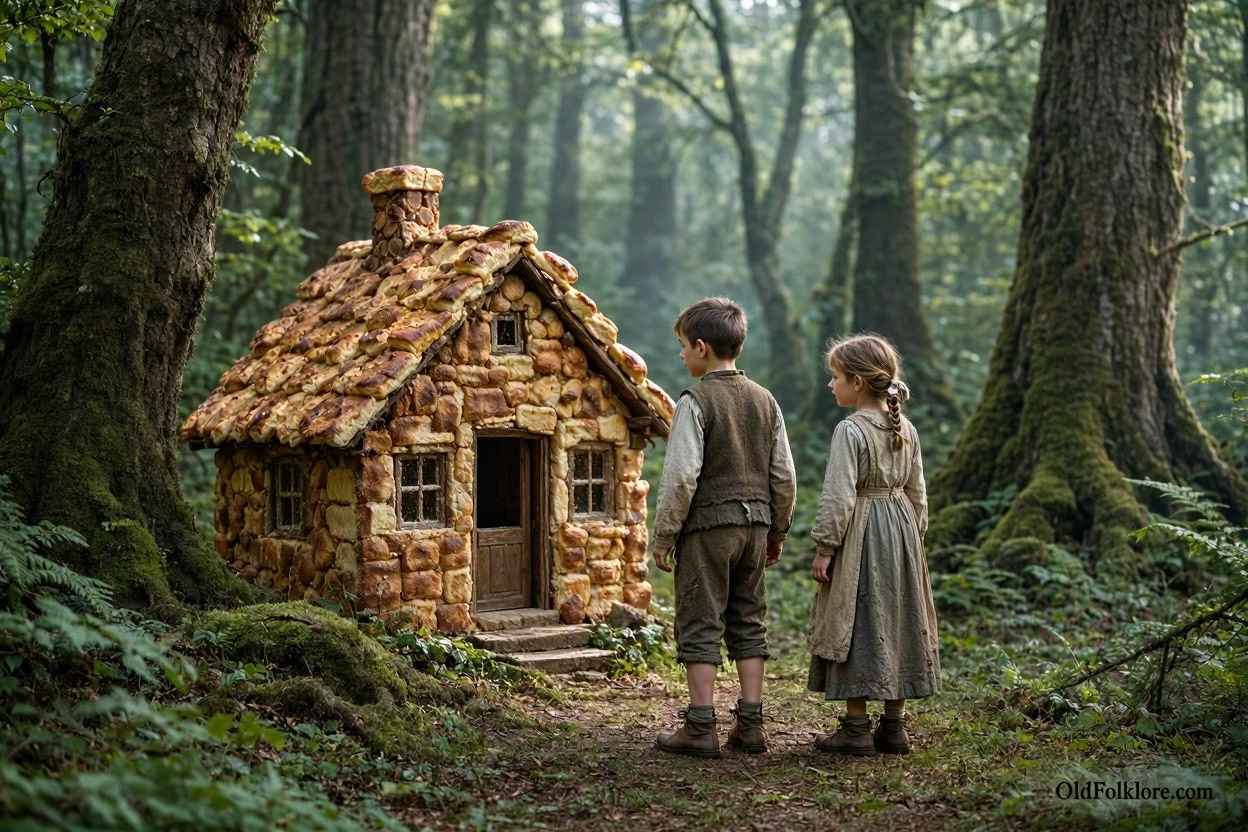
Curious, Hansel and Gretel followed it through the trees. Eventually, they came upon a little house unlike anything they had seen before. Its walls were made of bread, its roof was covered with cakes, and its windows were made of clear sugar.
The children were overwhelmed by hunger. Hansel broke off a piece of the roof and tasted it, while Gretel began nibbling at one of the sweet windows.
A voice came from inside, asking who was eating the little house. The children answered that it was only the wind and continued eating.
Suddenly, the door opened. An extremely old woman appeared, leaning on crutches. She welcomed the children warmly and invited them inside, promising that no harm would come to them.
She gave them milk, pancakes, sugar, apples and nuts. Afterwards, she prepared two clean beds where they could rest.
After their long ordeal, Hansel and Gretel believed they had finally found safety. They ate their meal and fell asleep without suspecting that their troubles had taken a more dangerous turn.
The old woman had only pretended to be kind. She was a wicked witch who had built the house to attract hungry children. When they came within her reach, she intended to kill and eat them.
The following morning, she seized Hansel and locked him inside a small stable with a barred door. She then ordered Gretel to fetch water and prepare food for her brother.
The witch planned to fatten Hansel before eating him. Gretel was forced to obey, and while Hansel received the best food, she was given little to eat.
Every morning, the witch approached Hansel and demanded that he stretch out a finger so she could discover whether he was becoming fat enough. Hansel, however, had found a clever way to deceive her.
Instead of offering his finger, he held out a small bone. Because the witch’s eyesight was poor, she mistook it for his finger and wondered why he remained so thin.
This trick worked for four weeks. Eventually, the witch lost patience. She announced that she would kill Hansel the following day, whether he had grown fat or not.
Gretel wept when she heard this. She feared that she and her brother would die in the forest after everything they had already endured.
Gretel Outsmarts the Witch
The next morning, the witch ordered Gretel to prepare water and light the fire. She had already heated the oven and kneaded the dough.
Afterwards, she told Gretel to climb inside the oven to check whether it was hot enough for baking. Her real intention was to push the girl inside and cook her.
Gretel understood that the witch meant to kill her. However, she did not reveal her fear. Instead, she pretended not to understand how she was supposed to enter the oven.
She asked the old woman to demonstrate.
The witch, believing that Gretel was foolish, approached the oven and bent forward to show her how to climb inside. The moment the witch put her head near the opening, Gretel gathered her courage and pushed her into the oven.
She shut the iron door and secured the bolt.
The witch screamed, but Gretel did not release her. The danger that had threatened the children was finally over.
Gretel immediately ran to the stable, unlocked the door and called to her brother. She told Hansel that they were saved and that the witch was dead.
Hansel sprang out of the stable, delighted to be free. The children embraced each other and celebrated their escape.
For the first time since their second abandonment, they could think about the future without fearing that the witch would return to harm them.
The Witch’s Treasure and the Journey Home
Before leaving, Hansel and Gretel searched the witch’s house. In its rooms, they discovered chests filled with pearls and precious stones.
Hansel filled his pockets with the treasure, while Gretel gathered as much as she could carry in her pinafore. They decided to leave the house and find a way out of the forest.
After walking for about two hours, they reached a large stretch of water. There was no bridge or plank to help them cross, and they could see no boat nearby.
Gretel noticed a white duck swimming on the water. She suggested asking it to help them reach the other side.
The children called to the duck, asking it to carry them across. When it came towards them, Hansel prepared to climb onto its back with his sister.
Gretel stopped him. She reasoned that carrying both children at once would be too heavy for the small duck. Instead, she suggested that they cross separately.
The duck carried them over the water one at a time, and soon both children stood safely on the opposite bank.
They continued walking through the forest. Gradually, the surroundings became familiar, and they recognised the path leading towards their father’s house.
At last, they saw the house in the distance. They hurried towards it, rushed inside and threw themselves into their father’s arms.
The woodcutter had been miserable since leaving his children behind. Their return filled him with happiness. The woman who had insisted on abandoning them was dead, leaving their father alone to welcome them home.
Gretel emptied her pinafore, scattering pearls and precious stones across the room. Hansel added the treasure he had carried in his pockets.
The children were no longer helpless and hungry. They had survived the forest, escaped the witch and returned with enough treasure to change their circumstances.
Their suffering finally came to an end, and the family lived together in happiness.
Explore our complete Historic Folklore & Fairy-Tale Collections archive.
Moral Lesson
The story of Hansel and Gretel highlights the importance of courage, resourcefulness and cooperation when facing danger. Hansel uses his quick thinking to create a trail home, while Gretel demonstrates decisive courage when she recognises the witch’s plan and acts to save them both.
The tale also warns against false kindness. The witch’s welcoming house and generous meal conceal a deadly intention, reminding readers that appearances can be deceptive.
Knowledge Check
1. Why did Hansel and Gretel’s stepmother want to abandon them?
She believed the family had too little food to survive and wanted to reduce the number of people they had to feed.
2. How did Hansel guide the children home after their first abandonment?
He scattered white pebbles along the path. Their shine in the moonlight helped the children find their way home.
3. Why did Hansel’s second attempt to leave a trail fail?
He used breadcrumbs, but birds ate them before the children could follow the trail back.
4. What was unusual about the house the children discovered?
It was made of bread and covered with cakes, with windows made of clear sugar.
5. How did Hansel deceive the witch when she checked whether he was fat enough?
He held out a small bone instead of his finger, and the witch’s poor eyesight prevented her from noticing the trick.
6. How did Gretel save herself and Hansel from the witch?
She tricked the witch into demonstrating how to enter the oven, then pushed her inside and secured the door. She subsequently freed Hansel from the stable.
Source
Grimm, Jacob and Wilhelm. Household Tales, translated by Margaret Hunt, 1884. “Hansel and Grethel,” KHM 15. Project Gutenberg, eBook No. 5314.
Explore More Brothers Grimm Tales
- The Three Languages: Grimm Fairy Tales
- Clever Elsie: A Brothers Grimm Fairy Tale
- The Wishing Table, the Gold Ass and the Cudgel
- Thumbling: A Grimm Fairy Tale
- The Wedding of Mrs Fox: Grimm Fairy Tale
- The Elves: A Grimm Fairy Tale
- The Robber Bridegroom’s Terrifying Secret
- Herr Korbes: A Strange and Deadly Grimm Tale