Long ago, in Inkum, there lived a chief named Leku. He was married to a woman called Achor, and the two had lived together for several years.
Around that time, a beautiful woman named Akoba became well known throughout the surrounding towns. She was admired for her light complexion, the elephant-tail hairs she wore around her neck, and the beads that adorned her body. She preferred to walk about without clothes, believing that her beauty needed no covering.
Many young men desired her, including several chiefs, but Akoba refused to marry any of them. She enjoyed the attention and the gifts she received from her admirers and had no intention of settling down with one man.
Explore more stories from our Ikom Folk Stories collection.
Eventually, she devised a strange challenge for those who wished to marry her. She took a calabash, decorated it with different colours and placed it some distance away. Then she announced that any man who wanted her as his wife must strike the calabash with a small stone.
One after another, the young men and chiefs attempted the challenge, but none succeeded. Akoba had placed a powerful ju-ju on them, preventing them from hitting their target.
At last, Chief Leku tried his luck. His stone struck the calabash, and he immediately claimed Akoba as his wife.
He took her home and celebrated the marriage in grand style. The women of the town were gathered for a great celebration, guns were fired, and Akoba was rubbed with camwood as the chief publicly announced that she was now his wife.
But married life soon disappointed Akoba.
She had enjoyed her freedom and the money she received from the men who admired her. Now she had to remain in Leku’s household, perform domestic duties and work on the farm. Her husband did not give her the gifts she had grown accustomed to receiving.
Before long, she began to think of a way to kill him so that she could return to her former life.
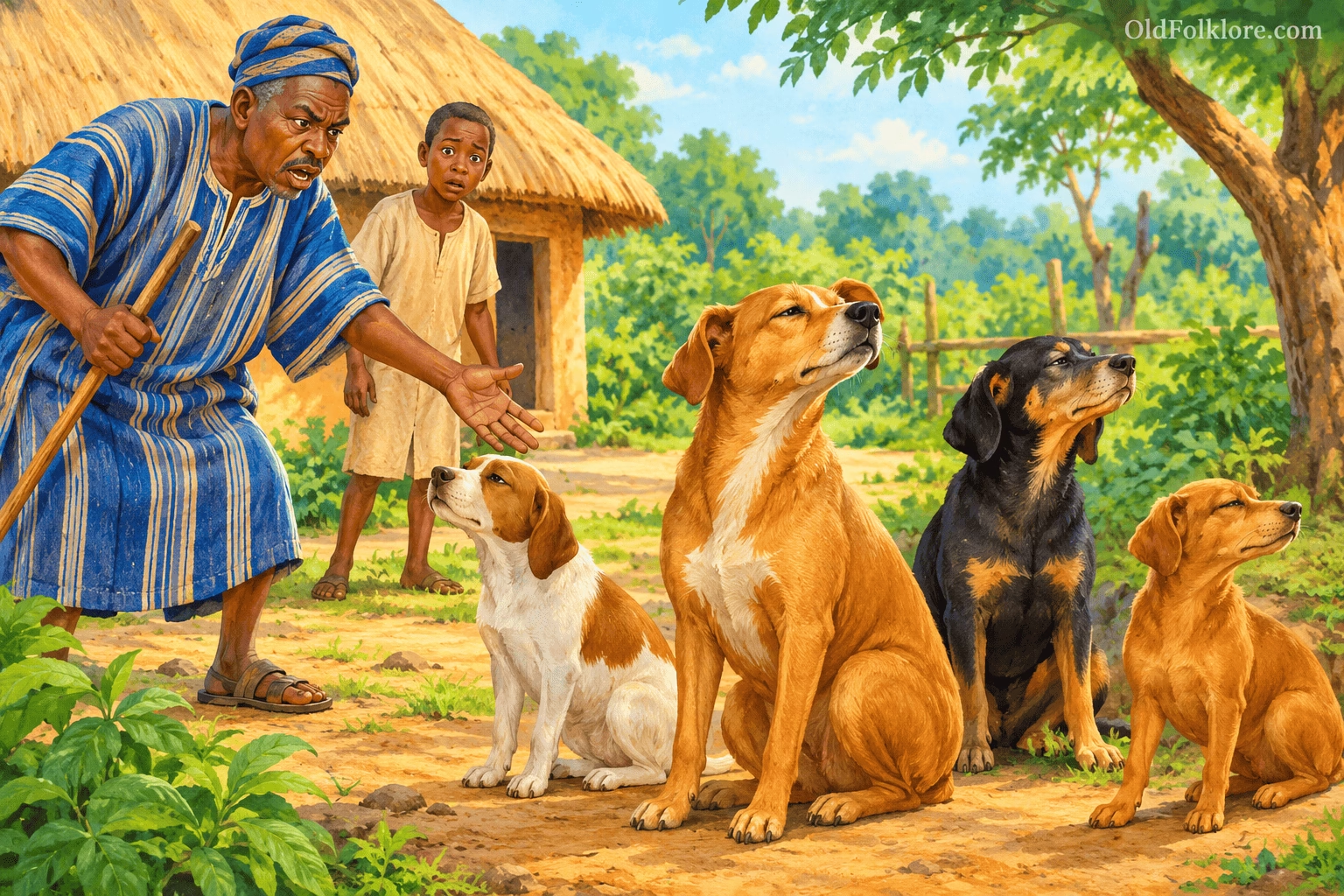
Chief Leku was a hunter who earned his living by killing animals in the forest and selling their meat. He owned five exceptionally clever hunting dogs. They had been trained to follow the scent of wounded animals, making them valuable companions on his hunting expeditions.
When the dogs were young, a special ju-ju had been prepared for them. Certain leaves were crushed and rubbed onto their noses, giving them an extraordinary sense of smell. With this ability, they could follow the tracks of wounded animals through the thick forest.
Akoba knew that the dogs were devoted to their master, so she decided to leave them behind when she put her plan into action.
One morning, she approached Leku and asked him to accompany her into the forest to gather palm nuts. She insisted that he should not bring his hunting dogs because she disliked having them around.
Leku agreed without suspecting anything.
When they reached a palm tree, the chief fastened his climbing belt, made from tie-tie, around the trunk and secured it behind his back. He then climbed towards the top and began cutting away the branches surrounding the palm nuts.
As soon as he was safely above the ground, Akoba produced a sharp axe. She began striking the tree and shouted that she intended to kill him.
The tree started to lean and eventually began falling. Fortunately for Leku, another tree caught it before it reached the ground. He quickly climbed across to the neighbouring tree, hoping to escape.
But Akoba was not finished. She turned her attention to the second tree and began cutting it down as well.
Realising that he was in grave danger, Leku called upon a bird and sent it with an urgent message to his five hunting dogs. He needed them to come immediately and rescue him.
The dogs received the message and raced into the forest.
However, Akoba was a witch, and she used her powers to create a flood across their path. The rising water prevented the dogs from following her scent, and for a while they could not reach their master.
But the dogs refused to abandon him.
At last, one of them plunged into the water and swam across. The other four followed, and together they continued towards the place where Leku was trapped.
When they arrived, the chief saw them beneath the tree and ordered them to attack the woman who was trying to kill him.
The five dogs sprang upon Akoba and bit her repeatedly until she died.
Leku was finally able to climb down from the tree. He then divided Akoba’s body into five bundles and instructed his dogs to carry them home. Each dog took a bundle, and together they made their way back to the chief’s compound.
By the time they arrived, night had fallen. Leku went to bed and told his first wife, Achor, what had happened to his new wife.
The following morning, Achor noticed the five bundles outside the house. Curious about how her husband had managed to bring them all home, she asked him who had carried them.
Leku refused to answer.
That evening, when they were preparing to sleep, Achor insisted that he tell her the truth. She even threatened not to share his bed unless he explained how the five bundles had been transported.
Leku was very fond of Achor and wanted her company, so he eventually gave in.
He told her that his five hunting dogs had carried the bundles all the way from the forest.
Achor said nothing more and went to bed.
Early the next morning, however, she rose and called the dogs to follow her to the farm. There, she gathered five bundles of firewood and arranged them in a row.
Turning to the dogs, she said that if they could carry bundles for their master, they could certainly carry her firewood. She ordered each of them to pick up a bundle and take it to the house.
The dogs obeyed without making a sound.
One after another, they picked up the firewood and carried it to the compound. But as each dog placed its bundle on the ground, it suddenly collapsed and died.
When Chief Leku came outside and discovered what had happened, he was horrified. All five of his faithful hunting companions were dead.
He turned angrily towards Achor and exclaimed that she had killed his dogs. He regretted telling her that they had carried the bundles for him, explaining that this was what had happened because he had revealed their secret.
And so, according to the tale, dogs have never been the same again.
They can understand what their masters say, but they no longer speak or willingly perform tasks for them as they once did. They remember that Chief Leku broke their law by revealing what they had done, and that is why dogs refuse to obey their masters to this day.
Explore our complete Historic Folklore & Fairy-Tale Collections archive.
Moral
A secret entrusted to you should not be revealed carelessly. Even when someone is close to you, betraying a confidence can destroy the trust of those who have helped you. Loyalty must be respected, not exploited.
Knowledge Check
1. Why did Akoba refuse the marriage proposals of the young men and chiefs?
She preferred her freedom and enjoyed making money from the men who admired her.
2. How did Chief Leku escape Akoba’s attempt to kill him?
He sent a bird with a message to his five hunting dogs, who crossed a flood to reach and rescue him.
3. Why did the five hunting dogs die?
After carrying Akoba’s body home, they were ordered by Achor to carry bundles of firewood. Each dog died after delivering its bundle.
4. What caused dogs to stop obeying their masters, according to the folktale?
Chief Leku revealed the dogs’ secret to Achor, breaking their law. Their refusal to obey humans thereafter became the explanation for their behaviour.
5. Who was the storyteller recorded in the original collection?
The story was told by Abassi of Inkum, as recorded by Elphinstone Dayrell.
Source
This retelling is based on “The Story of the Witch Who Tried to Kill Her Husband; or, Why Native Dogs Refuse to Obey Their Masters,” Chapter VI, in Ikom Folk Stories from Southern Nigeria by Elphinstone Dayrell, published in London in 1913 by the Royal Anthropological Institute of Great Britain and Ireland as Occasional Papers, No. 3.
Explore More Ikom Folk Stories