Once upon a time, a widower lived with his only daughter, a girl between ten and twelve years old. Her father sent her to school and entrusted her care to her schoolmistress because the child had no mother to look after her.
The schoolmistress, however, had other intentions. She had fallen in love with the girl’s father and wanted to marry him. Every day, she encouraged the young girl to ask her father whether he would take her as his wife.
At first, the widower hesitated. He warned his daughter that another marriage might bring her great trouble. The girl continued to repeat the schoolmistress’s request, however, until her father finally agreed to visit the woman.
The schoolmistress welcomed him warmly, and they arranged their marriage within a few days. She became the girl’s stepmother, but the child soon discovered that her new family arrangement had brought her misery rather than affection.
The stepmother treated Ermellina cruelly. Each day, she sent the girl onto a terrace to water a pot of basil. The terrace stood above a large river, and anyone who slipped from its edge would fall into the water below. Ermellina understood the danger, yet she had no choice but to carry out the task.
One day, while she watered the basil, she began to weep. A large eagle happened to pass by and noticed her distress.
“What are you doing here?” the eagle asked.
Ermellina explained her situation and showed how frightened she felt on the dangerous terrace. The eagle listened and offered to take her away.
“Get on my back, and I will carry you away. You will be happier than with your new mamma.”
Ermellina accepted. She climbed onto the eagle’s back, and the bird carried her away from the terrace. After a long journey, they reached a wide plain where a magnificent palace made entirely of crystal stood.
The Eagle Takes Ermellina to the Fairies
The eagle approached the palace and knocked at its door.
“Open, my ladies, open! I have brought you a pretty girl.”
The inhabitants welcomed Ermellina with delight. They admired her beauty, kissed her and treated her affectionately. She had escaped the stepmother’s cruelty and found a peaceful home among the fairies.
The eagle, meanwhile, believed that it had taken a satisfying revenge on the stepmother. It wanted the woman to understand that her mistreatment had driven the girl away.
One day, the eagle returned to the terrace where the stepmother watered the basil.
“Where is your daughter?” it asked.
The woman pretended not to know what had happened. She suggested that Ermellina might have fallen into the river and claimed that she had not heard from her for ten days.
The eagle revealed the truth. It explained that it had carried Ermellina away because of the woman’s harsh treatment and had taken her to live with the fairies. The girl was alive and well.
Instead of feeling relieved, the stepmother became furious. Jealousy consumed her, and she feared that Ermellina might return one day and tell her father how cruelly she had treated her. She worried that her husband would punish her if he discovered the truth.
Determined to prevent that possibility, she summoned a witch from the city and asked her to kill the girl.
The witch agreed to help.
The Witch’s First Deception
The witch prepared a small basket of sweetmeats and placed a charm inside them. She also wrote a letter, pretending to be Ermellina’s father. The false letter claimed that he had learned where his daughter lived and wanted to send her a present. It also expressed his happiness at knowing that she had found shelter among the fairies.
Explore more stories from our Italian Popular Tales collection.
The witch planned to disguise herself as one of the servants from Ermellina’s former home. She hoped that the familiar appearance and the supposed message from the girl’s father would persuade her to open the palace door.
Before the witch arrived, the fairies warned Ermellina about the danger.
They explained that they would leave the palace for four days and instructed her not to open the door to anyone during their absence. They knew that the stepmother had begun plotting against her and feared that someone might try to deceive her.
Ermellina promised to obey. She assured the fairies that she felt safe and believed her stepmother could no longer harm her.
The fairies departed, leaving her alone.
The next day, someone knocked at the palace door. Ermellina refused to answer. The visitor continued knocking until curiosity led the girl to look through a window.
Outside, she saw a woman who appeared to be one of the servants from her father’s household. In reality, the witch had disguised herself to look familiar.
The visitor called to Ermellina and explained that her father had been grieving because he believed her dead. She claimed that the eagle had informed him that his daughter was alive and living with the fairies. The father, she said, had sent the basket of sweetmeats as a gift.
Ermellina initially refused to open the door. She remembered the fairies’ warning and told the visitor that she wanted nothing. However, the woman’s continued appeals and the promise of a present eventually overcame her caution.
Ermellina went downstairs and opened the door.
The witch handed her the basket and urged her to taste the sweetmeats. She even broke off a piece and offered it to the girl. As soon as Ermellina took the first mouthful, the witch disappeared.
The charm took effect immediately. Ermellina had barely closed the door when she fell down on the stairs.
When the fairies returned, nobody answered their knocks. They sensed that something terrible had happened and began to weep. Their chief ordered them to break open the door.
Inside, they found Ermellina lying dead on the stairs.
Her friends begged their leader to restore her life. At first, the chief fairy refused. She reminded them that Ermellina had ignored her warning and opened the door to a stranger.
The other fairies continued pleading until their leader finally agreed. She opened Ermellina’s mouth, removed the piece of sweetmeat that the girl had not swallowed and raised her up.
Ermellina came back to life.
Her friends rejoiced, but the chief fairy reproved her for disobeying their instructions. The girl regretted her mistake and promised never to repeat it.
A Second Deception and the Crystal Casket
The fairies eventually had to leave the palace again. Before departing, their leader reminded Ermellina of what had happened.
“The first time I cured you,” she warned, “but the second time I will have nothing to do with you.”
Ermellina promised that she would not open the door to anyone. Yet the eagle soon returned to the stepmother and revealed that the girl remained alive.
The stepmother grew angry once more. She summoned the witch and demanded that she finish the task. The witch, who now faced the woman’s threats, devised another plan.
She advised the stepmother to buy a very handsome dress. Then she disguised herself as the family’s tailoress and carried the dress to the crystal palace.
When she knocked, she called out that she had come to fit a new dress for Ermellina.
The girl looked through the window and recognised the visitor as the tailoress who had made clothes for her family. She hesitated because she remembered the earlier trick.
“No, no; I have been deceived once,” Ermellina replied.
The witch insisted that she was not the old woman who had brought the sweetmeats. She reminded Ermellina that the girl knew her and had trusted her with dresses before.
Ermellina allowed herself to believe the disguise. She descended the stairs and opened the door.
The witch handed her the beautiful dress. As Ermellina began buttoning it, the woman fled and disappeared. The girl closed the door and tried to climb the stairs, but she collapsed and died.
When the fairies returned, they found the palace silent. They knocked, but nobody answered. They broke open the door and discovered Ermellina lying dead in the beautiful dress.
The chief fairy reminded the others that she had warned the girl about opening the door again. This time, she refused to restore her life. Although the fairies loved Ermellina, their leader would not reverse the consequences of her second disobedience.
The fairies wept over the young girl. Their chief then struck the ground with her enchanted wand and summoned a magnificent casket covered with diamonds and other precious stones. The other fairies made a beautiful garland of flowers and gold and placed it on Ermellina’s head. They carefully laid her inside the casket.
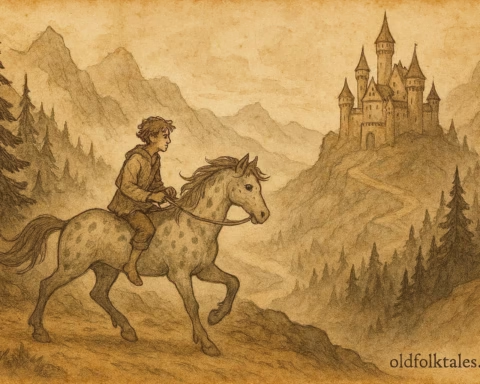
The chief fairy used her wand once more and summoned a handsome horse, finer than any horse the king possessed.
The fairies placed the casket on the horse’s back and led the animal into the city’s public square. Their leader gave it a special instruction: it must keep running until someone said the exact words, “Stop, for pity’s sake, for I have lost my horse for you.”
After giving the command, the fairies let the horse run away at full speed.
The Prince and the Enchanted Horse
A king’s son happened to pass through the city. He noticed the magnificent horse carrying the extraordinary casket and immediately wanted to catch it.
The prince spurred his own horse and chased after the enchanted animal. He rode so hard that his horse eventually died, forcing him to leave it lying in the road. Still, he continued the pursuit.
The enchanted horse remained beyond his reach. Exhausted and desperate, the prince finally cried out:
“Stop, for pity’s sake, for I have lost my horse for you!”
At once, the horse stopped.
The prince approached the casket and saw the beautiful girl lying inside. He became so captivated by her appearance that he forgot about his dead horse. He took the enchanted horse and carried the casket back to his palace.
His mother wondered what her son had brought home. The prince explained that he had gone hunting but had found a wife.
His mother could hardly understand him. She asked whether he meant a doll or a dead woman. The prince insisted that the girl in the casket was his wife and told his mother not to concern herself with what she saw.
His mother laughed at his strange declaration and returned to her own room.
From that day, the prince changed his habits. He stopped hunting and taking part in ordinary entertainments. He even stopped eating at the family table and took his meals alone in his room. He spent his time beside the casket, treating the lifeless girl as his wife.
The Chambermaids and Ermellina’s Awakening
War eventually broke out against the prince’s kingdom, and he had to leave the palace. Before departing, he called his mother and asked her to appoint two careful chambermaids to guard the casket.
He warned her that if anything happened to it before his return, he would have the chambermaids killed.
His mother loved him and promised to watch over the casket herself. The prince remained distressed about leaving his strange treasure, but he had no choice. Even after his departure, he continued writing letters in which he reminded his mother to care for the girl he called his wife.
His mother soon forgot her promise. She did not even arrange for anyone to dust the casket.
Some time later, a letter arrived announcing that the prince had won the war and would return within a few days. His mother suddenly remembered the casket and realised that she had neglected it.
She called the chambermaids and told them that they were in trouble. Together, they hurried to the prince’s room.
When they examined the girl, they found dust and fly-specks on her face and hands. They took a sponge and washed her face, but some drops of water fell onto her dress and left stains.
The chambermaids became frightened. They knew that the prince would notice the damaged dress and might punish them. They went to the queen mother for advice.
She suggested that they call a tailoress and obtain another dress exactly like the original. They could remove the stained garment and replace it before the prince returned.
The chambermaids followed her instructions. They went to the casket and began unbuttoning Ermellina’s dress.
As soon as they removed the first sleeve, Ermellina opened her eyes.
The chambermaids jumped back in terror. One of them, however, gathered her courage and reasoned that a woman like herself would not harm another woman. She continued removing the dress.
Once the garment came off, Ermellina began climbing out of the casket. She looked around in confusion, wondering where she was and how she had arrived there.
The chambermaids knelt before her and asked her to explain who she was. Ermellina told them everything: her father’s marriage, her stepmother’s cruelty, the eagle’s rescue, the fairies’ warnings and the witch’s two deceptions.
She then asked where she had come to.
The chambermaids called the king’s mother, who explained that the palace belonged to her son. Ermellina wept as she remembered the fairies and the extraordinary things they had done for her.
The prince’s return was close, so his mother gave Ermellina one of her finest dresses and arranged her clothes like those of a queen. She then placed the young woman in a small room so that her son would not see her before she could explain what had happened.
Ermellina Meets the Prince
The prince returned in great celebration. Trumpets sounded, banners flew and the people welcomed him after his victory.
He paid little attention to the festivities. His first thought was the casket, and he hurried to his room to see the girl he still believed lay inside it.
The chambermaids fell to their knees before him. They claimed that the girl had begun to smell so badly that they could no longer remain in the palace, so they had buried her.
The prince refused to accept their explanation. He became furious and ordered two palace servants to erect a gallows for them.
His mother tried to calm him. She reminded him that the girl had been dead and that the chambermaids had acted because they could no longer bear the condition of the body. But the prince would not listen. He insisted that they should have left the girl alone, whether she was alive or dead.
When his mother realised that he intended to carry out the punishment, she rang a small bell.
Ermellina appeared.
She no longer looked like the lifeless girl in the casket. Instead, she stood before them as a beautiful young woman. The prince stared in astonishment, unable to understand what had happened.
His mother, the chambermaids and Ermellina then explained the entire story. They told him how the fairies had cared for her, how the witch had deceived her and how she had awakened when the chambermaids removed her dress.
The prince listened carefully. He declared that he had loved Ermellina even when she appeared to be dead and had already called her his wife. Now that she stood alive before him, he wanted to marry her in truth.
His mother agreed. They arranged the wedding, and within a few days the prince and Ermellina became husband and wife.
The girl who had once suffered under her stepmother’s cruelty found a new life in the palace. Her journey had taken her from a dangerous terrace to a crystal home, through repeated enchantments and finally to an unexpected marriage.
Explore more stories from our European Folktales Collections archive.
Moral Lesson
The story highlights the importance of caution and the consequences of ignoring sound advice. Ermellina’s curiosity and trust in familiar-looking strangers expose her to danger, even after the fairies warn her. It also condemns cruelty and jealousy through the stepmother’s repeated attempts to harm an innocent child. The fairies’ protection and the chambermaids’ eventual kindness show how compassion can change another person’s fate.
Knowledge Check
1. Why did Ermellina’s father marry the schoolmistress?
The schoolmistress repeatedly asked Ermellina to persuade her father to marry her. The father eventually agreed after his daughter continued making the request.
2. What task did Ermellina’s stepmother give her each day?
She ordered Ermellina to water a pot of basil on a dangerous terrace above a large river.
3. Who rescued Ermellina from the terrace?
A large eagle carried her away to a crystal palace where the fairies welcomed her.
4. How did the witch deceive Ermellina for the first time?
She disguised herself as a servant from Ermellina’s former home and presented poisoned sweetmeats with a false letter supposedly sent by the girl’s father.
5. Why did the fairies refuse to revive Ermellina after her second death?
Their leader had warned her not to open the door again. Ermellina ignored the warning, so the chief fairy refused to restore her life a second time.
6. How did Ermellina awaken inside the casket?
The chambermaids began removing her dress so they could replace it. When they removed the first sleeve, Ermellina opened her eyes and eventually climbed out of the casket.
Source
Adapted from “XXI. The Crystal Casket” in Thomas Frederick Crane’s Italian Popular Tales (Boston and New York: Houghton, Mifflin and Company, 1885), pp. 326–331.
Explore More Italian Popular Tales