Long ago, in Monferrato, there lived a wealthy marquis named Lamberico and his wife, who longed for a child of their own. Though they had great riches and extensive lands, their greatest wish remained unfulfilled until the day they were blessed with a daughter named Biancabella.
One day, while the marchioness rested in the palace garden, a tiny serpent crept towards her and disappeared beneath her clothing. She felt no pain, and nothing seemed amiss. In time, however, she discovered that she was expecting a child.
When the day of delivery arrived, she gave birth to a beautiful daughter. To everyone’s astonishment, a small serpent was coiled three times around the newborn’s neck. The attendants feared that it might harm the infant, but the creature unwound itself peacefully and slipped away into the garden.
After the baby had been washed and dressed, the nurses noticed something extraordinary. Around her neck lay a delicate golden necklace, as though it had grown naturally beneath her skin. It encircled her neck three times, just as the serpent had done.
Fascinated by this tale? Discover more North African folktales
Because of her exceptional beauty, the child was named Biancabella. As she grew, her loveliness became the wonder of everyone who saw her.
When Biancabella was ten years old, she visited the garden with her nurse. While exploring the flowers and trees, she sat down to rest and suddenly noticed a little serpent approaching her.
Before she could cry out, the creature spoke.
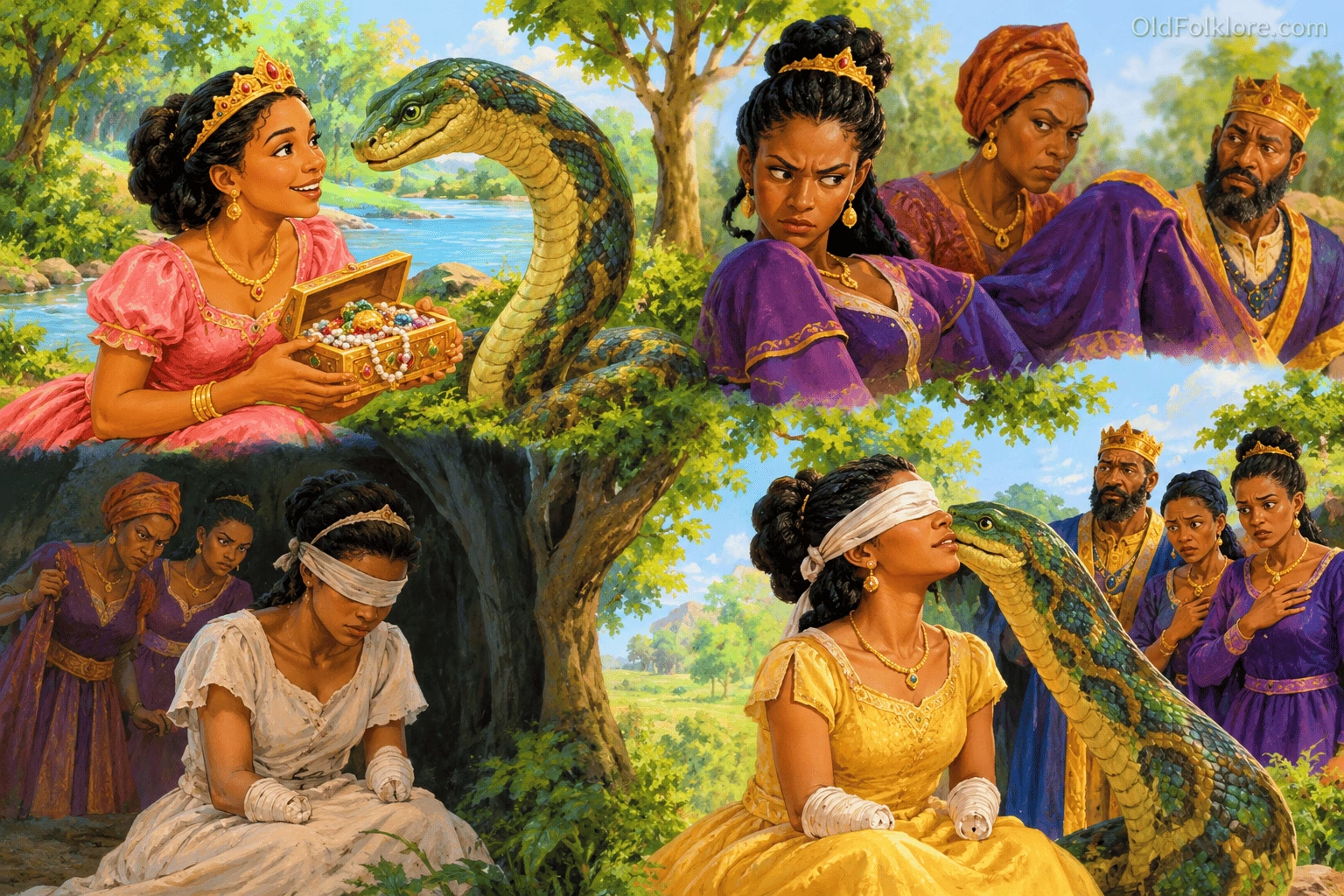
“Do not be afraid,” it told her. “I am your sister. We were born on the same day, at the same birth, and my name is Samaritana.”
The girl could hardly believe what she was hearing. Yet the serpent spoke with such assurance that she listened as it explained what she must do.
The following day, Biancabella was to bring two vessels into the garden. One had to contain pure milk, and the other the finest rose water. She must then return alone, without bringing anyone to accompany her.
Samaritana warned that obedience would bring happiness, while disobedience would expose her to terrible misfortune.
Biancabella returned to the palace without telling anyone what had happened. The next morning, she asked her mother to provide the two vessels. The marchioness readily agreed, and the milk and rose water were carried into the garden.
When the appointed hour arrived, Biancabella entered alone and shut the garden door behind her.
Samaritana appeared and instructed her to remove her clothes and step into the milk. The serpent wound itself around her, bathing her body and cleansing her from head to foot. Then it directed her into the rose water, whose fragrance seemed to restore her with new life.
At last, Samaritana told her to dress again. She commanded Biancabella to keep the encounter secret, even from her own parents, explaining that she wished no other woman in the world to equal her sister in beauty and grace.
From that day, Biancabella possessed gifts beyond ordinary understanding. When her mother combed her hair, pearls and precious stones fell from her golden locks. Whenever she washed her hands, roses, violets and other beautiful flowers appeared around them, filling the air with sweetness.
Her father, Lamberico, initially doubted the reports of these wonders. But when he saw them with his own eyes, his disbelief turned to astonishment. Proud of his daughter, he declared that no man in the world could possibly be worthy of marrying her.
A king wins her hand
News of Biancabella’s extraordinary beauty travelled far beyond Monferrato. Kings, princes and noblemen came from distant lands hoping to win her hand, but her father rejected them all.
Then Ferrandino, King of Naples, arrived to seek her in marriage. He possessed noble bearing, considerable wealth and great power. Lamberico judged him a worthy husband and agreed to the match.
Biancabella and Ferrandino were betrothed, and their marriage preparations began.
But before the ceremonies were completed, Biancabella remembered Samaritana’s warning. She hurried away to the garden, entered alone and called for her serpent sister.
There was no answer.
She searched the garden, calling again and again, but Samaritana remained hidden. At last, Biancabella understood that her sister had withdrawn because she had failed to obey the command to keep their secret and had allowed herself to become distracted from her sister’s instructions.
Grief-stricken, she returned to Ferrandino. The wedding proceeded, and she accompanied her husband to Naples, where the people welcomed the royal couple with great celebrations.
Yet an even greater danger awaited her in her new home.
The stepmother’s wicked plan
Ferrandino’s stepmother had two daughters of her own. Although both were unattractive, she had hoped to arrange a marriage between one of them and the king. Biancabella’s arrival destroyed that ambition, and the stepmother concealed a growing hatred beneath a show of affection.
Soon, trouble arose between Naples and the King of Tunis, who assembled a powerful army and advanced against Ferrandino’s kingdom. The Neapolitan king had to leave his pregnant wife behind and lead his forces into battle.
With Ferrandino gone, his stepmother saw an opportunity to remove the woman who stood between her daughters and the throne.
She summoned several loyal servants and ordered them to take Biancabella into the woods and kill her. To prove that they had carried out the command, they were to return with evidence of her death.
The servants led the unsuspecting queen away under the pretence of taking her on an outing. But when they saw her beauty and heard her gentle manner, they could not bring themselves to murder her.
Instead, they committed a terrible act of cruelty: they cut off both her hands and put out her eyes. Believing these injuries would convince the stepmother that Biancabella was dead, they carried the severed hands back to the palace.
The stepmother was delighted. She then devised a deception to conceal what she had done.
She spread the story that her own two daughters had died from illnesses. She also claimed that Biancabella had lost her unborn child after being overcome by grief at her husband’s departure, and that a severe fever had left her gravely disfigured.
Her real intention was to place one of her daughters in the king’s bed and persuade Ferrandino that the sick, altered woman was his wife.
When Ferrandino returned victorious from battle, he hurried to see Biancabella. Instead of the radiant queen he remembered, he found a pale, shrivelled woman lying in bed.
He could scarcely recognise her.
When he ordered her hair to be combed, no pearls or precious stones fell from it. Instead, worms emerged from the tangled locks. Nor did roses and violets appear when her hands were washed. The woman before him seemed to produce only filth.
The stepmother insisted that the terrible changes were the result of a prolonged illness. Confused and distressed, Ferrandino struggled to understand how his beloved wife could have changed so completely.
Meanwhile, the real Biancabella lay alone in the woods, blind and without hands. She called repeatedly for Samaritana, but only the echo of her own voice answered.
Kindness in the wilderness
As Biancabella despaired, an elderly man happened to pass through the woods. Hearing her cries, he followed the sound until he found her helpless among the trees and brambles.
Moved by compassion, he took her home and asked his wife to care for her. He also instructed his three daughters to keep Biancabella company and provide whatever assistance she needed.
His wife was displeased. She could not understand why her husband would bring a stranger who was blind and maimed into their home. She even suggested that the woman’s suffering must be punishment for some wrongdoing.
The old man would not tolerate such cruelty. He insisted that his household obey his instructions.
At first, the wife refused to help Biancabella with even the simplest tasks. But one of the daughters, touched by pity, eventually agreed to comb the stranger’s hair.
Almost immediately, pearls, rubies, diamonds and other precious stones fell from Biancabella’s golden locks.
The sight transformed the household’s attitude. The wife, who had previously treated Biancabella with hostility, began to regard her with affection. The family rejoiced at the wealth that the jewels promised to bring.
Biancabella then asked for a bucket of clean water. When the family washed her face and injured arms, roses, violets and other flowers appeared.
The old man and his household now understood that their guest possessed extraordinary gifts. Yet, even with their kindness and newfound good fortune, Biancabella remained troubled by her separation from her serpent sister.
After some time, she asked the old man to take her back to the place where he had found her. The family begged her to remain, but she had made up her mind. She promised to return and asked the old man to leave her alone in the woods for a while, then come back for her that evening.
Once he had gone, Biancabella wandered through the forest, calling for Samaritana. Still, no answer came.
Overcome by suffering and convinced that she had been abandoned by everyone, she began to believe that life offered her nothing more. She made her way to a pool, intending to drown herself.
Just as she stood at the water’s edge, a powerful voice thundered through the woods.
“Do not take your own life. Preserve it, for it has a better purpose yet to fulfil.”
Biancabella stopped. The voice sounded familiar, and she gathered the courage to ask who was speaking.
“It is I, Samaritana,” came the answer, “your sister, whom you have called for so long.”
At last, Biancabella broke down and begged for forgiveness. She admitted that she had failed to heed her sister’s warning, but explained that her mistake had come from ignorance rather than malice. She pleaded for help, telling Samaritana of the cruelty she had endured.
Samaritana listened and took pity on her. She gathered powerful medicinal herbs and placed them over the empty sockets where Biancabella’s eyes had been. Then she brought two hands and joined them to her sister’s wounded wrists. Miraculously, Biancabella was made whole again.
Samaritana then shed her serpent skin and revealed herself as a beautiful maiden.
When the old man returned, he found Biancabella restored and sitting beside another young woman of extraordinary beauty. Astonished by the sudden recovery, he asked how it had happened.
Biancabella explained that her sister had healed her. The two sisters then returned with the old man to his home, where his wife and daughters welcomed them warmly.
The palace that appeared overnight
Some time later, Biancabella, Samaritana and the old man’s family travelled to Naples. Near the royal palace, they found an empty space where they decided to settle.
After nightfall, Samaritana took a laurel twig and struck the ground three times while uttering mysterious words. Before long, a magnificent palace rose before them, so splendid that it seemed impossible for it to have appeared in a single night.
The next morning, Ferrandino looked out of his window and saw the astonishing building. He summoned his wife and stepmother to look at it, but the sight filled both women with unease.
As the king examined the palace, he noticed two beautiful ladies standing at a window. One of them reminded him of Biancabella, whose beauty he had once known so well.
He sent a messenger to ask whether he might visit them. They replied graciously that they would be honoured to receive him, but that it would be more proper for them to pay their respects to the king.
Ferrandino therefore went to their palace with the queen, his stepmother and several ladies of the court. The two women received their guests with courtesy, showing them the magnificent halls, richly decorated chambers and splendid galleries.
Before the king departed, they invited him and the queen to dine with them on an appointed day. Ferrandino accepted.
When the day arrived, the royal party attended the feast. After the meal, Samaritana proposed that someone should offer entertainment to make the gathering more pleasant.
She called upon a young woman named Silveria to sing. Taking up her lyre, Silveria performed a song that recounted the entire story of Biancabella, from her extraordinary birth to the terrible betrayal that had left her blind and without hands.
She did not mention Biancabella’s name.
When the song ended, Samaritana asked the king what punishment would be suitable for people capable of committing such a crime. Before Ferrandino could answer, his stepmother spoke up boldly.
Such criminals, she declared, deserved to be thrown into a blazing furnace.
Samaritana immediately turned on her.
“You have pronounced your own sentence,” she declared, exposing the stepmother as the woman responsible for Biancabella’s suffering.
Then she turned towards Ferrandino and revealed the truth: the woman before him was his real wife, the queen he had loved and believed lost.
To prove it, she asked the old man’s three daughters to comb Biancabella’s hair. As they passed the comb through her golden locks, precious jewels fell out. Roses and fragrant flowers appeared around her hands, and the delicate golden necklace was visible around her neck, shining as though it had grown beneath her skin.
Ferrandino recognised the unmistakable signs. Overcome with joy, he embraced Biancabella and wept at their reunion.
The stepmother’s deception was finally exposed. The king ordered a furnace heated and commanded that the wicked stepmother and her two daughters be thrown into it. Their punishment was terrible, but in the tale’s moral world, it answered the cruelty they had inflicted upon an innocent woman.
Afterwards, the old man’s three daughters were honourably married. Biancabella and Samaritana remained together, and Biancabella resumed her life with Ferrandino. The king and queen lived happily for many years, and when Ferrandino died, their son inherited the kingdom.
Thus Biancabella, who had lost almost everything through another woman’s envy, regained her sight, her hands, her husband and her place in the world. The sister who had once seemed an impossible mystery became the one who rescued her when all other help had failed.
Keep reading: Discover more Central African folktales
Moral
Do not allow jealousy and ambition to turn you against innocent people. Cruelty may temporarily conceal wrongdoing, but deception cannot guarantee that the truth will remain hidden. Biancabella’s story also reminds readers of the value of compassion: the old man’s kindness gives her shelter when she is most vulnerable, while Samaritana’s loyalty helps her recover what she has lost.
Knowledge Check
1. Why was Biancabella given her name?
Because she was exceptionally beautiful as a child.
2. Who was Samaritana?
Samaritana was Biancabella’s supernatural sister, who first appeared as a serpent and later revealed her human form.
3. Why did Ferrandino’s stepmother plot against Biancabella?
She resented Biancabella because the queen’s marriage to Ferrandino destroyed her hope of marrying one of her own daughters to the king.
4. How did Biancabella survive after being abandoned in the woods?
An elderly man discovered her and took her home. Later, Samaritana healed her injuries and restored her sight and hands.
5. How was the stepmother’s deception exposed?
At a banquet, a song recounted Biancabella’s story. Samaritana then revealed the truth, and the jewels, flowers and golden necklace confirmed Biancabella’s identity.
6. What is one of the central lessons of the tale?
Cruelty and deception can bring suffering, while compassion, loyalty and truth help restore what wrongdoing has taken away.
Source
Giovanni Francesco Straparola, The Nights of Straparola, W. G. Waters translation, Lawrence and Bullen, 1894, volume I. Project Gutenberg 75257.
Explore More African Folktales
- The Bremen Town Musicians: The Grimm Brothers’ Tale of Four Animals Who Found a New Home
- The Secret of the Little Iron House
- The Bremen Town Musicians: Grimm Fairy Tale
- Little Red Riding Hood: A Grimm Fairy Tale
- The Flea: Basile’s Italian Fairy Tale
- The Bronze Ring: A Classic Fairy Tale
- The Field of Boliauns: An Irish Folktale