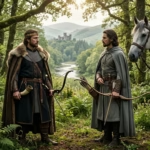
Bendigeid Vran, the mighty son of Llyr, ruled the Island of the Mighty from his royal seat in Britain. One day, while sitting at Harlech with his brother Manawyddan and their kinsmen Nissyen and Evnissyen, he noticed thirteen splendid ships approaching from the south of Ireland.
The ships belonged to Matholwch, King of Ireland, who had come with an important request. He wished to marry Branwen, Bendigeid Vran’s beautiful sister, and unite their kingdoms through marriage.
Bendigeid Vran welcomed the Irish king and agreed to the proposal. The marriage celebrations were arranged at Aberffraw, where the two royal households gathered beneath great tents. Since Bendigeid Vran was so enormous that no ordinary building could contain him, the feast was held outdoors.
Explore more stories from our The Mabinogion collection.
Branwen and Matholwch were married that night, and the following day preparations began for the Irish king’s departure with his new bride.
However, not everyone was pleased with the arrangement.
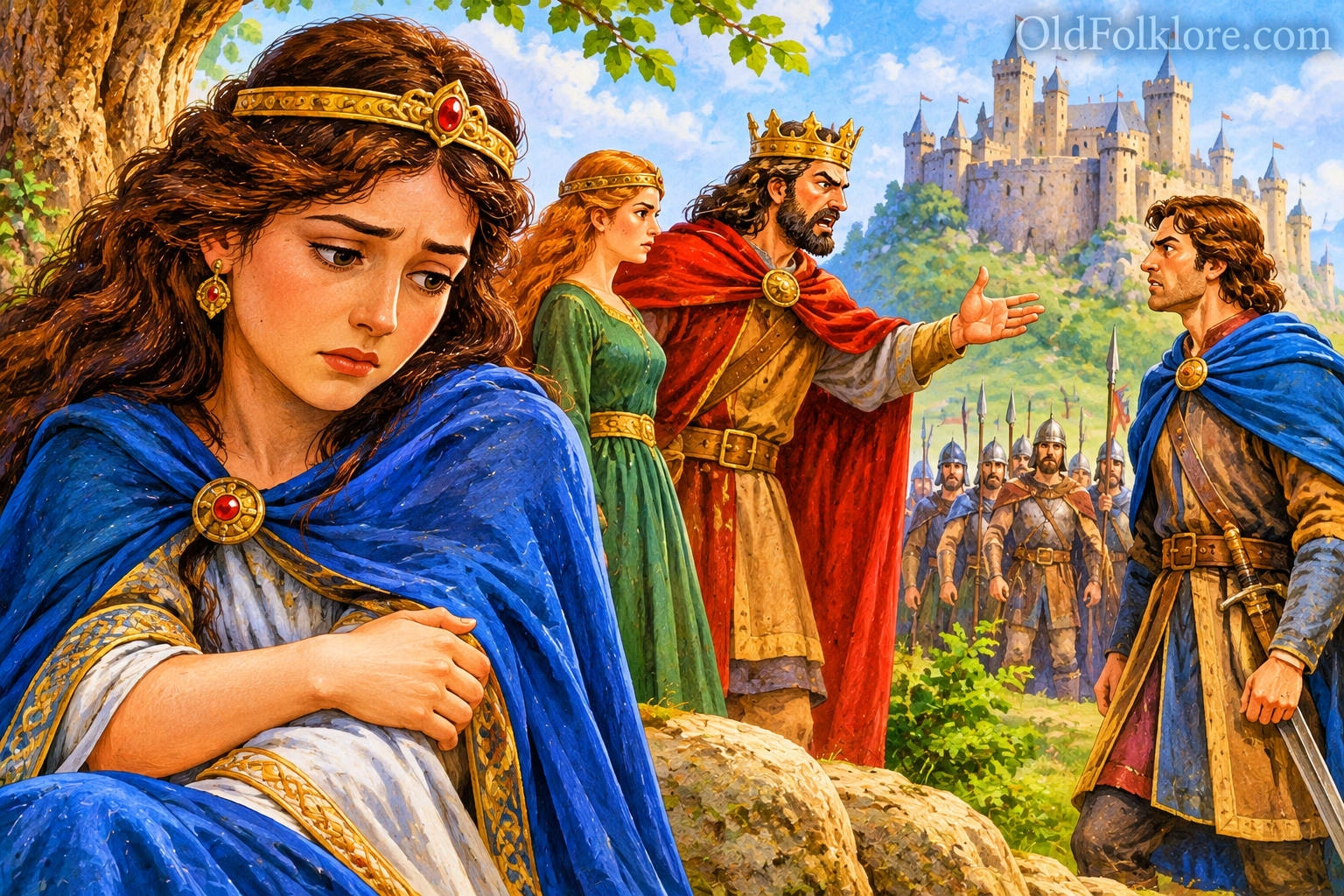
Evnissyen, Branwen’s half-brother, was a violent and quarrelsome man. When he discovered that Matholwch’s horses had been brought ashore, he demanded to know why his sister had been given in marriage without his permission.
Feeling insulted that such an important decision had been made without consulting him, Evnissyen took his anger out on the Irish king’s property. He mutilated the horses, cutting their ears, lips and tails and damaging their eyes until they were useless.
When Matholwch discovered what had happened, he was furious and deeply humiliated. He immediately prepared to return to Ireland.
Bendigeid Vran was informed that his new brother-in-law was leaving without taking his leave. He sent messengers to discover the reason, and Matholwch explained that he had never received such disrespectful treatment.
He was particularly troubled that the insult had come after he had been honoured with marriage to Branwen, a princess of such high standing.
The Price of Evnissyen’s Insult
Bendigeid Vran was distressed by the situation. He explained that the offence had not been committed with his approval and that he would do everything possible to restore peace.
He sent another embassy after Matholwch, offering a healthy horse for every animal Evnissyen had injured. He also promised a silver staff as tall as the Irish king and a gold plate as wide as his face.
Bendigeid Vran explained that Evnissyen was his brother through their mother, making it difficult for him to order his execution, but he was willing to make whatever additional arrangements Matholwch considered appropriate.
The Irish king consulted his advisers. They decided that refusing such compensation would only prolong the humiliation, so Matholwch agreed to return.
Yet Bendigeid Vran noticed that his brother-in-law remained unhappy. Believing the compensation might still be insufficient, he offered something far more extraordinary: a magical cauldron.
The cauldron possessed the power to restore dead warriors to life. Any man killed in battle who was placed inside it would emerge the following day ready to fight again. There was only one limitation: the restored warrior would never speak again.
Matholwch was delighted with this gift and eagerly accepted it.
During their subsequent conversation, the Irish king asked where the cauldron had come from. Bendigeid Vran explained that it had been given to him by Llassar Llaesgyvnewid, an Irishman who had escaped from an extraordinary ordeal with his wife, Kymideu Kymeinvoll.
Matholwch then recalled how the couple had once appeared in Ireland. The man was enormous, and his wife was even larger. They had arrived carrying a cauldron and explained that they were travelling because the woman was expecting a child who would be born fully armed as a warrior.
Matholwch had welcomed them and provided for them, but their behaviour eventually became intolerable. They began committing outrages and disturbing the nobles and ladies of the kingdom.
When the people demanded that the couple be removed, Matholwch’s advisers devised a terrible punishment. They constructed an iron chamber, heated it until the metal became white-hot and placed the couple and their children inside after giving them food and drink.
When the chamber was burning, the enormous man smashed through its heated iron walls, and his wife escaped with him. The others did not survive.
Matholwch believed that the couple had eventually reached Bendigeid Vran and that the cauldron had passed into his possession.
The British king confirmed that they had come to his kingdom and explained that he had allowed them to settle throughout his territories, where their descendants had become numerous and prosperous.
After the celebrations, Matholwch returned to Ireland with Branwen.
Branwen’s Life in Ireland
Matholwch’s return was celebrated throughout Ireland. Branwen quickly became popular among the Irish nobles and their families. Whenever important visitors came to see her, she presented them with valuable gifts, including jewellery, rings and royal ornaments.
She spent her first year enjoying the respect and affection of the kingdom. In time, she became pregnant and gave birth to a son named Gwern. The child was sent away to be raised by foster parents chosen from among the finest families in Ireland.
But the happiness did not last.
During the second year, Matholwch’s relatives and advisers began reminding him of the humiliation he had suffered in Britain. They mocked him for accepting compensation after the destruction of his horses and accused him of allowing the British to treat him disrespectfully.
Their complaints grew so persistent that Matholwch eventually gave in to their demands for revenge.
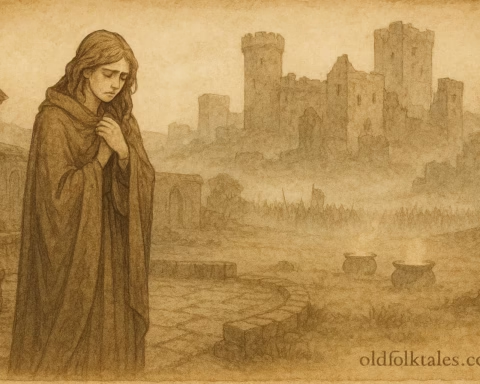
Branwen was removed from the royal chamber and forced to work as a cook for the entire court. Her position as queen offered her no protection. Every day, after the butcher had prepared the meat, he was ordered to strike her across the ear.
The woman who had once been welcomed with honour was now treated as a servant and subjected to daily humiliation.
Matholwch’s advisers also ordered that all communication between Ireland and Britain should be stopped. Ships, ferries and small boats were forbidden from crossing between the kingdoms. Anyone arriving from Britain was imprisoned to prevent news of Branwen’s suffering from reaching her family.
This continued for three years.
The Starling Carries a Message
Although Branwen was isolated, she refused to surrender all hope.
She had raised a starling in the cover of a kneading trough and patiently taught it to speak. She taught the bird about her brother, Bendigeid Vran, and made it familiar with the message she needed to send.
She then wrote a letter describing her suffering, the humiliation she had endured and the cruelty of her treatment in Ireland.
Tying the letter to the bird’s wing, she released it towards Britain.
The starling eventually reached Caer Seiont in Arvon, where Bendigeid Vran was holding a meeting. It landed on his shoulder and ruffled its feathers, drawing attention to the letter attached to its wing.
When the king read his sister’s message, he was overcome with grief and anger.
He immediately summoned the rulers and warriors of his territories. He explained what had happened to Branwen and sought their counsel.
They agreed that an army should cross the sea to Ireland and bring an end to her suffering.
Before departing, Bendigeid Vran appointed seven men to govern Britain in his absence, placing his nephew Caradawc, the son of Bran, in charge. Pendaran Dyved, who was still a young page, remained with them.
With his army assembled, Bendigeid Vran set sail for Ireland.
The Giant Crosses the Sea
When the Irish swineherds looked towards the sea, they noticed something extraordinary.
A great forest seemed to be growing out of the water where no forest had ever existed. Beside it stood an enormous mountain, and on top of the mountain was a ridge with a lake on either side. Stranger still, the entire formation appeared to be moving.
They hurried to Matholwch and reported what they had seen.
The king could not understand the sight, so he sent for Branwen and asked her to explain.
She immediately recognised what was approaching.
The apparent forest was the collection of ship masts and rigging belonging to her brother’s fleet. The mountain was Bendigeid Vran himself, who was so enormous that no ship could carry him. The two lakes were his eyes, one on either side of his nose, as he looked towards Ireland in anger.
Matholwch’s nobles gathered in alarm and advised him to retreat across the River Linon. They recommended destroying the bridge so that the invading army could not cross.
Bendigeid Vran eventually reached the river with his warriors, only to discover that the bridge had been destroyed.
His men asked how they could possibly cross.
The king gave a remarkable answer. If someone had to serve as the bridge, he would do it himself.
He lay down across the river, and his warriors placed hurdles over his enormous body. The army then crossed over him to the other bank.
From this extraordinary act came a saying that was remembered as a proverb: a true leader must sometimes become the bridge that allows others to pass.
The False Peace
As Bendigeid Vran rose from the river, messengers from Matholwch approached him.
They brought an offer of peace. Matholwch proposed surrendering the kingdom of Ireland to Gwern, his son by Branwen, who was also Bendigeid Vran’s nephew. He promised that Matholwch himself would live wherever the British king permitted.
But Bendigeid Vran was not satisfied.
He questioned why the kingdom should be given to the boy rather than to himself. He refused to make a final decision until further negotiations had taken place.
The messengers returned to Matholwch, who asked his advisers what to do next.
They recommended building an enormous hall that could accommodate both armies. Since Bendigeid Vran had never been able to enter an ordinary building, they believed that constructing a hall large enough for him would be considered a great honour. They advised Matholwch to surrender his kingdom and pay homage to him, hoping that the gesture would secure peace.
Bendigeid Vran consulted his own advisers, and Branwen also urged acceptance. She feared that continuing the conflict would destroy the country.
The agreement was made, and a vast hall was constructed.
However, the Irish had no intention of honouring the peace.
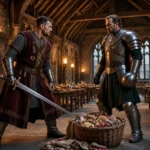
They secretly attached two hundred leathern bags to brackets around the pillars of the building. Inside each bag was an armed warrior, ready to attack the British guests when the opportunity arose.
When Evnissyen entered the hall, he immediately noticed the strange bags.
He asked an Irishman what they contained.
The man replied that they were filled with meal.
Evnissyen reached inside the first bag and discovered a man’s head. He crushed it between his hands until the warrior died. He then examined the remaining bags and repeated the same action.
One by one, he killed the hidden soldiers, including the final man, whose head was protected by a helmet.
After discovering and destroying the ambush, Evnissyen composed a short verse celebrating the discovery of the armed warriors concealed beneath the appearance of harmless bags of flour.
The British army could now enter the hall without falling into the trap.
Gwern’s Terrible Death
When the two armies gathered inside the hall, an agreement appeared to have been reached.
Gwern was formally recognised as king of Ireland. The boy was brought before Bendigeid Vran, who welcomed him affectionately. He then went to Manawyddan, who also treated him with love, before being introduced to Nissyen.
The child was warmly received by everyone.
Then Evnissyen called for him.
He complained that his nephew had visited the others but had not yet come to him. He insisted that he wished to hold the boy, even if Gwern had not been destined to become king.
Bendigeid Vran allowed the child to approach his uncle.
But Evnissyen had already decided what he would do.
As soon as Gwern came within reach, Evnissyen seized him by the feet and threw him headfirst into the blazing fire.
Branwen witnessed the terrible act and tried desperately to throw herself into the flames after her son. Bendigeid Vran restrained her with one hand while holding his shield with the other.
The hall erupted into chaos.
The British warriors rushed to find their weapons, while the Irish began attacking them. The fragile peace collapsed, and a fierce battle broke out.
The Irish brought out the magical cauldron Bendigeid Vran had given Matholwch. They began throwing the bodies of their dead warriors into it, and the following day the men emerged alive and ready to fight again.
However, they could no longer speak.
The British had no equivalent means of restoring their dead.
Evnissyen watched as the bodies of the British warriors remained lifeless. He realised that his own actions had helped bring his people into this terrible situation.
Overcome with regret, he decided that he must find a way to destroy the cauldron.
He pretended to be one of the dead Irish warriors and allowed himself to be thrown inside. Once in the cauldron, he stretched his body with all his strength until the vessel broke into four pieces.
The effort also caused his own heart to burst, and he died.
His sacrifice destroyed the instrument that had been keeping the Irish army fighting.
Nevertheless, the battle had already devastated both sides. The British achieved some success, but they were not victorious. Almost the entire army had perished.
Only seven men survived: Pryderi, Manawyddan, Gluneu Eil Taran, Taliesin, Ynawc, Grudyen the son of Muryel, and Heilyn the son of Gwynn Hen.
Bendigeid Vran himself had received a poisoned wound in the foot.
The Death of Bendigeid Vran
Knowing that he would not recover, Bendigeid Vran gave his surviving companions an extraordinary instruction.
They were to cut off his head and carry it to the White Mount in London, where it must be buried facing towards France.
He also gave them detailed instructions about their journey.
They were to stop at Harlech, where they would feast for seven years while the magical birds of Rhiannon sang to them. During that time, his head would remain with them and provide companionship as though he were still alive.
Afterwards, they were to travel to Gwales in Penvro, where they would spend another eighty years in a magnificent hall overlooking the sea.
There was one condition: they must never open the door facing Cornwall and Aber Henvelen.
As long as they obeyed this instruction, they would remain free from sorrow and the awareness of their terrible losses.
The seven survivors followed his command, cut off his head and began their journey. Branwen accompanied them.
They eventually reached Aber Alaw, where they stopped to rest. Branwen looked back towards Ireland and then towards Britain, remembering the destruction that had followed her marriage.
She was overwhelmed by guilt and sorrow.
She lamented that two islands had been devastated because of her and declared that she wished she had never been born.
Then she gave a great cry, and her heart broke.
Her companions buried her in a four-sided grave beside the River Alaw before continuing their journey with Bendigeid Vran’s head.
The Seven Years at Harlech
As the companions travelled towards Harlech, they encountered people who told them terrible news from Britain.
Caswallawn, the son of Beli, had seized the kingdom and crowned himself king in London.
The seven men asked what had happened to Caradawc and the other men who had been left behind to govern the island.
They learned that Caswallawn had killed six of them. Caradawc had witnessed their deaths but could not see who was wielding the sword. Caswallawn had concealed himself with a magical Veil of Illusion, leaving only the sword visible as it struck.
Caswallawn spared Caradawc because he was his nephew, but the grief of witnessing his companions’ deaths broke Caradawc’s heart.
Pendaran Dyved, the young page, had escaped into the forest.
The survivors continued to Harlech, where they settled down to eat and drink. Three extraordinary birds appeared and began to sing. Their music was so beautiful that every other song the companions had ever heard seemed unpleasant by comparison.
Although the birds appeared to be far away across the sea, their voices sounded remarkably clear.
The men remained there for seven years, enjoying the birds’ enchanting music and the companionship of their king’s head.
Eighty Years in the Hall at Gwales
At the end of the seven years, the companions travelled to Gwales in Penvro.
There they discovered a magnificent place overlooking the ocean, with a spacious hall that seemed perfectly suited to their needs.
They entered and found that two doors were open. A third door, however, remained closed. It was the door facing towards Cornwall, the very door Bendigeid Vran had warned them never to open.
Manawyddan reminded the others of their king’s instruction, and they agreed to leave it untouched.
Inside the hall, they enjoyed wonderful feasts and pleasant company. Their sorrow disappeared, and they no longer remembered the suffering, deaths and destruction they had experienced.
They lived without ageing or becoming weary. The head of Bendigeid Vran remained with them, perfectly preserved and as comforting as their king had been in life.
What seemed like a brief and joyful stay continued for eighty years.
The extraordinary period became known as the Entertaining of the Noble Head.
But eventually, one of the companions, Heilyn the son of Gwynn, became curious about the forbidden door.
He declared that he could no longer resist discovering what lay beyond it. Despite the warning, he opened the door and looked towards Cornwall and Aber Henvelen.
Immediately, the enchantment was broken.
All the sorrow they had escaped came rushing back. They remembered their dead companions, their suffering in Ireland, the destruction of their kingdoms and, above all, the death of Bendigeid Vran.
The eighty years of happiness were over.
Unable to remain in the hall any longer, the companions took up their king’s head and continued towards London.
When they arrived, they buried it at the White Mount, facing France, just as Bendigeid Vran had commanded.
According to the story, this burial was one of the three great concealments of Britain. While the head remained hidden there, no invasion from across the sea could successfully threaten the island. Its eventual discovery would become one of the three great disastrous disclosures.
The Fate of Ireland
The destruction of the Irish kingdom was almost complete.
According to the tale, only five pregnant women survived, having taken refuge together in a cave in the Irish wilderness.
Each woman gave birth to a son on the same night. They raised the five boys until they became grown men.
As the young men reached adulthood, they began looking for wives. Each eventually married the mother of one of his companions, and together they governed and repopulated the country.
The five men divided Ireland among themselves, and the story connects this division with the traditional five divisions of Ireland.
They also explored the places where the battles had been fought and discovered great quantities of gold and silver, making themselves wealthy.
Thus ended the story of Branwen, the daughter of Llyr, whose marriage had brought two kingdoms together only for pride, cruelty and revenge to destroy them.
Explore our complete Historic Folklore & Fairy-Tale Collections archive.
Moral
Uncontrolled pride, cruelty and the desire for revenge can turn a personal disagreement into a tragedy for entire communities. The story also reminds us that innocent people often suffer the greatest consequences of conflicts they did not create.
Knowledge Check
1. Who was Branwen, and whom did she marry?
Branwen was the daughter of Llyr and sister of Bendigeid Vran. She married Matholwch, the King of Ireland.
2. What started the conflict between Britain and Ireland?
Evnissyen mutilated Matholwch’s horses because he felt insulted that Branwen’s marriage had been arranged without his consent.
3. How did Branwen communicate her suffering to her brother?
She trained a starling to carry a letter describing her mistreatment to Bendigeid Vran in Britain.
4. What was special about the cauldron given to Matholwch?
It could restore dead warriors to life, although those brought back could never speak again.
5. How did Evnissyen destroy the cauldron?
He allowed himself to be thrown into it and stretched his body until the cauldron broke into four pieces, killing him in the process.
6. Why was Bendigeid Vran’s head carried to London?
He instructed his companions to bury it at the White Mount, facing France, where its supernatural protection would preserve Britain from invasion.
7. What happened when Heilyn opened the forbidden door at Gwales?
The enchantment ended, and the companions remembered all their suffering, losses and the death of their king.
Source
Based on The Mabinogion, translated from medieval Welsh by Lady Charlotte Guest, with notes, Third Edition, published by Bernard Quaritch, London, 1877, pp. 369–384, specifically the Second Branch, “Branwen the Daughter of Llyr.”
Explore More On The Mabinogion