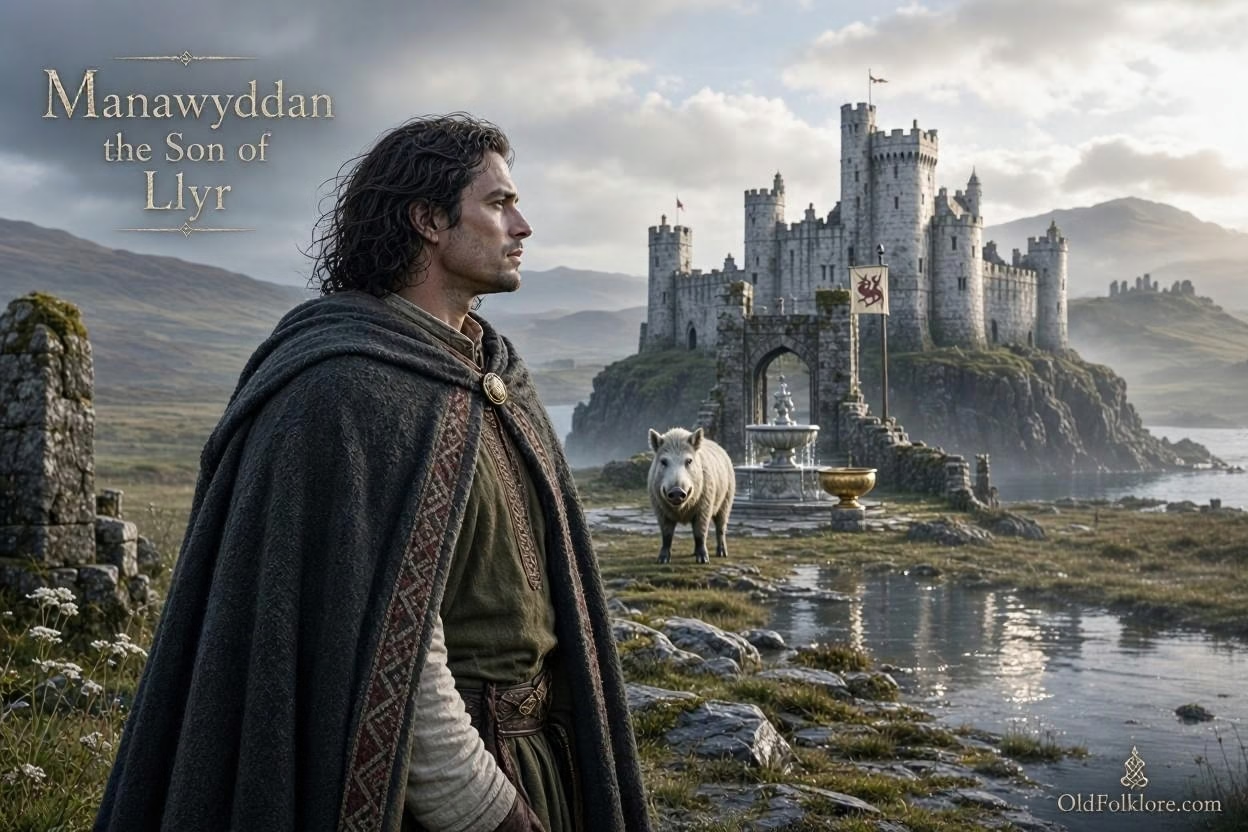
Manawyddan the Son of Llyr is a tale of loss, patience and determination from the Welsh collection known as The Mabinogion. It follows Manawyddan, a prince who finds himself without a home after the death of his brother, Bendigeid Vran. With the help of Pryderi, he settles in Dyved, marries Rhiannon and begins a new life. However, an extraordinary enchantment suddenly removes every person, animal and dwelling from the land, leaving only four companions behind.
As Manawyddan attempts to survive the mysterious disappearance, he encounters hostility, strange magical events and the loss of his closest companions. His journey eventually leads him to discover the person responsible for the enchantment and the reason behind the suffering of Dyved.
Manawyddan Loses His Home
After the death of Bendigeid Vran, seven survivors carried his head to London and buried it on the White Mount, with its face towards France, as he had commanded. Among those who returned from the journey was Manawyddan, the son of Llyr.
When the burial was completed, Manawyddan looked upon London and the companions around him. A deep sadness came over him because he had lost his brother and had no place he could truly call home. Caswallawn, his cousin, had taken the throne, and Manawyddan could not bear the thought of living in the same household with the man who had replaced Bendigeid Vran.
Pryderi noticed his sadness and offered him friendship. He reminded Manawyddan that seven cantrevs, or districts, of Dyved belonged to him and that his mother, Rhiannon, lived there. He offered Manawyddan the land and proposed that he should marry Rhiannon. Pryderi also explained that his own wife was Kicva, the daughter of Gwynn Gloyw.
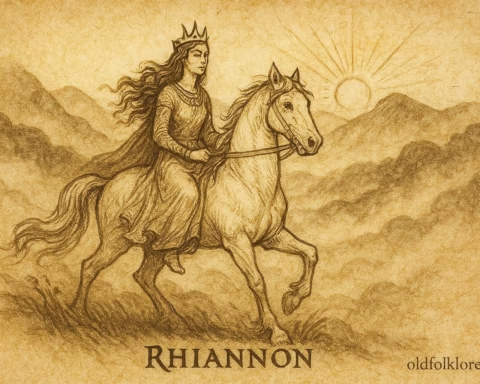
Manawyddan appreciated the offer and agreed to travel with Pryderi to Dyved. When they arrived at Narberth, Rhiannon and Kicva welcomed them with a feast. Manawyddan and Rhiannon spent time speaking together, and he became impressed by her beauty, intelligence and graceful manner. Before the feast ended, Rhiannon agreed to marry him.
A New Life in Dyved
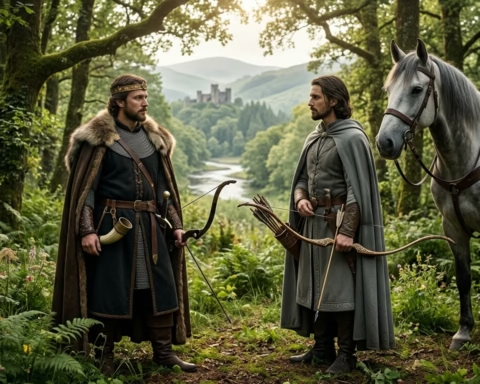
Manawyddan and Rhiannon settled in Dyved alongside Pryderi and Kicva. The four became close companions and enjoyed the pleasures of the land. They travelled through the districts, hunted and admired the beauty of their surroundings.
Dyved was a pleasant country, filled with good hunting grounds, honey and fish. The four companions found great happiness in one another’s company, and they rarely separated either during the day or at night.
Manawyddan also went to meet Caswallawn at Oxford and paid him homage. Caswallawn received him honourably, and Manawyddan returned to Dyved.
Explore more stories from our The Mabinogion collection.
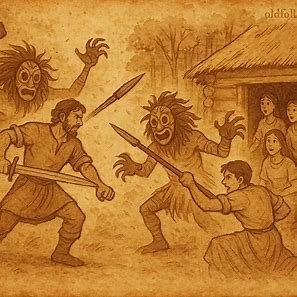
One evening, while they were holding a feast at Narberth, the four companions went out to the Gorsedd of Narberth after the first meal. Their attendants accompanied them. Suddenly, a terrible peal of thunder shook the surroundings, and a thick mist descended over the land. It became so dense that the companions could no longer see one another.
When the mist cleared and daylight returned, they looked around in astonishment. Every person had disappeared. The cattle, herds, houses, smoke and fires were gone. The surrounding country, which had once been full of life, had become completely deserted.
Only Manawyddan, Rhiannon, Pryderi and Kicva remained.
The Four Companions Face an Empty Land
The four searched the palace and its surroundings, hoping to discover what had happened to their people. They entered the hall, the castle, the sleeping chambers, the kitchen and the mead cellar, but found nobody.
They travelled through the land and visited the houses and settlements, yet there was no sign of human life. Only wild animals remained.
At first, they continued hunting and enjoying the provisions available to them. They also gathered honey from wild swarms. They managed to live this way for two years, but eventually the strange emptiness of the country became unbearable.
Manawyddan suggested that they travel to England, known in the tale as Lloegyr, where they could learn a trade and earn their living. The others agreed, and they journeyed to Hereford.
Manawyddan Becomes a Skilled Craftsman
In Hereford, Manawyddan began making saddles and decorating them with blue enamel. He had learnt the art from Llasar Llaesgywydd and produced work of remarkable quality. His saddles became so popular that customers stopped buying from the other craftsmen.
The local saddlers noticed that their businesses were suffering. They gathered together and agreed to kill Manawyddan and his companions. When the four received warning of the plan, Pryderi suggested fighting the craftsmen. Manawyddan refused because he believed that fighting them would bring them trouble and disgrace. Instead, he advised that they leave the town.
They travelled to another place and decided to make shields. Their workmanship again attracted many customers, and the local shield-makers soon became jealous. They also plotted to kill the newcomers.
Once more, Manawyddan refused to fight. The four left and travelled to another town, where he taught Pryderi how to make shoes. They used the finest leather and decorated the shoes with gilded clasps. Their work became so popular that the local shoemakers lost their customers.
When the shoemakers also plotted against them, Manawyddan decided that they should return to Dyved rather than continue moving from town to town or fighting their fellow craftsmen.
The Mysterious White Boar
Back in Dyved, Manawyddan and Pryderi settled at Narberth and returned to hunting. One morning, they went out with their dogs. Some of the dogs approached a nearby bush but suddenly drew back, their hair standing on end.
Pryderi and Manawyddan moved closer to investigate. A pure white wild boar emerged from the bush. The dogs rushed towards it, but the animal retreated whenever the men approached, leading them away from the place where it had first appeared.
The pursuit continued until they reached a large and magnificent castle. They had never seen a building there before, and its sudden appearance filled them with wonder.
The white boar ran into the castle, followed by the dogs. Pryderi and Manawyddan waited outside and listened, but they could hear nothing from within.
Pryderi wanted to enter the castle to find his dogs. Manawyddan warned him against going inside a building that had appeared mysteriously in a place where no castle had previously stood. He suspected that whoever had enchanted Dyved might have caused the building to appear.
Pryderi ignored the warning and entered.
The Golden Bowl and the Disappearance of Rhiannon
Inside the castle, Pryderi found no people, animals or dogs. Instead, he saw a beautiful fountain surrounded by marble. Beside it stood a golden bowl resting on a marble slab, with chains hanging mysteriously above it.
The bowl attracted his attention because of its beautiful gold and fine workmanship. He approached and touched it.
Immediately, his hands became fixed to the bowl and his feet became stuck to the marble slab. He could neither move nor speak.
Manawyddan waited for him until evening, but Pryderi did not return. He eventually went back to the palace and explained what had happened to Rhiannon.
Rhiannon was angry that Manawyddan had returned without her son. She went straight to the castle, following the directions he had given her. When she entered, she found Pryderi standing helplessly beside the fountain. She approached him and took hold of the bowl.
The moment she touched it, her hands and feet became fixed in the same way. She could not move or speak.
As night approached, thunder sounded across the land, and another thick mist descended. The castle disappeared, taking Rhiannon and Pryderi with it.
Only Manawyddan and Kicva remained at the palace.
Manawyddan Protects Kicva
Kicva was overwhelmed with grief when she discovered that her husband and mother-in-law had disappeared. She became so distressed that she seemed to have lost all desire to live.
Manawyddan noticed her sorrow and reassured her. He promised that he would treat her with honour and friendship, just as he had always respected his relationship with Pryderi. He also assured her that she had nothing to fear from him.
Kicva was comforted by his words and regained some courage.
Since the palace no longer provided enough food and their dogs had disappeared, Manawyddan suggested that they return to England. Kicva agreed, and they travelled together.
Manawyddan continued making shoes, although Kicva thought the occupation was not suitable for a man of his noble position. He refused to abandon the trade. His shoes again became so popular that the local shoemakers grew jealous and plotted against him.
When Manawyddan learnt of their intentions, he decided that they should return to Dyved once more.
The Destruction of the Wheat Fields
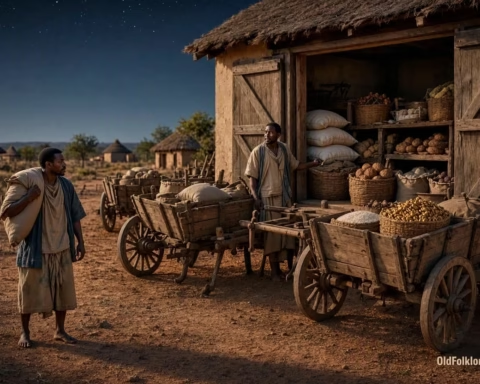
Manawyddan returned to Narberth with a supply of wheat. He was delighted to see the land again and began fishing, hunting deer and preparing fields for cultivation.
He sowed three fields of wheat, and all three grew remarkably well. As the harvest approached, he inspected the first field and found that the wheat was ready. He decided to reap it the following morning.
However, when he returned at dawn, he discovered that every ear of wheat had been removed. Only the bare stalks remained.
He went to inspect the second field, expecting to find it untouched. To his astonishment, the same thing had happened. Every ear of wheat had disappeared.
Manawyddan became concerned that whoever had begun destroying his property intended to ruin the entire country. He therefore decided to guard the third field through the night.
He informed Kicva of what had happened and prepared himself for the watch.
The Army of Mice
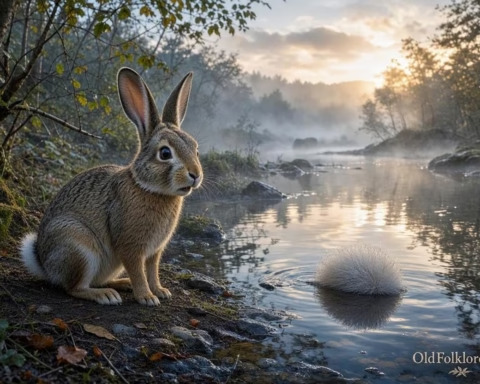
At midnight, Manawyddan heard an enormous commotion. When he looked towards the field, he saw countless mice moving through the wheat.
The mice climbed the stalks, bent them under their weight and cut off the ears of wheat. Each carried away its portion, leaving the field stripped of its harvest.
Manawyddan rushed towards them, but the mice moved too quickly for him to catch them. He managed to capture one that was slower than the others. He placed it inside his glove, tied the opening with a string and carried it back to the palace.
When Kicva asked what he had caught, he explained that it was a thief responsible for destroying his wheat. He told her that he intended to hang it the following morning and would have punished all the mice if he had been able to capture them.
Kicva advised him that it was beneath a man of his dignity to hang such a small creature. She suggested that he release it, but Manawyddan refused. He believed the mouse deserved punishment for destroying his harvest.
The Scholar, the Priest and the Bishop
The next morning, Manawyddan carried the mouse to the Gorsedd of Narberth. He prepared two wooden forks to support a crossbeam from which he intended to hang it.
As he worked, a poor scholar approached. The scholar questioned him about the mouse and asked him to release it. He offered Manawyddan a pound that he had received as alms, but Manawyddan refused.
Soon afterwards, a priest arrived and made a similar request. He offered three pounds to secure the mouse’s freedom, but Manawyddan remained determined to carry out his punishment.
Then a bishop arrived with his attendants and baggage horses. He also asked Manawyddan to release the mouse. He offered seven pounds, then twenty-four pounds, and eventually all the horses and baggage accompanying him.
Manawyddan refused every offer.
The bishop finally asked what Manawyddan wanted in exchange for the mouse. Manawyddan demanded that Rhiannon and Pryderi be released. The bishop agreed, but Manawyddan added another condition. He wanted the enchantment removed from the seven cantrevs of Dyved.
The bishop agreed again. However, Manawyddan was still unwilling to release the mouse. He wanted to know its true identity and demanded that no further revenge should be taken against him, Rhiannon or Pryderi.
The Truth Behind the Enchantment
The bishop finally revealed the truth. The mouse was his wife, whom he had transformed through magic. He identified himself as Llwyd, the son of Kilcoed, and admitted that he had placed the enchantment over Dyved.
Llwyd explained that he had done this to avenge Gwawl, the son of Clud, because of his friendship with him. His anger was connected to an earlier incident involving Pwyll, Prudery’s father, who had played the game of Badger in the Bag against Gwawl.
Llwyd had directed his revenge against Pryderi and the land of Dyved. When he learnt that Manawyddan had settled there, members of his household asked to be transformed into mice so they could destroy Manawyddan’s crops.
They had carried away the wheat from the first two fields. On the third night, Llwyd’s wife and the ladies of his court had joined them. Llwyd transformed them into mice, but his wife was pregnant. This condition made her slower than the others and allowed Manawyddan to catch her.
Llwyd promised to restore Rhiannon and Pryderi and remove the enchantment from Dyved. Manawyddan insisted that the land must never again be placed under such a spell. He also demanded that no revenge should be taken against any of them for what had happened.
Llwyd accepted all the conditions.
The Restoration of Dyved
After the agreement was reached, Llwyd restored Rhiannon and Pryderi. He then asked Manawyddan to release his wife.
Manawyddan agreed, and Llwyd struck her with a magic wand. She immediately returned to her original form as a beautiful young woman.
Llwyd then instructed Manawyddan to look across the land. When he did, he saw that Dyved had returned to its former condition. The fields were cultivated again, and the country was filled with people, herds and dwellings.
The enchantment had finally ended.
Manawyddan also learnt what had happened to Rhiannon and Pryderi while they were held captive. Pryderi had been made to carry the knockers of the palace gate around his neck, while Rhiannon had been forced to wear the collars used by asses carrying hay.
With the restoration of the land and the return of his companions, Manawyddan’s long struggle came to an end.
Thus ends the tale of Manawyddan the Son of Llyr, the third portion of the Mabinogi.
Explore our complete Historic Folklore & Fairy-Tale Collections archive
Moral Lessons of the Story
Manawyddan’s story teaches the importance of patience and careful judgement. Rather than responding to every difficulty with violence, he considers his circumstances and chooses a course of action that avoids unnecessary conflict. His decisions eventually help him uncover the truth and restore what was lost.
The tale also demonstrates that revenge can extend beyond the person against whom it is directed. Llwyd’s desire to avenge Gwawl brings hardship to Dyved and its inhabitants. His actions show how personal resentment can create suffering far beyond its original cause.
Another lesson concerns loyalty and responsibility. Manawyddan remains faithful to his companions even when they are no longer present. His determination to secure their freedom and protect them from further revenge reflects the value of honouring friendships and standing by those who have shown kindness.
Knowledge Check
1. Who was Manawyddan’s brother?
His brother was Bendigeid Vran, the son of Llyr.
2. Who offered Manawyddan the seven cantrevs of Dyved?
Pryderi offered him the seven cantrevs of Dyved.
3. What happened when the thick mist disappeared from Dyved?
All the people, animals, houses and other signs of human habitation had disappeared, leaving only Manawyddan, Rhiannon, Pryderi and Kicva.
4. What led Pryderi into the mysterious castle?
A white wild boar led him towards the castle, and he entered to find his missing dogs.
5. What did Manawyddan discover was destroying his wheat fields?
He discovered that enormous numbers of mice were carrying away the ears of wheat.
6. Who was responsible for the enchantment of Dyved?
Llwyd, the son of Kilcoed, was responsible for the enchantment.
Source
Manawyddan the Son of Llyr is the third portion of the Mabinogi in The Mabinogion, translated by Lady Charlotte Guest and published in the nineteenth century.
Explore More On The Mabinogion