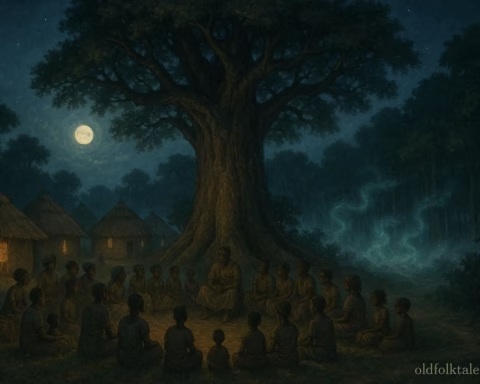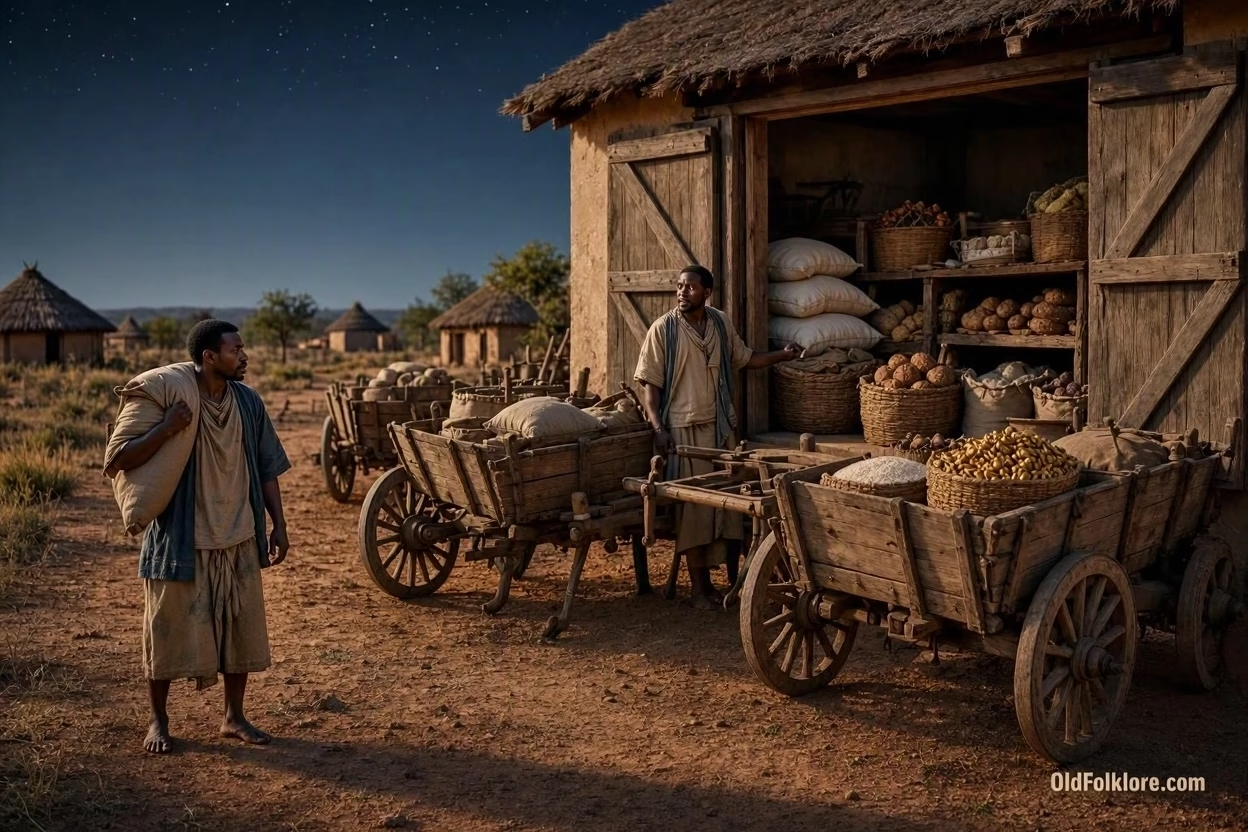
A terrible famine has left a once-inhabited land almost empty. Families struggle to find food, and parents watch their children go hungry. In this desperate situation, one man discovers something extraordinary: a mysterious storehouse filled with provisions, visited at night by strange ox-drawn carts.
His discovery offers a chance to survive, but it also introduces a danger he does not fully understand. When his neighbour learns about the hidden food, the two men embark on the same journey. However, their different decisions produce very different results.
The Hidden Storehouse is an adaptation of a documented Angolan folktale that explores hunger, caution, greed and the terrifying consequences of entering an unfamiliar world without understanding its dangers.
The Hidden Storehouse
A Land Devastated by Famine
A terrible famine had descended upon the land. Food had become so scarce that people could no longer find enough to sustain themselves. The suffering was widespread, and the people who had once lived in the area had gradually disappeared.
Only two households remained.
In one lived a man, his wife and their children. Their neighbours were another man, his wife and their children. Both families faced the same desperate circumstances, but neither knew where to turn for help.
One morning, after watching their children go without food, the first man’s wife could no longer hide her fear.
“We shall surely die of hunger,” she told her husband.
Her words expressed a reality that neither could ignore. Their children needed food, and the family had nothing left to give them.
The man spent the night thinking about their situation. He knew that remaining at home would not solve their problem. If he wanted his family to survive, he needed to search for food elsewhere.
He prepared himself to leave. Rather than setting out in the morning, however, he departed in the afternoon.
He travelled until the sun went down. When night approached, he stopped along the way, settled down and prepared a little food for himself.
The journey had brought him away from home, but he had not yet found the provisions he needed. He continued thinking about his family’s predicament as he rested.
The Strange Ox-Drawn Carts
Around midnight, the man noticed something unusual.
From the direction of a place where he had gone to fetch water, ox-drawn carts began to emerge. They were empty, and their appearance puzzled him.
He wondered where they had come from and why they were travelling through that place at such an hour.
Rather than immediately approaching the carts, he watched them. He wanted to understand what he had seen.
After the carts had departed, curiosity drew him towards the place from which they had emerged.
What he discovered astonished him.
Before him stood a storehouse filled with food. There was flour, rice, pasta, bread and other provisions. The supplies were so abundant that the sight seemed almost impossible in a land where people were dying from hunger.
The man stood before this unexpected discovery and considered what to do.
Entering the storehouse meant taking food that did not belong to him. Yet his family had nothing to eat, and hunger had become an immediate threat to their survival.
His thoughts turned towards his empty home and the children who had gone to bed hungry.
He decided to enter.
The First Journey into the Storehouse
Inside the storehouse, the man found numerous empty sacks. He took some and began filling them with food.
He gathered flour and rice, then added pasta and bread. Instead of attempting to carry everything he saw, he concentrated on filling his sack.
When he had collected enough provisions, he tied it securely and left the storehouse.
Outside, he returned to the place where he had made his fire and sat down.
He did not run away when the ox-drawn carts returned. He remained where he was and watched them approach the storehouse.
The carts entered the building, and everything closed up again.
The man observed the scene without interfering. He had found a place containing more food than he could have imagined, but he had also witnessed something mysterious. The carts appeared and disappeared in a way he could not explain.
As dawn approached, the roosters began to crow.
The man picked up his sack and made his way home.
When he arrived, he presented the provisions to his wife.
She was surprised and asked what he had brought.
He reminded her of the conversation they had shared the previous evening, when she had feared that their children would starve. He had gone out to search for food, and now he had returned with enough to feed them.
His wife thanked him.
She carried the provisions into the household’s storage area, and the family could finally begin preparing meals again.
A Hungry Stranger Arrives
The following morning, the household began cooking with the food the man had obtained.
During the day, the couple encountered a hungry man who had come from the surrounding wilderness. He had no settled place to stay and admitted that he was suffering from hunger and thirst.
The couple offered him food and drink.
They also gave him a place in their household, with the expectation that he would work as their servant and prepare meals for the family.
The stranger accepted the arrangement. He received food himself and then cooked for the man, his wife and their children.
The household’s circumstances had changed considerably. Where there had recently been hunger, there was now food to prepare and share.
Their neighbours, however, continued to struggle.
One day, the second couple’s children went to play with the children of the household that had discovered the storehouse.
While playing, they noticed the food being prepared and served. They were astonished to see flour, rice, bread and other provisions in a place where they had expected everyone to be hungry.
They hurried home to tell their parents what they had seen.
Their mother could hardly believe them. How could anyone possess so much food when the surrounding land had been devastated by famine?
The children insisted that they had seen the provisions with their own eyes.
Their mother decided to wait until her husband returned.
When he arrived, she told him what the children had reported. Their neighbours had food in abundance, while their own children continued to suffer.
She urged her husband to visit the household and discover what was happening.
The Second Man Seeks an Explanation
The second man went to his neighbour’s home that evening.
He greeted the household politely, and his hosts welcomed him. The conversation began with ordinary courtesies. He did not immediately ask about the provisions that had attracted his attention.
His hosts eventually offered him food.
The hungry visitor began eating. He ate so much that he became absorbed in satisfying his own appetite. Although he had come because he wanted to understand how his neighbours had obtained their provisions, he did not remember to ask the question while he was there.
When he finally prepared to leave, he thanked his hosts and returned home.
His wife wanted to know what he had discovered.
He told her that their neighbours possessed enormous quantities of food. There were sacks of flour, rice, pasta and bread. He had never seen such abundance in that famine-stricken land.
His wife reminded him that their own children were hungry. She questioned why he had returned without finding out where the food came from.
That night, she urged him to visit their neighbour again and ask directly.
He followed her advice the next morning.
He explained that his family was close to starvation and asked where his neighbour had obtained the provisions. He hoped that the man might show him how to find food for his own household.
The first man did not refuse to help.
He explained that he would take his neighbour to the place where he had found the provisions, but the man would have to wait. Two nights were to pass before the journey.
On the third day, the second man would return with his wife and children, and they would travel together.
The neighbour agreed.
A Journey into the Wilderness
When the appointed day arrived, the second man set out with his wife and children to meet the first man.
They prepared their small bags and made ready for the journey. The first man welcomed them, and the group departed.
Once they were well away from their homes, the guide explained that they would not reach the storehouse immediately. They would wait until the sun began to decline and the cattle returned for the evening.
The second man was eager to find food, but he had to accept the delay.
They continued through the wilderness until the appropriate time arrived. The first man then led his companion towards the place where he had previously discovered the mysterious storehouse.
When they reached the location, they sat down and waited.
The second man could not understand why they had stopped. He asked whether they would continue travelling.
His companion explained that they were already at the place where they would find food. There was no need to hurry.
As darkness settled, the strange ox-drawn carts began to emerge.
The second man became frightened. The sight reminded him that they were approaching something beyond his understanding, and he wanted to flee.
His companion caught hold of him and prevented him from running away.
The first man reminded him that he had come because his family was starving. If he had remained at home, hunger might have killed them. Now that they had reached the place where food could be found, he should not allow fear to make him abandon the journey.
He reassured the frightened man and explained what they needed to do.
When the carts had passed, they would enter the storehouse, fill their sacks quickly and leave before the owners returned.
The second man agreed.
The Fatal Mistake
The two men entered the storehouse.
The first man knew what to do. He took a sack and began filling it with provisions. He collected flour, rice, pasta, bread and other food, just as he had done during his earlier visit.
He worked quickly because he understood the danger of remaining inside too long.
The second man, however, approached the task differently.
He gathered food and placed it in piles. He collected flour and bread, then moved on to other provisions. Instead of putting the food directly into his sacks, he kept arranging it and gathering more.
He seemed unable to decide when he had collected enough.
The first man filled his sack, tied it and left the storehouse.
His companion remained inside.
He continued collecting provisions, moving from one pile to another. Each time he thought about leaving, he found something else he wanted to take.
His desire to gather more food prevented him from finishing the task.
Then the ox-drawn carts returned.
The owners of the storehouse discovered the intruder. They regarded him as a stranger from another world and immediately treated him as an enemy.
They surrounded him and accused him of belonging to the old world.
The man had no opportunity to escape. The owners brought out their knives and killed him.
Outside, his companion waited.
He watched for signs of the second man but saw nothing. When the carts returned to the storehouse, he understood that his companion had probably been caught.
He could do nothing to save him.
Carrying his own sack, he turned towards home.
A Lie Conceals the Truth
The surviving man returned to his wife with the food he had collected.
She noticed that he appeared troubled and asked what had happened to his companion.
The man explained that his companion had become extraordinarily wealthy. According to the story he invented, the second man had discovered so much food that he no longer intended to return home.
He claimed that the man had sent a message asking for his wife and children to join the surviving household temporarily. The first man would provide them with food until the second man was ready to call them to his new home.
This was a lie.
The surviving man knew that his companion had been killed inside the storehouse. He concealed that truth and presented an invented account of his neighbour’s supposed success.
The next morning, he sent his servant to summon the dead man’s wife and children.
They came to the household, believing that the message concerned their husband’s and father’s good fortune.
The surviving man welcomed them and repeated his explanation. He said that the second man had found a great quantity of provisions and that his family should move into the household until he sent for them.
The hungry woman accepted the arrangement.
She believed that her husband had found a way to provide for them. With her children close to starvation, she saw little reason to refuse a place where food was available.
She and her children moved into the other household.
They no longer had to prepare every meal themselves, because the servant cooked for the family. The children received food, and their immediate suffering appeared to have ended.
For two nights, they lived in their new circumstances without knowing what had happened to the man they believed would soon return for them.
The Dead Man Joins the Spirits
Inside the mysterious storehouse, the dead man’s story had taken a different turn.
After two nights had passed, he became one of the evil spirits associated with the dwelling.
The spirits asked him how he had died.
He explained that he had gone with his companion in search of food. He admitted that he had agreed to enter the storehouse to take provisions because his family had been starving.
However, he had remained inside too long. While his companion escaped, he continued gathering food until the owners returned and killed him.
The spirits listened to his explanation.
They told him that he now belonged to a different world. Having died in the storehouse, he had become one of their kind and would take part in their activities.
The newly transformed spirit accepted his new existence.
The spirits then continued with their work, loading their carts and travelling to other places. After completing one journey, they returned to their dwelling.
They soon asked the new spirit to guide them to the land from which he had come.
He agreed.
The spirits prepared their ox-drawn carts, loaded their possessions and set out. They travelled until they reached the household where the surviving man lived with his wife, the dead man’s wife and the children.
The new spirit recognised the place.
He told the others that they had arrived.
A Deadly Visit
The spirits did not attack the household immediately.
They waited until the sun began to set, then approached the home as travellers. The people inside welcomed them, believing they were ordinary visitors.
The newcomers explained that they were travelling towards Humbe and needed somewhere to stay for the night.
Their hosts welcomed them.
The travellers asked whether they could place their oxen in the household’s cattle enclosure. The owners allowed them to do so, and the animals were brought in.
The spirits then settled near their carts and ate their meal.
Afterwards, two of them went to greet the owner of the household. They found him sitting beside the fire.
They exchanged greetings and explained that they had come simply to wish him a good evening. They suggested that they would leave early the next morning to continue their journey.
The owner received them without suspicion.
He did not recognise the danger represented by the visitors, nor did he realise that one of them was the man who had supposedly become wealthy elsewhere.
The spirits had already decided what they would do.
When night came, everyone settled down to sleep.
In the middle of the night, the spirits rose together and attacked the household.
They killed the man, the women and the children. No one in the house was spared.
Afterwards, they searched the household’s storage areas and examined everything they could find. They took the possessions and provisions, loading them onto their carts.
By morning, they had gathered the goods and prepared to leave.
They claimed that they were returning to the road towards Humbe, but this was another deception. Their destination was the place from which they had originally come.
They yoked their oxen to the carts and began the return journey.
The possessions they had taken from the household travelled with them, and they carried everything back to their own dwelling.
Thus ended the story of the two neighbours who had sought food in a mysterious storehouse. One escaped with provisions, while the other remained behind and was killed. The survivor concealed the truth, but the deception did not protect him or the household that sheltered the dead man’s family.
The storehouse had offered a chance to survive famine, yet the journey ended in death and destruction.
Moral Lesson
Desperation can lead people to take dangerous risks, but greed and dishonesty can make an already difficult situation worse. The second man lost his life because he failed to leave the storehouse in time, while the first man concealed the truth about his companion’s death.
The story also warns against trusting appearances without understanding what lies beneath them. The travellers appeared to be ordinary guests, yet their visit brought destruction to the household that welcomed them.
The tale does not offer a simple promise that caution alone guarantees safety. Instead, it presents a frightening world in which hunger, supernatural danger and deception combine to produce tragic consequences.
Knowledge Check
1. What had happened to the land before the story began?
A terrible famine had swept through the land, and almost everyone had died or disappeared. Only two neighbouring households remained.
2. What did the first man discover during his journey?
He discovered a mysterious storehouse filled with flour, rice, pasta, bread and other provisions. He noticed strange ox-drawn carts entering and leaving the place at night.
3. Why was the second man killed?
He remained inside the storehouse gathering and arranging food instead of filling his sack quickly and leaving. The owners returned, discovered him and killed him.
4. What lie did the surviving man tell the dead man’s family?
He claimed that the dead man had become extremely wealthy and had sent word for his wife and children to join the surviving household temporarily.
5. What happened when the evil spirits visited the household?
They arrived pretending to be travellers seeking a place to stay. During the night, they killed everyone in the household and stole its possessions.
6. What central themes does the story explore?
The story explores famine, desperation, greed, dishonesty, supernatural danger and the consequences of failing to recognise the risks surrounding an apparently fortunate discovery.
Source
Estermann, Carlos, with the collaboration of António Joaquim da Silva. Cinquenta Contos Bantos do Sudoeste de Angola: Texto Bilingue com Introdução e Comentários. Luanda: Instituto de Investigação Científica de Angola, 1971. Story 42, “Omulume n’Omukai wae p’Enima Lyondyala” (Portuguese title: “Um Homem e Sua Mulher num Ano de Fome”), pp. 221–233.