Long ago, in the province of Tamba, there lived a wealthy merchant named Inamuraya Gensuké. He had a daughter named O-Sono, who was both beautiful and intelligent. Believing that she deserved a better education than the local schools could provide, her father sent her to Kyōto under the care of trusted attendants. There, she received the kind of education given to young ladies of the capital, learning the accomplishments expected of a woman from a respectable family.
When her education was complete, O-Sono married Nagaraya, a merchant who was a friend of her father’s family. Their marriage was a happy one, and for nearly four years they lived together peacefully. They had a little son, who was the joy of their household. But before their fourth wedding anniversary, O-Sono became ill and died.
Her death brought great sorrow to the family. The funeral was held, and the household began the difficult process of adjusting to life without her.
Yet something happened on the very night after her burial.
O-Sono’s little boy came downstairs in fright and told the family that his mother had returned. She was upstairs, he explained. She had smiled at him, but when he tried to speak to her, she remained silent. Unable to understand what he had seen, the child had become frightened and run away.
Several members of the household went upstairs to investigate. When they entered O-Sono’s former room, they saw something that filled them with terror.
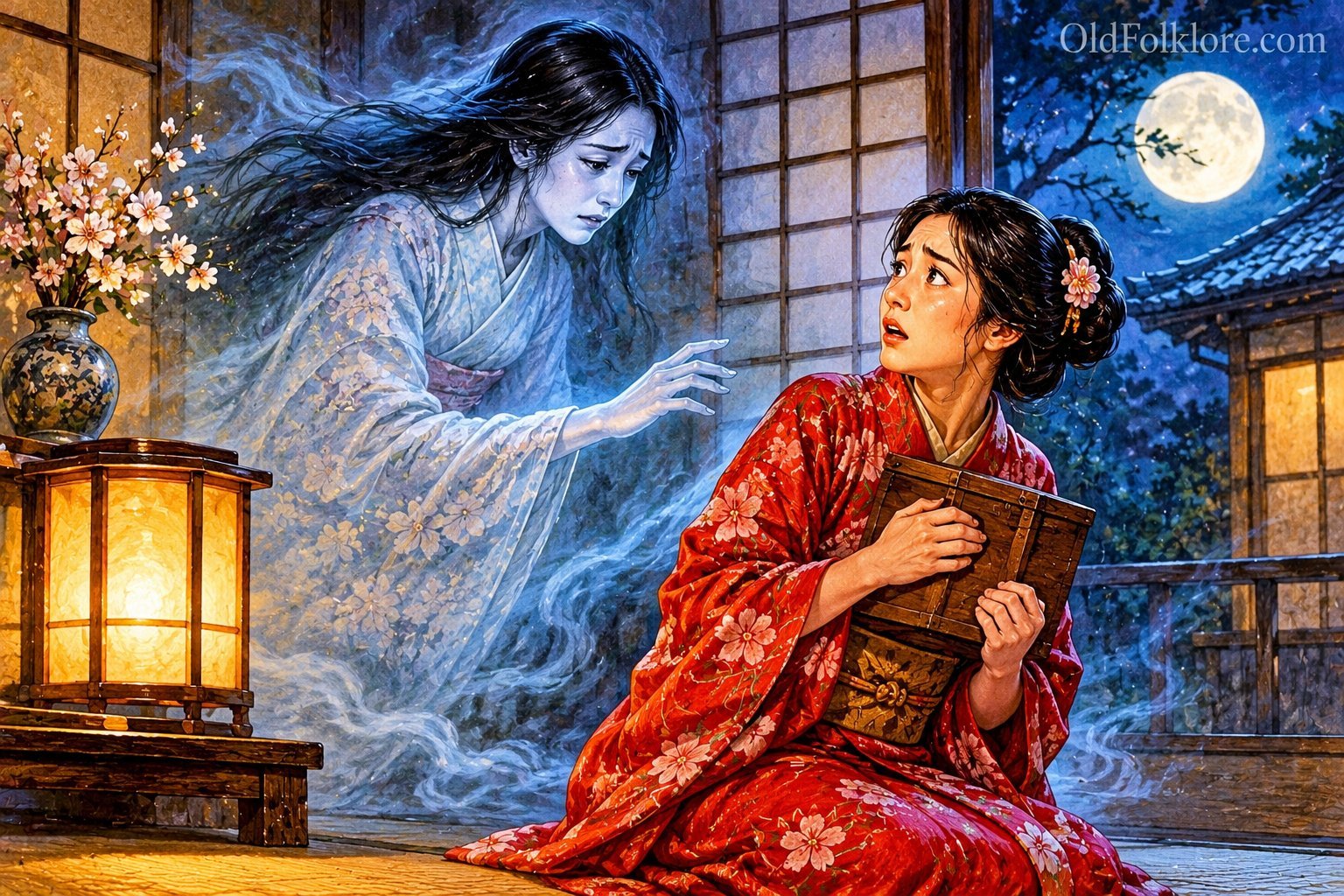
In the faint light of a small lamp burning before the household shrine stood the unmistakable figure of the dead woman. She appeared to be facing the tansu, the chest of drawers in which she had kept her clothes and personal ornaments. Her head and shoulders were clearly visible, but the rest of her body gradually faded until it became completely transparent. She looked less like a living person than a reflection appearing briefly upon the surface of water.
The frightened family hurried out of the room.
When they gathered downstairs to discuss what had happened, O-Sono’s mother-in-law offered an explanation. She remembered how deeply O-Sono had cherished her possessions and suggested that her spirit might have returned because she was unwilling to leave them behind.
According to an old belief, the spirits of the dead sometimes returned to look upon their treasured belongings. Giving those possessions to the local temple, she suggested, might free O-Sono from her attachment and allow her to rest.
The family agreed. The following morning, they emptied every drawer of the tansu. O-Sono’s dresses, ornaments and girdles were collected and presented to the temple.
But the solution made no difference.
That night, O-Sono’s figure appeared again, standing before the empty chest. The following night she returned once more, and then again on the night after that. Her repeated appearances turned the household into a place of dread. No one could understand why she continued to return when everything that had belonged to her had already been given away.
At last, her mother-in-law went to the local Zen temple and explained the troubling events to its chief priest. The priest was an elderly, learned man known as Daigen Oshō. After listening carefully, he suggested that something connected with the chest of drawers must still be troubling O-Sono.
The woman assured him that every drawer had been emptied. There was nothing left inside.
Daigen Oshō nevertheless decided to investigate for himself. He promised to visit the house that evening and keep watch in O-Sono’s room. He instructed the family not to enter while he was there unless he called for them.
After sunset, the priest arrived and settled himself alone in the room. He began reading the sacred Buddhist scriptures, waiting patiently for whatever might appear.
For several hours, nothing happened. But after the Hour of the Rat, when midnight had passed, O-Sono’s figure gradually emerged before the chest.
Her expression was sorrowful. She did not move towards the priest or attempt to speak. Instead, she kept her eyes fixed upon the tansu, as though something hidden within it held all her attention.
Explore more stories from our Lafcadio Hearn’s Kwaidan collection.
Daigen Oshō recited the sacred formula prescribed for such an encounter. Then, addressing her by her Buddhist posthumous name, he told her that he had come to help.
Perhaps, he suggested, there was something in the chest that continued to trouble her. Would she allow him to search for it?
The ghost gave a slight movement of her head, as though agreeing.
The priest rose and opened the drawers one after another. He examined the first, then the second, the third and the fourth. Each was empty. He looked behind them, beneath them and throughout the interior of the chest, but found nothing.
Still, O-Sono remained before him, watching with the same troubled expression.
Daigen Oshō paused to consider what he might have overlooked. Then a thought occurred to him. Although the drawers had been emptied, perhaps something had been concealed beneath the paper lining their bottoms.
He carefully removed the lining of the first drawer. There was nothing beneath it. He examined the second and third drawers, but found nothing there either.
Finally, he lifted the lining of the lowest drawer.
Hidden beneath the paper was a letter.
The priest held it up and asked O-Sono whether this was what she had been searching for. At once, the ghost turned towards him. Her faint eyes settled upon the letter.
Daigen Oshō understood.
He asked whether she wished him to burn it. O-Sono bowed her head in agreement.
The priest promised that he would take the letter to the temple and burn it that very morning. He also assured her that nobody else would read it. He alone would know what it contained.
At last, O-Sono smiled.
Then her figure disappeared.
As dawn approached, Daigen Oshō left the room and descended the stairs. The family had been waiting anxiously for news. Seeing the priest emerge, they gathered around him, eager to know whether the haunting had ended.
He reassured them that they need not be afraid. O-Sono would not return.
And he was right. From that night onward, her ghost was never seen again.
The priest kept his promise. He took the letter to the temple and burned it without allowing anyone else to read it.
It was a love letter, written to O-Sono during her years of study in Kyōto. Whatever it contained, whatever affection or secret it revealed, Daigen Oshō never disclosed its contents.
He carried the knowledge with him until his own death.
And so the secret remained buried with him.
Explore our complete Historic Folklore & Fairy-Tale Collections archive.
Moral
Some secrets are deeply personal and deserve to remain private. The story also reminds us that the attachments people carry may be more complicated than they appear, and that compassion sometimes means respecting what another person cannot bring themselves to reveal.
Knowledge Check
1. Who was O-Sono?
O-Sono was the daughter of a wealthy merchant named Inamuraya Gensuké. She married Nagaraya and had a young son.
2. Why did O-Sono’s spirit keep appearing after her death?
She was troubled by a hidden love letter beneath the paper lining of the lowest drawer of her chest.
3. Why did the family initially believe that she had returned?
They thought she was attached to her clothes, ornaments and other personal belongings.
4. Who helped resolve the haunting?
Daigen Oshō, the elderly chief priest of the local Zen temple, discovered the hidden letter and promised to burn it.
5. What was inside the letter?
It was a love letter written to O-Sono during her years of study in Kyōto.
6. Why is the story called A Dead Secret?
Although the priest discovered the letter’s existence and knew its contents, he never revealed them to anyone. The secret died with him.
Source
The controlling text is Lafcadio Hearn’s Kwaidan: Stories and Studies of Strange Things, specifically the tale “A Dead Secret,” pages 101–107 in the digitised edition consulted.
Explore More Lafcadio Hearn’s Kwaidan Tales