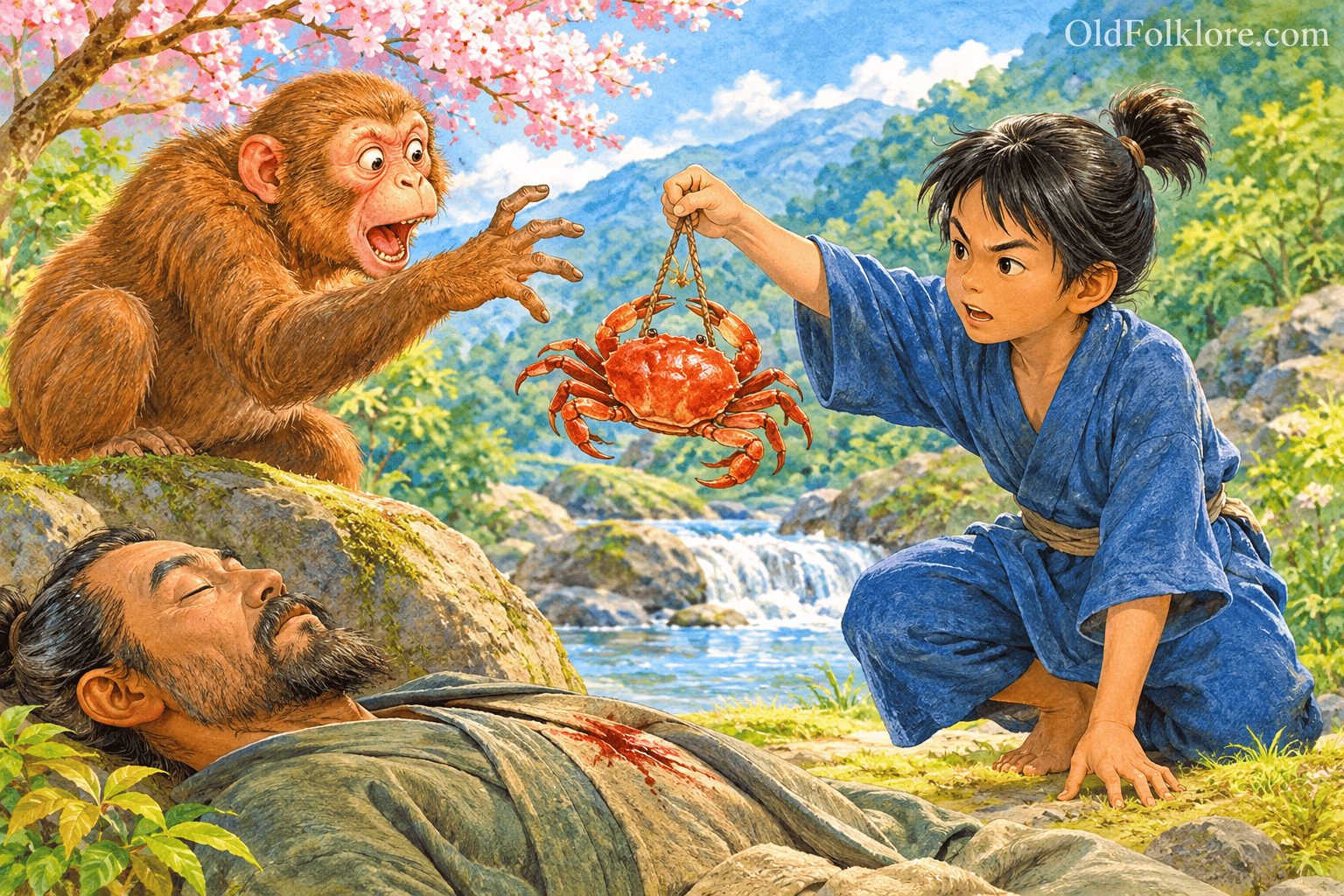
Long ago, on a beautiful autumn day in Japan, a monkey and a crab were playing together beside a river. During their play, the crab discovered a rice dumpling, while the monkey found a persimmon seed.
The crab proudly showed his discovery to his companion.
“Look at this wonderful thing I have found!” he said.
The monkey held up his seed in reply. “And I have found something too!”
Although the monkey loved eating persimmons, he had little interest in the hard seed itself. When he saw the crab’s delicious rice dumpling, however, he immediately began wishing he could have it.
He proposed that they exchange their discoveries, but the crab was reluctant. Why should he surrender something ready to eat for a hard seed that offered no immediate pleasure?
The monkey, being clever and greedy, quickly thought of an argument.
“Don’t be so short-sighted,” he told the crab. “You can eat that dumpling today, but what good will it do you tomorrow? Plant my seed in the ground, and it will grow into a magnificent persimmon tree. In a few years, it will be covered with beautiful fruit. You will have more persimmons than you could possibly eat!”
Explore more stories from our Yei Theodora Ozaki’s Japanese Fairy Tales collection.
He continued describing the sweetness of the future harvest until the crab began imagining the wonderful tree.
Eventually, the crab agreed to the exchange. The monkey eagerly swallowed the rice dumpling, while the crab took possession of the persimmon seed. They went their separate ways, the monkey returning to the forest and the crab making his way home beside the river.
As soon as he arrived, the crab planted the seed in the ground.
The following spring, a small shoot appeared. The crab watched it grow year after year until it became a fine tree. Eventually, the branches blossomed, and by the following autumn, they were laden with beautiful persimmons. The fruits hung among the green leaves like golden ornaments, gradually ripening into a rich orange colour.
The crab was delighted. Every day, he watched his tree with growing excitement, looking forward to enjoying the harvest he had waited so patiently for.
When the persimmons were finally ripe, he tried several times to climb the tree. Unfortunately, his little legs were not suited to climbing branches. He could move swiftly across the ground and over stones, but reaching the fruit was beyond his abilities.
Then he remembered his old companion, the monkey, who was an excellent climber.
The crab travelled into the forest and found the monkey resting in his favourite pine tree. He explained that the persimmon seed had grown into a magnificent tree and that the fruit was now ready to be picked.
The monkey was delighted by the news. He immediately agreed to help, although he had already begun thinking about how he could take the entire harvest for himself.
When they arrived at the tree, the monkey was astonished by the abundance of fruit. He climbed up and began picking the ripest persimmons, eating one after another. He chose the finest fruits for himself and continued until he could eat no more.
All the while, the hungry crab waited beneath the tree, expecting his share.
But the monkey had no intention of giving him anything. When the crab finally called up to remind him of his promise, the monkey ignored him. Instead, he picked an unripe persimmon, hard as a stone, and hurled it at the crab.
The fruit struck him painfully.
The monkey continued throwing the hard persimmons, one after another. The helpless crab could neither escape the attack nor protect himself. Eventually, he collapsed beneath the tree, covered in wounds, and died.
The monkey, seeing what he had done, fled in terror.
Not far away, the crab’s young son had been playing with a friend. On his way home, he discovered his father’s body lying beneath the tree. His father’s head was badly injured, his shell was broken, and unripe persimmons lay scattered around him.
The young crab sat down and wept bitterly.
After some time, however, he realised that crying would not bring his father back. He resolved to discover who had killed him and avenge his death.
Looking around, he noticed that most of the ripe persimmons had disappeared. Their peels and seeds lay scattered on the ground, together with the hard fruits that had killed his father. He remembered the story his father had once told him about exchanging a rice dumpling for a persimmon seed.
He knew then that the monkey was responsible.
The young crab burned with anger and initially wanted to confront the murderer immediately. But he understood that he could not defeat such a strong and cunning opponent alone. He would need help.
He went to visit his father’s old friend, the stone mortar, and told him everything. The mortar was deeply saddened by the news and promised to help punish the monkey. He also summoned two other old friends of the crab: a bee and a chestnut.
When they heard what had happened, both readily agreed to join the young crab’s plan.
After discussing how they would carry out their revenge, the friends separated. The mortar accompanied the young crab home and helped him bury his father.
Meanwhile, the monkey congratulated himself on escaping the consequences of his wicked actions. He had taken all the finest persimmons and, as he believed, removed the only witness to his wrongdoing.
Nevertheless, he was uneasy. He feared that the crab’s family might discover the truth and seek revenge. For several days, he remained indoors, avoiding the settlement.
Eventually, he grew tired of hiding.
“No one knows that I killed the crab,” he told himself. “He is dead and cannot tell anyone what happened. Why should I remain indoors when nobody suspects me?”
Feeling confident again, he ventured into the crab settlement, quietly observing the neighbours to discover whether they were discussing the old crab’s death.
He heard nothing suspicious.
What he did not realise was that the young crab had deliberately concealed his knowledge of the murder. He wanted the monkey to believe that nobody knew the truth, allowing him to carry out his revenge without raising suspicion.
The monkey returned home feeling completely reassured.
One day, a messenger arrived with an invitation from the young crab. He explained that the old crab had died after falling from a persimmon tree while trying to reach its fruit. The young crab was preparing a memorial gathering on the seventh day after his father’s death and wished the monkey, who had been one of his father’s closest friends, to attend.
The monkey was overjoyed. The invitation convinced him that the young crab had no idea what had really happened.
He pretended to be deeply saddened.
“How terrible!” he exclaimed. “Your father and I were such good friends. I remember when we exchanged a rice dumpling for a persimmon seed. It pains me to think that the very seed I gave him was connected with his death. I shall certainly come to honour his memory.”
He even managed to produce a few artificial tears.
The messenger thanked him politely, hiding his amusement. He knew that the monkey would soon have a reason to weep for real.
On the appointed day, the monkey dressed carefully and went to the crab’s home. The family and relatives received him with elaborate courtesy. The young crab welcomed him, and after the customary greetings, they escorted him into the hall.
A generous feast had been prepared, and the monkey was treated as an honoured guest. He ate and drank happily, believing that his old friend’s family had welcomed him without suspicion.
After the meal, the young crab invited him into the tea room.
He left the monkey there, explaining that he would return shortly.
Time passed, but nobody came back. The monkey eventually became impatient and decided to pour himself some hot water from the kettle beside the charcoal fireplace.
As he approached, something suddenly burst out of the ashes with a loud pop.
It was the chestnut, which had been hiding among the ashes. It struck the monkey painfully in the neck, burning him and sending him stumbling backwards.
He rushed towards the exit, screaming.
But another danger awaited him. The bee, concealed outside the screens, flew straight at his face and stung him on the cheek.
The monkey cried out in pain and tried desperately to escape. His neck was burned, his face was swollen, and he could hardly think clearly.
As he ran beneath the entrance gate, the stone mortar, which had been hidden above it with several other stones, came crashing down upon him.
The heavy mortar struck his head and crushed him to the ground. Unable to rise, the monkey lay helpless beneath its weight.
At that moment, the young crab approached, holding his powerful claws above the fallen animal.
“Do you remember now that you murdered my father?” he demanded.
The monkey stared at him in disbelief.
“So you are my enemy?” he managed to gasp.
“Of course,” replied the young crab.
Still refusing to accept responsibility, the monkey struggled to defend himself.
“It was your father’s fault, not mine!” he protested.
The young crab would hear no more excuses. With a final strike of his powerful claws, he cut off the monkey’s head.
Thus, the greedy monkey met the punishment he had brought upon himself, and the young crab avenged his father’s murder.
Explore our complete Historic Folklore & Fairy-Tale Collections archive.
Moral
Greed and dishonesty can lead to terrible consequences. Those who deceive and harm others should not assume that they will escape responsibility. The story also reminds us that courage, loyalty, and cooperation can help the vulnerable stand against a powerful wrongdoer.
Knowledge Check
1. What did the monkey and the crab find beside the river?
The monkey found a persimmon seed, while the crab discovered a rice dumpling.
2. Why did the crab agree to exchange his rice dumpling?
The monkey persuaded him that planting the seed would eventually produce a tree bearing plenty of delicious persimmons.
3. How did the monkey kill the old crab?
After eating the ripe persimmons, he repeatedly threw hard, unripe fruits at the crab until he died from his injuries.
4. Which three friends helped the young crab avenge his father?
The stone mortar, the bee, and the chestnut.
5. How did the young crab and his companions defeat the monkey?
The chestnut attacked him from the fireplace, the bee stung his face, and the stone mortar fell upon him from above the gate. The young crab then killed him with his claws.
6. What is the central lesson of the story?
Greed, deception, and cruelty bring consequences, while loyalty and cooperation can help overcome wrongdoing.
Source
The retelling is based on the supplied text titled “The Quarrel of the Monkey and the Crab.”
Explore More Yei Theodora Ozaki’s Japanese Fairy Tales
- The Tongue-Cut Sparrow
- The Bamboo-Cutter and the Moon-Child: Princess Moonlight’s Journey
- The Farmer and the Badger