Many years ago, the devil grew tired of listening to men complain about their wives. Wherever husbands gathered, he heard the same accusations: their wives were demanding, difficult to please, and never satisfied with what they already possessed.
At last, he decided to discover whether these complaints were justified. Rather than continue listening to other men’s grievances, he would marry and experience married life for himself.
To carry out his plan, he assumed the appearance of a handsome young gentleman named Pancrazio Stornello. He presented himself as a wealthy man of good manners, with considerable lands and riches. When news spread that he intended to marry, matchmakers hurried to introduce him to eligible young women from respectable families.
Among all the ladies presented to him, Pancrazio chose Silvia Balastro, a noblewoman of considerable beauty. Their wedding was celebrated with extraordinary splendour. Relatives travelled from distant places to attend, and the festivities were the finest the city had seen in years. Pancrazio also invited his respected acquaintance, Gasparino Boncio, to serve as his best man.
A few days after the wedding, the devil decided to establish the terms of his marriage.
Explore more stories from our Straparola’s Nights collection.
“My dear Silvia,” he said affectionately, “you know how much I love you. I have already shown you many signs of my devotion, and there is one more kindness I wish to offer. Tell me everything you could possibly desire for the remainder of your life. Ask for dresses, jewels, pearls, ornaments, and anything else that pleases you. Whatever you request, I shall provide, even if it costs me a kingdom. But I ask one thing in return: once you have received everything, you must never trouble me with another request. If you do, I shall refuse you, regardless of your tears or pleading.”
Silvia was surprised by this unusual offer. Before answering, she went to consult her mother, Signora Anastasia, who was known for her worldly wisdom.
After hearing the proposal, Anastasia took out a pen and paper and began making a list. She included so many dresses, ornaments, jewels, and other costly possessions that describing them aloud would have taken two whole days.
“Take this list to your husband,” she advised. “Ask him to provide everything written here. If he agrees, you will have little reason to complain.”
Silvia returned to Pancrazio and presented the list. He read it carefully before asking whether she was certain that nothing had been forgotten.
“Are you quite sure, my dear, that this is everything you could ever want? Think carefully. Once I have fulfilled this request, neither prayers nor tears will persuade me to give you anything more.”
Silvia examined the list and could think of nothing else. She accepted his condition, and Pancrazio immediately arranged for everything to be made and delivered.
Soon, Silvia possessed an extraordinary wardrobe. Her dresses were richly embroidered and decorated with magnificent pearls. She received expensive rings, precious stones, elegant headpieces, elaborate belts, and countless ornaments. No other woman in the city could rival the splendour of her possessions.
For a while, she was perfectly content.
Then news arrived of a grand celebration to which the city’s noble families had been invited. Silvia was naturally among the distinguished ladies expected to attend.
As the occasion approached, the women began discussing what they would wear. They agreed that the old fashions were no longer suitable and set about preparing entirely new styles of clothing. Each wanted to appear more elegant than the others, and competition over the finest dresses became the chief subject of conversation.
When Silvia heard about the change, her happiness disappeared.
Although she possessed more beautiful clothes and jewels than anyone else, she suddenly considered them old-fashioned. She imagined the other ladies laughing at her appearance and began to fear that she would become an embarrassment to her husband.
She stopped eating properly, lost sleep, and spent her days sighing and complaining.
Pancrazio noticed her unhappiness and eventually asked what was wrong.
“What troubles you, Silvia? Surely you are looking forward to the celebration?”
“How can I look forward to it?” she replied. “Everyone will be wearing the latest fashions, while I shall have nothing suitable. I cannot possibly attend dressed in clothes that are already out of date. The other ladies will ridicule me.”
Pancrazio reminded her of their agreement.
“Have you forgotten that I gave you everything you said you would need for the rest of your life? Why are you asking me for more?”
Silvia wept and insisted that she could not possibly appear before the other women in her existing clothes.
Seeing that she would not be satisfied, Pancrazio offered one final concession.
“Very well. I shall grant this request too. Ask for whatever you desire, and I shall provide it. But understand that there will be no further opportunity after this.”
Silvia immediately became cheerful again. She returned to her mother and prepared another enormous list of fashionable garments and ornaments. Pancrazio fulfilled the request without delay, supplying her with everything she needed to appear in the newest styles.
Yet the arrangement did not solve the problem.
Some time later, the women of the city once again changed their fashions. Once more, Silvia discovered that her beautiful clothes were no longer considered fashionable.
This time, however, she remembered her husband’s warning. She knew that she had already received two exceptional gifts and that he had forbidden her from making another request.
Nevertheless, she could not bear the thought of appearing less fashionable than the other ladies. She became miserable again, spending her days mourning her situation.
Pancrazio watched her carefully, knowing exactly what was troubling her.
“Why are you so unhappy, my love?” he asked.
“Do you really need to ask?” Silvia replied. “I have no clothes in the latest fashion. I cannot show myself among the other ladies without being laughed at. They will ridicule me, and you will suffer embarrassment because of me. After all the respect and loyalty I have shown you, I do not deserve to be placed in such a humiliating position.”
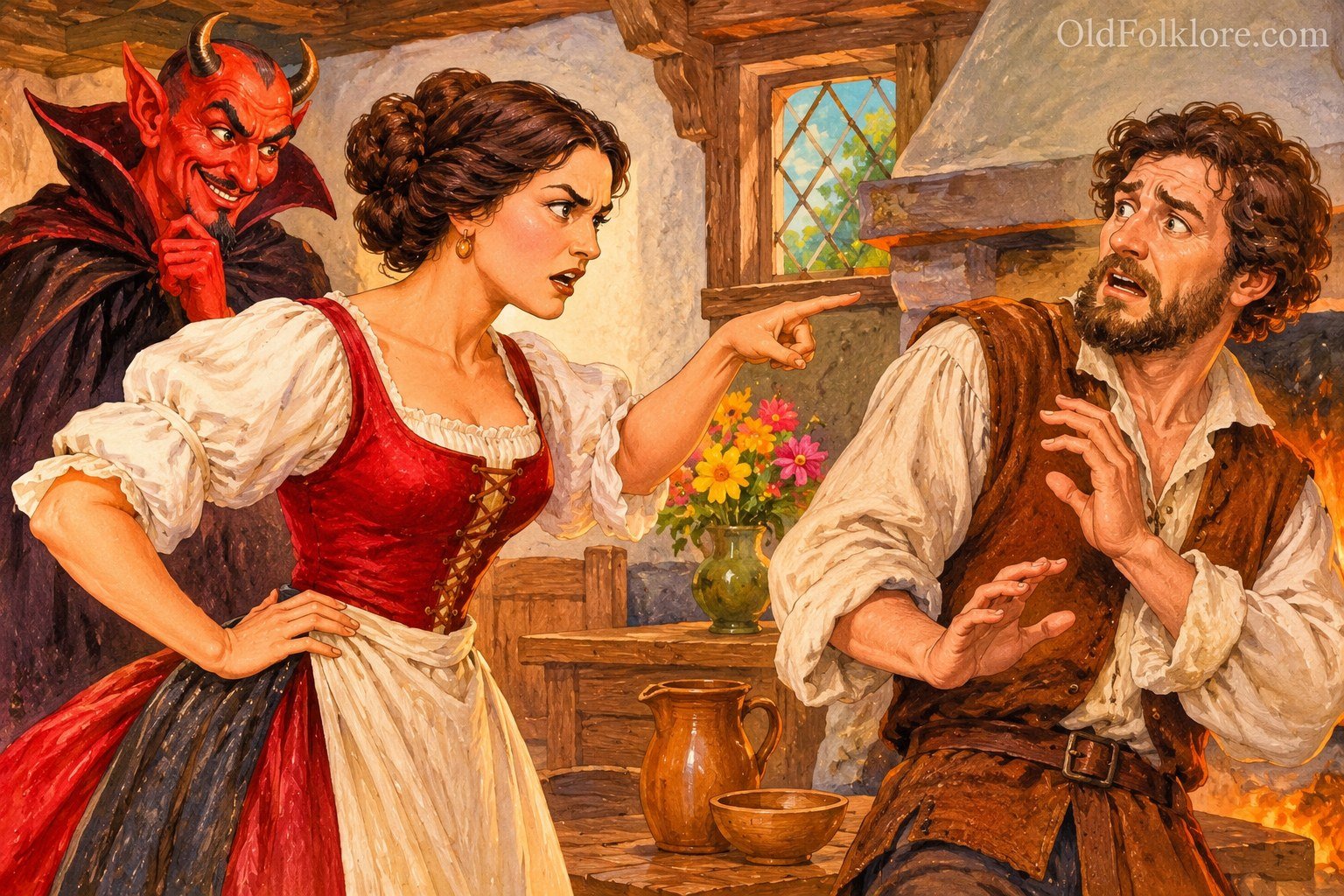
Her words finally exhausted the devil’s patience.
“How can you speak as though I have wronged you?” he demanded. “Have I not given you everything you asked for, not once but twice? Your desires have no end. Nothing I provide can keep you satisfied.”
He then made one last promise.
“I shall give you everything you want this time, but afterwards I shall leave you. You will never see me again.”
Pancrazio kept his word. He ordered another magnificent collection of fashionable dresses and ornaments for Silvia. Once everything had been delivered, he disappeared without even saying goodbye.
He travelled to Malphi, where he decided to seek amusement elsewhere. There, he entered the body of the duke and began tormenting him so severely that the unfortunate ruler could find no peace.
Gasparino’s Dangerous Boast
Meanwhile, Gasparino Boncio, who had served as Pancrazio’s best man, had fallen into trouble of his own.
After committing an offence that forced him to flee his former city, he travelled to Malphi. He had no respectable profession and survived mainly through gambling and various tricks. Although he liked to present himself as a capable and accomplished gentleman, he was little more than a dishonest adventurer.
One day, while gambling with several gentlemen, Gasparino cheated them so openly that they became furious. They were so offended that they might have killed him had they not feared the consequences of breaking the law.
One of the men, determined to punish him, devised a scheme.
He went to the duke and explained that a man named Gasparino lived in the city and claimed to possess the power to drive evil spirits out of anyone’s body.
The duke, who was suffering terribly from the devil’s presence, immediately ordered that Gasparino be brought before him.
When Gasparino arrived, the duke addressed him.
“I have heard that you can expel evil spirits. As you must know, I am tormented by one, and I urgently need your assistance. If you can deliver me from this misery, I promise to reward you generously. You shall have enough wealth to live comfortably for the rest of your life.”
Gasparino was horrified.
He had never claimed to be an exorcist and knew nothing about driving spirits out of possessed bodies. He tried to deny the accusation, but the gentleman who had brought him forward insisted that he had personally heard Gasparino boast of these abilities.
The duke refused to entertain further arguments.
“You have three days to prepare yourself,” he declared. “If you succeed in freeing me from this spirit, I shall give you the finest castle in my dominions and whatever else you request. But if you fail, I shall have you strangled between two of these columns before eight days have passed.”
Gasparino left the palace in despair. He had been trapped by a boast he had never made, and now his life depended on accomplishing something he did not know how to do.
For three days, he worried over his predicament, searching desperately for a way to escape his promised punishment.
When the appointed day arrived, he went to the palace and ordered a large carpet to be spread across the floor. He then began performing his supposed exorcism, calling upon the evil spirit to leave the duke’s body.
The devil, however, was perfectly comfortable where he was.
Instead of answering, he sent such a powerful blast of air through the duke’s throat that the unfortunate man nearly choked.
Gasparino continued his incantations.
At last, the devil spoke.
“My friend, you are free to enjoy your life. Why will you not leave me in peace? I am quite comfortable here, and all your foolish ceremonies will accomplish nothing.”
He began mocking Gasparino, who nevertheless refused to abandon his efforts.
As he continued questioning the spirit, he gradually discovered its identity.
It was none other than Pancrazio Stornello, the devil who had married Silvia Balastro.
The devil recognised him too.
“Why, it is Gasparino Boncio, my dear old friend! Have you forgotten the merry evenings we once spent together?”
Gasparino was astonished.
“My friend,” he replied, “why have you come to torment this unfortunate duke?”
“That is my own business,” the devil answered. “I am perfectly happy here. Why should I leave?”
Gasparino continued talking with him, and eventually the devil revealed the entire story of his marriage. He explained how he had married Silvia to discover whether husbands’ complaints were justified, how her endless demands had driven him to desperation, and how he had finally abandoned her to seek refuge in the duke’s body.
He also made it perfectly clear that nothing in the world could persuade him to return to his wife.
Gasparino saw an opportunity.
“My dear friend,” he said, “there is something I must ask of you. For the sake of our old friendship, please leave this poor duke’s body.”
The devil was unimpressed.
“I never thought you particularly wise, Gasparino, but this request proves that you are a fool. Why should I abandon a place where I am so comfortable?”
Gasparino pleaded with him, reminding him of their former friendship and the pleasant times they had shared.
He explained that the duke had been persuaded that he possessed the power to cast out evil spirits. If he failed, he would be executed, and the devil would bear responsibility for his death.
But the devil refused to be moved.
“Our friendship does not oblige me to rescue you from your own foolishness. Why did you go about boasting of powers you never possessed?”
With that, he roared furiously and threw the duke into another violent fit.
When the duke finally recovered, Gasparino approached him with renewed confidence.
“My lord, do not despair. I believe I have discovered a way to free you. But I shall need your assistance.”
He instructed the duke to summon every musician in the city to the palace the following morning. At a particular signal, they were to play their instruments as loudly as possible. The church bells were also to ring, while the city’s gunners fired their cannons in celebration.
The duke agreed to the arrangement.
The Devil’s Final Escape
The following morning, Gasparino returned to the palace and began his incantations.
At the appointed moment, the musicians struck up their instruments. Trumpets, cymbals, drums, and other instruments filled the palace with deafening music. The bells rang, and cannon fire thundered through the city.
The uproar was so tremendous that it seemed as though the entire world had been thrown into confusion.
Inside the duke’s body, the devil became increasingly curious.
“What is this dreadful noise?” he demanded. “What is happening outside?”
Gasparino pretended to be surprised.
“Only now do you hear it? The noise has been going on for quite some time!”
“You must remember,” the devil replied, “that mortal bodies are heavy and dull. They prevent me from hearing everything that happens outside. But tell me, what is the reason for this extraordinary disturbance?”
“I shall explain,” Gasparino answered, “provided you allow the duke a little peace.”
The devil agreed, and Gasparino delivered the explanation he had carefully prepared.
“My dear friend, news of your troubles has reached the duke. He has learned that you fled your wife because you could no longer endure her demands for fashionable clothes and ornaments. Having heard of your difficulties, he has invited Silvia Balastro to Malphi. The entire city is celebrating her arrival. All this music, ringing, and cannon fire is in honour of your wife’s coming.”
The devil immediately understood the trick.
“Gasparino!” he exclaimed. “You have beaten me at my own game. What a clever fellow you are! And I see now that I was wrong to think so little of friendship.”
But the thought of seeing Silvia again filled him with absolute horror.
“Very well,” he declared. “You have won. I would rather go to the deepest pit of hell than live anywhere near that woman again. I shall leave this body at once. Farewell, Gasparino. You will never see or hear from me again.”
As soon as he finished speaking, the duke began choking and struggling violently. His eyes rolled back, and his body seemed close to death. But these terrifying signs announced that the devil was finally departing.
A dreadful smell of sulphur filled the palace, and the evil spirit vanished.
Gradually, the duke recovered his senses and returned to health.
Overwhelmed with gratitude, he summoned Gasparino and rewarded him as promised. He gave him a magnificent castle, a substantial fortune, and numerous servants to attend to his needs.
Although some courtiers became jealous of his sudden good fortune, Gasparino lived comfortably and prospered for many years.
Silvia’s fate, however, was far less fortunate.
The devil’s departure had been accompanied by a terrible consequence. All the splendid garments, precious jewels, and treasures he had given her were transformed into smoke and ashes.
When Silvia discovered that everything she had valued had disappeared, the shock overwhelmed her. She lost her reason and eventually died in misery.
Thus ended the devil’s experiment in marriage. He had set out to discover whether husbands’ complaints were justified, but after experiencing Silvia’s endless dissatisfaction, he decided that even the deepest regions of hell offered a more peaceful home.
Explore our complete Historic Folklore & Fairy-Tale Collections archive.
Moral
Contentment is more valuable than endless possessions. A person who constantly compares what they have with what others possess may never find happiness, no matter how much they receive. The story also demonstrates that intelligence and an understanding of another person’s weaknesses can succeed where force and supposed supernatural powers fail.
Knowledge Check
1. Why did the devil decide to marry?
He wanted to discover whether the complaints men made about their wives were justified.
2. What agreement did Pancrazio make with Silvia?
He promised to provide everything she could possibly want, on the condition that she would never ask him for anything again.
3. Why did Silvia become dissatisfied with her wardrobe?
The other women repeatedly adopted new fashions, making her expensive clothes seem outdated.
4. How did Gasparino discover the devil’s identity?
Through persistent questioning, he discovered that the spirit was his former friend Pancrazio Stornello.
5. How did Gasparino persuade the devil to leave the duke?
He arranged an enormous musical and cannon-filled celebration, then told the devil that the noise was being made to welcome Silvia, who was supposedly arriving in Malphi.
6. What happened to Silvia at the end?
Her treasures turned into smoke and ashes. Overwhelmed by their disappearance, she lost her reason and died miserably.
7. What is the significance of Gasparino’s victory?
It demonstrates that cleverness and knowledge of another person’s weaknesses can be more effective than force.
Source
Adapted from The Nights of Straparola, Volume I, by Giovanni Francesco Straparola, translated into English by W. G. Waters and illustrated by E. R. Hughes. Published in London by Lawrence and Bullen in 1894.
Explore More Straparola’s Nights