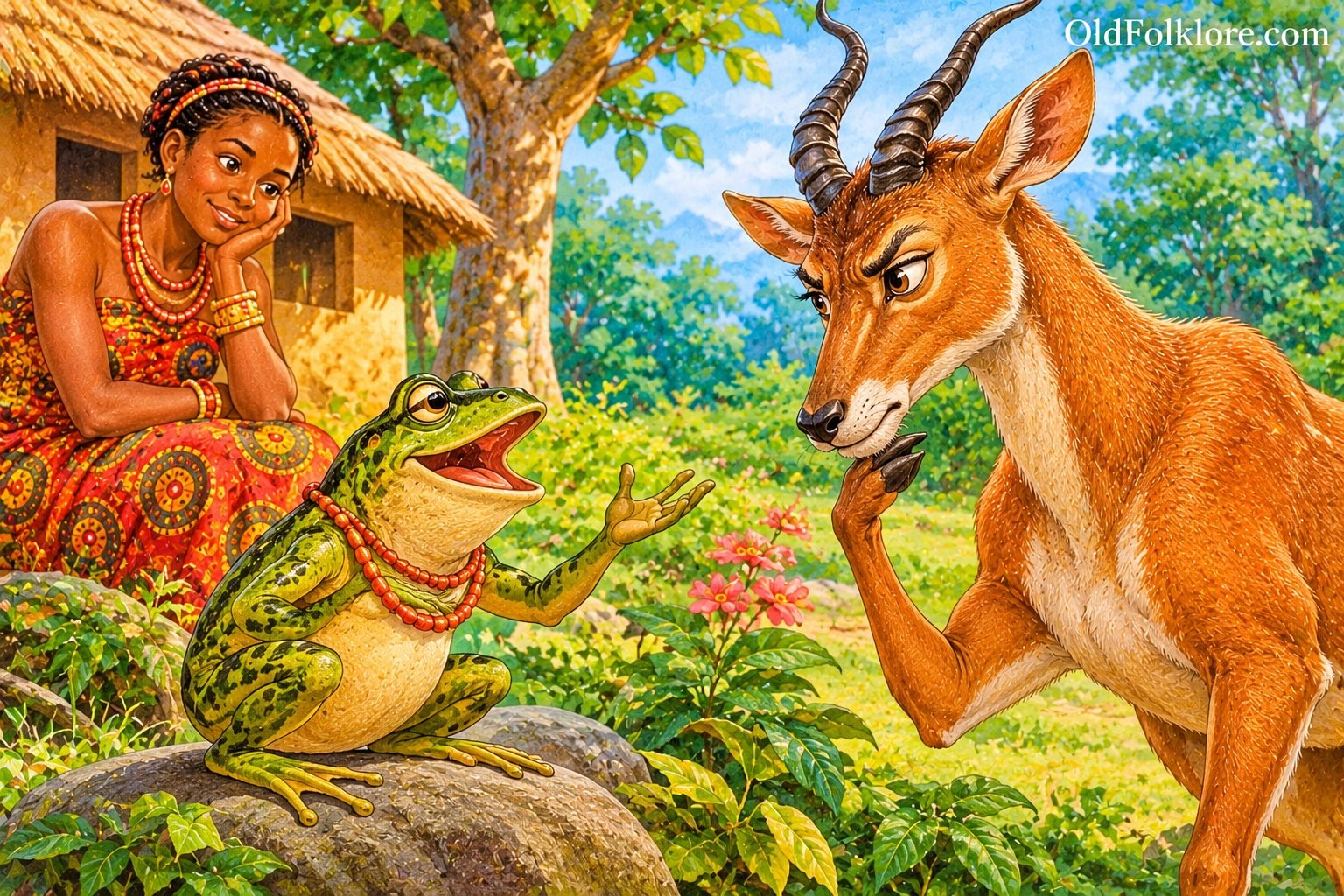
Long ago, when human beings, animals, and birds lived together, there was a handsome and powerful bush buck known throughout the country for his extraordinary speed. He had a beautiful daughter whose reddish skin shone like a polished red stone. Her beauty attracted admirers from far and wide, and many men and animals wished to marry her.
However, her father demanded an enormous dowry. No suitor could afford the price, and the bush buck showed no willingness to reduce it. He was deeply attached to his daughter and had little desire to give her away.
Eventually, some frustrated young men approached him and begged him to lower the dowry to something they could afford. The bush buck refused, but offered them another way to win his daughter’s hand.
Anyone who could defeat him in a race would receive the young woman as a wife without paying any dowry.
The offer sounded generous, but the bush buck was confident that nobody could beat him. He was widely recognised as the fastest runner in the country, and he believed the challenge would keep his daughter safely beyond the reach of every suitor.
A day was chosen for the competition, and a long, straight racing course was prepared. The competitors would begin at the starting point, run to the far end, turn around, and race back. Whoever returned first would be declared the winner.
Explore more stories from our Ikom Folk Stories collection.
When the appointed day arrived, crowds gathered along both sides of the course. Several young men known for their speed entered the competition, along with some of the fastest animals. One after another, they challenged the bush buck, but none could defeat him.
News of the beautiful daughter and her father’s unusual challenge spread to distant places. More competitors arrived, hoping to succeed where others had failed, but the result remained the same. The bush buck continued to win every race.
Then, one day, something unexpected happened.
The bush buck’s daughter went to a spring to fetch drinking water. There she encountered a young frog who immediately fell in love with her. Although he knew that many powerful and swift competitors had already failed, he decided that he too would seek her hand in marriage.
Before approaching her father, however, the frog called together his numerous companions and announced his intention to challenge the bush buck.
The other frogs burst into laughter. They could hardly imagine how their little companion expected to defeat an animal that could cover the racing course before a frog had even completed a single jump.
The young frog waited patiently until their laughter subsided.
“I have a plan,” he told them. “If you help me, I am certain we can win this race. When I marry the bush buck’s daughter, I will prepare a great feast for everyone who helps me. Think how wonderful it will be for us to succeed where all the others have failed!”
He then asked his companions whether they were all alike.
“Yes!” they answered together with a loud croak.
The frog explained his strategy. Since the race required the competitors to run to the end of the course and return to the starting point, he wanted his companions to position themselves in hiding places at intervals along the entire route. One frog would wait at the turning point, while the others would occupy holes along the course.
Whenever the bush buck called out to ask where his opponent was, one of the hidden frogs would answer. The bush buck would believe that the young frog was still somewhere ahead of him, keeping pace with the race.
The plan depended on every frog playing his part.
His companions agreed immediately. They promised to hide at their assigned positions and help their friend secure victory.
With the arrangements settled, the young frog approached the bush buck and challenged him to a race for his daughter’s hand.
The bush buck laughed when he heard the challenge. A frog wanted to race against him! Nevertheless, he had made his offer publicly and could not refuse without breaking his word. The competition was therefore arranged for the following morning, using the same course and rules as before.
At daybreak, the frogs took their positions along the track. Each settled into a hiding place, while the young frog waited at the starting point for his opponent.
By the time the bush buck arrived, a large crowd had gathered to witness the unusual contest. Everyone was curious to see how the tiny frog would fare against such a celebrated runner.
The signal was given, and both competitors started together.
The bush buck immediately raced forward at full speed. The frog, however, did not follow him. He simply slipped back into his hiding place near the starting point.
The bush buck continued running alone, confident that he would soon leave his opponent far behind.
When he had covered about half the distance, he called out:
“Where are you, frog?”
Immediately, one of the hidden frogs answered.
“I am here! Are you already tired of running?”
The bush buck was astonished. He had expected the frog to be far behind, yet the answer seemed to come from somewhere ahead.
Exhausted from his rapid run, he admitted that he was tired and suggested that they turn around and race back to the starting point.
Believing that the frog was still somewhere on the course, the bush buck changed direction and began running towards the finish.
Meanwhile, the young frog remained safely hidden near the starting point. He waited until the bush buck was approaching, then jumped out of his hole and made his way across the finishing line.
The spectators watched in amazement. The frog had returned before the bush buck!
According to the rules of the competition, he was the winner.
Many of the young men who had previously competed were furious. They had spent their efforts trying to win the beautiful daughter, only for a little frog to succeed through an unexpected trick. Some cursed their luck as they watched him claim the prize.
When the bush buck finally arrived, he was breathless and bewildered. He could scarcely believe that he had been defeated by a frog.
Nevertheless, he had given his word. Since the frog had been declared the winner, he handed his daughter over to him as promised, without demanding any dowry.
The frog took his new wife to his home near the spring. There, he organised a great celebration with dancing and merrymaking. True to his promise, he provided generous quantities of food and tombo for all the companions who had helped him win the race.
His fellow frogs enjoyed the feast, delighted that their clever plan had succeeded.
When the celebrations were over, the young frog entered the water and called to his wife to follow him.
She stepped into the stream, but as the water rose towards her neck, fear overcame her. She struggled back towards the bank and refused to go any farther.
“I cannot live in the water,” she told her husband. “If you want us to live together, you must come out and stay on the land with me.”
The frog climbed out and joined her.
Unfortunately, their differences soon became impossible to ignore. The bush buck’s daughter could walk quickly across the land, but her frog husband could not keep up with her. Their ways of living were simply too different, and the marriage did not last.
Before long, the young woman wandered into the forest, where she met a handsome young bush buck. She forgot about her frog husband and went away with her new companion.
The frog had won the race, but he could not keep the wife he had worked so cleverly to obtain.
One day, when the bush buck’s daughter returned to the spring to fetch water, her former husband recognised her and called out, begging her to come back to him.
She refused.
And so the frog lost forever the beautiful wife he had won through the cleverest trick in the country.
Explore our complete Historic Folklore & Fairy-Tale Collections archive.
Moral
Cleverness and cooperation can overcome physical disadvantages, but winning a competition does not necessarily guarantee lasting happiness. A successful outcome requires more than defeating an opponent; compatibility and understanding matter too.
Knowledge Check
1. Why did the bush buck organise a race for his daughter’s hand in marriage?
He demanded an enormous dowry that no suitor could afford. The race offered another way to win her without paying a dowry.
2. How did the frog defeat the bush buck?
He organised for other frogs to hide at intervals along the racing course and answer whenever the bush buck called out. This trick made the bush buck believe the frog was keeping pace with him.
3. Why did the other frogs agree to help?
They believed in their companion’s plan and were promised a large feast if he succeeded.
4. Why did the frog’s marriage fail?
His wife could not live comfortably in the water, while the frog could not keep up with her on land. Their different ways of living eventually separated them.
5. What makes the ending unusual?
The frog wins the race and marries the bush buck’s daughter, but he cannot keep her. She eventually leaves him for another bush buck.
Source
This retelling is adapted from “XXVIII. How the Frog Beat the Bush Buck in a Race, and Won His Daughter as a Wife,” recorded in Ikom Folk Stories from Southern Nigeria by Elphinstone Dayrell, published in London in 1913 by the Royal Anthropological Institute of Great Britain and Ireland as Occasional Papers, No. 3.
Explore More Ikom Folk Stories