There once lived a poor Brahman named Harisarman. He was neither particularly clever nor successful, and his large family made his poverty even harder to bear. With little means of supporting them, he wandered from place to place, seeking employment and depending on the kindness of others.
Eventually, he arrived in a certain city and found work in the household of a wealthy man named Sthuladatta. His sons were employed looking after the household’s cattle and other property, his wife worked as a servant, and Harisarman himself remained near the house, performing various duties.
For a while, the arrangement provided the family with a place to stay. Yet Harisarman was unhappy with the little respect he received.
His opportunity seemed to arrive when Sthuladatta organised a grand celebration for his daughter’s wedding. Friends of the bridegroom, relatives, and numerous guests gathered at the house. Food and drink were prepared in abundance, including delicious meat and rich ghee.
Explore more stories from our Joseph Jacobs’ Indian Fairy Tales collection.
Harisarman eagerly looked forward to the feast. He imagined eating until he was completely satisfied and hoped to carry enough food home for his family. But as the celebration continued, nobody remembered him. The guests ate, the festivities carried on, and the poor Brahman remained forgotten.
That night, deeply offended by the treatment he had received, Harisarman spoke to his wife.
“My poverty and foolishness are the reasons people treat me this way,” he complained. “But I shall find a way to make them respect me. I will pretend to possess knowledge of magic and hidden things. When you find an opportunity, tell Sthuladatta that I am skilled in these arts.”
His wife listened to his plan.
Harisarman then decided that words alone would not be enough. While the household slept, he secretly took the horse belonging to his master’s son-in-law. He led it away and concealed it at some distance from the house.
The following morning, the disappearance caused great alarm. The bridegroom’s friends searched everywhere, but the horse was nowhere to be found. Sthuladatta was distressed, fearing that the theft was an unfortunate omen following his daughter’s wedding.
Seeing her opportunity, Harisarman’s wife approached him.
“My husband is a learned man,” she explained. “He understands astrology and the magical sciences. If anyone can discover where the horse has gone, it is he. Why not ask him for help?”
Sthuladatta immediately summoned Harisarman.
The Brahman, remembering how he had been ignored during the previous night’s celebration, could not resist making his feelings known.
“Yesterday, when there was a feast, nobody remembered me,” he said. “Today, because a horse has disappeared, suddenly everyone remembers that I exist!”
Sthuladatta apologised and begged him to forgive the oversight. He then asked Harisarman to discover who had taken the animal.
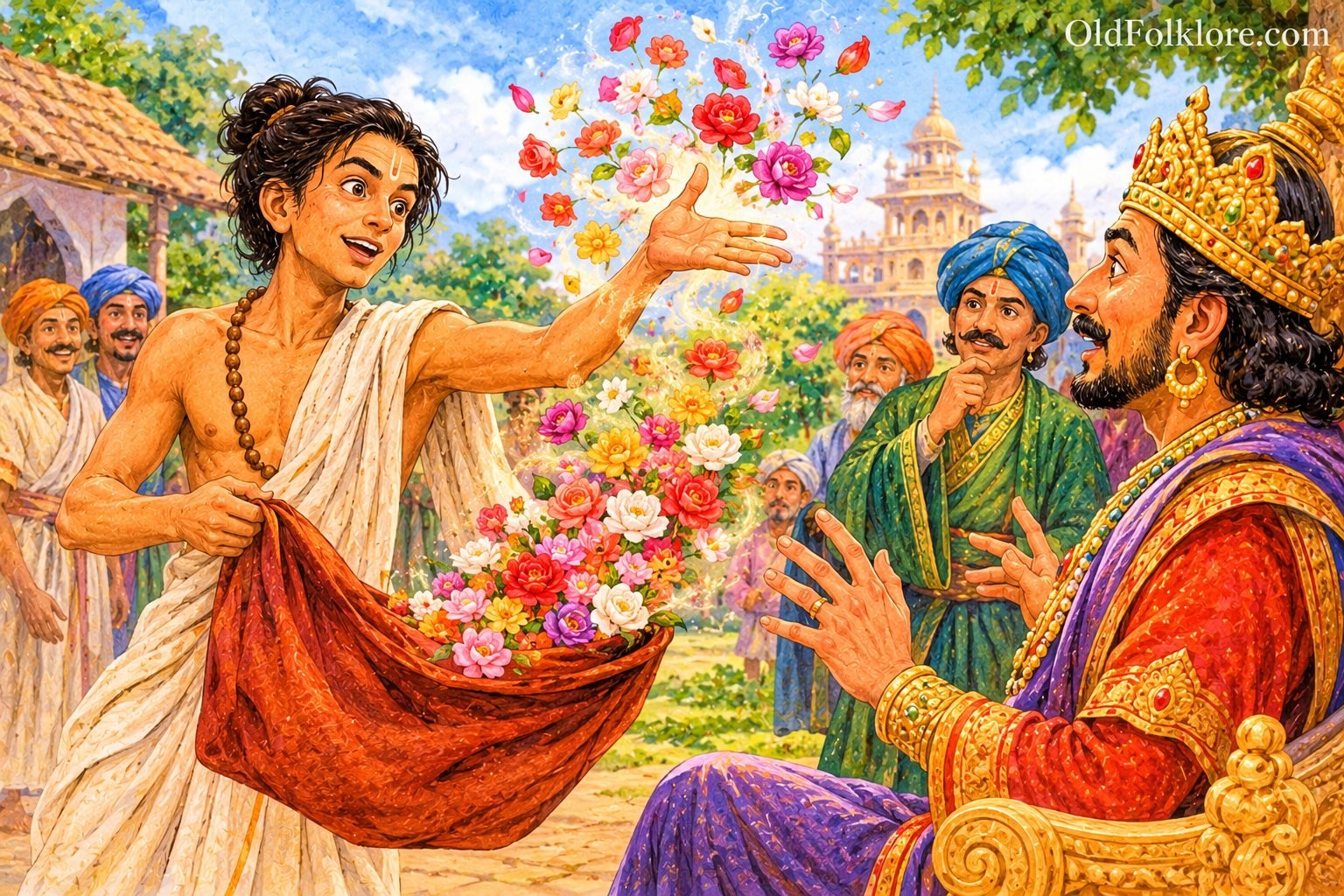
Harisarman pretended to perform mysterious calculations, drawing various diagrams as though consulting secret knowledge. After a while, he announced that the horse had been hidden near the southern boundary of the area.
“The thieves have concealed it there,” he declared. “But they intend to remove it before the end of the day. Send men quickly, and they will find it.”
Sthuladatta immediately dispatched several men. They searched the indicated place and, to everyone’s amazement, recovered the missing horse.
The household erupted in praise. Harisarman was treated as a remarkable man, and the very people who had previously overlooked him now regarded him with admiration. Sthuladatta honoured him, and the Brahman began enjoying a comfortable life.
The King’s Missing Treasure
As the days passed, Harisarman’s reputation spread beyond Sthuladatta’s household. Before long, even the king heard stories of the Brahman’s extraordinary abilities.
Unfortunately for Harisarman, the royal palace had recently suffered a serious theft. A large quantity of gold and precious jewels had disappeared, and despite extensive searches, nobody could discover who had taken them or where they had been hidden.
The king, having heard of Harisarman’s supposed magical powers, ordered him to appear at the palace.
When Harisarman received the summons, his confidence disappeared. Finding a stolen horse that he himself had hidden was one thing. Discovering the whereabouts of an unknown thief and a considerable royal treasure was quite another.
Nevertheless, he could not refuse the king.
“I shall reveal everything tomorrow,” he told the king, hoping to gain a little time.
The king agreed but ordered that he be confined in a chamber and closely guarded until morning.
Alone in the room, Harisarman became overwhelmed with fear. His deception, which had brought him comfort and admiration, now threatened to destroy him. He had no magical abilities, no secret knowledge, and certainly no idea where the stolen treasure was hidden.
Meanwhile, a maidservant in the palace named Jihva had reason to be frightened. She and her brother were responsible for the theft. Together, they had secretly taken the royal treasure from inside the palace.
Hearing that a celebrated magician had been summoned to discover the thief, Jihva feared that her secret was about to be exposed.
That night, she crept towards the chamber where Harisarman was being held. She pressed her ear against the door, hoping to discover what the supposed magician knew and whether he had already identified her.
Inside, Harisarman was lamenting his foolishness. In his distress, he began blaming his own tongue for creating the dangerous situation.
“Ah, Tongue!” he cried. “What have you done through your greed? You wicked thing! Soon you will receive the punishment you deserve!”
He was referring to the tongue that had made him boast of magical knowledge he did not possess.
But Jihva understood his words very differently.
Her own name meant Tongue. Hearing the Brahman speak of a tongue that had committed a crime and would soon be punished, she became convinced that he had discovered her identity.
Terrified, she found a way into the chamber and threw herself at his feet.
“Master Brahman,” she pleaded, “I am Jihva, the woman whose theft you have discovered. I know you have uncovered my secret. I took the king’s treasure, but I buried it in the garden behind the palace, beneath a pomegranate tree. Please spare me and do not expose me. I also have a little gold in my possession, which I will gladly give you.”
Harisarman could hardly believe what was happening. The very criminal he had been expected to identify had come forward voluntarily, simply because she had misunderstood his complaints.
He quickly recovered his composure and decided not to reveal his astonishment.
“Go in peace,” he told her proudly. “I already know everything. Nothing of the past, the present, or the future is hidden from me. But since you have come to me for protection, I shall not expose you. However, you must return whatever gold remains in your possession.”
Jihva agreed and hurried away.
Left alone, Harisarman reflected on the extraordinary turn of events.
“What a strange thing fate is!” he thought. “When disaster seemed certain, fortune delivered an escape beyond anything I could have imagined. I was blaming my tongue for bringing me trouble, and suddenly Jihva, the thief whose name means Tongue, fell at my feet. Truly, fear can bring secret crimes into the open.”
For the remainder of the night, he rested much more comfortably.
The next morning, Harisarman led the king and his attendants into the palace garden. Maintaining his appearance of mysterious wisdom, he directed them towards the pomegranate tree and indicated where the stolen treasure had been buried.
The king’s men dug beneath the tree and discovered the hidden wealth.
Harisarman explained that the thief had already carried away part of the treasure but that the remaining portion had been recovered. The king was delighted. Once again, the Brahman’s supposed supernatural knowledge appeared to have saved the day.
In gratitude, the king rewarded him with the revenues of several villages.
The Minister’s Test
Although the king was convinced of Harisarman’s extraordinary abilities, his chief minister, Devajnanin, remained suspicious.
He privately approached the king and questioned the Brahman’s reputation.
“How can an ordinary man possess such remarkable knowledge without having studied the sacred books and sciences?” he asked. “It is possible that he has some secret arrangement with the thieves and is earning his living through dishonest dealings. Your Majesty should test him again before placing complete trust in him.”
The king considered this advice and decided to put Harisarman through another trial.
He obtained a covered pitcher and secretly placed a frog inside it. Then he summoned the Brahman and presented him with the vessel.
“Tell me what is inside this pitcher,” the king commanded. “If you discover it correctly, I shall honour you greatly.”
Harisarman stared at the covered vessel. This time, there was no missing horse he could retrieve and no frightened criminal ready to confess. He had absolutely no idea what the king had placed inside.
He was certain that his luck had finally run out.
As he contemplated his approaching ruin, he remembered something from his childhood. His father had once given him the affectionate nickname Froggie, using it playfully when he was a little boy.
Thinking of that old nickname, Harisarman lamented his unfortunate situation and suddenly exclaimed:
“Ah, Froggie! What a fine pitcher this is for you! It will soon become the swift destroyer of your helpless self!”
His words were immediately greeted with astonishment.
The people gathered around the king heard the reference to Froggie and realised that there was indeed a frog concealed inside the pitcher. They burst into applause, marvelling at the Brahman’s supposed ability to discover even the smallest hidden object.
“Wonderful!” they exclaimed. “What a great sage! He even knows about the frog inside the pitcher!”
The king was delighted. He believed that Harisarman’s success could only be explained by extraordinary powers of divination.
The Brahman received further rewards, including the revenues of additional villages, gold, a ceremonial umbrella, and splendid royal carriages.
Thus, the poor and foolish Harisarman, who had begun his adventure simply because he wanted to be treated with respect and enjoy a proper meal, became a wealthy and celebrated man.
His reputation as a great magician was firmly established, even though every success had come through deception, misunderstanding, and extraordinary good fortune rather than any genuine supernatural knowledge.
Explore our complete Historic Folklore & Fairy-Tale Collections archive.
Moral
Appearances can be misleading, and good fortune can sometimes accomplish what knowledge and skill cannot. Harisarman’s story shows how easily people can mistake coincidence for wisdom. It also reminds us that fear and guilt can cause people to reveal secrets they desperately wish to conceal.
Knowledge Check
1. Why did Harisarman pretend to possess magical knowledge?
He wanted to gain the respect of Sthuladatta and escape the humiliation associated with his poverty.
2. How did Harisarman recover the missing horse?
He secretly hid the horse himself and then pretended to discover its location through magical calculations.
3. Who was Jihva?
She was a palace maid who had stolen the king’s treasure with the assistance of her brother.
4. Why did Jihva confess to Harisarman?
She misunderstood his words about his tongue as a revelation that he had discovered her identity and her crime.
5. How did Harisarman identify the frog inside the pitcher?
His childhood nickname was Froggie. While lamenting his fate, he accidentally mentioned the name, which the assembled people interpreted as a supernatural discovery.
6. What is the central idea of the story?
The story illustrates how coincidence, fear, and mistaken interpretations can create a reputation for wisdom where no such knowledge exists.
Source
This retelling is a creative adaptation of Harisarman, as presented in Joseph Jacobs’s Indian Fairy Tales (1892).
Explore More Joseph Jacobs’ Indian Fairy Tales
- The Lambikin: A Classic Indian Folktale
- The Rose-Tree: A Grim Fairy Tale
- Tom Tit Tot
- How the Raja’s Son Won the Princess Labam