Long ago, when the world was still young, the Creator completed the work of shaping the heavens and the earth. Having established the foundations of creation, she entrusted the care of the world to her children. Among them were two powerful brothers, Sagbata and Sogbo, whose responsibilities would determine the relationship between the earth and the sky.
Although they shared the same divine parentage, the brothers had different characters and ambitions. Sagbata was the elder, while Sogbo was the younger and possessed formidable power. Their disagreement over their respective positions eventually became a problem for the entire world.
The Brothers Choose Their Domains
When the time came for the brothers to take their places in creation, the Creator advised them to remain united. She explained that they were meant to exist together, like the two halves of a closed calabash, with the world contained within their shared responsibility.
She assigned Sagbata, the elder brother, to the lower portion and Sogbo, the younger, to the upper. In this arrangement, the brothers would remain connected, each exercising authority over a different part of creation.
However, Sogbo was unwilling to leave his mother’s heavenly dwelling. He preferred to remain in the sky, close to the Creator and the other divine beings. Sagbata, on the other hand, decided to descend to the earth.
Before leaving, Sagbata gathered the inheritance and blessings he had received from his mother. He carried his possessions with him, believing they would help him establish his authority among the people below. As he travelled farther from the heavens, returning became increasingly difficult.
Sogbo remained above, where his influence and power continued to grow. He became associated with the forces of fire, thunder and lightning. His position in the sky gave him control over powers that would later prove essential to life on earth.
The brothers had separated, but their responsibilities were not independent of one another. What happened in the heavens would affect the earth, just as the conditions on earth would eventually demand the attention of the powers above.
Sagbata Establishes His Kingdom
After reaching the earth, Sagbata established himself as a ruler among the people. He possessed considerable wealth and had inherited many of his mother’s gifts. His arrival brought expectations of prosperity, and the people looked to him for leadership.
At first, Sagbata appeared to have everything required to govern successfully. He had his inheritance, the authority of a divine ruler and a community over which he could exercise control.
Explore more stories from our Beninese Folktales Collections archive.
But there was one important thing he had failed to bring with him: water.
Although Sagbata had carried much of his inheritance from the heavens, the power over rain remained with Sogbo. The younger brother controlled the forces that could release water from the sky, and without that power, Sagbata’s earthly kingdom could not flourish.
The consequences soon became apparent.
The rains stopped falling. Rivers and streams began to diminish, while the land grew increasingly dry. The fields could no longer receive the water necessary for cultivation, and the people became worried about their survival.
The people approached their king and complained about the worsening conditions. They reminded him that since his arrival, the rain had disappeared. Their crops were suffering, and they feared that hunger would soon spread throughout the kingdom.
Sagbata encouraged them to remain patient. He hoped that the situation would improve and that rain would eventually return. However, his reassurance could not change the conditions of the land.
Days passed, followed by months and then years. The drought continued, and the people became increasingly desperate. Three years passed without the expected rainfall. What had begun as a period of difficult weather had become a serious crisis for the kingdom.
Sagbata had the wealth and authority of a ruler, but he could not command the rain. The power he needed remained with the brother he had left in the heavens.
The Arrival of the Diviners
During this difficult period, two men descended from the sky into the land of Fe. Their mission was to travel among the people and teach Fa, the system of divination through which questions about human affairs and the unseen world could be examined.
At that time, the population of the earth was still small. News of the visitors and their teachings soon reached Sagbata.
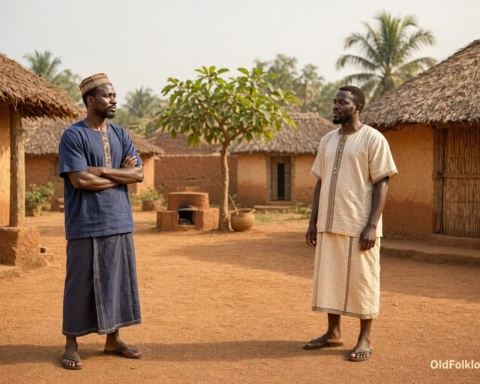
The king summoned the two men because he wanted an explanation for the prolonged drought. When they appeared before him, he recognised that they spoke the language of the sky. Their speech was familiar to him because he had once lived in the heavenly realm.
Sagbata asked them why the rain had stopped and why his people had been left to suffer for so long.
The visitors explained that they had come to teach Fa rather than to control the weather. They could not immediately provide an answer, but they agreed to examine the matter through divination.
Using the divining materials associated with Fa, they consulted the signs to discover the cause of the drought. The result pointed towards a disagreement between two brothers who desired the same thing.
The diviners recognised that the problem was connected to Sagbata’s younger brother, Sogbo. The two brothers had separated without resolving their differences, and Sogbo’s anger had affected the earth by preventing the rain from falling.
The message of Fa was clear: the elder brother needed to acknowledge the younger brother’s authority if balance was to be restored.
Sagbata understood that his earthly wealth could not replace the powers he had left behind. He had become a ruler, but his position could not provide water for his people. He therefore accepted the counsel of the diviners and recognised that reconciliation was necessary.
Wututu Carries the Message
Following the consultation, a messenger named Wututu came from the heavens carrying a message from the Creator.
Wututu’s task was to communicate with Sogbo and explain the situation. The message acknowledged that Sagbata had taken much of their mother’s inheritance when he descended to the earth. However, two essential powers had remained in the heavens: water and fire.
These were not ordinary possessions. They were powerful forces upon which the survival and order of creation depended. The Creator’s message recognised Sogbo’s authority over them and established his importance in maintaining the relationship between the heavens and the earth.
When Wututu approached Sogbo, the younger brother recognised the messenger’s voice. He instructed his sons to behave and allowed Wututu to come closer.
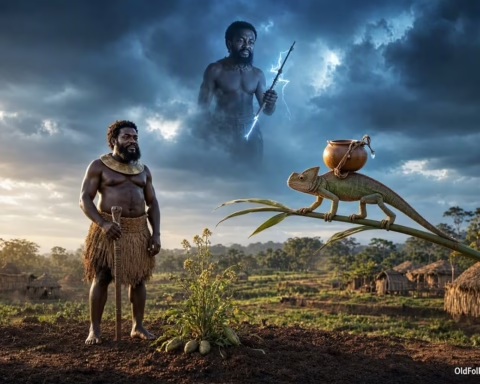
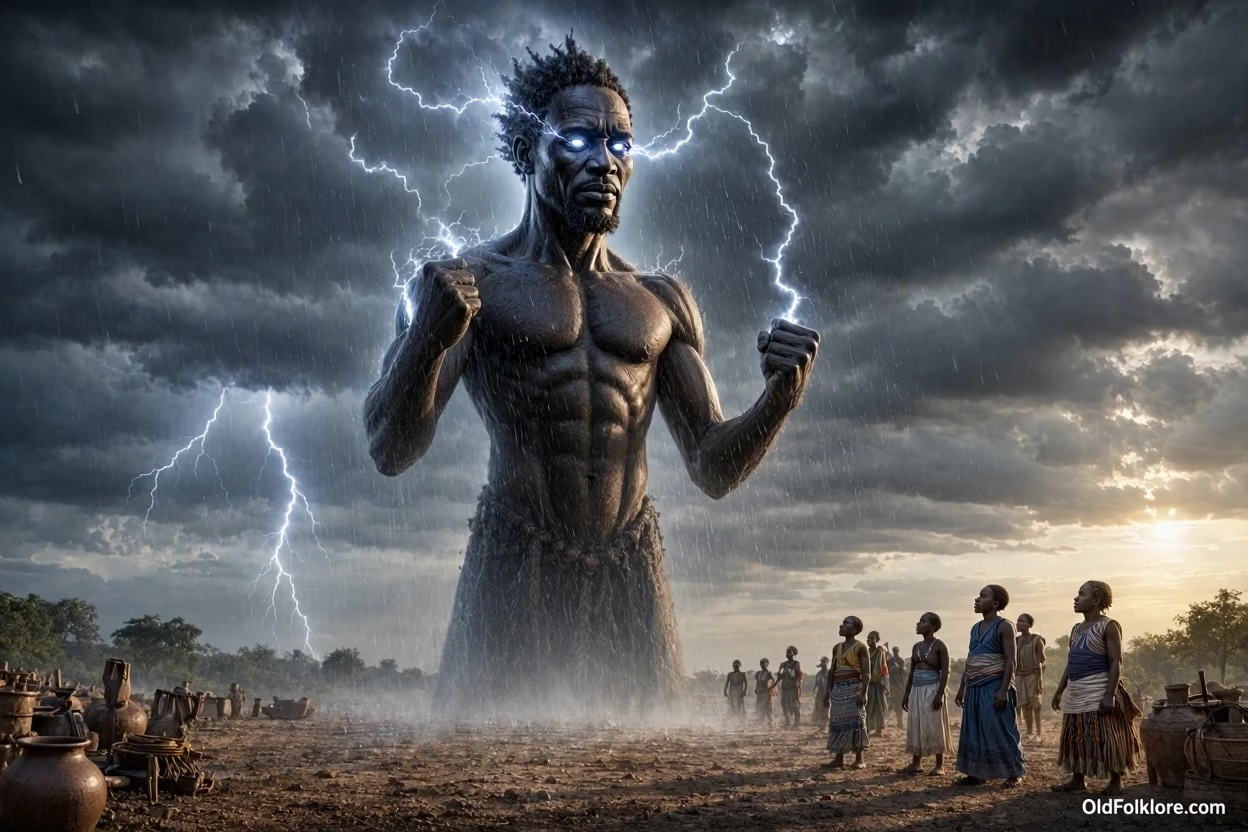
As the messenger approached, Sogbo demonstrated his power through a flash of lightning. The display made his authority unmistakable. His connection with the forces of the sky was not something that Sagbata’s earthly wealth could challenge.
Sogbo then sent Wututu back with a message for his elder brother. Sagbata might possess the treasures and possessions inherited from their mother, but Sogbo controlled the powers of water and fire. These forces gave him authority over matters that affected the entire world.
The message was not simply about which brother possessed greater wealth. It revealed that each had a different responsibility and that neither could govern creation successfully without acknowledging the other’s place.
The Return of the Rain
Before Wututu had completed his journey back to Sagbata, the weather began to change. Clouds gathered, thunder sounded across the sky and lightning illuminated the heavens.
Then the rain began to fall.
After three years of drought, water returned to the earth. The parched land received the rainfall it desperately needed, and the suffering caused by the prolonged dry season began to ease.
When Wututu arrived, Sagbata was overjoyed. The messenger had brought more than words from the heavens; his journey had been accompanied by the return of the rain.
Sagbata understood the importance of Wututu’s service. The bird had carried a message between the two brothers and helped restore the relationship between the earth and the sky.
In gratitude, Sagbata declared that Wututu must never be harmed. If anyone accidentally killed the messenger, a special ceremony would be required to honour him. The ceremonial head-pad associated with his sacred duty would also have to be removed as part of the required observance.
This decree established Wututu’s special place in the story. His role as a messenger had helped restore the balance on which the people depended.
Sogbo’s Authority Over Fire and Water
With the return of the rain, the conflict between Sagbata and Sogbo came to an end. The brothers’ separate positions were now understood in relation to one another.
Sagbata remained the ruler associated with the earth, while Sogbo retained authority over the powerful forces of the heavens. The elder brother possessed earthly wealth and dominion, but the younger brother controlled fire and water, forces that could sustain or threaten life.
The people could now understand why the rain had stopped and why its return was accompanied by thunder and lightning. These natural events became reminders of the relationship between the two brothers and the importance of maintaining harmony between their domains.
Each year, the arrival of rain accompanied by thunder and lightning recalls the power of Sogbo and the restoration of balance between heaven and earth.
Through this account, Sogbo becomes master of the universe, not because his brother’s authority disappears, but because his control over fire and water establishes his importance in the order of creation. Sagbata’s earthly kingdom and Sogbo’s heavenly power remain connected.
The story therefore explains the relationship between the forces that govern the sky and those that sustain the earth. It also reminds listeners that wealth and authority are not always enough to maintain a kingdom. Even a powerful ruler must recognise the responsibilities and powers that exist beyond his control.
Explore our complete Africa Folktales collection.
Moral Lesson
The story teaches that power and responsibility must exist in balance. Sagbata possessed wealth and authority on earth, but he could not provide rain without recognising Sogbo’s control over the heavens. Their reconciliation restored the conditions necessary for life. The tale also highlights the importance of communication, respect and cooperation when disagreements threaten the wider community.
Knowledge Check
1. Who were Sagbata and Sogbo?
They were divine brothers, children of the Creator, who received different responsibilities in the governance of creation.
2. Why did Sagbata descend to the earth?
He left the heavens to establish his authority among the people and took much of his inheritance with him.
3. What caused the drought on earth?
Sogbo withheld the rain, and the earth suffered because Sagbata did not possess control over the water in the heavens.
4. Who were the two visitors from the sky?
They were men who travelled to teach Fa, the system of divination.
5. What role did Wututu play in the story?
Wututu served as a messenger between the heavenly powers and Sagbata, helping communicate the message that led to the restoration of rain.
6. What does the story explain about thunder and rain?
It connects these natural events with Sogbo’s authority and the reconciliation between the divine brothers.
Source
Adapted from “Sogbo Becomes Master of the Universe” in Harold Courlander’s A Treasury of African Folklore (1996), p. 163. The story is identified as a Dahomean (Fon) myth.
Explore More Beninese Folktales
- The Princess and the Dangerous Lion
- The Orphan Girl and Her Stepmother
- The Truth Behind the King’s First Wife
- Turtle’s Revenge on the Lion
- The King and the Magic Stone