In a recorded Dahomean account of creation, the beginning of humanity is connected to the actions of Mawu, the Creator, and Legba, a powerful figure within the Dahomean spiritual tradition. The account describes how the first human beings were formed from the earth and how an unexpected intervention changed the fate of two of them.
At the centre of the story are Adanhu and Yewa, remembered as the first man and woman who populated the world. Their beginning is linked to the creation of four human figures, two of whom became monkeys after Legba interfered with Mawu’s work.
This account also preserves an important distinction between the Dahomean explanation of humanity’s beginnings and a different version introduced by Christian missionaries. Rather than accepting the missionary interpretation, the recorded narrator explained the account as it was understood within the tradition.
The Beginning of Humanity
According to the recorded account, humanity began with a man and a woman named Adanhu and Yewa. They were remembered as the first human couple and as the ancestors of the people who later populated the world.
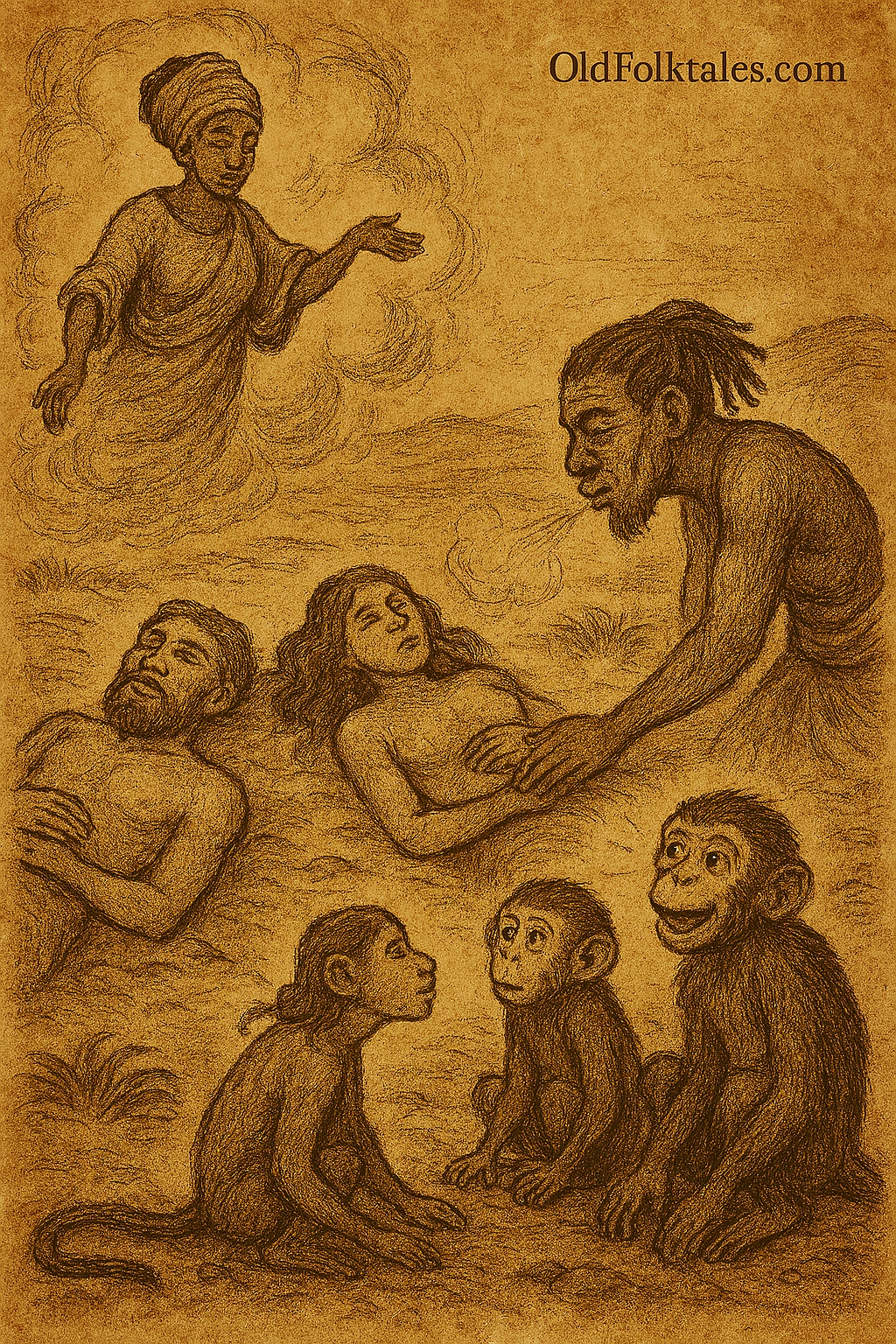
Their story begins with Mawu, the Creator. Mawu formed four human figures from the earth. There were two male figures and two female figures. Although their bodies had been made, they were not yet alive.
The creation of these figures marked an important stage in the beginning of humanity. They had been shaped from the earth, but their existence was not yet complete. Mawu’s work had not reached its final stage.
The account does not describe the process in great detail. Instead, it focuses on what happened next, when Legba interfered with the unfinished creation.
Legba’s Unexpected Intervention
While Mawu was responsible for creating the four human figures, Legba acted without the Creator’s knowledge. He attempted to change two of them, although he did not know how to carry out the work properly.
Explore more stories from our Beninese Folktales Collections archive.
His intervention produced an unexpected result. The two figures he changed became monkeys.
In the account, these monkeys were not simply animals that appeared separately from humanity. Their existence was connected to the unfinished human figures that Legba had altered. The narrator explained that all monkeys descended from those two transformed beings.
The other two figures remained under Mawu’s work. They became Adanhu and Yewa, the first man and woman remembered in the story.
Through this explanation, the account connects the beginnings of humanity and the origin of monkeys. Both are traced to the same act of creation, but their paths became different because of Legba’s intervention.
Adanhu and Yewa, the First Couple
Adanhu and Yewa became the first human couple in this Dahomean account. They were remembered as the people from whom humanity developed.
Their names are important to the way the story explains human origins. Rather than presenting the first man and woman as figures whose beginnings were unknown, the account gives them distinct identities and connects them directly to Mawu’s creation.
The story does not provide a detailed description of their lives, their relationship or the number of children they had. Its attention remains on their origin and their place in the beginning of humanity.
By identifying Adanhu and Yewa as the first couple, the account offers an explanation of how human life began. It also distinguishes their creation from the transformation that produced the ancestors of monkeys.
The Story and the Missionary Interpretation
The recorded account includes a disagreement about another explanation of humanity’s beginnings.
The narrator rejected a version associated with Christian missionaries. That version involved the familiar story of a forbidden fruit and an act of disobedience. The narrator explained that this was not the Dahomean account being described.
According to the recorded statement, the missionaries had heard the names Adanhu and Yewa and assumed that the figures belonged to a story similar to the one they knew from their own religious tradition. The narrator disagreed with that interpretation and stated that the people had not told such a story about Legba giving them fruit.
This distinction is important because it shows that the recorded account was not simply a local version of the missionary narrative. It had its own explanation of the first human beings, the creation of monkeys and Legba’s intervention.
The narrator’s correction also reminds readers that similar names or themes do not necessarily mean that two traditions share the same story. Accounts should be understood within the contexts in which they were told and recorded.
The Name of Zogbo
The recorded passage also mentions a man named Zogbo. The narrator refers to him as someone who came to the place and preserves a saying connected to his name.
The proverb states: “When one says he is greater than another, ask him, ‘Are you Zogbo?’”
The saying uses Zogbo as a point of comparison when someone claims superiority over another person. However, the recorded passage does not provide enough information to establish a complete account of Zogbo’s journey or to connect him to a detailed migration narrative.
For that reason, his mention is best understood as a separate part of the recorded statement rather than as evidence for an extended story about the movement of the first people.
A Distinct Account of Creation
The story of Adanhu and Yewa preserves a particular explanation of human origins within Dahomean oral tradition. It describes Mawu forming four human figures from the earth, Legba changing two of them without the Creator’s knowledge, and the remaining pair becoming the first man and woman.
The account also explains the origin of monkeys through the transformation of the two altered figures. This connection gives the story a distinctive place among traditional explanations of the relationship between human beings and animals.
Its rejection of the missionary interpretation is equally significant. The narrator made a clear distinction between the account being shared and a different story that had been associated with the same names.
As with other oral traditions, the recorded version represents the account preserved by a particular narrator. It should not automatically be treated as the only creation story known throughout Dahomey or among every community connected with its history.
Nevertheless, it provides valuable evidence of how one Dahomean account explained the beginning of humanity and the origin of monkeys.
Explore our complete Africa Folktales collection.
Moral of the Story
The story preserves a traditional explanation of human origins and the consequences of an intervention in the work of creation. Its central lesson lies in the distinction between the roles of Mawu and Legba and in the importance of understanding a tradition through the account in which it was recorded.
Knowledge Check
- Who were Adanhu and Yewa?
They were the first man and woman in the recorded Dahomean creation account. - Who created the four human figures?
Mawu, the Creator, formed the four figures from the earth. - How many human figures did Mawu create?
Mawu created four figures: two males and two females. - What happened to the two figures changed by Legba?
They became monkeys, and the account identifies them as the ancestors of all monkeys. - What happened to the other two figures?
They became Adanhu and Yewa, the first human couple. - Why did the narrator reject the missionary interpretation?
The narrator explained that the story involving forbidden fruit was not the Dahomean account being told.
Source
Source: Adapted from a Dahomean account recorded in Melville J. Herskovits and Frances S. Herskovits, Dahomean Narrative: A Cross-Cultural Analysis (1958), pp. 150–151.
Explore More Beninese Folktales
- The Truth Behind the King’s First Wife
- Turtle’s Revenge on the Lion
- The King and the Magic Stone
- Why Death Came to the World
- The Talking Drum’s Warning
- The Generous Young Woman and the Stranger