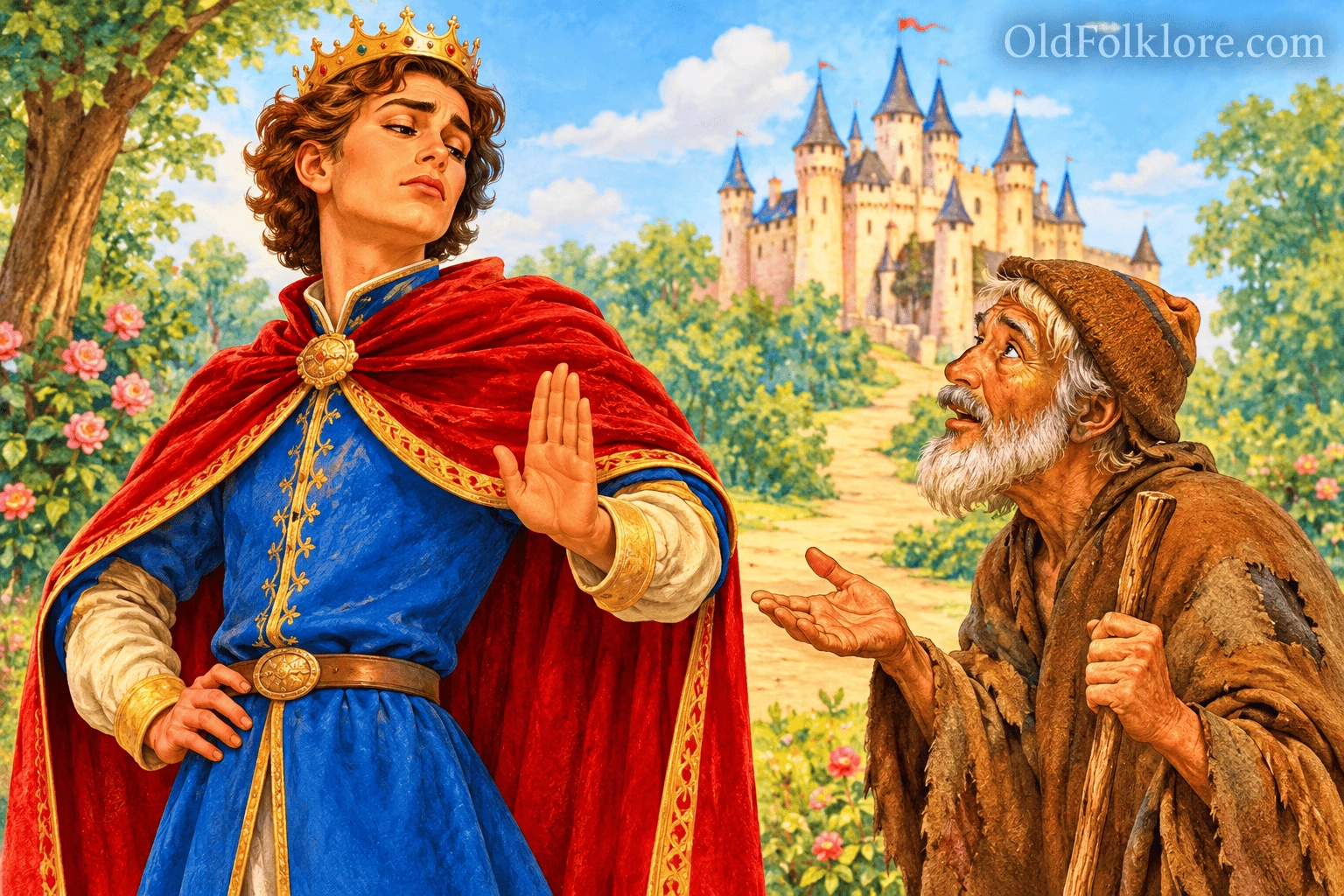
Long ago, there lived a king so fair, generous, and compassionate that everyone in his kingdom called him the Good King. He treated his subjects with kindness and believed that even the smallest creature deserved protection.
One afternoon, while hunting in the forest, the king noticed a little white rabbit fleeing from his hounds. Terrified, the animal leapt into his arms. The king immediately shielded it.
“Do not be afraid, little one. You have come to me for protection, and I shall see that nobody harms you.”
Explore more stories from our Andrew Lang’s Colour Fairy Books collection.
He carried the rabbit back to his palace, where he provided it with a comfortable little house and plenty of food.
That night, as the king sat alone in his chamber, a beautiful lady suddenly appeared before him. Her gown was as white as freshly fallen snow, and a crown of white roses rested upon her head.
“I am the Fairy Truth,” she announced. “Earlier today, I took the form of that little rabbit to discover whether you were truly as kind as people claim. Your compassion has pleased me. Those who show mercy to helpless animals are often capable of great kindness towards their fellow human beings. From this day forward, I shall be your friend. Ask me for anything, and I shall grant it.”
The king was delighted, but he did not ask for riches, power, or a longer life.
“I have only one son, whom I love dearly. His name is Prince Darling. If you would grant me a favour, I ask that you become his friend.”
The fairy smiled. She offered to make the young prince the handsomest, wealthiest, or most powerful ruler in the world.
“None of those things matters as much as goodness,” replied the king. “What use would all the wealth and kingdoms in the world be if my son were wicked? A person can only find true happiness by becoming good.”
The Fairy Truth agreed, but explained that she could not simply make the prince virtuous. He would have to choose goodness for himself. She could guide him, correct his mistakes, and punish him when he refused to correct them.
The king gladly accepted her promise.
Not long afterwards, the Good King died. Prince Darling was heartbroken. He loved his father so deeply that he would have surrendered every treasure and kingdom he possessed if only he could have brought him back.
The Golden Ring
Two nights after his father’s death, the Fairy Truth appeared in the prince’s bedroom.
“I promised your father that I would be your friend,” she said. “I have come to give you something that will help you become the man he hoped you would be.”
She placed a small golden ring upon his finger.
“Guard this ring carefully. Whenever you commit a bad deed, it will prick you. If you ignore its warning and continue doing wrong, you will eventually lose my friendship, and I shall become your enemy.”
For a while, Prince Darling behaved admirably. He treated his subjects fairly and tried to follow the good example his father had set. His ring remained silent, and the people affectionately called him Prince Darling the Happy.
But his good behaviour did not last.
One afternoon, after a disappointing hunting expedition, he returned to the palace in a foul temper. His little dog, Bibi, rushed towards him, wagging her tail and jumping excitedly around his feet.
“Get away!” he snapped. “You are disturbing me!”
Bibi did not understand. She tugged at his coat, hoping to attract his attention. The irritated prince kicked her away.
Immediately, his golden ring gave him a painful prick.
Ashamed and surprised, he sat down and examined his finger.
“What have I done that deserves such punishment?” he wondered. “Surely a king should be allowed to discipline his own dog!”
The Fairy Truth answered his thoughts.
“You have committed several faults. First, you allowed your disappointment to make you unpleasant to everyone around you. Then you gave yourself over to anger. Finally, you were cruel to a helpless creature that had done nothing to hurt you.
“Do you imagine that being a king gives you the right to mistreat those who are weaker than you? If greatness entitled one person to abuse another, then I, being a fairy, could treat you just as cruelly. The purpose of power is not to give someone permission to do whatever pleases them. It is to give them greater opportunities to do good.”
Prince Darling recognised his wrongdoing and promised to improve.
Unfortunately, he repeatedly broke that promise.
A Prince Spoiled by His Upbringing
The prince’s troubles had begun long before he inherited the throne. As a child, he had been raised by a foolish nurse who gave him everything he demanded.
Whenever he cried, stamped his feet, or threw a tantrum, she hurried to satisfy him. She also constantly reminded him that he would become a king, and that kings could do whatever they pleased because everyone was obliged to obey them.
By the time Prince Darling grew older, pride, stubbornness, and vanity had become deeply rooted habits.
He was not entirely without goodness. Whenever he behaved badly, he often felt genuine regret. Sometimes the ring’s warning was enough to make him stop. On other occasions, however, he ignored its painful pricks.
Eventually, he became tired of being constantly reminded of his faults. He wanted to act without feeling guilty, so he removed the ring and threw it aside.
Freed from its warnings, he gave himself over to his worst impulses. His kindness disappeared, his temper became unbearable, and his subjects gradually came to hate him.
Celia Refuses the Prince
One day, Prince Darling encountered a beautiful young shepherdess named Celia. She was not only lovely but also gentle, honest, and courageous.
The prince immediately decided that he wanted to marry her.
He assumed that Celia would be delighted to become his queen, with all the riches, fine clothing, and privileges that came with the position.
But when he proposed marriage, she refused.
“Sire, I am only a poor shepherdess, but I cannot marry you.”
The prince was astonished.
“Do you dislike me?” he demanded.
“No, my prince,” Celia replied. “I cannot deny that you are handsome. But what good would your wealth and magnificent palace do me if I had to watch you behave wickedly every day? I would eventually come to despise you.”
Her honesty wounded his pride. Rather than accepting her decision, he ordered his officers to imprison her and bring her to the palace.
Although he was angry, he still loved her and could not bring himself to punish her immediately.
The Flatterers and the Betrayal of Suliman
Among Prince Darling’s closest companions was his foster-brother. The prince trusted him completely, although he was a wicked man who encouraged every one of his master’s worst qualities.
Seeing the prince troubled by Celia’s refusal, the foster-brother offered his advice.
He told the prince that he should stop trying to win the shepherdess’s affection and instead force her to obey. He suggested keeping her in prison, feeding her only bread and water, and threatening to have her executed if she continued to refuse marriage.
The prince hesitated.
“Would it not be shameful to have an innocent girl put to death? She has committed no offence.”
His foster-brother replied that anyone who disobeyed a king deserved punishment. More importantly, he warned that allowing Celia to defy him would encourage the rest of his subjects to challenge his authority.
This struck the prince’s weakest point. Afraid of losing his power and respect, he abandoned his intention to improve himself.
His foster-brother then invited three equally corrupt courtiers to dine with the prince. They filled his cup with wine and spent the evening provoking his anger. They even claimed that Celia had laughed at his affection.
Enraged, Prince Darling rushed towards her prison, threatening to have her sold into slavery if she continued to refuse him.
But when he arrived, Celia had disappeared. The prison was empty, and the key had remained in his own pocket.
Furious, the prince demanded to know who had helped her escape.
His wicked companions seized the opportunity to accuse Suliman, an elderly nobleman who had once been the prince’s tutor.
Suliman had always loved Prince Darling like his own son. Even after being dismissed from court for speaking honestly about the prince’s faults, he had continued to hope that his former pupil would change.
The courtiers knew that Suliman’s influence might one day be restored. They therefore invented a story that he had boasted of helping Celia escape. They even bribed three men to support the false accusation.
Without properly investigating the matter, Prince Darling ordered his foster-brother and a company of soldiers to seize Suliman and bring him before the court in chains.
The Fairy’s Punishment
The prince had scarcely returned to his chamber when a tremendous clap of thunder shook the palace.
The Fairy Truth appeared before him.
“I promised your father that I would guide you and punish you if you refused to follow my advice,” she declared. “You have rejected every warning and allowed yourself to become a creature of cruelty. You may still look like a man, but your actions have made you a monster.”
She explained that his anger resembled that of a lion, his greed that of a wolf, his ingratitude towards Suliman that of a snake, and his stubborn cruelty that of a bull.
“Since you have imitated these creatures in your behaviour, you shall now bear their appearance.”
Before Prince Darling could answer, the transformation began.
His head became that of a lion, great bull’s horns grew from it, his feet became those of a wolf, and his body took the shape of a snake.
In an instant, he found himself beside a clear lake in the middle of a forest. Looking into the water, he saw the dreadful creature he had become.
The Fairy’s voice sounded once more.
“Look at what your wickedness has made of you. Your soul is a thousand times uglier than the body you now possess.”
The prince roared in fury and tried to find the fairy so that he could attack her. But she had vanished.
She warned him that his pride would now be humbled by falling into the hands of his own subjects.
Desperate to escape the sight of his reflection, Prince Darling rushed towards the forest. Before he had gone far, he fell into a deep hunting pit designed to trap bears.
Hunters hiding nearby climbed down, fastened several chains around him, and carried him towards the principal city of his kingdom.
Even then, the prince refused to accept responsibility. He blamed the Fairy Truth for his suffering and fought furiously against his chains.
A New King Takes the Throne
As the hunters approached the city, they noticed that the streets were filled with celebration.
When they asked what had happened, the people explained that Prince Darling was believed to have been killed by a thunderbolt. Four of his wicked courtiers had attempted to seize the kingdom and divide it among themselves.
But the people had risen against them, recognising that these men were responsible for encouraging the prince’s cruelty. The four conspirators had been executed.
The crown had then been offered to Suliman, who had been imprisoned by the former king.
The people rejoiced because they believed that the noble old man would restore peace and justice.
Prince Darling was horrified.
When the hunters brought him into the great square before his palace, he saw Suliman seated upon the royal throne, surrounded by cheering subjects.
The new king raised his hand to quiet the crowd.
“I have accepted this crown,” Suliman announced, “but I do not wish to keep it for myself. I shall hold it for Prince Darling, who is not truly dead. The Fairy has assured me that there remains hope that he may one day return, restored to goodness and virtue.”
He continued by explaining that the prince had been led astray by flatterers. He had always believed there was goodness in his former pupil’s heart, and he hoped that the young man might yet recover it.
“Let us condemn his wicked actions, but let us also pity him and pray for his restoration. I would gladly give my life if doing so could bring back the prince I once knew.”
These words deeply affected Prince Darling.
For the first time, he understood how much Suliman truly loved him. The old tutor had been betrayed, humiliated, and imprisoned, yet he still wished for his former pupil’s happiness.
The prince began to recognise the harm he had caused. His anger gradually disappeared, and he stopped struggling against the bars of his cage.
At last, he accepted that his punishment was deserved.
The Monster’s First Good Deed
The hunters took Prince Darling to a menagerie, where he was chained among other wild animals.
Determined to make amends for his past behaviour, he decided to be gentle and obedient towards his keeper.
Unfortunately, the keeper was a cruel man who frequently beat him, even when he had done nothing wrong.
One day, while the keeper slept, a tiger broke free from its chain and sprang towards him.
Prince Darling initially felt pleased. The tiger might kill the man who had tormented him, and he would finally be rid of his suffering.
But then he reconsidered.
“Why should I allow him to die when I have the opportunity to save him? I shall return good for evil.”
No sooner had he formed this intention than the iron door of his cage flew open.
He rushed towards the keeper, who had awakened and was desperately trying to defend himself.
Seeing the strange monster approaching, the man feared that his death was certain. Instead, Prince Darling attacked the tiger and killed it.
When the danger had passed, he returned to the keeper and crouched humbly at his feet.
Overwhelmed by gratitude, the man reached down to stroke the creature that had saved his life.
At that moment, a mysterious voice declared:
“A good action should never go unrewarded.”
The monstrous creature vanished, and in its place stood a beautiful little dog.
Prince Darling was delighted. He jumped about joyfully, and the keeper, astonished by the transformation, lifted him into his arms and carried him to the Queen.
The Queen was charmed by the little dog and decided to keep him. She treated him affectionately, although she worried that he might become overweight.
After consulting the royal physician, she ordered that he should eat only bread and very little of it.
Prince Darling consequently spent much of his time hungry, but he endured his discomfort patiently.
The Palace of Pleasure
One morning, the little dog received his usual piece of bread. He decided to carry it into the garden and eat beside a brook he knew.
But when he reached the place, he was astonished.
The brook had disappeared. In its place stood an enormous palace that seemed to be constructed from gold and precious stones.
Music, dancing, and feasting filled the magnificent building. Beautifully dressed people entered through its doors, but those who emerged looked completely different.
They were pale, exhausted, and dressed in torn clothing. Some collapsed and died almost immediately. Others crawled away weakly, while many lay on the ground begging for food.
Yet the people entering the palace ignored their desperate pleas.
Prince Darling noticed a young girl trying to survive by eating blades of grass. His heart filled with pity.
Although he was desperately hungry himself, he knew that he could wait for another meal, while the girl might not survive without food.
He placed his piece of bread in her hands.
The girl ate it eagerly and soon began to recover. Prince Darling felt happy that he had been able to save someone.
But his happiness was interrupted by a terrible commotion.
He turned and saw Celia being dragged unwillingly into the palace.
He desperately wished he could return to his monstrous form, for then he might have been strong enough to rescue her. As a little dog, however, he could do little more than bark and chase after her.
The people carrying Celia kicked him away.
The prince remained nearby, blaming himself for her suffering.
He remembered that he had once done exactly the same thing to her. Had nobody intervened, he might have treated her even more cruelly.
As he stood watching the palace, a window opened above him.
To his delight, Celia appeared and threw a plate of delicious-looking food into the garden before closing the window.
The starving little dog hurried towards it.
But before he could take a bite, the young girl whose life he had saved rushed forward and lifted him into her arms.
“Do not eat that, poor little creature! That building is the Palace of Pleasure. Everything that comes out of it is poisoned!”
At that instant, the mysterious voice spoke again.
“You see that a good action always brings its reward.”
Prince Darling was transformed once more, this time into a beautiful white dove.
The Search for Celia
The prince recognised the significance of his new appearance. White was the Fairy Truth’s favourite colour, and he began to hope that she might finally be pleased with him.
But he had another concern: Celia.
He flew around the Palace of Pleasure, searching for a way inside. Eventually, he found an open window and entered.
He searched through its rooms but could find no trace of the shepherdess.
Desperate to discover where she had gone, he decided to search the world until he found her.
For several days, he flew across great distances until he reached a vast desert. There, he noticed a cavern.
Inside sat Celia, sharing a simple breakfast with an old hermit.
Overjoyed, the white dove flew towards her and settled upon her shoulder. He gently rubbed against her, hoping she would understand how happy he was to see her again.
Celia was delighted by the beautiful bird’s affection. She stroked its feathers and spoke tenderly.
“I accept the gift you have given me of yourself, and I shall love you always.”
The old hermit, who had been watching them, asked:
“Are you certain you are prepared to keep that promise?”
“I certainly hope so, my dear shepherdess!” exclaimed the dove.
Before Celia could recover from her astonishment, the bird had become a handsome young man.
It was Prince Darling, restored to his natural appearance.
“You promised to love me always,” he said. “Do you truly mean it? Otherwise, I shall have to ask the Fairy to turn me back into the dove you found so pleasing.”
The Return of the Fairy Truth
The old hermit suddenly threw aside his disguise.
Beneath the rough clothing stood the Fairy Truth.
“Do not fear, Prince Darling,” she said. “Celia has loved you since the first time she saw you. But she could not bring herself to tell you while you were so proud, stubborn, and wicked. Now that you have repented and genuinely wish to become good, you deserve the happiness you once threw away.”
Celia and Prince Darling fell at the fairy’s feet.
The prince thanked her repeatedly for giving him another chance. He confessed how deeply he regretted his past behaviour, and Celia promised to love him for the rest of her life.
The Fairy Truth smiled.
“Rise, my children. I shall take you back to the palace, where Prince Darling will receive the crown he lost through his own misconduct.”
In an instant, they found themselves in Suliman’s great hall.
The old nobleman could hardly believe his eyes. His beloved former pupil had returned!
Overcome with happiness, Suliman gladly surrendered the throne and welcomed Prince Darling back as his rightful king. He remained his most faithful subject and trusted adviser.
Prince Darling and Celia were married and ruled together for many years.
The prince never forgot the suffering his selfishness had caused. He was determined to govern justly, protect the weak, and fulfil his responsibilities.
He also began wearing his golden ring again.
This time, it rarely troubled him, for he had finally learned to recognise his faults and correct them before they became wicked deeds.
And so Prince Darling discovered that true greatness did not come from possessing a crown, commanding obedience, or enjoying endless riches. It came from having the wisdom and goodness to use one’s power for the benefit of others.
Explore our complete Historic Folklore & Fairy-Tale Collections archive.
Moral
True greatness comes from goodness, not wealth, beauty, or authority. People must take responsibility for their actions, listen to honest advice, and learn to treat others with kindness, particularly those who are weaker or less powerful.
The story also teaches that genuine repentance requires more than feeling sorry. A person must demonstrate a willingness to change through consistent good actions.
Knowledge Check
1. Why did the Fairy Truth become the Good King’s friend?
Because the king showed compassion by protecting the white rabbit, which was actually the fairy in disguise.
2. What was special about Prince Darling’s golden ring?
It pricked his finger whenever he committed a bad deed. More serious wrongdoing produced more painful warnings.
3. Why did Celia refuse to marry Prince Darling?
Although she recognised his handsome appearance, she could not accept his wicked behaviour and feared that she would eventually despise him.
4. Who was Suliman, and why was he important?
Suliman was Prince Darling’s former tutor. He continued to love the prince despite his mistreatment and remained hopeful that he would eventually become a good ruler again.
5. What actions helped Prince Darling regain his humanity?
He chose to save his cruel keeper from a tiger and later sacrificed his own bread to feed a starving girl. These acts demonstrated genuine compassion.
6. What is the central lesson of the Fairy Truth’s golden ring?
Goodness cannot be imposed from outside. Advice and warnings can guide someone, but personal responsibility and the willingness to correct one’s faults are essential.
Source
Lang, Andrew (ed.). The Blue Fairy Book. London: Longmans, Green, and Co., 1889, pp. 278–289. “Prince Darling.” Adapted from the French Le Cabinet des Fées, translated/adapted by Miss Minnie Wright.
Explore More Andrew Lang’s Colour Fairy Books
- Prince Hyacinth and the Dear Little Princess
- The Bronze Ring: A Classic Fairy Tale
- Why the Sea Is Salt: The Blue Fairy Book
- The Death of Koschei the Deathless: The Red Fairy Book
- Thumbling
- The Wedding of Mrs Fox
- The Elves
- The Robber Bridegroom’s Terrifying Secret