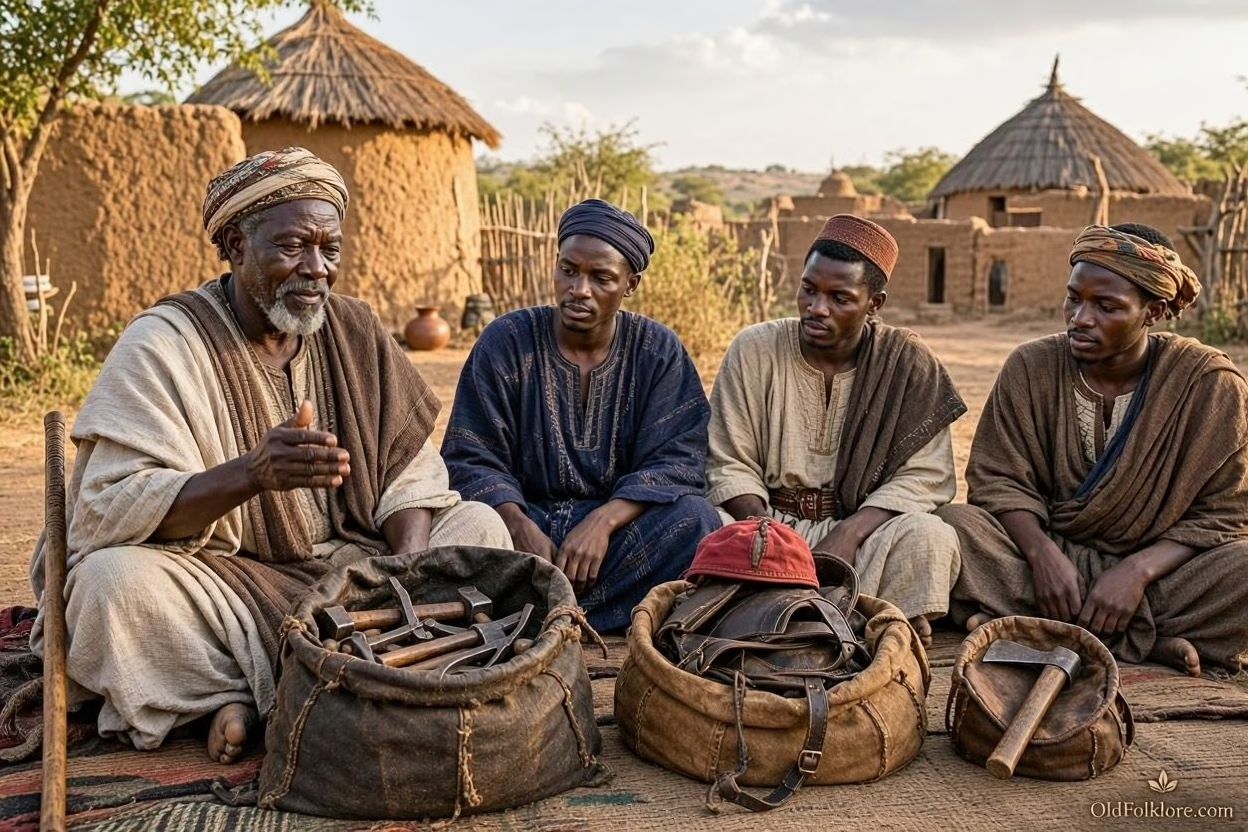
In traditional Mossi society, different groups held important responsibilities in the organisation of their communities. Blacksmiths worked with iron and fire, kings exercised political authority, and chiefs of the land maintained responsibilities connected with the earth.
A Mossi origin legend explains the relationship between these groups through the story of a father and his three sons. Before his death, the father presented each son with an inheritance contained in a separate bag. Their choices determined the roles their descendants would occupy.
The eldest received the tools of the forge and became the ancestor of blacksmiths. His younger brothers received inheritances associated with kingship and the leadership of the land. Through this story, the Mossi explained how three important groups came to form part of their society.
The Father and His Three Sons
Long ago, a father had three sons. As he approached the end of his life, he called them together because he wanted to distribute his possessions before he died.
He told his children that he would soon leave them, but he did not intend to depart without giving each of them an inheritance.
Before the three brothers, he placed three bags. Each contained something intended for one of his sons. Rather than assigning the bags himself, the father allowed the brothers to choose.
He explained that each bag held a different inheritance and instructed them to make their selections.
The brothers looked at the bags, each considering which one to take. They did not know exactly what their father had placed inside them, but their choices would determine the paths their descendants followed.
The Eldest Brother Chooses the Heaviest Bag
The eldest son moved first. Among the three bags, he selected the heaviest one.
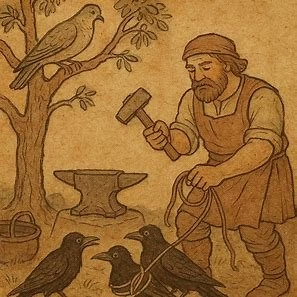
When he opened it, he discovered tools used for working in a forge. These were the instruments of a blacksmith, the craftsman who shaped iron into objects useful to the community.
Explore more stories from our Burkinabe Folktales Collections archive
The inheritance established his place as the ancestor of the blacksmiths.
His descendants would become associated with the craft of working iron, producing the tools and other objects required for different aspects of community life.
The story therefore connects the blacksmith lineage with the eldest of the three brothers. His choice of the heaviest bag gave his descendants an identity tied to the forge and the knowledge of nonworking.
The Second Brother Receives the Royal Inheritance
After the eldest brother had made his selection, the second brother approached the remaining bags.
He chose the largest one. When he opened it, he found a saddle harness and a red cap.
These objects represented the authority and position of a ruler. Through this inheritance, the second brother became the ancestor of kings.
His descendants would belong to the group associated with political leadership and kingship among the Mossi.
The objects in the bag were therefore more than ordinary possessions. Within the story, they represented the authority that would distinguish the royal lineage from the other groups.
The Youngest Brother Receives the Inheritance of the Land
The youngest brother waited until his two elder brothers had chosen their bags.
Only one remained. It was the smallest and lightest of the three.
He opened it and discovered an adze, a tool used for cutting and shaping wood.
His inheritance established him as the ancestor of the chiefs of the land and rain.
Although his bag was smaller than those selected by his brothers, it carried an important responsibility. His descendants would be associated with the authority and duties connected with the land.
The three brothers had now received their different inheritances. One became the ancestor of blacksmiths, another the ancestor of kings, and the youngest the ancestor of chiefs of the land and rain.
The Meaning of the Three Inheritances
The legend does not end with the distribution of the bags. Its meaning becomes clearer through the explanation given by the person who recounted it.
The father in the story was identified as wêde, meaning divinity. The three brothers represented the ancestors of the different groups, while the people living in the land of Yadega were understood as descendants of these three children.
The story therefore provides more than an explanation of how the blacksmiths acquired their place in society. It presents a traditional account of the relationship between blacksmiths, kings and chiefs of the land.
Each group received a different inheritance, and each inheritance represented a distinct responsibility.
The blacksmiths were connected with nonworking and the forge. The royal descendants were associated with political authority, while the descendants of the youngest brother were linked with the land and rain.
The three inheritances together represented important parts of Mossi social organisation.
The Place of Blacksmiths in Mossi Society
Blacksmiths occupied a distinctive position in the society of the Mossi of Yatenga. Their work involved more than producing useful objects from iron.
The blacksmith was connected with several important aspects of community life. His craft supplied agricultural tools and weapons, while his responsibilities could also extend into social and ceremonial matters.
In his 1961 study, Dominique Zahan explains that the blacksmith occupied an important position between the groups associated with political authority and those connected with the land. He describes the blacksmith as a figure who linked these different parts of Mossi society.
This helps explain why the inheritance of the eldest brother was significant. His descendants were not simply remembered as people who possessed tools for making iron objects. Their lineage represented a distinct social role within the wider community.
The legend preserved this understanding through a simple story about a father, three sons and three bags.
Explore our complete Africa Folktales collection.
Moral of the Story
The Three Inheritances teaches that different responsibilities contribute to the organisation of a community. It highlights the importance of recognising the roles of different groups and understanding how their contributions are connected. It also preserves a traditional Mossi explanation of the origins of blacksmiths, kings and chiefs of the land.
Knowledge Check
1. How many sons did the father have?
The father had three sons.
2. What did the eldest son find in his bag?
He found tools used for working in a forge.
3. What did the second brother receive?
He received a saddle harness and a red cap, which represented the royal inheritance.
4. What did the youngest brother find in his bag?
He found an adze, a tool used for cutting and shaping wood.
5. Which social group descended from the eldest brother?
The blacksmiths descended from the eldest brother.
6. What does the legend explain about Mossi society?
It explains the traditional origins of blacksmiths, kings and chiefs of the land through the inheritances received by three brothers.
Source
Adapted from the Mossi inheritance legend recorded by Dominique Zahan in “Pour une histoire des Mossi du Yatenga,” L’Homme, vol. 1, no. 2 (1961), pp. 5–22. The legend appears on pp. 19–20.