Long ago, in the lands north of the White Volta, there lived a princess whose courage made her famous among warriors. Her name was Yennenga, and she was the daughter of a powerful Dagomba ruler. She could ride a horse with great skill and take part in military expeditions, earning the admiration of those who served her father. Yet the life that brought her honour also created a conflict within the royal household. Her father valued her strength so greatly that he struggled to accept the future she wanted for herself.
Yennenga’s decision to leave her father’s kingdom would lead her into unfamiliar territory, where she would meet a hunter named Rialé and give birth to a son called Ouedraogo. In Mossi oral tradition, the story of this family explains the beginnings of a royal lineage and the emergence of the Mossi kingdoms.
The Princess Who Rode Like a Warrior
In the days of the old kingdoms, a powerful ruler named Nédéga governed from Gambaga, in a region associated with the Dagomba people. His authority extended over neighbouring communities, and his warriors defended the kingdom against its enemies. Among the members of his royal household was his daughter, Yennenga.
Nédéga loved his daughter and recognised her unusual abilities from an early age. She was not content to remain within the palace while others prepared for the affairs of the kingdom. She wanted to learn the skills that made the warriors strong, and she showed a natural confidence around horses.
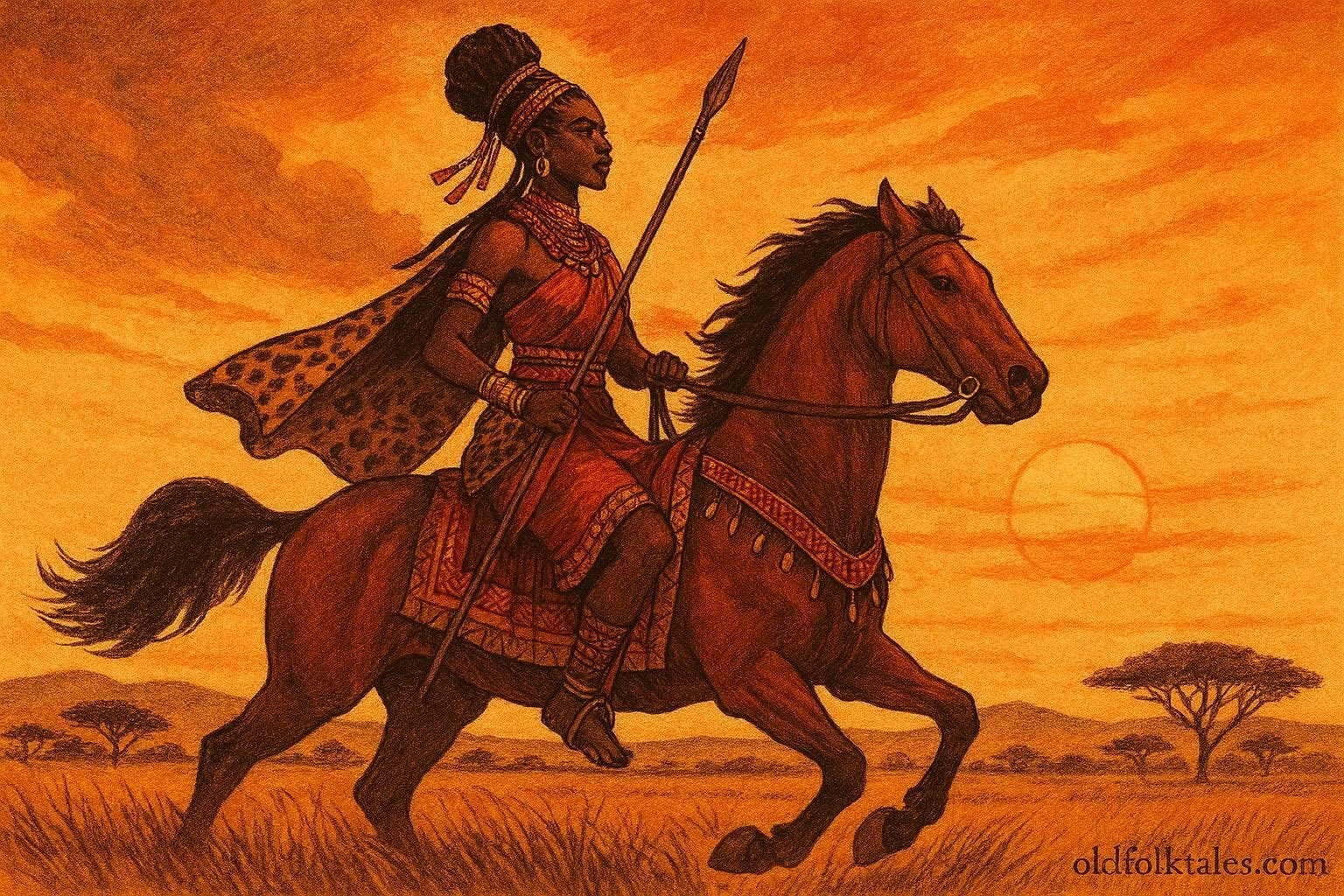
As she grew older, Yennenga became an accomplished horsewoman. She learned to handle her mount, travel across difficult ground and take part in the activities of the royal warriors. Her courage and ability earned her a place in the military life of the kingdom.
In time, she became more than a princess who enjoyed riding. She took part in expeditions and commanded warriors. The men who accompanied her came to respect her determination and skill. She could face the dangers of a journey without easily losing her resolve.
Her father took pride in her achievements. Yennenga’s abilities brought honour to his household, and her presence among the warriors demonstrated the strength of his royal family. In the eyes of many people, she was an extraordinary daughter.
However, the qualities that made her valuable to her father also shaped the future he imagined for her. He became so accustomed to seeing her as a warrior that he found it difficult to consider her wishes as a young woman who wanted a family of her own.
A Father Who Would Not Let Her Marry
As Yennenga grew older, she began to desire marriage. She had spent much of her life serving the kingdom and proving her courage, but she wanted the opportunity to build a life beyond the battlefield.
Her father did not share her feelings.
Nédéga regarded Yennenga as a warrior of exceptional value. He was reluctant to lose her from his household, and he wanted any man who married her to possess great influence and strength. He did not believe that the men available to him were suitable husbands for his daughter.
Explore more stories from our Burkinabe Folktales Collections archive.
He therefore delayed giving his permission for her marriage.
At first, Yennenga may have hoped that her father would eventually understand her wishes. She had served him faithfully and brought honour to the kingdom. She had demonstrated that she could be trusted with responsibility. Yet her achievements did not give her the freedom to decide what kind of future she wanted.
The disagreement became a painful matter between father and daughter. Nédéga continued to value her as a warrior, while Yennenga wanted to make choices about her own life.
She could not remain indefinitely in a household where her future was determined entirely by another person. The princess began to consider leaving.
It was a difficult decision. Her father’s kingdom was the only home she had known, and her departure meant abandoning the security and position she enjoyed there. She also understood that leaving without her father’s approval could damage their relationship.
Nevertheless, Yennenga believed that she could not allow her life to be decided for her forever.
Yennenga Leaves Her Father’s Kingdom
One day, Yennenga left Gambaga and travelled northwards. She rode away from the familiar surroundings of the royal household and entered lands where she had no established position.
The journey was unlike the military expeditions she had previously undertaken. On those occasions, she had travelled with other warriors and carried out duties connected to her father’s authority. Now she was travelling for herself.
She had to depend on her own judgement and the abilities she had developed over the years. Her knowledge of horses and her experience in difficult journeys became valuable companions.
Different versions of the tradition describe the circumstances of her departure in different ways. In one account, she deliberately leaves because her father refuses to allow her to marry. Other retellings describe her horse becoming difficult to control and carrying her away from the royal party. Although the details vary, the tradition remembers her journey as the beginning of a new chapter in her life.
As she travelled farther from Gambaga, the familiar authority of the palace became less important. She was no longer surrounded by people who knew her as the king’s daughter. She had entered a world where she would have to establish relationships through her actions rather than her royal position.
The Hunter Named Rialé
During her journey, Yennenga encountered a hunter named Rialé. He lived away from the royal household and earned his living through hunting. His life was different from the one she had known in the palace.
Some traditions describe Rialé as a man of Manding origin, while other accounts give different explanations of his ancestry. What remains central to the story is his meeting with the travelling princess.
Their encounter brought two people from different backgrounds together. Yennenga had been raised in a royal household and had taken part in the military life of her father’s kingdom. Rialé lived as a hunter, depending on his knowledge of the land and his ability to provide for himself.
They became acquainted, and their relationship gradually developed. Yennenga found a new life with him, away from the expectations that had surrounded her in Gambaga. Their union was remembered as an important event in the ancestry of the Mossi people.
For Yennenga, the meeting marked a change in her circumstances. She had left behind the position of a royal daughter and begun a family in a different land. Her life was no longer defined only by her father’s kingdom or the responsibilities she had carried as a warrior.
In time, Yennenga gave birth to a son.
The Birth of Ouedraogo
Yennenga and Rialé named their son Ouedraogo. The name is commonly explained in the tradition as meaning a male horse or stallion, recalling the horse associated with Yennenga’s journey.
The child represented the joining of two family backgrounds. Through his mother, he was connected to the royal house of Nédéga. Through his father, he belonged to Rialé’s family.
Yennenga raised her son with an understanding of his ancestry. She knew that he belonged to a family whose story began far beyond the place where he was growing up. She also knew that the disagreement with her father had left an important matter unresolved.
Ouedraogo grew older, and his connection to his grandfather became significant. Although Yennenga had left Gambaga, the relationship between the two families had not disappeared. The child was Nédéga’s grandson, and his existence offered an opportunity to restore the connection that had been broken by Yennenga’s departure.
The tradition remembers Yennenga as the person who helped make this reunion possible. She had not forgotten her father, even though she had chosen to leave his household. The future of her son gave her a reason to consider returning.
The Return to Gambaga
When the time came, Yennenga and her son approached Nédéga’s kingdom. Their return was important because Yennenga had left without her father’s approval. She could not assume that the king would immediately welcome her or accept the family she had established.
The journey back therefore carried more than the hope of seeing familiar people. It was also an attempt to restore a relationship that had been strained by the events of the past.
When Nédéga learned that his daughter had returned with a son, he was faced with the child who connected him to a new generation. Ouedraogo was not merely a visitor. He was his grandson and a descendant of the royal family.
In the traditional account, the king eventually accepted them. He granted Ouedraogo valuable gifts and support, including horses, livestock and men who could serve as warriors. The assistance recognised the boy’s royal ancestry and gave him the means to establish his own position.
The reunion changed the direction of the family’s story. Yennenga had left her father’s household because she wanted to make decisions about her own future. Her return showed that the distance between them did not have to remain permanent.
Her son now had an opportunity to build a future connected to both sides of his family.
Ouedraogo and the Mossi Founding Tradition
As Ouedraogo grew into adulthood, he became associated with the movement of horsemen towards the lands that would become central to Mossi political history. With the support and followers connected to his grandfather’s gift, he travelled into the region and established authority.
Mossi traditions remember Ouedraogo as a founding ancestor of the royal line. He is associated with the emergence of early Mossi political communities and the establishment of a lineage from which later rulers traced their descent.
The traditions connect his family background to the formation of the Mossi kingdoms. His mother, Yennenga, came from the Dagomba royal world, while his father, Rialé, belonged to a different background. Their union became part of the explanation for the ancestry of the Mossi ruling families.
The story is not simply about a princess who left home and married a hunter. It also explains how a new political lineage was remembered through family relationships, ancestry and the movement of people across different territories.
Yennenga’s role remained essential. Without her journey, her meeting with Rialé and the birth of Ouedraogo, the founding story would not have taken the form remembered in Mossi oral tradition.
The Legacy of Yennenga
Generations later, Yennenga continued to be remembered as a courageous woman whose life was connected to the beginnings of Mossi royalty. Her story became part of the cultural heritage of Burkina Faso and an important symbol of the country’s historical identity.
She is often celebrated as a warrior princess who demonstrated that courage and leadership were not limited to men. Her story also reflects the importance of family connections, marriage, ancestry and the establishment of political authority in traditional accounts of the past.
Different communities and storytellers have preserved variations of her story. Some emphasise her military achievements, others focus on her disagreement with her father, while many highlight her journey, her relationship with Rialé and the birth of Ouedraogo.
Despite these differences, the central figures remain connected through a shared founding tradition. Yennenga is remembered as the mother of Ouedraogo, and Ouedraogo is remembered as an ancestor of the Mossi royal line.
Her legacy therefore extends beyond the story of one woman’s journey. It is woven into the way generations have explained their ancestry and the beginnings of their kingdoms.
Yennenga’s name has endured because her story brings together courage, determination, family and the creation of a lasting legacy. She left the security of her father’s household to pursue a different future, and the family she established became central to one of West Africa’s best-known royal origin traditions.
Explore our complete Africa Folktales collection.
Moral of the Story
Yennenga’s story teaches that courage involves more than facing danger. It also means having the strength to make difficult decisions and accept the responsibilities that follow. Her journey reminds us that our choices can influence not only our own lives but also the future of generations. It also shows the importance of reconciliation and the lasting connections between family members.
Knowledge Check
1. Who was Yennenga?
Yennenga was a princess and warrior, the daughter of the Dagomba ruler Nédéga.
2. What made Yennenga famous in her father’s kingdom?
She was an accomplished horsewoman who took part in military expeditions and commanded warriors.
3. Why did Yennenga leave her father’s kingdom?
She wanted to marry, but her father was reluctant to allow her to do so.
4. Whom did Yennenga meet after leaving Gambaga?
She met a hunter named Rialé.
5. What was the name of Yennenga’s son, and what is its traditional meaning?
His name was Ouedraogo, commonly explained as meaning a male horse or stallion.
6. What role does Ouedraogo play in Mossi oral tradition?
He is remembered as a founding ancestor of the Mossi royal line and an important figure in the origins of Mossi kingdoms.
Source
Adapted from Mossi oral traditions discussed in:
- Yamba Tiendrebeogo, “Histoire traditionnelle des Mossi de Ouagadougou,” Journal de la Société des Africanistes, vol. 33, no. 1 (1963), pp. 7–46.
- Dominique Zahan, “Pour une histoire des Mossi du Yatenga,” L’Homme, vol. 1, no. 2 (1961), pp. 5–22.
- Michel Izard, Gens du pouvoir, gens de la terre: Les institutions politiques de l’ancien royaume du Yatenga (1985).
Explore More Burkinabe Folktales
- The Hare, the Dog and the Hyena
- Hare and the Bull
- The Hare and the Hyena
- How Man Became Stronger Than the Animals
- Hare and the Chief’s Daughter