In the beginning, before the earth had taken its familiar shape, Mawu began the work of creation. Beside her was Aido-Hwedo, a mighty cosmic serpent whose strength and movements played an important part in bringing the world into being. He was no ordinary creature. His enormous body carried the Creator during her work and later became the support beneath the earth.
In the Fon creation tradition of Dahomey, now part of present-day Benin, Aido-Hwedo has a special place in the explanation of how the world was formed and how it remains in place. His story connects the creation of the land with the mountains, the sea, the treasures beneath the earth and the trembling of the ground during earthquakes.
Although Aido-Hwedo lives beyond human sight, the tradition remembers him as a powerful being whose responsibility continues long after the work of creation.
The Serpent Who Carried Mawu
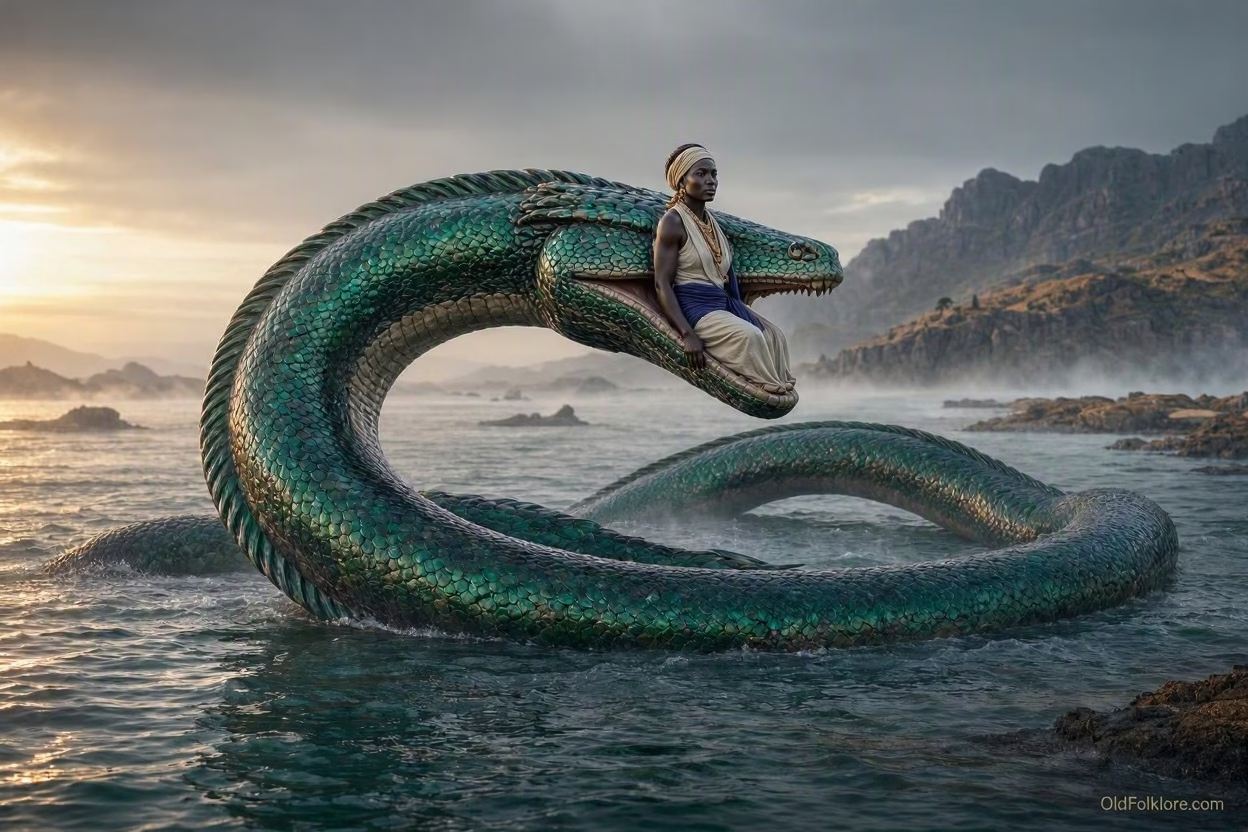
When Mawu began shaping the world, Aido-Hwedo accompanied her. As she travelled across the waters, the great serpent carried her in his mouth. His enormous body moved through the waters while the Creator carried out her work.
Mawu directed the process of creation, while Aido-Hwedo provided the strength and movement that supported her journey. Together, they travelled through the world in its earliest state, before it became the familiar home of people, animals and plants.
As the serpent moved, the landscape began to take shape. The earth developed its curves, slopes and hollows through the movements associated with his journey. Their work was not simply about forming a place for living creatures. It also established the physical features that would become part of the world.
Explore more stories from our Beninese Folktales Collections archive.
Aido-Hwedo’s role was therefore closely connected to the creation of the land. He carried Mawu as she worked, and his movements helped shape the earth beneath them.
The Formation of Mountains and Hidden Treasures
The creation tradition also explains the presence of mountains through the journey of Mawu and Aido-Hwedo. When the Creator and her companion stopped to rest, mountains formed at the places where they stayed.
The story gives these natural features a connection to the activities of the two powerful beings. Mountains were not merely raised portions of land; they were associated with important moments in the journey of creation.
Aido-Hwedo’s connection to the mountains also explains the presence of valuable materials beneath the earth. According to the tradition, his excrement became the source of the riches found within them. Minerals and cowries were among the treasures associated with these remains.
This explanation links the wealth of the natural world to the serpent’s work during creation. The valuable substances hidden within the earth are presented as part of what Aido-Hwedo left behind while accompanying Mawu.
Through this belief, the mountains became more than physical features of the landscape. They also represented the lasting presence of the cosmic serpent and his contribution to the formation of the world.
The Earth Becomes Too Heavy
After Mawu had completed the creation of the world, another problem arose. The earth had become too heavy to support itself. It carried mountains, trees, elephants and many other things, placing an enormous burden on its foundations.
Mawu recognised that the world needed something strong enough to hold it in place. Without proper support, the earth could not remain stable beneath the weight of everything it contained.
She therefore turned to Aido-Hwedo and gave him a new responsibility. He would have to descend beneath the earth and coil his enormous body around it. In this position, he would support the world like a carrying pad, preventing it from collapsing under its own weight.
Aido-Hwedo accepted the task. The serpent moved beneath the earth and arranged his body to carry the heavy land above him. His strength, which had helped Mawu during creation, now served another purpose: keeping the completed world steady.
The responsibility was immense. The serpent had to remain beneath the earth, carrying its weight while remaining hidden from the people and creatures who would eventually inhabit the surface.
The Sea Becomes the Serpent’s Home
Mawu also considered the conditions in which Aido-Hwedo would have to live. The serpent disliked heat, and remaining beneath the earth could expose him to uncomfortable warmth.
To provide a suitable place for him, Mawu created the sea. Its waters offered the cool surroundings Aido-Hwedo needed while he continued to support the earth.
The sea therefore became part of the arrangement that allowed the serpent to fulfil his responsibility. He remained beneath the world, surrounded by water, while his enormous body held the land above him.
This part of the tradition connects the sea with the serpent’s continuing role in creation. The waters are not simply a feature of the landscape; they also provide the environment in which Aido-Hwedo carries out his task.
Mawu’s decision ensured that the serpent could continue supporting the earth while living in conditions suited to him.
The Serpent Beneath the World
From that time onward, Aido-Hwedo remained beneath the earth. His body supported the heavy land, and his presence helped maintain the world’s balance.
However, the serpent was not always completely still. Whenever he shifted his enormous body to adjust the weight above him, the ground could tremble. The Fon tradition associates these movements with earthquakes, offering a spiritual explanation for the shaking of the earth.
His hidden position also explains why people cannot see the being responsible for supporting their world. Although Aido-Hwedo remains out of sight, the tradition remembers him through the natural events and features connected to his existence.
The mountains preserve traces of his journey with Mawu, the treasures beneath them recall the remains associated with his body, and earthquakes reflect his movements beneath the land.
Aido-Hwedo’s work did not end when Mawu finished creating the world. Instead, his responsibility continued beneath the surface, where he remained the unseen support of the earth.
A Living Lesson
The story of Aido-Hwedo presents creation as an undertaking that depends on both direction and strength. Mawu shapes the world, while the serpent carries her during the process and later accepts the responsibility of supporting everything she has created.
The tradition also connects the natural world with the activities of powerful spiritual beings. Mountains, the sea, underground riches and earthquakes all have a place in its explanation of creation.
Aido-Hwedo’s position beneath the earth gives the story another important idea: a being does not need to remain visible to make an essential contribution. His work continues even though the world above him carries on without seeing him.
Explore our complete Africa Folktales collection.
Moral of the Story
The tale of Aido-Hwedo teaches that great achievements require cooperation and shared responsibility. Mawu shaped the world, but Aido-Hwedo’s strength helped create and sustain it. The story reminds us that those who carry great responsibilities deserve recognition, even when their efforts take place beyond the sight of others.
Knowledge Check
- Who was Aido-Hwedo in the Fon creation tradition?
Aido-Hwedo was the mighty cosmic serpent who carried Mawu during creation and later supported the earth. - How did Aido-Hwedo assist Mawu during creation?
He carried Mawu in his mouth as she travelled across the waters and shaped the world. - How does the tradition explain the formation of mountains?
It says that mountains formed at places where Mawu and Aido-Hwedo stopped to rest. - Why did Mawu instruct Aido-Hwedo to descend beneath the earth?
The earth had become too heavy to support itself, so Mawu instructed the serpent to coil beneath it and carry its weight. - Why did Mawu create the sea for Aido-Hwedo?
She created it to provide cool surroundings because the serpent disliked heat. - What natural event is associated with Aido-Hwedo’s movements?
Earthquakes are explained as the result of the serpent shifting his body beneath the earth.
Source
Adapted from the Fon creation tradition recorded in Melville J. Herskovits, Dahomey: An Ancient West African Kingdom (1938).
Explore More Beninese Folktales
- Two Beninese Tales That Teach Lessons on Humility and Creation
- Stealing Fire from the Creator: The Wisdom of Chameleon and Tortoise
- The Test of Friendship
- The Story of Vijxenanyi and Xwenasu
- The Partridge and the Rooster