Long ago, among the communities of southwestern Taiwan, families faced the uncertainties of illness, harvests and changing seasons. The Siraya, an Indigenous people of Taiwan, had spiritual traditions that formed part of their understanding of the world. Historical accounts from the seventeenth century describe spiritual beings associated with different aspects of life, including healing. Inspired by this documented historical context, this imaginative tale follows a farmer whose child’s illness leads him to reflect on the beliefs of earlier generations, the support of his community and the hope that helps families endure difficult times.
A Farmer’s Worry
In the fertile plains of southwestern Taiwan, a farmer named Tao lived with his wife and young daughter. Each morning, he rose early to tend his crops, working until the sun began to sink towards the horizon. His livelihood depended on the land, but his greatest happiness came from knowing that his family was safe and well.
One season, however, his peaceful life changed when his daughter became seriously ill.
The child grew weak and lost her appetite. She spent much of the day resting while Tao and his wife watched over her anxiously. They tried to comfort her, hoping that the illness would soon pass, but her condition remained uncertain.
As the days went by, Tao found it increasingly difficult to concentrate on his work. Even when he stood among his crops, his thoughts remained with his daughter. He wondered what else he could do to help her and feared what might happen if she did not recover.
His wife shared his distress. Together, they sought advice from people whose knowledge they trusted and continued caring for their child. Yet the uncertainty weighed heavily on them both.
At night, Tao sat beside his daughter and listened to her quiet breathing. He remembered the knowledge passed down through earlier generations and thought about the spiritual traditions through which people had sought to understand the mysteries of life.
He longed for reassurance that his family would find its way through the difficult days ahead.
The Search for Healing
Tao’s concern eventually led him to seek advice beyond his household. He listened to experienced members of his community and considered their suggestions. He wanted to understand what more he could do to help his daughter regain her strength.
Historical accounts provide a glimpse into the religious beliefs associated with the Siraya people during the seventeenth century. In his scholarly study Religious Beliefs in ‘Aboriginal Taiwan’, historian Christopher Joby examines early descriptions recorded by Chinese observers, Dutch East India Company employees and Spanish missionaries.
The accounts discuss several spiritual beings associated with different aspects of life. Among them are Tagittellaegh and Tagisikel, whom the historical records examined by Joby associate with healing.
These descriptions offer insight into how the spiritual world was represented in the surviving accounts of Siraya religious beliefs. However, the records must be interpreted carefully. Their authors were outsiders whose cultural and religious assumptions influenced how they described Indigenous traditions. The surviving evidence therefore provides only a partial picture of Siraya spiritual life.
The historical study does not record Tao’s family or the events described in this tale. Instead, the story uses the documented religious context as inspiration for an imaginative exploration of how a family might respond to illness, uncertainty and the need for hope.
As Tao listened to others and reflected on the beliefs of earlier generations, he began to recognise that facing hardship did not mean carrying every burden alone.
The Lady in the Moonlit Field
One evening, after another difficult day, Tao stepped outside his home and walked towards the fields.
The moon illuminated the land, casting a pale glow over the crops and narrow paths. A cool breeze moved through the grasses, while the village gradually settled into silence.
Tao stopped in an open field and looked towards the distant hills. His thoughts returned to his daughter. He wondered whether she would regain her strength and whether he had done everything possible to help her.
Overwhelmed by worry, he lowered his head and stood quietly beneath the moonlight.
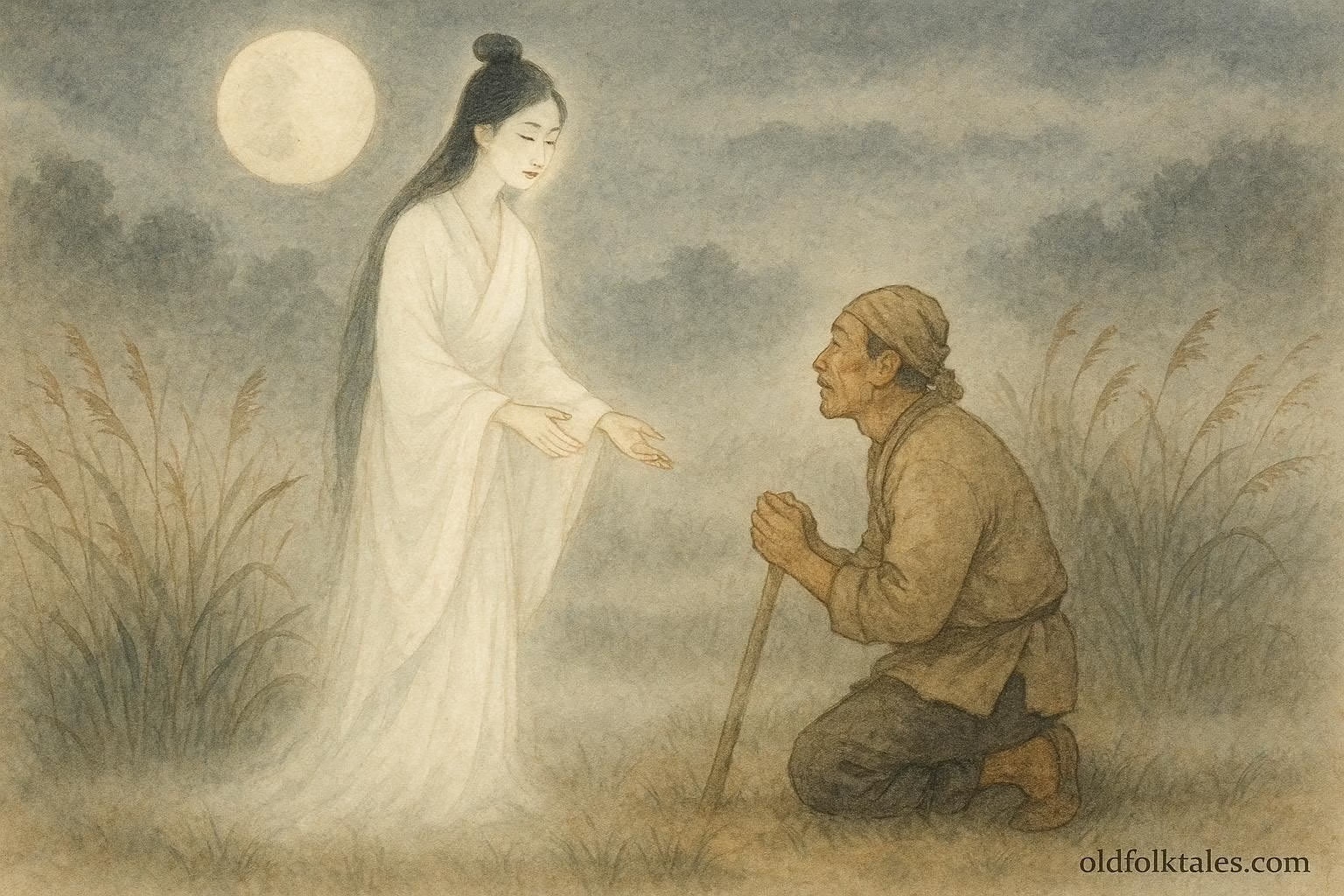
When he looked up, he noticed a woman standing near the edge of the field.
She wore a pale garment that caught the moonlight, and her expression was calm. Tao could not tell where she had come from or how long she had been standing there.
“Why do you stand alone with such sadness?” the woman asked.
Tao explained his daughter’s illness and described the helplessness he felt. He told her how his family had sought advice and how each passing day brought fresh worries.
The woman listened carefully.
“You cannot control everything that happens in life,” she said. “But you can continue to care for those you love. Listen to people who possess knowledge, accept help when it is offered and do not allow fear to separate you from your family.”
Tao was surprised by her response. He had expected a mysterious stranger to offer a remedy or promise that his daughter would recover. Instead, she reminded him of the responsibilities and choices that remained within his power.
Before he could ask her name, the breeze stirred the grasses between them. Tao briefly turned towards the sound. When he looked back, the woman had disappeared.
He searched the nearby path but found no sign of her.
Tao wondered whether she had been a traveller passing through the fields or whether the encounter had been shaped by his troubled state of mind. He had no way of knowing who she was.
Although he could not explain what had happened, her words stayed with him as he made his way home.
The woman in this scene is an imaginative character created for the story. She is not identified with Tagittellaegh, Tagisikel or any other documented Siraya spiritual being.
A New Sense of Purpose
When Tao returned home, he found his wife sitting beside their daughter. She looked exhausted after spending so many hours caring for the child.
For the first time in several days, Tao recognised how much his wife had been carrying while he struggled with his own fear.
He sat beside her and offered to take over some of her responsibilities so she could rest. Together, they discussed their daughter’s condition and considered where they might seek further help.
Tao also accepted assistance from neighbours who offered practical support. Some helped with household tasks, while others shared their advice and knowledge. Their kindness reminded him that his family did not have to face every difficulty alone.
The experience changed his understanding of strength. He had believed that a good father needed to solve every problem himself. Now he realised that caring for his family also meant listening to others, accepting support and recognising his own limitations.
He continued to think about the mysterious woman in the field. Her identity remained unknown, but he remembered her encouragement whenever worry threatened to overwhelm him.
Tao could not control the course of his daughter’s illness. What he could do was remain beside her, continue seeking appropriate help and give his family the care they needed.
The Meaning of Spiritual Belief
As the days passed, Tao reflected on the spiritual traditions associated with his community and the ways earlier generations had understood illness, hardship and recovery.
Historical accounts discussed by Christopher Joby describe several spiritual beings associated with the religious beliefs attributed to the Siraya. In these records, Tagittellaegh and Tagisikel are associated with healing, while other spiritual beings are linked to different aspects of human life.
Such descriptions provide a glimpse into the religious world represented by the historical observers. They do not establish that every Siraya community held identical beliefs or practised the same traditions.
The circumstances in which the accounts were written also matter. European observers encountered Indigenous communities during a period of colonial contact and frequently described unfamiliar beliefs through the language and assumptions of their own religions.
For this reason, documented evidence must be distinguished from later interpretations and imaginative storytelling.
Tao’s encounter with the woman in the moonlit field is not part of the historical evidence examined by Joby. The woman is a narrative figure created for this tale, not a verified Siraya deity or a documented figure from Siraya oral tradition.
The story uses the imagined encounter to explore a broader human experience. When illness brings fear into a household, people may seek comfort through their beliefs, relationships and the knowledge available within their communities.
For Tao, hope does not arrive as a miraculous answer. Instead, he finds renewed purpose in caring for his family and accepting the help of those around him.
A Family Finds Hope
Eventually, Tao’s daughter began to recover.
Her improvement was gradual. She regained her appetite, became more alert and slowly returned to the activities she had enjoyed before her illness. Tao and his wife continued caring for her, grateful to see her strength returning.
One morning, Tao heard his daughter laughing outside their home. The familiar sound filled him with relief, and he realised how deeply the difficult weeks had changed his understanding of family life.
He had spent so much time searching for an answer that he had almost forgotten the importance of sharing his fears and accepting support.
His wife had remained steadfast beside their child, while their neighbours had helped them through the hardest days. Their combined efforts had made the burden easier to bear.
Tao never discovered who the woman in the field had been. He could not say whether she had been a traveller or whether the encounter had been shaped by his worries. Nor did he claim that she represented any of the spiritual beings described in historical accounts of Siraya beliefs.
Instead, he remembered the encounter as a moment that encouraged him to return to his family with renewed purpose.
The woman in the moonlit field remained a mystery, but the experience reminded Tao that hope could grow from small acts of care, shared responsibilities and the support of a community.
Although the events are imaginative, the historical religious context that inspired the tale offers a documented starting point for exploring how spiritual beliefs have shaped people’s understanding of illness and the search for healing.
Remembering Siraya Heritage
The Siraya people are an Indigenous community historically associated with the plains of southwestern Taiwan. Their religious beliefs, language and cultural practices have attracted scholarly attention, particularly through historical records created during the seventeenth century.
These records are valuable because they preserve descriptions of beliefs and practices that researchers can examine today. At the same time, scholars must consider who recorded the information, why it was recorded and how the authors’ assumptions influenced their descriptions.
Christopher Joby’s study examines historical accounts of Indigenous Taiwanese religious beliefs, including descriptions of Siraya spiritual beings associated with healing. The names Tagittellaegh and Tagisikel provide examples of the religious traditions represented in those records.
Such evidence provides a foundation for learning about the beliefs described by historical observers. It does not establish the existence of the woman in Tao’s story or confirm that this narrative was traditionally told by the Siraya people.
Responsible cultural storytelling requires a clear distinction between documented history and creative interpretation. Historical beliefs can inspire a contemporary narrative, but the imaginative elements should not be presented as authentic oral tradition without supporting evidence.
In The Siraya Lady of the Moonlit Field, the mysterious woman represents the hope Tao seeks during his daughter’s illness. Her encounter with the farmer invites readers to consider how people draw strength from their beliefs, their families and their communities.
The story is an imaginative narrative, not a recovered Siraya folktale. Its central concern, however, is familiar across cultures: when uncertainty enters a household, compassion, patience and mutual support can help people endure difficult times.
Discover more East Asian Folktales from the lands of dragons, cherry blossoms, and mountain spirits
Moral Lesson
Compassion, patience and mutual support help families face difficult times. Learning about Indigenous cultural traditions also requires respect for documented evidence and a clear distinction between historical beliefs and imaginative storytelling.
Knowledge Check
1. Where did the Siraya people historically live?
They were historically associated with the plains of southwestern Taiwan.
2. Which academic study informs the historical background of this tale?
Christopher Joby’s Religious Beliefs in ‘Aboriginal Taiwan’ (2023).
3. Which two spiritual beings are associated with healing in the historical accounts discussed by Joby?
Tagittellaegh and Tagisikel.
4. Why must historical accounts of Siraya spiritual beliefs be interpreted carefully?
They were recorded by outside observers whose descriptions were influenced by their own cultural and religious perspectives.
5. What did Tao learn while caring for his daughter?
He learned the importance of accepting help, supporting his family and drawing strength from his community during difficult times.
6. Is the encounter with the woman in the moonlit field a documented Siraya folktale?
No. The encounter is an imaginative element inspired by the historical context of Siraya religious beliefs. It is not a verified traditional Siraya story.
Source
An imaginative tale inspired by historical accounts of Siraya religious beliefs discussed in Christopher Joby’s Religious Beliefs in ‘Aboriginal Taiwan’ (2023).