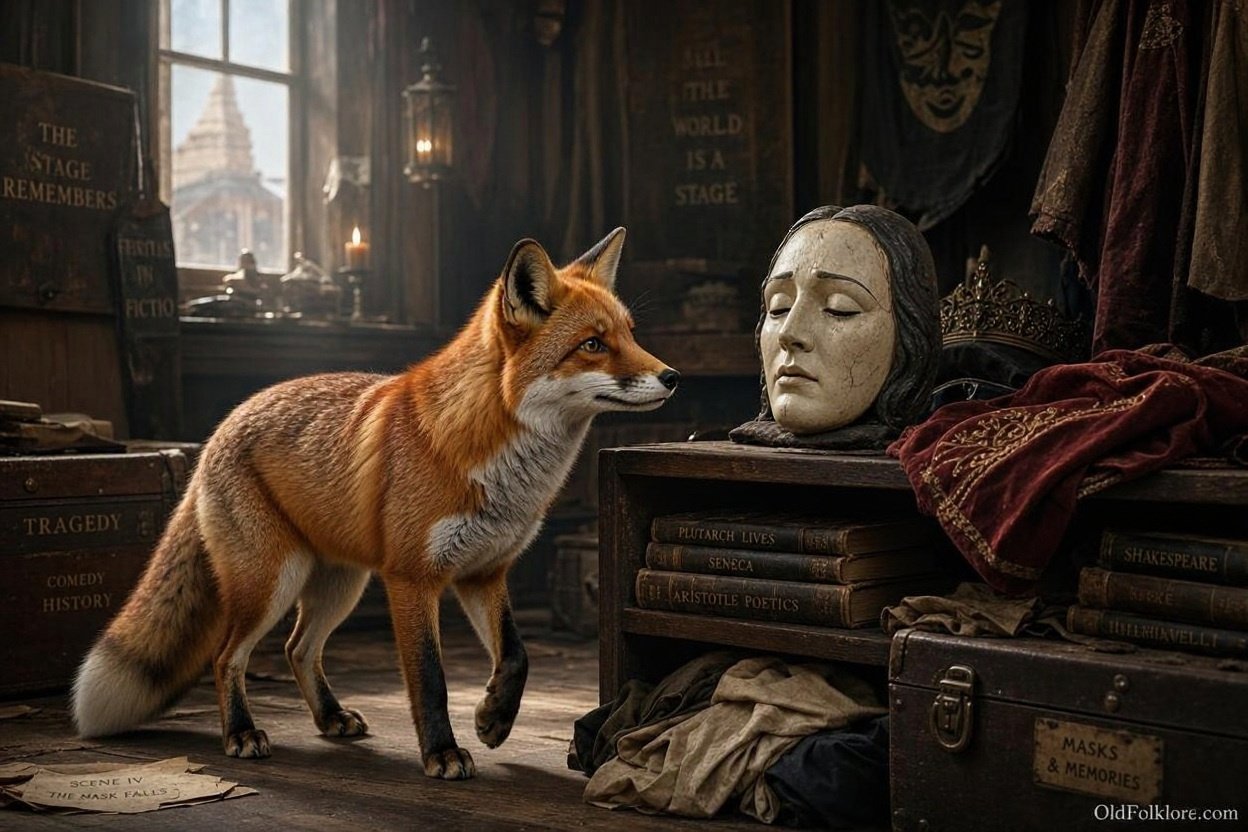
The Fox and the Mask is a short but meaningful fable about the difference between appearance and substance. During an exploration of a theatre’s storeroom, a curious fox discovers a beautifully made mask. At first, its lifelike appearance catches his attention, but closer inspection reveals that the impressive face conceals nothing more than an empty covering. Through this simple encounter, the story reminds readers that outward beauty does not necessarily reflect intelligence, wisdom or inner worth.
A Strange Discovery in the Theatre
One day, a fox somehow found his way into the storeroom of a theatre. The room contained objects used in performances, including costumes, decorations and other theatrical properties. These items were kept for actors who needed them when preparing to appear before an audience.
As the fox explored the unfamiliar room, something suddenly caught his attention. He noticed what appeared to be a human face glaring down at him.
The sight frightened him. He had not expected to encounter such a strange object in the quiet storeroom. Its fixed expression made it appear as though someone were watching him.
Explore more stories from our Aesop’s Fables collection.
The fox stopped and looked more carefully. He was cautious at first, but curiosity soon overcame his fear. Rather than running away, he moved closer to discover what the strange face really was.
The Mask Without a Mind
After examining the object, the fox realised that it was not a living face. It was a theatrical mask, the kind actors wore over their faces during performances.
The mask had been made to look impressive. Its features gave it the appearance of a real human face, and its expression could attract attention. However, the fox soon understood that there was no living person behind it.
He looked at the mask and recognised the difference between its attractive appearance and its actual nature.
The fox then remarked that the mask looked very fine but lacked brains. Although its face appeared impressive, it had no intelligence or understanding.
Having made this observation, the fox recognised that the mask’s beauty was only external. It could imitate the appearance of a face, but it could not think or act like a living creature.
The Lesson Behind the Discovery
The fox’s comment provides the central lesson of the fable. An attractive appearance may catch people’s attention, but it does not automatically indicate intelligence, wisdom or good character.
A person may dress impressively, possess physical beauty or attract admiration through outward appearances. However, these qualities alone cannot establish a person’s true worth.
The mask represents anything that looks impressive on the outside but lacks substance within. The fox’s discovery reminds readers to look beyond appearances and consider the qualities that matter more deeply.
The fable ends with the moral that outward show is a poor substitute for inner worth.
Explore our complete Historic Folklore & Fairy-Tale Collections archive.
Moral Lessons
The fable teaches that appearance should never be confused with intelligence or personal value. Beauty, fine clothing and impressive presentation may attract attention, but they cannot replace wisdom, understanding and good character.
It also encourages readers to look beyond what they see. A person should not be judged solely by physical appearance or outward possessions. What matters more is the quality of the person’s thoughts, actions and character.
Finally, the story reminds us that genuine worth comes from within. An impressive exterior may create a favourable first impression, but inner qualities determine whether that impression has real substance.
Knowledge Check
1. Where did the fox find the mask?
He found it in the storeroom of a theatre.
2. What frightened the fox when he first entered the room?
He saw what appeared to be a face glaring down at him.
3. What did the fox discover after examining the strange face?
He discovered that it was a theatrical mask used by actors.
4. Why did the fox say the mask had no brains?
Although it looked attractive, it was only an object and had no intelligence.
5. What does the mask represent in the fable?
It represents outward appearance without inner substance or worth.
6. What is the main moral of the story?
Outward beauty and impressive appearances cannot replace intelligence, wisdom and inner worth.
Source
This fable is recorded in Joseph Jacobs’s The Fables of Æsop: Selected, Told Anew, and Their History Traced (1894). It appears as “The Fox and the Mask” on page 52.
Explore More Aesop’s Fables
- The Dog and the Shadow: An Aesop Fable
- The Hare and the Tortoise
- The Fox and the Crow
- The Wolf and the Crane: An Aesop Fable
- The Wind and the Sun: An Aesop’s Fable
- The Fox and the Grapes
- The Goose with the Golden Eggs
- The Wolf and the Lamb