Long ago, a king lost his way while hunting in a vast forest. His horse carried him farther than his attendants could follow, and by the time evening approached, he could find neither the path home nor anyone to guide him.
As he wandered among the trees, an old woman appeared before him. Her head bobbed constantly, and the king soon discovered that she was a witch.
“I can show you the way out of this forest,” she told him, “but only if you agree to marry my daughter. Refuse, and you may never find your way home.”
The king had little choice. Fearing that he would die in the forest, he accepted her condition. The witch led him to her cottage, where her beautiful daughter waited beside the fire. Although the young woman was pleasing to look at, something about her filled the king with unease. Nevertheless, he took her to his palace and married her.
Explore more stories from our Brothers Grimm Tales collection.
The king already had seven children from his first marriage: six sons and a daughter. They were the greatest treasures of his life, and he feared that his new wife might mistreat them.
To protect them, he sent them to a secluded castle deep within a forest. The place was so well hidden that even he could not have found it without the help of a wise woman, who had given him a magical ball of yarn. Whenever he threw it onto the ground, the ball unravelled by itself, revealing the path he needed to follow.
The king visited his children whenever he could. Before long, his new queen noticed his frequent absences and grew suspicious. She bribed his servants until they revealed the secret of the hidden castle and the magical ball that guided him there.
The queen had learned witchcraft from her mother, and she wasted no time preparing a cruel plan.
The Six Princes Become Swans
While the king was away hunting one day, the queen took six little shirts made of white silk. She had secretly sewn a spell into each one. Then she seized the magical ball of yarn and followed its trail through the forest to the children’s castle.
From a distance, the children saw someone approaching. Thinking their beloved father had returned, the six boys ran out eagerly to welcome the visitor.
Instead, the queen threw a shirt over each prince.
The moment the enchanted garments touched their bodies, the boys changed into six white swans. With a rush of wings, they rose into the air and disappeared among the trees.
The queen returned to the palace, satisfied that she had rid herself of her stepchildren. She had not noticed that the little princess had remained inside the castle.
When the king arrived the following day, he found only his daughter waiting for him.
“Where are your brothers?” he asked anxiously.
The princess told him that she had watched them fly away in the shapes of swans. She showed him the feathers they had left behind, which she had carefully gathered from the courtyard.
The king was heartbroken. He could not imagine what had happened to his sons, and he did not suspect that his own wife was responsible. Afraid that his daughter might also disappear, he offered to take her back to the palace.
But the girl feared her stepmother. She begged her father to let her remain at the secluded castle for one more night.
The king reluctantly agreed.
That evening, the princess made a decision that would change her life. She would leave the castle and search for her brothers herself.
The Secret of the Six Swans
The princess entered the forest alone and walked through the night. She continued into the following day until exhaustion forced her to stop.
Eventually, she discovered a small hut. Inside stood six little beds. Rather than lie in one of them, she crawled underneath a bed and settled on the hard floor, hoping to rest until morning.
Just before sunset, she heard the sound of wings.
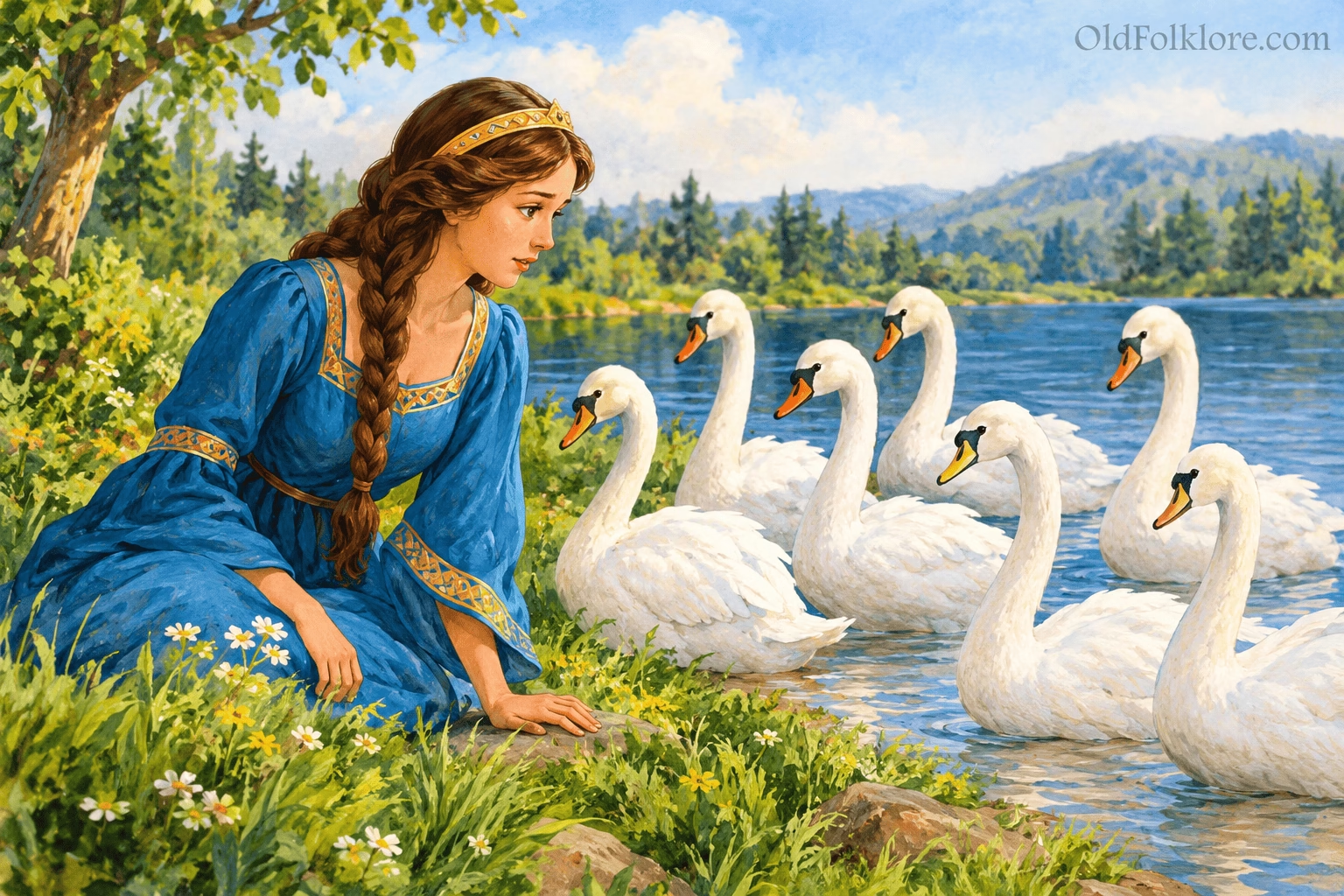
Six swans flew through the window and landed inside the room. They shook themselves and blew against their feathers until their swan skins slipped away like garments. Before the princess’s astonished eyes, the six birds became young men.
She recognised her brothers immediately and hurried out from beneath the bed.
The reunion filled them all with joy, but their happiness was short-lived. The brothers warned their sister that the hut was a shelter for robbers. If the robbers returned and discovered her there, they might kill her.
The princess asked whether her brothers could protect her.
“We cannot,” they explained. “Only for fifteen minutes each evening can we remove our swan skins and become human again. When that time passes, we must return to our bird forms.”
Their sister wept. She had found them at last, yet she could not bring them home.
“Is there no way to break the spell?” she asked.
“There is,” they replied, “but the conditions are terrible. For six years, you must neither speak nor laugh. During that time, you must gather starwort and sew six shirts from it, one for each of us. If you utter even a single word, all your work will be wasted.”
The fifteen minutes soon passed. The brothers changed back into swans and flew away through the window.
The princess understood what the task would demand. She would have to endure years of silence, loneliness and hardship, without knowing whether she would succeed. Yet she did not turn away from the challenge.
She left the robbers’ hut, found a tree in the forest, and spent the night among its branches. The next morning, she began gathering starwort and sewing the first shirt.
From that moment, she spoke to no one and gave herself entirely to her work.
The Silent Maiden and the King
The princess worked in solitude for a long time. She gathered the plants she needed and sewed patiently, never allowing herself to speak or laugh.
One day, a king was hunting in the same forest. His huntsmen came upon the tree where the young woman sat working.
“Who are you?” they called.
She did not answer.
“Come down. We will not hurt you,” they urged.
Still, she remained silent. Hoping to satisfy them without breaking her vow, she threw down her golden necklace. When they continued questioning her, she gave them her girdle, then her garters, and eventually everything she could spare until she had little left to cover herself.
The huntsmen were not persuaded to leave her alone. They climbed the tree, brought her down and led her before their king.
He asked her who she was and why she had been living in a tree, but she would not speak. He questioned her in every language he knew, yet she remained silent.
Her silence did not drive him away. Instead, he was moved by her beauty and gentle manner. He covered her with his mantle, lifted her onto his horse and took her to his castle.
There, he ordered that she be given fine clothes. At his table, he observed her quiet courtesy and modest behaviour, and his affection for her deepened.
“I will marry this maiden,” he declared. “No other woman in the world will take her place.”
After a few days, the king married her, even though she had never told him her name or explained her mysterious silence.
For a time, the young queen lived in the palace, but her happiness was threatened by the king’s mother, an older woman who disapproved of the marriage. She regarded the silent stranger as unworthy of her son and looked for a way to destroy her reputation.
Three Children and a Terrible Accusation
A year after the marriage, the young queen gave birth to her first child. While she slept, the king’s mother secretly carried the baby away and smeared blood around the queen’s mouth.
She then went to the king and accused his wife of eating her own child.
The king refused to believe such a dreadful accusation. He knew his wife to be gentle and could not imagine her committing such a crime. Meanwhile, the queen continued sewing her shirts, unable to explain what had happened without losing the chance to save her brothers.
When she gave birth to a second child, the king’s mother repeated her scheme. She stole the baby and again stained the queen’s mouth with blood before accusing her of the same monstrous act.
Once more, the king defended his wife. He believed her to be good and innocent, and he regretted that her silence prevented her from defending herself.
But the king’s mother did not give up. When the queen gave birth to a third child, the older woman stole the baby as she had stolen the first two. She repeated her accusation, and this time the king could no longer protect his wife from the demands of justice.
The young queen was sentenced to death by burning.
Through all the accusations, she had remained silent. She could not reveal the truth about the stolen children, explain her own innocence or tell the king why she had chosen not to speak. Her six years of sacrifice were nearly over, but the final test was now upon her.
The Day the Curse Was Broken
The day appointed for the queen’s execution was also the final day of the six years she had promised to spend in silence.
By then, she had completed five shirts and nearly finished the sixth. Only its left sleeve remained unsewn.
As she was led towards the place of execution, she carried the shirts with her. The crowd watched as she climbed onto the platform beside the stake. The fire was about to be lit when she looked up and saw six swans approaching through the air.
Her brothers had come.
The swans descended towards her, and she seized her chance. She threw the shirts over them, one after another. As each enchanted garment touched a swan, the bird’s feathers and skin disappeared, revealing a human figure beneath.
One by one, her brothers stood before her, restored to their human forms. Only the youngest remained partly transformed: because the sixth shirt lacked its left sleeve, he still had a swan’s wing in place of his left arm.
The brothers embraced their sister, overjoyed to be reunited after years of enchantment. The young queen had fulfilled her promise, and the curse that had separated them was broken.
At last, she was free to speak.
She turned to her husband and declared that she was innocent. She explained how the king’s mother had stolen their three children and framed her for their disappearance.
The truth was finally revealed. To the king’s great relief and happiness, the three children were found and brought back to their parents.
The king’s mother was punished for her wickedness. She was bound to the same stake intended for the queen and burned to ashes.
The young queen was saved, her brothers were restored, and her children were returned to her. Though the youngest prince carried the mark of the unfinished spell, the family was reunited.
The king, his queen, her six brothers and their children lived together in happiness and peace for many years.
Explore our complete Historic Folklore & Fairy-Tale Collections archive.
Moral
True love is demonstrated through loyalty, courage and sacrifice. The princess refuses to abandon her brothers, even when saving them requires years of silence and exposes her to suffering and injustice. Her determination shows the power of perseverance, while the eventual discovery of the truth reminds readers that cruelty and deception can be exposed.
Knowledge Check
1. Why did the six princes become swans?
Their stepmother used enchanted silk shirts to transform them into swans because she wanted to get rid of her husband’s children.
2. What did their sister have to do to break the curse?
She had to remain silent and refrain from laughing for six years while sewing six shirts from starwort.
3. Why was the young queen accused of harming her children?
The king’s mother stole each of her three children and smeared blood around the queen’s mouth to make it appear that she had eaten them.
4. Why did the youngest brother remain partly transformed?
The sixth shirt was missing its left sleeve, so he retained a swan’s wing in place of his left arm.
5. What does the princess’s silence represent in the story?
It represents her commitment to the difficult task of rescuing her brothers. Speaking before the six years ended would have destroyed her efforts.
Explore More Brothers Grimm Tales
- The Snowman: A Danish Folktale by Andersen
- The Golden Goose: A Brothers Grimm Fairy Tale
- The Bremen Town Musicians: Grimm Fairy Tale
- Clever Hans: A Brothers Grimm Fairy Tale
- The Girl Without Hands: A Grimm Fairy Tale
- The Devil with the Three Golden Hairs: Grimm Tale
- The Louse and the Flea: A Grimm Fair