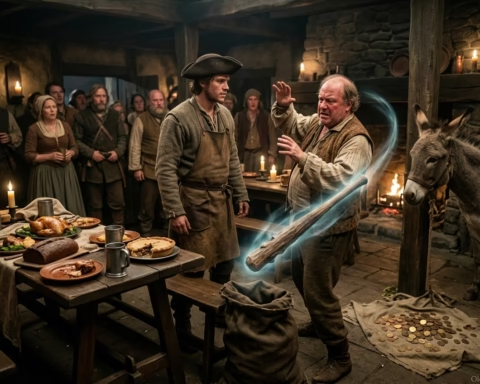
The Three Languages is a German fairy tale collected by Jacob and Wilhelm Grimm. It follows a young count who struggles to meet his father’s expectations because he learns things his father considers useless. After being sent away, the young man discovers that his unusual knowledge of animals can help others and open an unexpected path for him. The story explores the difference between conventional learning and knowledge whose value becomes clear only when circumstances change.
The Count’s Disappointing Son
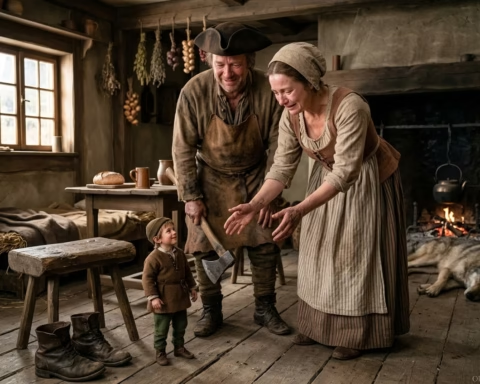
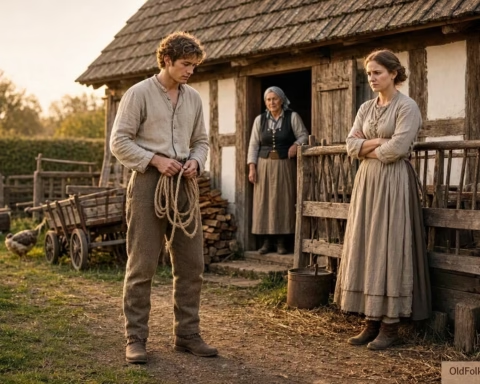
There once lived an aged count in Switzerland who had an only son. The count possessed wealth, land and a respected position, but his greatest concern was his heir. He wanted his son to become an educated and capable young man who could one day manage the family estate and honour their name.
Unfortunately, the boy seemed unable to learn the things his father considered important. His lessons brought little improvement, and no matter how patiently his teachers explained their subjects, the young count failed to make the progress expected of him.
His father grew increasingly frustrated. He had hoped that his only son would become knowledgeable, but the years passed without bringing the results he wanted.
At last, the old count decided that the boy needed a different teacher.
“My son,” he said, “I have tried everything I know, yet I cannot get anything into your head. I will send you to a celebrated master in another town. Perhaps he will succeed where others have failed.”
The young count obeyed. He left his father’s home and travelled to a strange town, where he was placed under the care of the first master.
He remained there for an entire year.
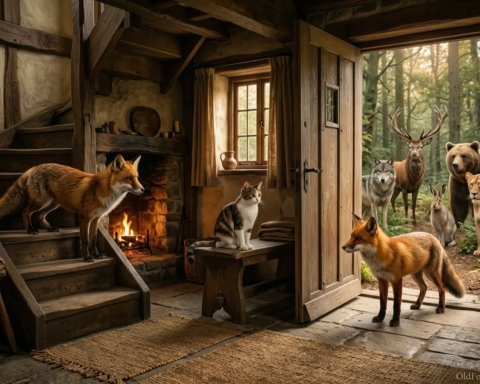
During that time, the young man learned something extraordinary. He discovered that he could understand what dogs were saying when they barked. To him, their sounds were no longer meaningless noises. He could recognise their communication and understand what their cries conveyed.
When the year ended, he returned home, expecting his father to ask about his education.
The old count summoned him and asked the question he had been waiting to ask.
“Now, my son, what have you learnt?”
The young man answered honestly.
“Father, I have learnt what the dogs say when they bark.”
The count stared at him in disbelief.
“What did you say? Is that all you have learnt in an entire year?”
He could scarcely believe that his son had spent twelve months studying only to return with such an answer. The count had expected knowledge that would prepare the young man for his future responsibilities. Understanding the sounds of dogs seemed completely useless to him.
He shook his head in disappointment.
“Lord have mercy on us! I will send you to another town and place you under another master. Perhaps this time you will learn something worthwhile.”
The Language of the Birds
The young count was sent away again. He travelled to another town and began a second year of instruction under a different master.
His father hoped that the change of teacher would produce a better result. The young man, however, continued learning in his own unusual way.
By the end of the second year, he had acquired another remarkable ability. He could understand what birds were saying.
The calls of birds, which other people heard as ordinary chirping and cries, now carried meaning for him. He had learned a language that his father had never considered worthy of study.
When the young count returned home, his father called him before him once more.
Explore more stories from our Brothers Grimm Tales collection
“My son, what have you learnt this time?”
The young man replied without hesitation.
“Father, I have learnt what the birds say.”
The old count’s patience finally broke.“You wretched fellow!” he cried. “You have wasted another precious year and learnt nothing. Are you not ashamed to appear before me?”
The young count listened quietly. He had followed his father’s instructions and spent another year with a teacher, yet his achievement brought him no praise. His father could see no value in the knowledge he had gained.
Still, the count decided to make one final attempt.
“I will send you to a third master,” he declared. “But if you return having learnt nothing useful this time, I will no longer acknowledge you as my son.”
The young man left for the third town.
For another year, he studied under a master. This time, he learned to understand the croaking of frogs.
When the year was over, he returned to his father’s home with his third unusual accomplishment. He had learned to understand dogs, birds and frogs, but he still lacked the conventional education his father had wanted him to acquire.
The old count called him before him.
“Well, my son, what have you learnt this year?”
The young man answered respectfully.
“Dear father, I have learnt what the frogs croak.”
The Count Casts Out His Son
The count was overcome with fury.
Three years had passed. He had paid for three masters in three different towns, hoping that his son would return with the knowledge expected of a nobleman’s heir. Instead, the young count had learned the languages of dogs, birds and frogs.
His father could no longer tolerate what he considered a complete failure.
“This man is no longer my son!” he shouted.
He summoned his servants and ordered them to take the young count into the forest and kill him.
The servants were shocked by the command. Although they were expected to obey their master, they could not bring themselves to murder a young man who had done no harm to them.
They took the count’s son into the forest as instructed. However, when the moment came to carry out the order, pity overcame them.
They decided to spare his life.
To convince the old count that they had obeyed, the servants killed a deer and removed its eyes and tongue. They carried these back as tokens, allowing the count to believe that his son was dead.
The young count was left alive in the forest.
He had lost his home, his family and the future that should have belonged to him. The knowledge that had disappointed his father was all he possessed, and he now had to discover how to survive in the wider world.
Rather than returning to the estate, he wandered onwards.
The Tower of the Wild Dogs
After travelling for some time, the young count came to a fortress. He approached its lord and asked for a place to sleep for the night.
The lord agreed, but he warned the traveller that the offer came with grave danger.
“If you wish to spend the night here, you may go down into the old tower,” he said. “But I must warn you that it may cost you your life. The tower is full of wild dogs. They bark and howl without stopping, and at certain times a man must be given to them. The dogs devour him, and nobody has been able to put an end to this trouble.”
The wild dogs had brought fear and sorrow to the surrounding district. Their constant noise disturbed the fortress, and the threat of being sent into the tower hung over the people. Nobody seemed to know how to stop the animals or free the place from their presence.
The young count listened to the warning without becoming frightened.
“Let me go down to the dogs,” he said. “Give me something I can throw to them. They will do me no harm.”
The lord of the fortress could hardly believe that a stranger would willingly enter a place everyone else feared. Nevertheless, the young man insisted, and the lord arranged for food to be given to him.
The count’s son was then led down into the old tower.
Inside, the wild dogs surrounded him. Their voices filled the dark space, and their barking and howling had frightened many people before him.
But the animals did not attack.
Instead, they wagged their tails and gathered around the young man in a friendly manner. He gave them the food he had brought, and they ate without harming him.
Because he understood the language of dogs, he could also understand what they were communicating. They revealed that they were under a spell and had been forced to guard a great treasure hidden beneath the tower. They could not rest or leave their duty until the treasure was removed.
The young count understood their predicament. The dogs were not simply dangerous animals creating trouble for the district. They were bewitched guardians trapped in an unhappy task.
He also learned from their speech how the treasure could be reached and removed.
The following morning, the young man emerged from the tower alive and unharmed.
The lord and the people of the fortress were astonished to see him. They had expected that he would never return.
The young count explained what the dogs had told him.
“They are bewitched,” he said. “They have been compelled to guard a treasure hidden beneath the tower. They cannot rest until it is taken away, and they have revealed how it can be done.”
The people rejoiced at the news. The lord of the fortress promised that he would adopt the young man as his son if he succeeded in removing the treasure.
The young count returned to the tower. Because he understood the dogs’ instructions, he knew what needed to be done. He followed their directions and brought out a chest full of gold.
Once the treasure had been removed, the wild dogs disappeared. Their howling was no longer heard, and the district was freed from the trouble that had troubled it for so long.
For the first time, the young count’s unusual knowledge had brought a clear benefit to others. The ability his father had despised had helped solve a problem that ordinary people could not overcome.
A Journey Towards Rome
After some time, the young count decided to travel to Rome.
He left the fortress and continued on his way. During his journey, he passed by a marsh where many frogs were sitting and croaking.
The young man stopped and listened.
Because he understood the language of frogs, he could follow their conversation. What he heard made him thoughtful and sad. The knowledge seemed to concern his future, although the full meaning of it was not immediately clear to anyone else.
He continued towards Rome, carrying the words in his mind.
When he finally arrived, he discovered that the Pope had just died. The city was facing an important decision: a successor had to be chosen, but the people responsible for the appointment could not agree on whom to select.
They discussed the matter at length. The new Pope needed to be someone they could recognise as chosen through divine and miraculous signs.
At last, they agreed that the person who displayed such a sign should become the next Pope.
It was at this moment that the young count entered the church.
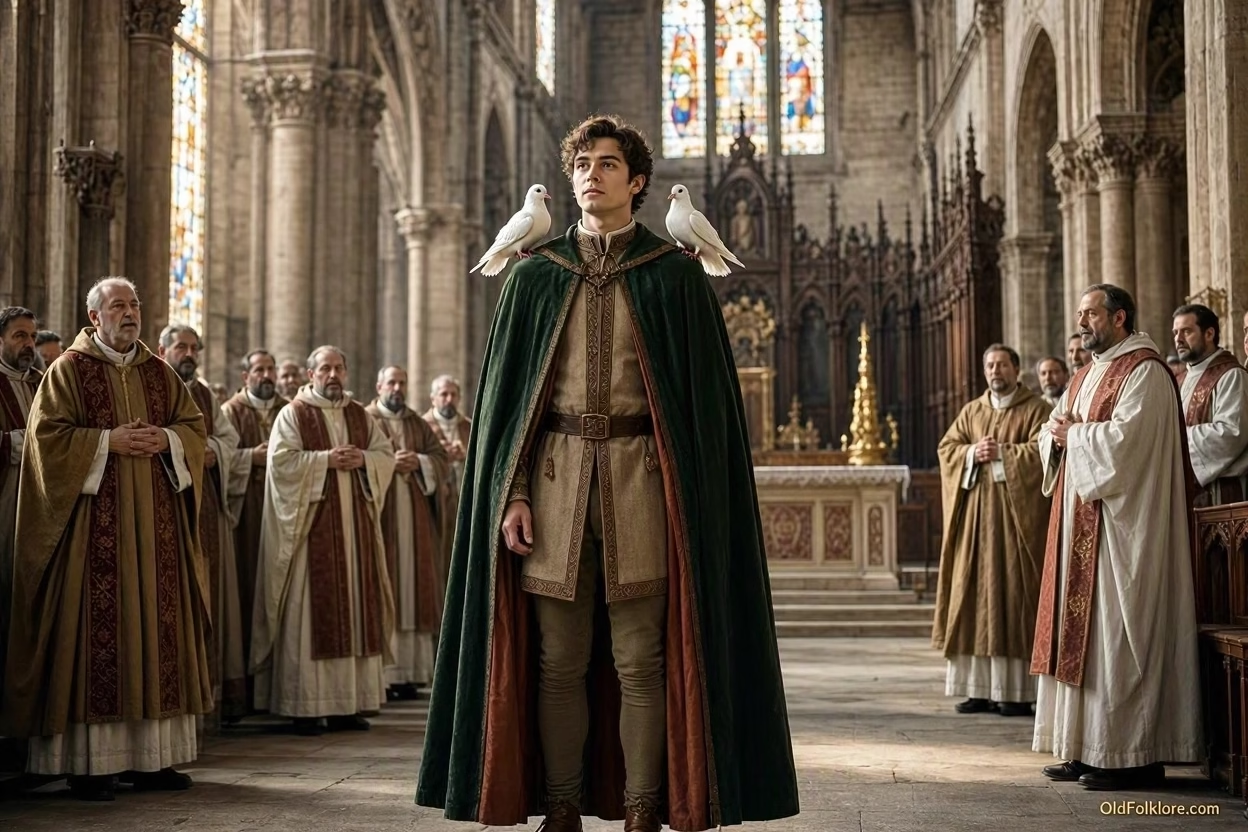
Suddenly, two snow-white doves flew down and settled upon his shoulders. They remained there, calm and unafraid.
The assembled ecclesiastics looked upon the sight with wonder. They believed that the appearance of the two white doves was the heavenly sign they had been waiting for.
They turned to the young man and asked whether he would accept the position of Pope.
The Unexpected Calling
The young count was taken by surprise.
He had been rejected by his own father because his learning seemed worthless. He had wandered through the world without knowing where he belonged, and his understanding of animals had brought him first to the tower of the wild dogs and then towards Rome.
Now he stood in a church, with two white doves resting on his shoulders, being asked to accept one of the highest positions in the Church.
He was uncertain whether he was worthy of such responsibility.
The two doves, however, counselled him to accept. Their presence reassured him, and at last he agreed.
The ecclesiastics anointed and consecrated him as Pope. In this way, the words he had heard from the frogs during his journey came to pass: he was to become His Holiness the Pope.
Yet another difficulty remained. The young count was expected to sing a Mass, but he did not know the words.
Once again, the animals he understood helped him. The two white doves remained upon his shoulders and quietly spoke the words into his ear. He was able to repeat what they told him and carry out the duty expected of him.
The young man who had been dismissed as foolish had reached a position his father could never have imagined for him.
His father had judged his learning by whether it matched conventional expectations. The world, however, had presented circumstances in which that unusual knowledge was exactly what was needed.
The young count’s ability to understand the dogs had helped release a fortress and its surrounding district from a terrible burden. His understanding of the frogs had foretold his destiny, and the two white doves guided him through the final steps towards it.
Thus, the young man who had once been cast out became Pope, and the knowledge that had seemed useless to his father became the means by which his unexpected destiny was fulfilled.
Explore our complete Historic Folklore & Fairy-Tale Collections archive.
Moral Lesson
Do not judge a person’s abilities only by conventional standards. Knowledge that seems unusual or unimportant may prove valuable in ways others cannot foresee.
Knowledge Check
1. Why was the old count disappointed in his son?
The young man did not learn what his father considered useful subjects. Instead, he learned to understand the languages of dogs, birds and frogs.
2. What three languages did the young count learn?
He learned what dogs say when they bark, what birds say and what frogs croak.
3. Why did the count order his servants to kill his son?
He believed his son had wasted three years of education and was no longer worthy of being his heir.
4. How did the young count survive the night in the old tower?
He understood the dogs’ language, treated them peacefully and learned that they were bewitched guardians of a hidden treasure.
5. What happened after the young count removed the treasure?
The wild dogs disappeared, and the surrounding district was freed from their disturbance.
6. How did the young count become Pope?
After the Pope died, two white doves settled on the young count’s shoulders. The ecclesiastics interpreted this as a divine sign, and he accepted the position. The doves later helped him recite the words of the Mass.
Source
Jacob Grimm and Wilhelm Grimm, Household Tales, translated by Margaret Raine Hunt, 1884, Tale 33, “The Three Languages” (German: “Die drei Sprachen”).
Explore More Brothers Grimm Tales
- The Snowman: A Danish Folktale by Andersen
- The Golden Goose: A Brothers Grimm Fairy Tale
- The Bremen Town Musicians: Grimm Fairy Tale
- Clever Hans: A Brothers Grimm Fairy Tale
- The Girl Without Hands: A Grimm Fairy Tale
- The Devil with the Three Golden Hairs: Grimm Tale
- The Louse and the Flea: A Grimm Fair