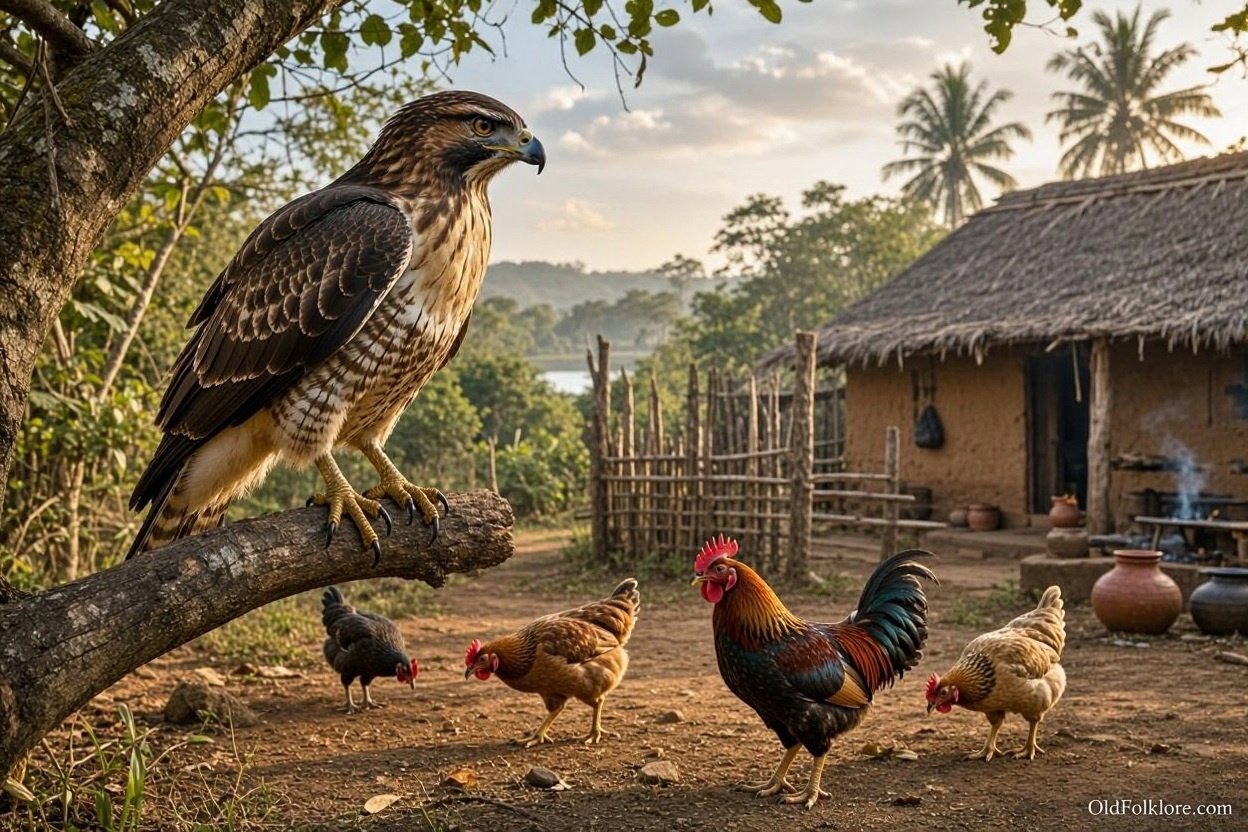
Traditional folk stories often explain familiar events through memorable accounts passed down from one generation to another. Some describe how animals acquired particular habits, while others use imaginative stories to explain relationships between people and the natural world. Why a Hawk Kills Chickens is one such explanatory tale recorded in Southern Nigeria. It tells of a beautiful hen whose marriage to a hawk leads to a disagreement, a royal judgement and an unusual arrangement that is said to explain why hawks carry away chickens.
The Beautiful Hen
Long ago, a beautiful young hen lived with her parents in the bush. She was admired for her appearance, and her parents looked after her in their home.
One day, while she was picking up corn near her father’s house, a hawk noticed her. He was attracted to her and approached her with an offer of marriage.
The hawk wanted the hen to become his wife. She accepted his proposal, and the matter was taken to her parents. As was customary in the account, the hawk had to provide a dowry before he could take her away.
He paid the agreed bride-price to the hen’s parents. Much of the payment consisted of corn. With the arrangement settled, the hawk prepared to take his new wife to his home.
The Hen Leaves Her Parents
The following day, the hawk took the hen away to live with him. He believed that their marriage had been properly arranged and that she would remain in his household.
However, another bird had feelings for the hen. A young cock had loved her for several months, and he was unhappy that she had married the hawk.
Explore more stories from our Folk Stories from Southern Nigeria collection.
The cock discovered where the hen was living. Early one morning, he went to the hawk’s home and called out to her.
When the hen heard him, she came out. The cock persuaded her to leave the hawk and return to her parents. She agreed and went back with him.
The hawk saw the hen leaving his home. He was furious because he believed that he had paid her parents a dowry and had a right to keep her as his wife. Her departure left him feeling cheated, and he decided to seek justice.
The Hawk Appeals to the King
Unable to settle the matter himself, the hawk flew to Calabar to complain to the king. He explained that he had married the hen and paid her parents the agreed dowry, but she had returned to her family.
The hawk wanted the king to intervene and ensure that he received justice. He expected the hen’s parents to take responsibility for the marriage arrangement and the payment he had made.
The king listened to his complaint and considered the matter. He then ordered the hen’s parents to return the dowry that the hawk had paid.
The parents, however, could not meet this demand. They explained that they were poor and did not have enough wealth to repay the hawk. The payment had already been made, and they had no means of replacing it.
The King’s Judgement
The king had to find another way to settle the dispute. Since the hen’s parents could not return the dowry, he made a different arrangement to compensate the hawk.
He permitted the hawk to kill and eat the cock’s offspring whenever he found them. In this way, the hawk would receive compensation for the dowry he had lost when the hen left his home.
The judgement settled the dispute in the king’s court. The hawk received permission to prey on the young of the cock, and the arrangement became the explanation for the relationship between hawks and chickens.
Why the Hawk Carries Away Chickens
According to the traditional explanation in this tale, hawks continue to carry away chickens because of the king’s judgement. The permission granted to the hawk is presented as the reason that hawks hunt chickens and take them away.
Thus, a disagreement over marriage and an unpaid dowry becomes the explanation for a familiar occurrence in the world of birds.
The story ends by connecting the hawk’s behaviour to the old dispute, preserving the traditional account of why hawks kill chickens.
Explore our complete Historic Folklore & Fairy-Tale Collections archive.
Moral Lessons
The story highlights the importance of responsibility when making agreements. The hen’s parents accepted the dowry, but when the marriage arrangement failed, they could not repay what they had received. Their situation demonstrates how an agreement can create obligations that may be difficult to fulfil when circumstances change.
It also shows how disputes can arise when people have different expectations. The hawk believed that the marriage arrangement gave him a right to keep the hen, while the hen chose to return to her family. The king’s judgement reflects the traditional way the tale explains how the disagreement was settled.
Beyond its explanation of animal behaviour, the story reminds readers that decisions can have consequences beyond the people directly involved.
Knowledge Check
1. Where did the beautiful hen live with her parents?
She lived with her parents in the bush.
2. Which bird wanted to marry the hen?
A hawk wanted to marry her.
3. What did the hawk give the hen’s parents as dowry?
He paid the agreed dowry, which consisted mostly of corn.
4. Which bird persuaded the hen to leave the hawk?
A young cock who had loved her for several months persuaded her to leave.
5. Where did the hawk go to seek justice?
He flew to Calabar to appeal to the king.
6. What judgement did the king make?
He permitted the hawk to kill and eat the cock’s offspring whenever he found them as compensation for the lost dowry.
Source
Adapted from “Why a Hawk Kills Chickens”, Chapter XV, page 62, in Folk Stories from Southern Nigeria, West Africa (1910), collected and recorded by Elphinstone Dayrell.
Explore More Folk Stories from Southern Nigeria
- Why the Bat Flies by Night: A Nigerian Folktale
- The King’s Magic Drum
- Why the Cat Kills Rats
- The Hippopotamus and the Tortoise: A Nigerian Folktale
- The Disobedient Daughter Who Married a Skull
- The Mother Sheep and the Angry Ram
- King Effiom and the Cock’s Daughter