Among the supernatural beliefs preserved in Irish folklore, the fairies were not always presented as friendly visitors or harmless figures of enchantment. They could be beautiful, mysterious and dangerous, drawing unsuspecting people away from the familiar world. Stories and poems about encounters with them often reflect an uneasy relationship between human beings and the unseen inhabitants of the landscape.
The Fairy Well of Lagnanay, a ballad by the Irish poet Samuel Ferguson, explores this relationship through the story of two sisters, Una and Ellen. Haunted by the memory of someone who has abandoned her, Una longs for relief from her sorrow. When Ellen tells her of a ritual associated with a fairy well, Una sees an opportunity to escape the memories that trouble her.
The sisters’ journey takes them to a lonely mountain fountain before sunrise. What begins as an attempt to forget an unhappy love becomes a frightening encounter with the supernatural. Through its repeated refrains, haunting atmosphere and tragic conclusion, the ballad presents the fairy world as a place from which a mortal visitor may never return.
Una’s Unhappiness
The ballad opens with Una expressing deep sorrow to her sister, Ellen. Her words reveal a young woman overwhelmed by the memory of someone who has left her. She cannot find peace, and her grief seems to have become a constant part of her life.
Una wonders why the person who abandoned her did not also take away her memories. Although the relationship has ended, the recollection of it remains painful. She wishes that she could forget everything that has happened and be free from the sadness that follows her.
Her distress is so great that she begins to consider an unusual escape. She speaks of going to Sleamish Hill, where she intends to pluck a fairy hawthorn tree and allow the spirits to do as they please with her. She is no longer concerned about whether the result will be fortunate or harmful. Her greatest desire is to lose the memory that continues to trouble her.
Una’s words also reveal her willingness to enter a world beyond ordinary human experience. She knows that the fairies are associated with a strange and unsettling existence. They are described as silent and pale, unlike ordinary people. Yet even the thought of becoming separated from the human world does not frighten her as much as the sorrow she already carries.
Her longing is not simply for comfort. She wants to escape her own memories entirely.
Ellen’s Warning
Ellen listens to her sister’s confession with sadness and concern. She understands how deeply Una is suffering, but she does not share her willingness to seek help from supernatural forces.
Ellen urges her sister not to surrender herself to such overwhelming grief. She describes Una’s sorrow as something that troubles her too, showing that she is emotionally affected by the suffering of the person closest to her.
However, Ellen does not dismiss Una’s request. Instead, she remembers something she has heard from wise women concerning the Fairy Well of Lagnanay.
According to this belief, a maiden who visits the well before the morning dew has risen may perform a ritual that will make her forget her tears and sighs. The instructions are precise. She must wash her bosom three times in the well’s cold water with a pure hand, gather three lady-brackens and walk around the fountain three times.
The ritual is presented as a way of removing sorrow. It offers Una the possibility of forgetting the memories that have made her unhappy.
Ellen is uneasy about the idea, and her words suggest that she does not fully trust the supernatural practice. Nevertheless, she tells Una what she has heard, perhaps hoping that the knowledge will provide some comfort.
Una immediately asks her sister to accompany her to the hill. She believes that the ritual may finally bring the relief she has been seeking.
The Journey Before Dawn
The sisters rise quietly before daylight. Their mother remains asleep, unaware of their departure. The ballad briefly mentions her presence, reminding readers that the young women are leaving the safety and familiarity of their home.
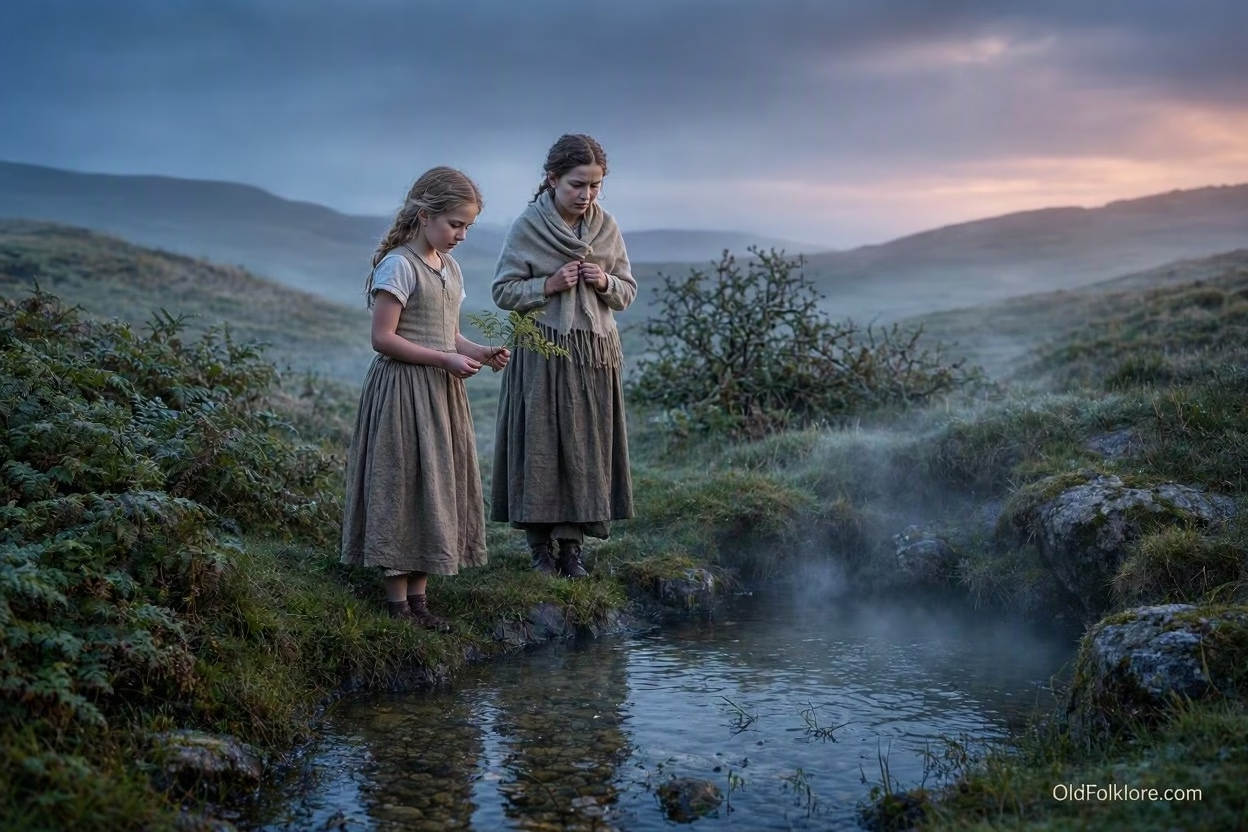
Their journey takes them towards the Fairy Well of Lagnanay, a secluded fountain on the mountain.
Ferguson describes the well as the mountain’s eye, clear, cold and grey. The image gives the water a mysterious presence. It is not presented merely as an ordinary source of water but as a place associated with supernatural power.
Explore more stories from our Irish Fairy and Folk Tales collection.
The landscape is quiet and lonely. The sisters arrive before the morning dew has disappeared, as the instructions require. They stand beside the fountain, and the passage of time seems uncertain.
The stillness of the scene creates an atmosphere of expectation. Una has come with the hope of freeing herself from sorrow, while Ellen remains beside her, sharing the experience despite her earlier fears.
The well stands at the centre of the encounter. Its water is cold, and its association with the fairies makes the ritual more than an ordinary act of washing. Una is approaching a boundary between the human world and the mysterious realm that she hopes will remove her suffering.
The Ritual at the Well
As the morning approaches, Una begins the ritual.
She bares her bosom and washes herself three times with the water of the fountain. The ballad describes the water as moving in subtle streams, giving the action an almost dreamlike quality.
After washing, Una gathers the three lady-brackens required by the instructions. She then walks around the well three times, completing the actions that Ellen has described.
Every part of the ritual follows the traditional instructions. Una has visited the fountain at the appointed time, used its water and gathered the required plants. She has also completed the three circuits around the well.
For Una, the act represents the possibility of a new beginning. She hopes that once the ritual is finished, the memories that have caused her so much pain will disappear.
But the ballad does not present the result as a simple release from grief.
Instead, the supernatural presence of the well becomes increasingly threatening. The ritual that promised to remove Una’s sorrow appears to have placed her within the power of the fairies.
Ellen watches as the strange event unfolds. She has accompanied her sister out of concern, but she cannot control what is happening.
Una Disappears
When Ellen looks towards the well, she sees her sister’s reflection. She watches it appear upon the surface of the water, but the scene begins to change.
The fountain, the hill and Una seem to merge into one indistinct image. Everything becomes blurred, as though the ordinary world is dissolving before her eyes.
Ellen calls out to her sister, but there is no answer.
Una has vanished.
The disappearance is sudden and terrifying. There is no struggle described, no visible path by which she leaves and no explanation that can make sense of what has happened. The person who stood beside Ellen moments earlier is no longer there.
Ellen searches with her eyes and calls for Una, but the young woman cannot be found. The ballad emphasises the complete nature of the disappearance. No part of Una’s body remains visible, and no ordinary trace explains where she has gone.
The supernatural world has taken her beyond the reach of her sister.
The Empty Fountain
After Una’s disappearance, the ballad turns to the well itself.
The surrounding banks are described as green and bare. There is no pit or opening into which Una could have fallen. Anyone who visits the fountain may look into it, but there is nothing extraordinary to see.
Only smooth pebbles and small pieces of straw remain in the water, turning and moving with the current.
This ordinary appearance makes the disappearance even more disturbing. The place gives no visible evidence of the supernatural event that has taken place. A person arriving afterwards might see nothing unusual about the fountain or the surrounding ground.
The ballad then asks who could know what happened to Una. It names Jurlagh Daune as the only possible person who might possess the answer.
The reference leaves the mystery unresolved. Una has entered a world that ordinary human beings cannot understand, and Ellen is left without the sister who accompanied her to the hill.
The final refrain becomes a warning to others. The listener is urged to pray for protection from fairy captivity.
Una’s attempt to forget her sorrow has ended in a far greater loss. She sought freedom from painful memories, but the ritual has separated her permanently from the human world.
The Folklore Behind the Ballad
The Fairy Well of Lagnanay draws upon the traditional Irish belief that fairies inhabit a world closely connected to the human landscape but governed by different powers and rules.
In Irish folklore, hills, wells, springs and other natural places could be associated with supernatural beings. Such locations were sometimes approached with caution because people believed that the fairies might be encountered there. A place that appeared ordinary could also be understood as a point of contact between the visible world and the unseen one.
The fairy well in Ferguson’s ballad reflects this understanding. It is a natural fountain, but its association with supernatural forces gives it a dangerous significance. Una approaches it because she believes its water and the accompanying ritual can remove her sorrow. Instead, the well becomes the place where she disappears.
The ballad also draws upon the belief that fairies could take human beings away from their communities. Such disappearances were a recurring feature of Irish fairy traditions. The person taken might be described as entering a hidden world, becoming inaccessible to family and friends.
The poem does not explain the fairies’ motives or reveal what happens to Una after she vanishes. This uncertainty is central to its supernatural atmosphere. The disappearance is presented as something beyond ordinary human understanding.
The repeated refrains strengthen the traditional ballad form. They return throughout the poem, creating a musical pattern that reinforces the sadness, warning and mystery of the events. The story is therefore not simply a description of a supernatural encounter. Its rhythm and repeated lines help convey the emotional experience of the characters.
Explore our complete Historic Folklore & Fairy-Tale Collections archive.
Moral Lesson
The ballad warns against allowing sorrow and desperation to lead to reckless decisions. Una is so overwhelmed by painful memories that she becomes willing to risk entering the supernatural world without knowing the consequences.
Her disappearance also reflects the danger associated with places and practices believed to be under fairy influence. The story encourages caution towards mysterious forces that people do not understand.
Knowledge Check
1. Who are the two sisters in the ballad?
Una and Ellen.
2. Why is Una unhappy?
She is distressed by the memory of someone who has left her.
3. What does Una hope to achieve by visiting the fairy well?
She hopes to forget her sorrow and the memories that trouble her.
4. What instructions does Ellen describe for the ritual?
Una must wash herself three times in the well’s water, gather three lady-brackens and walk around the fountain three times before the dew has risen.
5. What happens after Una completes the ritual?
She mysteriously disappears, leaving Ellen unable to find her.
6. Who wrote The Fairy Well of Lagnanay?
The ballad was written by the Irish poet Samuel Ferguson.
Source
Source: Samuel Ferguson, “The Fairy Well of Lagnanay,” included in Fairy and Folk Tales of the Irish Peasantry, edited and selected by W. B. Yeats, first published in 1888, p. 13 onwards.
Explore More Irish Fairy and Folk Tales