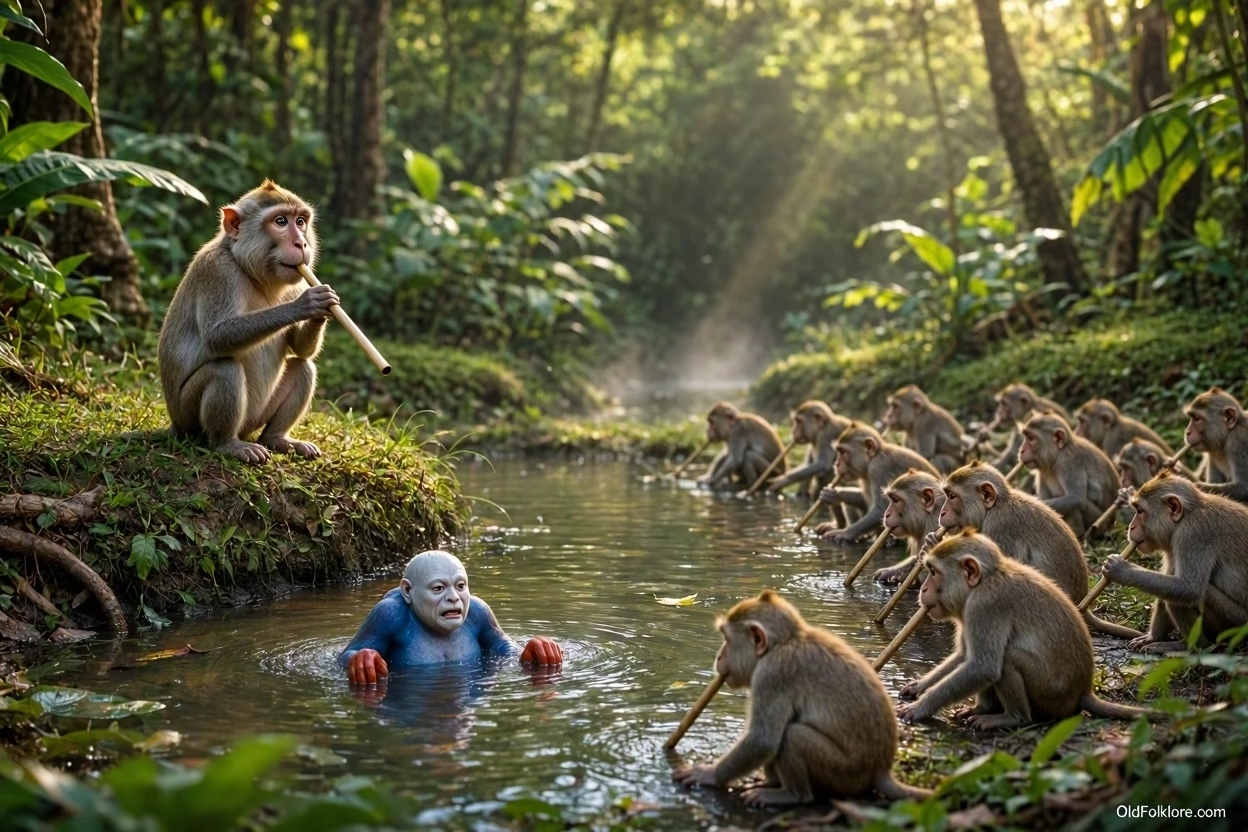
Deep within an ancient forest, a troop of monkeys discovers a pond that promises relief from their thirst. However, the water hides a deadly danger, and one careless decision could cost them their lives. Their survival depends on the wisdom of their king, whose careful observation and clever thinking will help them overcome a terrifying enemy without entering the dangerous water.
The Buddha’s Former Command
When the Buddha was living near the village of Naḷapāna, a group of monks discovered something unusual about the reeds growing beside a lake. After bathing in the water, they asked novices to bring them reeds to make needle-cases. The monks expected the reeds to be solid inside, but every one they examined was hollow from root to tip.
They wondered how this strange feature had come about. When they approached the Buddha for an explanation, he told them that the reeds had become hollow because of a command he had given in a previous birth.
He then related the story of a forest inhabited by a great troop of monkeys and a dangerous water demon.
The Monkey King’s Warning
Long ago, a densely wooded forest surrounded a lake inhabited by a water demon. The creature preyed upon anyone who entered the water, carrying its victims away so that they never returned.
In that forest lived a wise monkey king, the Bodisat, who was destined to become the Buddha. He resembled the fawn of a red deer in size and led a troop of approximately eighty thousand monkeys.
The monkey king cared deeply for his followers. Knowing that the forest contained poisonous trees and pools haunted by demons, he warned the troop against eating unfamiliar fruits or drinking from unknown waters without first consulting him.
His followers agreed to obey.
One day, the monkeys wandered into a part of the forest they had never visited before. They spent much of the day searching for food and water. Eventually, they discovered a pond, but they did not drink from it. Remembering their king’s warning, they settled beside the water and waited for him to arrive.
Their decision would save their lives.
The Dangerous Footprints
When the monkey king reached the pond, he found his troop waiting on the bank. He asked why they had not drunk the water, and they explained that they had waited for his guidance.
Explore more stories from our Jataka Tales collection.
The king praised their caution and began examining the ground around the pond.
He noticed footprints leading down towards the water. However, he could find no footprints showing that anyone had returned from the pond.
This discovery immediately aroused his suspicion. He realised that the water was probably inhabited by a demon that had seized every creature that entered it.
The monkeys had been right to wait.
The water demon soon noticed that its intended victims were refusing to approach the pond. Determined to lure them into danger, it abandoned its hiding place beneath the water and emerged in a terrifying form.
Its belly was blue, its face pale, and its hands and feet red. It splashed through the water and demanded to know why the monkeys were sitting on the bank instead of drinking.
The demon urged them to enter the pond, expecting hunger and thirst to overcome their caution.
The monkey king remained calm.
The Demon Reveals Its Power
The Bodisat asked the creature whether it was the water demon that haunted the pond.
The demon admitted that it was. It boasted that every creature entering the water fell under its power. Even a bird that came down to the pond would become its prey.
It declared that it intended to devour the entire troop of monkeys.
The king refused to be intimidated. He explained that the monkeys would drink the water without allowing the demon to capture them.
The demon challenged him to explain how this could be possible.
It assumed that drinking required the monkeys to enter the pond. As far as the creature was concerned, anyone who approached the water would eventually fall into its grasp.
The Bodisat knew otherwise.
He had observed the danger before taking action and had already begun considering a safer solution. Instead of allowing his followers to enter the pond, he would find a way for them to drink while remaining on dry ground.
The Hollow Reeds
The monkey king announced that the troop would drink through reeds.
Each monkey would take a reed from the pond’s bank and use its hollow stem to draw up water. In this way, the animals could quench their thirst without entering the demon’s territory.
The demon was astonished by the plan. It had expected the monkeys to behave like other creatures and approach the water directly. It had not anticipated that their king would find a way around the danger.
The Bodisat then demonstrated the solution.
He asked for a reed to be brought to him. Calling upon the power of the Ten Great Perfections cultivated through his present and previous births, he performed a miracle. He blew into the reed, causing it to become hollow throughout, with none of its internal joints remaining.
He repeated the process with additional reeds.
Once he had prepared enough, the monkey king walked around the pond and commanded that every reed growing there should be hollow from root to tip.
His command was fulfilled. The reeds around the lake became hollow throughout, allowing the monkeys to drink through their stems without entering the water.
The unusual condition of the reeds was no ordinary accident. In the Jataka account, it was the lasting result of the Bodisat’s extraordinary power and goodness.
The Demon Is Defeated
With the reeds prepared, the monkey king sat down beside the pond and began to drink through one of them.
The eighty thousand monkeys followed his example. Each took a reed and drew water from the lake while remaining safely on the bank.
The water demon could do nothing to stop them. Its power depended on creatures entering the pond, but the monkeys had found a way to satisfy their thirst without stepping into the water.
Not one monkey fell into the demon’s grasp.
Defeated by their king’s wisdom, the demon returned sorrowfully to its own place. The Bodisat and his troop then returned to the forest unharmed.
The danger had been overcome without a battle. The monkey king had protected his followers by recognising the threat, refusing to rush into danger and devising a practical solution.
The Explanation of the Hollow Reeds
After telling the story, the Buddha explained how it related to the monks’ discovery near Naḷapāna.
The hollow reeds were the result of the monkey king’s former command. The Buddha identified himself with the wise Bodisat who had protected the troop.
He also explained that the water demon had been Devadatta, while the eighty thousand monkeys represented the Buddha’s followers.
The tale therefore served two purposes. It explained the unusual reeds around the lake and recalled an earlier life in which the Bodisat had demonstrated wisdom, foresight and concern for the safety of others.
The monks’ question had brought the former event to mind, allowing the Buddha to teach through the story.
The Meaning of The Monkeys and the Demon
The story shows that danger can sometimes be overcome through observation and careful planning rather than direct confrontation. The monkey king did not ignore the warning signs or allow his followers to approach the pond simply because they were thirsty.
Instead, he examined the footprints, recognised the likely presence of a predator and waited until he understood the danger. Only then did he devise a solution.
His leadership also depended on trust. The monkeys remembered his instructions and waited for him rather than acting recklessly. Their willingness to follow sound guidance helped save the entire troop.
Within the Buddhist Jataka tradition, the Bodisat’s actions also demonstrate the qualities cultivated across his previous births. His wisdom and concern for the lives of others allowed him to protect his followers while overcoming a dangerous obstacle.
Explore our complete Historic Folklore & Fairy-Tale Collections archive.
Moral Lesson
The story teaches the importance of caution, wisdom and thoughtful leadership. It reminds readers to examine warning signs before acting and to seek guidance when facing unfamiliar dangers.
It also shows that a difficult problem does not always require force. Careful observation, patience and an inventive approach can provide a safer and more effective solution.
Knowledge Check
1. Why did the monkeys refuse to drink from the pond?
They waited for their king because they had been warned to seek his guidance before drinking from unfamiliar pools.
2. What did the monkey king discover by examining the footprints?
He saw that footprints led into the pond but none appeared to lead out, suggesting that a demon was taking those who entered the water.
3. How did the water demon try to capture the monkeys?
It emerged from the pond in a frightening form and urged them to enter the water and drink.
4. How did the monkey king enable the troop to drink safely?
He used his extraordinary power to make the reeds hollow throughout so that the monkeys could draw water through them while remaining on the bank.
5. What happened to the water demon after the monkeys drank?
Unable to capture any of them, it returned sorrowfully to its own place.
6. What did the Buddha explain about the story at the end?
He explained that he had been the monkey king in that former birth, Devadatta had been the water demon, and the eighty thousand monkeys represented his followers.
Source
Source: “The Monkeys and the Demon,” also titled “Naḷapāna Jātaka,” No. 20, in Buddhist Birth Stories; or, Jātaka Tales, Volume I, edited by V. Fausbøll and translated by T. W. Rhys Davids (1880).