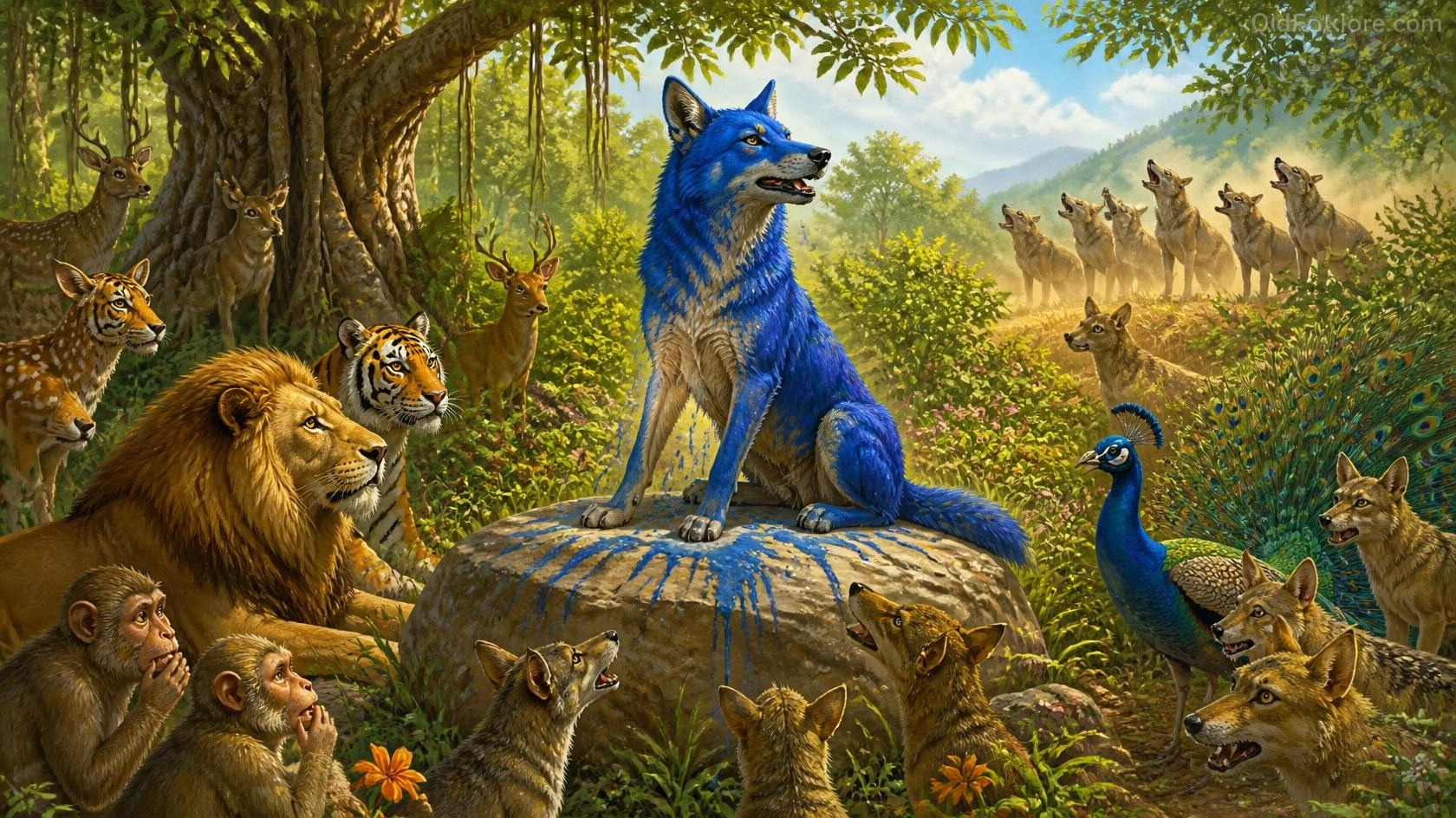
Once upon a time, there lived a jackal named Fierce-Howl in a cave near the outskirts of a city. Life in the wilderness was not always easy, and one evening, driven by hunger, he wandered into the city in search of something to eat.
Unfortunately, the city dogs spotted him.
They rushed towards him, barking furiously and snapping at his legs with their sharp teeth. Terrified, Fierce-Howl darted through the streets, twisting and turning as he desperately searched for somewhere to hide.
In his panic, he stumbled into the house of a dyer and fell straight into a large vat filled with indigo dye.
The dogs eventually gave up the chase and returned home. Once the streets were quiet, the frightened jackal struggled out of the vat and escaped into the forest.
He had survived the dogs, but he had acquired something he never expected: his entire body was now stained a brilliant blue.
Explore more stories from our The Panchatantra collection.
A Strange Creature Appears
When Fierce-Howl returned to the forest, the animals caught sight of his unusual appearance and were astonished.
Never had they seen a creature of such extraordinary colour. They could not tell what kind of animal he was, where he had come from, or whether he possessed powers they should fear.
Panic spread through the forest. Lions, tigers, leopards, monkeys, rabbits, gazelles, jackals, and other animals began to flee, afraid of what this mysterious stranger might do.
As they ran, they warned one another that it was dangerous to trust a creature whose nature, ancestry, and courage were unknown.
Fierce-Howl quickly realised that his strange appearance had given him an unexpected advantage. The animals were frightened not because they knew him to be powerful, but because they did not understand what they were seeing.
He decided to turn their fear into an opportunity.
The Jackal Declares Himself King
Fierce-Howl called out to the fleeing animals.
“Come back! Why are you running away from me? Have I harmed any of you?”
The animals stopped at a cautious distance.
He continued, speaking with the confidence of a ruler addressing his subjects.
“The great god Indra has recognised that the forest has no monarch. He has therefore appointed me king over all its creatures. My name is Fierce-Howl, and I have come to protect you. You may live in peace beneath my powerful paws.”
The animals were overwhelmed by his appearance and his bold declaration. None questioned how a mysterious blue creature had suddenly appeared or demanded proof of his supposed divine appointment.
Instead, they bowed before him.
“Your Majesty,” they said, “tell us what duties we must perform.”
Fierce-Howl had achieved what he could never have accomplished through strength alone. Without fighting a single animal, he had risen from a frightened fugitive to the ruler of the forest.
A Kingdom Built on Deception
Once he had secured his throne, the Blue Jackal organised his kingdom.
He appointed the lion as his prime minister and gave the tiger the position of lord of his bedchamber. The leopard became the keeper of his betel, the elephant served as the doorkeeper, and the monkey was assigned to carry the royal parasol.
Every animal received a place in the new royal household.
But Fierce-Howl treated his fellow jackals differently. Rather than welcome his own kind, he struck them and drove them away. He feared that their presence would expose his true identity.
Meanwhile, the other animals accepted their new ruler without suspicion. The lions, tigers, and other powerful creatures hunted for food, which they brought before him. He then divided the food among his subjects as a king was expected to do.
Days passed, and Fierce-Howl grew comfortable with his new life. He enjoyed the respect of the forest, the service of powerful animals, and the privileges of kingship.
Yet his authority rested on a single fragile deception. His subjects believed he was an extraordinary creature, but he was still an ordinary jackal wearing a coat of borrowed colour.
The Sound That Destroyed a Kingdom
One day, while Fierce-Howl sat in his royal court, he heard a pack of jackals howling somewhere nearby.
The familiar sound stirred something deep within him.
His body trembled with excitement, and tears of joy filled his eyes. Before he could control himself, he sprang to his feet and answered them with a loud, piercing howl of his own.
For a moment, the forest court fell silent.
Then the truth became clear.
The creature they had crowned as their extraordinary king was nothing more than a jackal. His blue colour had come from a dyer’s vat, not from divine power. His royal claims were lies, and his authority had been built upon the animals’ fear and ignorance.
The lions and the other creatures felt humiliated. They had trusted a pretender and allowed themselves to be deceived.
Anger replaced their former reverence.
“Look at what he has done!” they cried. “This jackal has fooled us. He must be killed!”
Fierce-Howl immediately understood that his kingdom had collapsed. He tried to escape, just as he had fled the city dogs, but this time there was no safe vat of dye to fall into and no unfamiliar appearance to protect him.
A tiger caught him and tore him to pieces.
Thus ended the reign of the Blue Jackal. The disguise that had raised him to a throne could not silence the nature he had tried to conceal, and the very instinct that connected him to his kind brought about his downfall.
Explore more stories from our Italian Popular Tales collection.
Moral
Deception may bring temporary success, but a false identity is difficult to maintain forever. Fierce-Howl gains a kingdom through appearances and lies, but his own instincts expose him. The story also warns against blindly trusting someone simply because they look powerful, unusual, or impressive.
Knowledge Check
1. Why did Fierce-Howl enter the city?
He was hungry and searching for food when the city dogs chased him.
2. How did the jackal become blue?
He accidentally fell into a vat of indigo dye while escaping the dogs.
3. How did he persuade the forest animals to accept him as king?
He claimed that the god Indra had appointed him ruler because the forest lacked a monarch.
4. Why did Fierce-Howl drive away the other jackals?
He feared that they would recognise him and expose his deception.
5. What finally revealed his identity?
Hearing other jackals howl stirred his natural instincts, and he answered them with a howl of his own.
6. What is the central lesson of the tale?
False appearances and dishonest claims cannot guarantee lasting authority, especially when the truth eventually comes to light.
Source
Richard Wilhelm, editor; Frederick H. Martens, translator, The Chinese Fairy Book, Frederick A. Stokes, 1921. Project Gutenberg 29939.