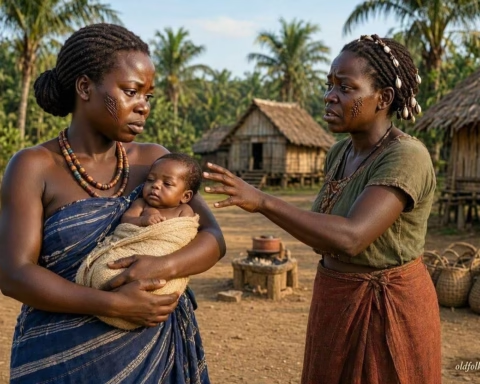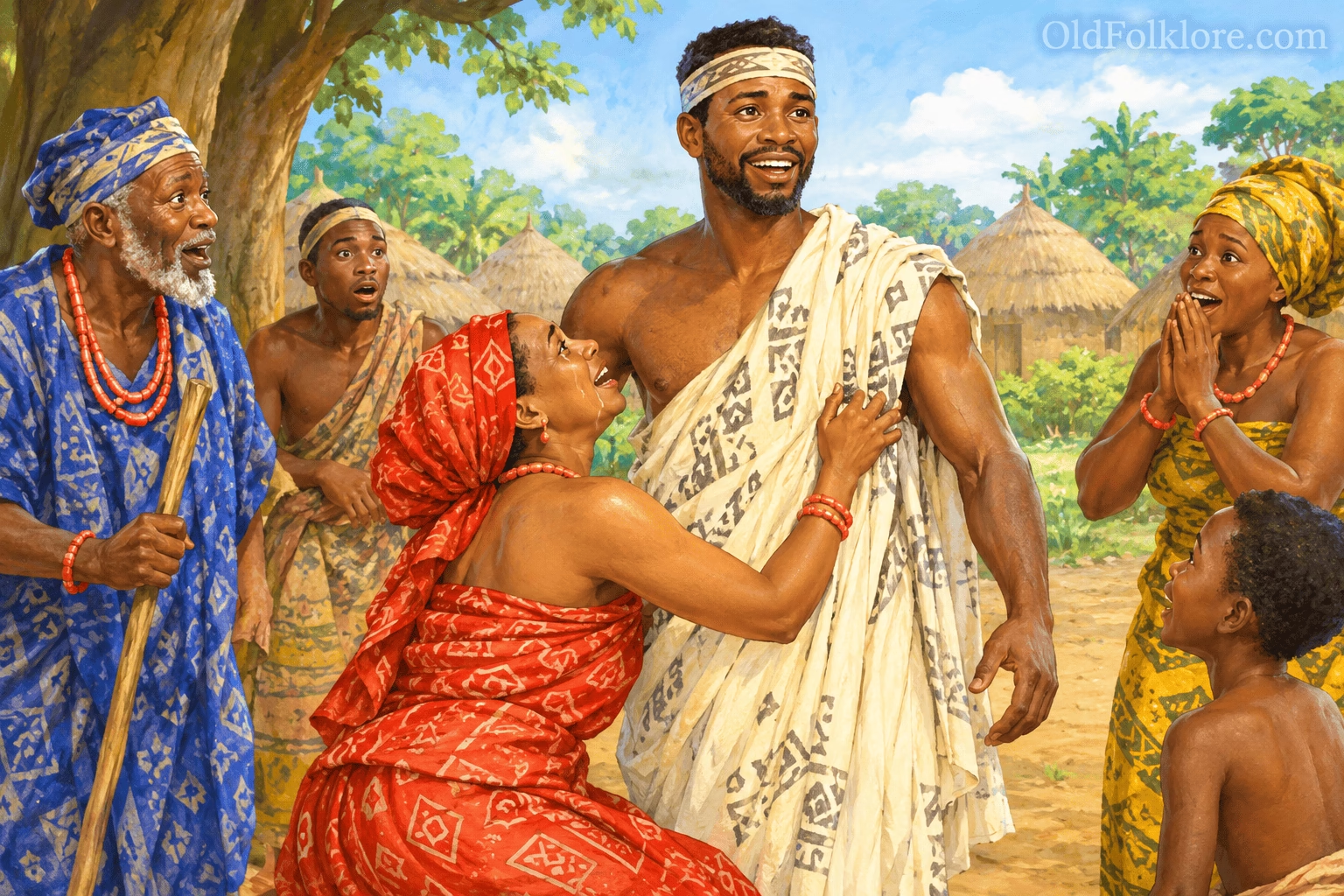
Elili and Aikor were wives of Chief Nyip, and each had a daughter. Elili, the senior wife, managed the household, and for years the family lived without serious trouble.
But when Elili fell ill and died, everything changed for her young daughter, Oga.
Aikor took over the household and became responsible for preparing and sharing the food. She favoured her own daughter, Nagor, giving her the best portions while leaving Oga with barely enough to eat. Her jealousy towards Elili extended even to the child Elili had left behind.
Explore more stories from our West African Folk-Tales collection.
Day after day, Oga endured this unfair treatment. Eventually, the small portions of food became too much for her to bear. She carried what little she had received to her mother’s grave, sat beside it, and wept, calling for the mother who had once cared for her.
When evening came, she returned home. The following day, she went back to the grave and cried again. As she wept, something extraordinary happened. The earth opened, and the top of her mother’s head appeared.
Oga continued crying until sunset, then went home.
The next morning, she returned as soon as daylight came. She cried with renewed determination, and by evening, her mother’s head and shoulders had emerged from the ground.
On the following day, her mother rose as far as the waist. Oga did not give up. She continued visiting the grave and pouring out her grief until, after several more days, Elili finally emerged completely.
Her mother had returned from the dead.
Elili Returns Home
By the time Elili came out of the grave, dusk was approaching. Oga quickly led her to the back of the house and hid her in a small room used for storing yams and baskets.
There, Elili remained undiscovered for three days.
At the end of that time, Oga approached her father with an unusual request.
“If you give me a good present,” she told him, “I will show you my mother alive.”
Chief Nyip agreed and gave his daughter a piece of cloth. Oga then led him to the little storeroom and revealed Elili.
“Here is my mother,” she explained, “whom I have brought back alive from the grave.”
Chief Nyip was overjoyed. His beloved wife had returned, and he welcomed her back into his household. Before long, they were living together as they had done before her death.
For Oga, the return of her mother brought an end to the loneliness and suffering she had endured.
But the household’s troubles were not over.
Aikor’s Death and Nagor’s Suffering
Not long after Elili returned, Aikor died. Her daughter, Nagor, was left in the care of Elili and Oga.
Now Elili had the opportunity to treat Nagor as Aikor had treated Oga. Instead of showing kindness to the child who had lost her mother, Elili sought revenge for the suffering her own daughter had experienced.
Nagor was made to perform the hardest household tasks and was given so little food that she was left half-starved.
Unable to endure this treatment, Nagor eventually turned to the grave of her dead mother, just as Oga had done before her.
She wept bitterly, longing to have Aikor back.
For three days, Nagor cried beside the grave. Her persistence brought the same extraordinary result: her mother began to rise from the earth.
On the fourth day, Aikor’s head and shoulders appeared above the ground.
Nagor was desperate to bring her mother out completely. Remembering how Elili had been restored to life, she seized Aikor by the head and pulled with all her strength.
But she pulled too hard.
Instead of freeing her mother, Nagor tore her head from her shoulders.
Her attempt to reunite with the mother she had lost ended in a terrible disaster.
The Origin of the Palm Fruit
Horrified by what had happened, Nagor carried her mother’s severed head to the same storeroom where Oga had hidden Elili after bringing her back from the grave.
She then called her father to come and see what she had accomplished.
But when Chief Nyip saw Aikor’s head, he was furious. Rather than celebrating, he ordered Nagor to take it back and bury it in the grave.
Nagor did not obey.
Instead, she threw her mother’s head among the young palm oil trees.
According to the tale, this act brought about a remarkable transformation. The young palm trees began to bear clusters of fruit resembling a woman’s head in both shape and size. The fruits were said to look like a woman’s head, complete with plaits of hair arranged around it.
And so the story ends by explaining the unusual appearance of the fruit clusters on young palm trees.
Oga had brought her mother home through patience and persistent grief. Nagor, desperate to achieve the same result, had lost her mother a second time through impatience. Her final act left behind a strange feature of the natural world that the storyteller connected to the tragedy.
Explore our complete Historic Folklore & Fairy-Tale Collections archive.
Moral of the Story
Patience and care are important, especially when we are distressed. Acting out of desperation without thinking about the consequences can make a painful situation worse.
The story also warns against revenge. When one person answers cruelty with more cruelty, suffering continues rather than coming to an end.
Knowledge Check
1. Who were Elili and Aikor?
They were the wives of Chief Nyip, and each had a daughter.
2. Why did Oga repeatedly visit her mother’s grave?
She was hungry, mistreated by Aikor, and desperately missed her mother.
3. How did Oga bring Elili back home?
She wept at the grave for several days until Elili emerged, then hid her in a storeroom before revealing her to Chief Nyip.
4. Why did Nagor fail to bring her mother back safely?
She pulled Aikor’s head too forcefully while trying to bring her completely out of the grave, separating it from her shoulders.
5. What does the story say about the origin of the palm fruit clusters?
It says Nagor threw her mother’s head among young palm oil trees, causing them to bear fruit resembling a woman’s head with plaits of hair.
Source
Dayrell, Elphinstone. Ikom Folk Stories from Southern Nigeria. Section IV, “How Elili of Inkum died, and was Brought Back to Life Again,” printed pages 9–10.
Explore More West African Folk-Tales
- Thunder and Anansi: A West African Folktale
- Tom Tit Tot: The Girl Who Outwitted a Terrifying Imp by Guessing His Name
- Why the Sun and the Moon Live in the Sky: A Southern Nigerian Folktale
- Igiri and the Mushroom Baby: An Ikom Folktale
- The Envier and the Envied: A Powerful Arabian Nights Tale
- The Old Man and the River Spirit
- The Enchanted Date Palm of the Oasis