A princess sets out from her mother’s kingdom to marry a distant prince, carrying her royal dowry and the blessings of her family. However, the journey takes a cruel turn when her own waiting-maid forces her to exchange identities and surrender her place as the bride.
Stripped of her fine clothes and separated from her faithful horse, Falada, the princess finds herself working as a goose-girl in the prince’s kingdom. Although she suffers in silence, the truth gradually emerges through the words of Falada’s severed head and the strange events witnessed by a wise old king. The princess’s hidden identity finally comes to light, bringing justice for the betrayal she endured.
A Princess Prepares for Marriage
Once upon a time, there lived an old queen whose husband had been dead for many years. She had one beautiful daughter who was betrothed to a prince living in a distant kingdom.
When the time came for the princess to travel to her future husband’s home, her mother prepared a magnificent dowry. She packed vessels of silver and gold, valuable ornaments, cups, jewels, and other treasures suitable for a royal bride.
The queen loved her daughter dearly and wanted her journey to be successful. She therefore arranged for a waiting-maid to accompany the princess and deliver her safely to the bridegroom.
Two horses were prepared for the journey. The princess rode a remarkable horse named Falada, who possessed the extraordinary ability to speak.
Before her daughter departed, the queen went into her bedroom and took a small knife. She cut her finger until it bled, then caught three drops of blood on a white handkerchief.
She gave the handkerchief to the princess and instructed her to keep it carefully, explaining that it would be useful during the journey.
The princess accepted the gift and set out with her waiting-maid. She carried her mother’s blessing and the precious handkerchief, unaware that the journey would soon become a struggle for her identity and freedom.
The Waiting-Maid Reveals Her Cruelty
After travelling for some time, the princess became thirsty. She asked her waiting-maid to fetch her a little water from a nearby stream.
The maid refused to serve her.
“If you are thirsty, get down from your horse and drink for yourself,” she replied. “I do not intend to be your servant.”
The princess was shocked by this disrespectful answer. Nevertheless, she climbed down from Falada and knelt beside the stream to drink.
Explore more stories from our Brothers Grimm Tales collection.
She did not complain, although she had been accustomed to the care and respect given to a royal daughter.
Later, the princess became thirsty again. Once more, she asked her waiting-maid to bring her water.
Again, the maid refused. She insisted that she would no longer serve the princess and would only continue travelling with her if they exchanged clothes and horses.
The waiting-maid had discovered an opportunity to seize the princess’s position. She knew that the prince expected to marry a royal bride, and she intended to present herself as that bride.
The princess was frightened and distressed, but the maid threatened her life if she revealed what had happened. Afraid of being killed, the princess surrendered her fine clothes and exchanged horses with her companion.
The waiting-maid took the princess’s royal garments and rode Falada, while the true princess was left wearing the maid’s clothes and riding the inferior horse.
The maid also took possession of the handkerchief containing the queen’s three drops of blood. Without it, the princess had lost the special protection her mother had given her for the journey.
A Promise Made Under Threat
The two travellers continued towards the prince’s kingdom, but their positions had been reversed.
The waiting-maid now appeared to be the princess, while the real royal daughter travelled in the clothes of a servant.
The false bride warned the princess that she must never reveal what had happened. If she told anyone the truth, the maid would kill her.
The princess was forced to promise silence.
When they eventually reached the royal court, the prince welcomed the woman he believed to be his intended bride. The waiting-maid presented herself as the princess, and nobody questioned her identity.
The real princess could not expose the deception because she had sworn not to reveal her suffering. She also lacked the evidence and authority needed to challenge the woman who had taken her place.
The waiting-maid’s scheme had succeeded. She was received as a royal bride, while the true princess was treated as an ordinary servant.
Falada Must Be Killed
The false bride was afraid that Falada might reveal the truth. The horse had belonged to the real princess and could speak, making him a dangerous witness to the deception.
The false bride therefore demanded that the horse be killed.
When the princess heard this, she was heartbroken. Falada had accompanied her from her mother’s kingdom and remained connected to the life she had lost.
She secretly approached the man responsible for killing the horse and offered him a reward if he would perform one final favour.
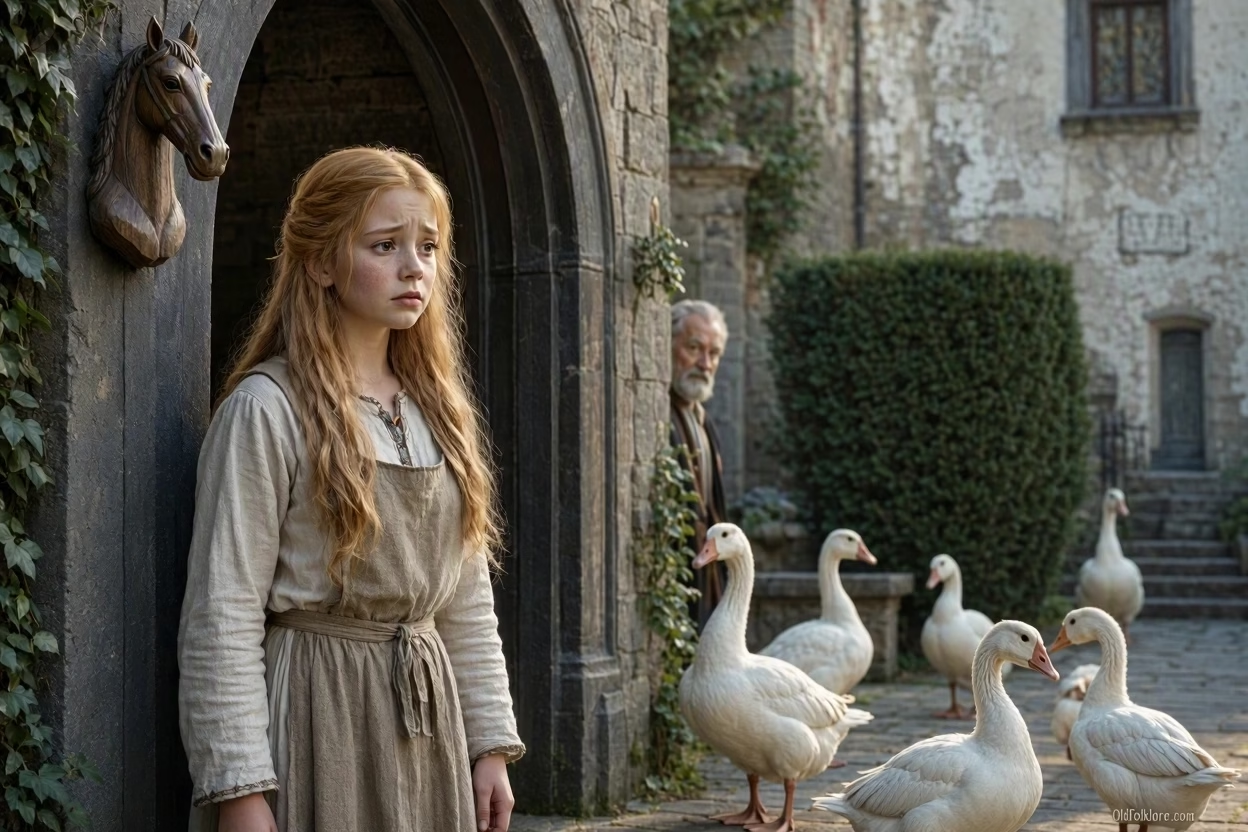
She asked him to fasten Falada’s head beneath the dark gateway through which she would pass each morning on her way to tend the geese.
The man agreed. Falada was killed, and his head was fixed beneath the gateway.
Although the princess could no longer ride her faithful horse, she would still see him each day. The sight of his head reminded her of her former life and the betrayal that had taken everything from her.
The false bride had removed Falada because she feared the truth he could reveal. Yet she could not prevent the princess from speaking to him, and the horse’s head would soon become part of the evidence that exposed her crime.
The Princess Becomes a Goose-Girl
The old king of the prince’s kingdom ordered that the young woman who had arrived with the bride should be put to work tending geese.
He did not know that she was a princess. To him and the other members of the household, she appeared to be an ordinary servant.
The young woman accepted the work, though her life had changed completely. She had once travelled with a royal dowry and expected to marry a prince. Now she wore plain clothing and spent her days looking after geese.
Each morning, she passed beneath the dark gateway where Falada’s head hung.
Whenever she saw it, she spoke to the horse in sorrow:
“Alas, Falada, hanging there!”
The horse’s head answered with words that expressed the princess’s suffering. It lamented her unhappy circumstances and declared that her mother’s heart would break if she knew what had happened.
The princess was comforted by these familiar words, but she could not explain her situation to anyone else.
A young goose-boy named Conrad accompanied her to the pasture. He soon noticed that she spoke to the horse’s head, and he became curious about her unusual behaviour.
The Wind and the Princess’s Golden Hair
Each day, the princess and Conrad took the geese to the pasture.
Although the princess wore plain clothes, her hair was exceptionally beautiful. It shone with a golden radiance, and when she sat down to comb it, Conrad was fascinated by its appearance.
He wanted to pull out some of her hair, perhaps hoping to possess a strand of such beautiful golden locks.
The princess did not want him to touch it. She knew that her appearance might reveal her royal identity, and she wished to avoid drawing attention to herself.
Whenever Conrad tried to seize her hair, she recited a verse asking the gentle wind to blow his hat away.
The wind responded to her words. It carried Conrad’s hat far across the pasture, forcing him to chase it while the princess continued combing and plaiting her hair.
By the time Conrad returned, her golden hair had been neatly arranged and secured.
The incident happened repeatedly. Conrad grew frustrated because the princess’s strange words always seemed to bring about the same result.
He could not understand how she managed to make the wind carry his hat away whenever he tried to touch her hair.
Eventually, he decided that he could no longer work with her.
Conrad Complains to the King
One evening, after returning from the pasture, Conrad went to the old king and complained that he no longer wished to tend the geese with the young woman.
The king asked him to explain the reason.
Conrad described how the goose-girl spoke to Falada’s head beneath the gateway each morning. He also explained how she recited her unusual verse whenever he tried to touch her golden hair.
According to Conrad, the wind always blew his hat away, forcing him to chase it while the girl finished arranging her hair.
The king listened carefully. Rather than dismissing the complaint, he decided to investigate the matter himself.
The next morning, he hid behind the dark gateway and waited for the goose-girl to arrive with the geese.
He heard her speak to Falada’s head and listened to the horse’s reply. The exchange confirmed that something unusual lay behind the girl’s behaviour.
The king then followed the goose-girl to the pasture and concealed himself among the bushes.
There, he watched her sit down and undo her hair. Its golden beauty shone as she combed and plaited it.
When Conrad approached and tried to seize her hair, she recited her verse again. A gust of wind carried his hat away, and he had to run after it.
The king had now witnessed the strange events for himself. He understood that the goose-girl was not an ordinary servant, but he still needed to discover why she lived in such misery.
The Secret Told to the Iron Stove
That evening, the king called the goose-girl aside and asked why she spoke to Falada’s head and why the wind seemed to obey her words.
The young woman refused to explain.
She told the king that she had sworn by heaven not to reveal her troubles to any human being. If she broke that promise, she feared she would lose her life.
The king continued questioning her, but she would not disclose the truth.
He then suggested that she might tell her story to the iron stove instead. Since a stove was not a human being, she could speak freely without breaking her oath.
The princess accepted the suggestion.
She crept inside the iron stove and began to weep. Believing herself alone, she poured out her grief.
She explained that she was a king’s daughter who had been betrayed by her waiting-maid. The false bride had forced her to exchange clothes and horses, taken her place with the bridegroom, and left her working as a goose-girl.
She also expressed sorrow that her mother did not know what had happened. If the queen could see her daughter’s suffering, the princess believed her heart would break.
Unknown to her, the old king stood outside the stove’s pipe and listened to everything she said.
At last, he understood the truth. The young woman tending geese was the genuine princess, while the woman living at the royal court had deceived everyone.
The True Bride Is Revealed
Once the princess finished speaking, the old king called her out of the stove.
He ordered that royal garments be brought for her. When she dressed in them, her beauty and dignity became unmistakable.
The king then summoned his son and explained what he had discovered.
The woman presented as the bride was only a waiting-maid who had stolen the princess’s identity. The true bride was standing before them, having been forced to work as a goose-girl.
The young prince was delighted when he saw the princess and learned the truth. The woman he had believed to be his bride was an impostor, and the royal daughter he had never properly met was finally revealed.
The old king arranged a great feast and invited the people of the kingdom and their friends.
At the head of the table sat the bridegroom. The true princess sat on one side of him, dressed in her royal garments, while the false bride sat on the other.
The waiting-maid had been blinded and did not recognise the princess in her dazzling clothes.
The king now had an opportunity to expose the deception publicly and establish what punishment the false bride deserved.
The False Bride Pronounces Her Own Sentence
When the feast had ended and the guests were merry, the old king posed a question to the false bride.
He described the case of a servant who had betrayed her mistress, stolen her identity, and forced her into a life of hardship. He then asked what such a person deserved.
The false bride did not realise that the king was describing her own crimes. Confident that she was being asked to judge someone else’s behaviour, she declared that the guilty woman deserved a cruel death.
She said the offender should be stripped naked and placed inside a barrel lined with sharp nails. Two white horses should then be harnessed to the barrel and made to drag it through the streets until the woman died.
The king listened to her answer.
Then he revealed the truth.
“You are that person,” he declared, explaining that she had pronounced her own sentence.
The punishment was carried out as the false bride had described. Her deception had been exposed, and the cruel judgement she proposed was turned against her.
The king’s decision brought the betrayal to an end. The waiting-maid could no longer enjoy the position she had stolen, and the princess was restored to her rightful place.
The young king married his true bride, and they ruled their kingdom in peace and happiness.
Explore our complete Historic Folklore & Fairy-Tale Collections archive.
Moral Lesson
The Goose-Girl is a tale about betrayal, patience, and the eventual discovery of truth. The waiting-maid uses threats and deception to steal the princess’s identity, but her success does not last.
The princess suffers greatly, yet she remains faithful to her promise and does not surrender her dignity. Falada’s speaking head, Conrad’s complaint, and the old king’s careful investigation all help uncover the truth.
The story also shows the importance of looking beyond appearances. The woman dressed as a princess is an impostor, while the young woman tending geese is the true royal bride. In the end, the deception is exposed, and the princess receives the future that was taken from her.
Knowledge Check
1. Why was the princess travelling to a distant kingdom?
She was travelling to marry a prince to whom she had been betrothed.
2. What gift did the queen give her daughter before the journey?
She gave her a white handkerchief containing three drops of her own blood.
3. How did the waiting-maid take the princess’s place?
She threatened the princess, forced her to exchange clothes and horses, and took the handkerchief before presenting herself as the royal bride.
4. Why was Falada killed?
The false bride feared that the speaking horse could reveal the truth about the exchange of identities.
5. How did the old king discover the princess’s identity?
He observed her unusual behaviour, then listened secretly as she told her story to an iron stove.
6. How was the false bride punished?
At the royal feast, she unknowingly pronounced the sentence for her own crime. The king then ordered the punishment to be carried out.
Source
“The Goose-Girl” is tale number 89 in Household Tales by Jacob and Wilhelm Grimm, translated into English by Margaret Hunt and published in 1884.
Explore More Brothers Grimm Tales
- The Wishing Table, the Gold Ass and the Cudgel
- Thumbling: A Grimm Fairy Tale
- The Wedding of Mrs Fox: Grimm Fairy Tale
- The Elves: A Grimm Fairy Tale
- The Robber Bridegroom’s Terrifying Secret
- Herr Korbes: A Strange and Deadly Grimm Tale
- The Seven Ravens: A Brothers Grimm Tale
- Hansel and Gretel: A Grimm Fairy Tale