Long ago, when King Brahmadatta ruled Benares, the Bodhisatta served as one of his ministers. He was known for his wisdom and ability to understand situations that others found difficult to explain.
At that time, a dog had discovered a reliable source of food near the stable where the king’s elephant was kept. Whenever the elephant ate, small lumps of rice fell to the ground, and the dog would eagerly gather them up.
At first, the dog came simply because he was hungry. But as the days passed, something more than food brought him back.
Explore more stories from our Jataka Tales collection.
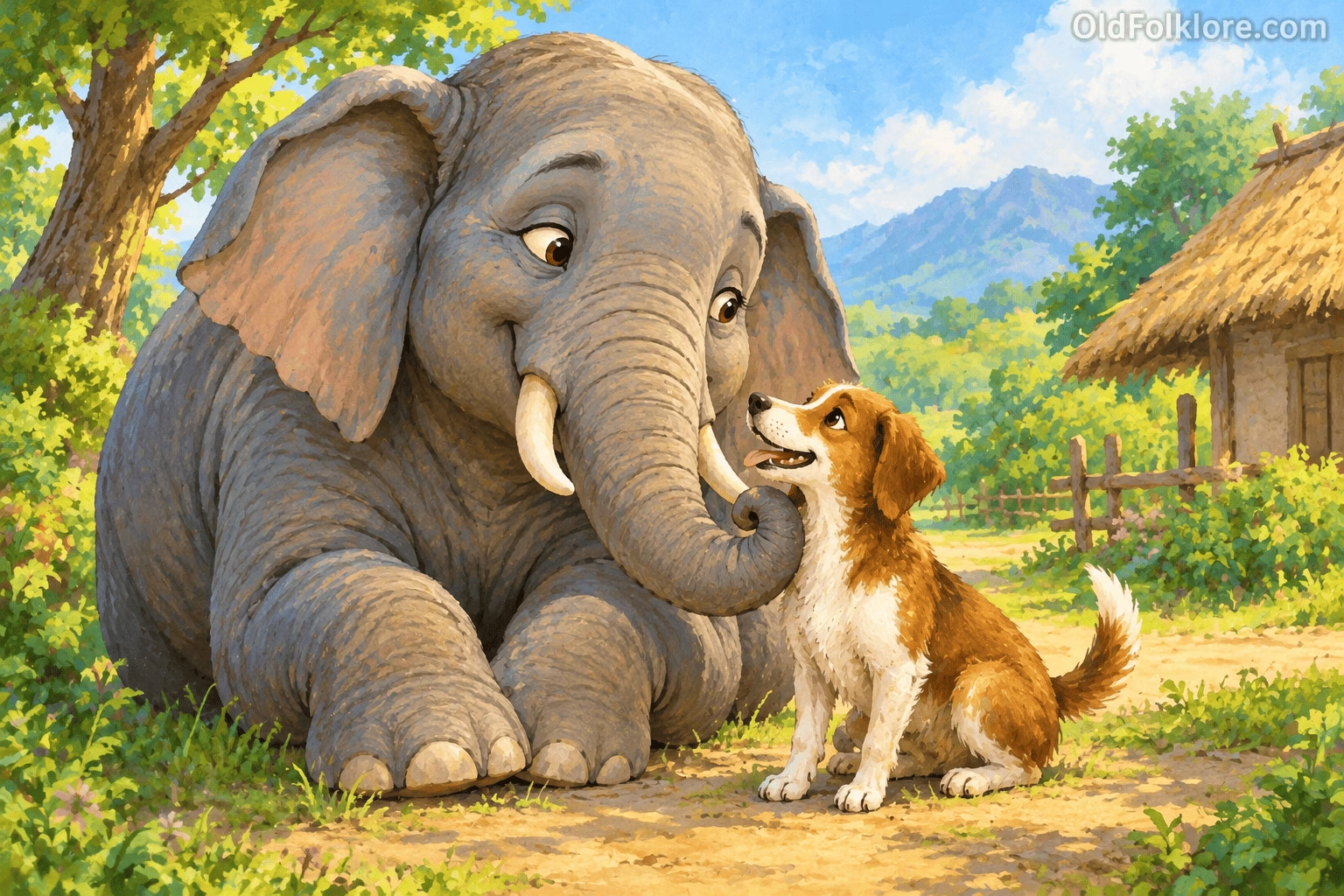
The elephant did not chase the little visitor away. Instead, the two animals gradually grew comfortable in each other’s company. The dog ate beside the elephant, and before long, their quiet companionship became a close friendship.
The dog would sometimes play by catching hold of the elephant’s trunk and swinging back and forth. The great animal tolerated his small companion’s games, and the dog appeared perfectly at ease beside his enormous friend.
Their attachment deepened until neither seemed content without the other. What had begun with a few fallen grains of rice had become a friendship neither animal appeared willing to live without.
The Day the Dog Disappeared
One day, a peasant arrived at the elephant’s stable. He gave the elephant-keeper money in exchange for the dog and took the animal away to his village.
The dog did not return to the stable that day.
Nor did he return the next day.
With his little companion gone, the elephant became miserable. He refused his food and would not drink water. He no longer seemed interested in bathing, either. The stable attendants watched him grow increasingly unhappy, unable to persuade him to resume his ordinary routine.
At first, they could not understand what had happened. The elephant was not behaving like an animal suffering from an obvious physical illness, yet nothing they tried could restore his appetite or his spirits.
Concerned about the king’s elephant, they reported the matter to the palace.
King Brahmadatta listened to their account and summoned his wise minister, the Bodhisatta.
“Go to the stable,” the king instructed him. “Find out what is troubling my elephant and discover why he has stopped eating and drinking.”
The Bodhisatta went to the stable and carefully observed the elephant. He noticed how unhappy the animal appeared, but he could see no clear sign that a bodily illness was responsible.
He considered the elephant’s behaviour and suspected that the cause might lie elsewhere.
Perhaps, he thought, the elephant was grieving for someone he had grown deeply attached to.
The Minister Discovers the Cause
The Bodhisatta turned to the elephant-keepers and asked whether the animal had formed a particularly close attachment to anyone.
“Yes, sir,” they replied. “There was a dog he was extremely fond of. The two were always together.”
“And where is the dog now?” the minister asked.
“Someone came and took him away.”
“Do you know where that person lives?”
The keepers admitted that they did not.
The Bodhisatta now understood the reason for the elephant’s distress. The animal was not refusing his food because he had lost his appetite through illness. He was suffering because his companion had disappeared.
He returned to the king and explained what he had discovered.
“Your Majesty, there is nothing visibly wrong with the elephant’s body. He had become very close to a dog that used to stay with him in the stable. I believe his grief over losing that companion is why he refuses to eat, drink, or bathe.”
To express his conclusion, the wise minister recited a verse explaining that the elephant could no longer enjoy even rice or grass, and that bathing had lost its appeal, because constant companionship had caused him to love the dog.
The king understood that the elephant’s suffering would not end until his missing friend was returned.
“But what can we do to bring the dog back?” he asked.
The Bodhisatta proposed a simple solution.
“Your Majesty, issue a public proclamation. Announce that someone has taken away a dog beloved by the royal elephant, and that whoever is found keeping the animal will be fined.”
The king agreed and ordered the proclamation to be made.
The Friends Reunite
When the peasant heard the king’s announcement, he realised that keeping the dog could bring him trouble. Rather than risk the punishment, he released the animal.
The dog was free again.
As soon as he could, he hurried back to the elephant’s stable, returning to the place where his friend had been waiting for him.
The elephant recognised him immediately.
Overjoyed, the great animal lifted the dog with his trunk and placed him on his forehead. His happiness was so overwhelming that he wept and cried out. He then lowered the dog gently and watched as his companion began to eat.
Only after seeing the dog safely beside him again did the elephant return to his own food.
The change was unmistakable. The animal who had refused nourishment and neglected his usual activities was once again comforted by the presence of the friend he had lost.
When King Brahmadatta learned how the matter had ended, he greatly honoured the Bodhisatta. The minister had recognised the cause of the elephant’s suffering when others could not understand it. His wisdom had restored the friendship and brought the troubled animal relief.
The Meaning of the Friendship
The Buddha concluded the story by connecting it to the conduct of two people in the present. After teaching the Four Noble Truths, he identified the dog as the lay convert, the elephant as the old monk, and the wise minister as himself in a previous birth.
The story therefore presents the elephant and the dog not merely as animals that happen to enjoy one another’s company, but as examples of a bond strong enough to survive differences in size, appearance, and kind.
Their friendship began through repeated encounters and became meaningful through familiarity. When they were separated, the elephant’s behaviour revealed how much the relationship mattered to him. Their reunion restored his happiness.
The minister’s role is equally important. Instead of treating the elephant’s refusal to eat as a problem of discipline, he looked for the cause of the animal’s distress. His understanding allowed the king to respond with a practical solution.
The tale’s enduring appeal lies in its recognition that companionship can become essential to well-being, and that affection is not limited to those who look alike or belong to the same kind.
The Friendship That Began in a Previous Life
The tale begins with another pair of close friends living at Sāvatthi. One had joined the Buddhist monastic Order, while the other remained a layman. Each day, the layman provided his friend with a meal. Afterwards, he accompanied the monk back to the monastery, where they spent time together talking until sunset. The monk then walked with his friend to the city gate before returning to the monastery.
Their friendship became a subject of conversation among the other monks. When the Buddha heard them discussing it, he explained that the two had shared a close bond in a previous birth as well.
He then told the story of the elephant and the dog.
After recounting the tale, the Buddha taught the Four Noble Truths and explained the connection between the two friendships. The lay convert had been the dog, the old monk had been the elephant, and the wise minister had been the Buddha himself in that earlier life.
This framing connects the animal story to the Buddhist understanding of rebirth, showing how the narrative’s friendship extends beyond a single lifetime.
Explore our complete Historic Folklore & Fairy-Tale Collections archive.
Moral
True friendship can grow between very different beings, and separation can reveal the depth of their attachment. The story also teaches the importance of compassion and understanding: recognising the cause of another’s suffering is often the first step towards helping them.
Knowledge Check
1. Why did the dog visit the elephant’s stable?
The dog came to eat the rice that fell while the royal elephant was feeding. Over time, their repeated encounters developed into friendship.
2. Why did the elephant stop eating and bathing?
He was distressed because a peasant had taken the dog away, separating him from his close companion.
3. How did the Bodhisatta solve the problem?
He recognised that the elephant was grieving and advised the king to announce a fine for anyone keeping the missing dog. The peasant released the dog, allowing the friends to reunite.
4. What happened when the dog returned?
The elephant lifted him with his trunk, placed him on his forehead, and showed his joy. After watching the dog eat, the elephant resumed eating himself.
5. What is the significance of the story’s ending?
The Buddha connects the elephant and dog to two friends in the present, identifying himself as the wise minister in the earlier life. This reinforces the Jataka tradition’s use of past-life stories to explain present relationships and convey Buddhist teachings.
Source
This article is an original literary adaptation of The Elephant and the Dog, based on the specified 1880 English translation by T. W. Rhys Davids.