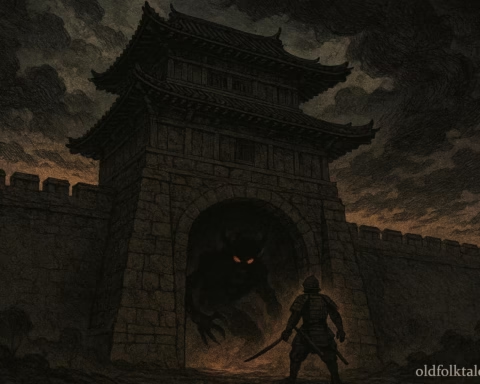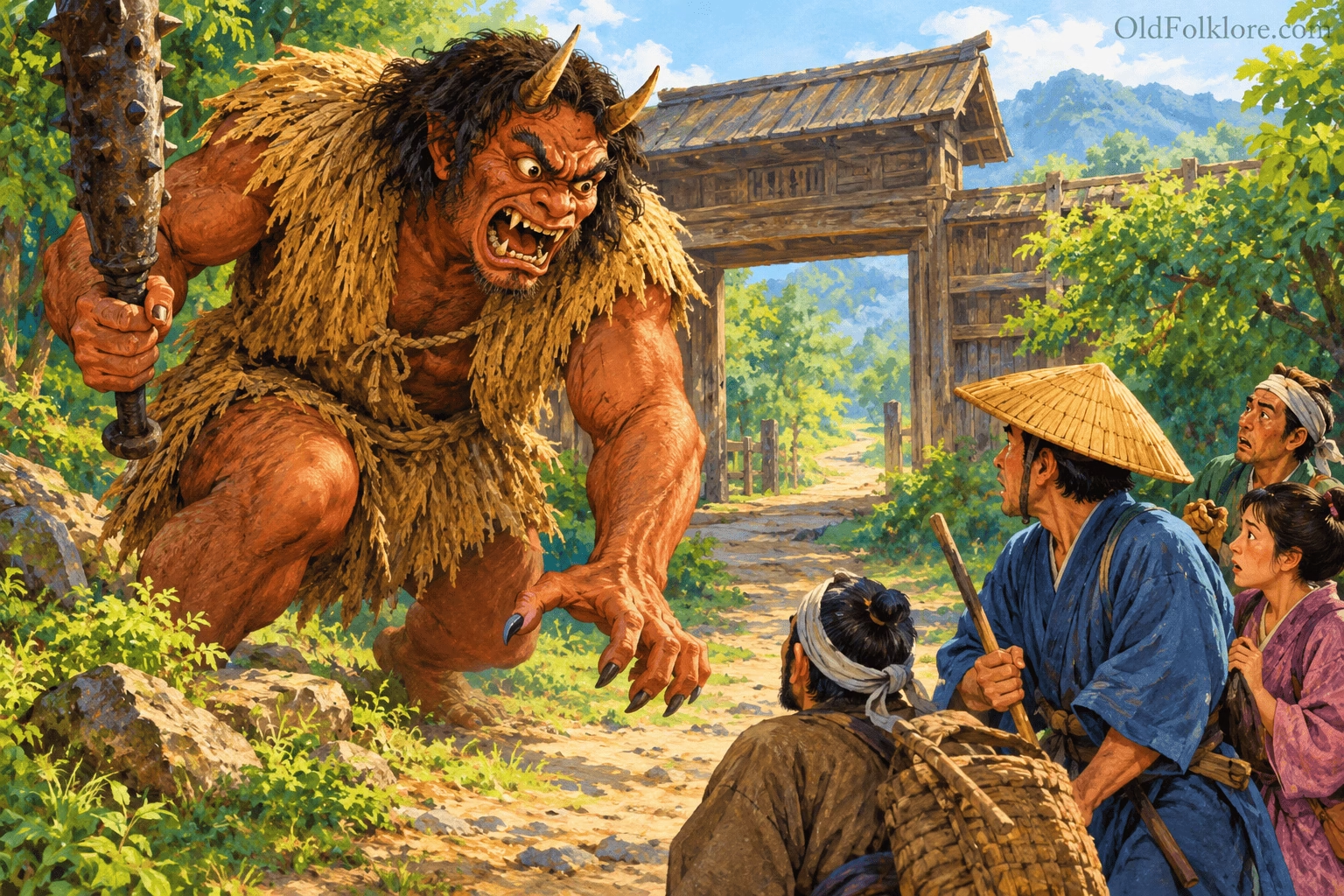
Long ago, the people of Kyoto lived in fear of a terrible ogre that haunted the Gate of Rashomon after sunset. Travellers who passed through the area disappeared without a trace, and rumours spread that the monster devoured everyone it captured. As evening approached, the roads emptied and families hurried indoors, unwilling to risk an encounter with the creature.
At that time, a celebrated general named Raiko lived in Kyoto. He had won fame by defeating a company of ogres at Mount Oeyama, where monstrous creatures were said to drink human blood. Raiko had destroyed their leader, and many believed that no ogre would dare trouble the city while he remained alive.
One evening, five of Raiko’s trusted warriors gathered for a feast. As they ate and drank, Tojo mentioned the rumours about the ogre at Rashomon.
Watanabe, one of the warriors, dismissed the story.
“How can that be true?” he asked. “Our master defeated the ogres at Oeyama. Any that escaped would surely be too frightened to approach Kyoto.”
Explore more stories from our Yei Theodora Ozaki’s Japanese Fairy Tales collection.
Tojo challenged him to investigate the matter himself. Unwilling to appear afraid before his companions, Watanabe accepted immediately.
He put on his armour, fastened his sword at his side, and mounted his horse. Before leaving, he asked his friends to write their names on a sheet of paper. He would attach it to the gate as proof that he had visited the place.
The night was dark and stormy. Rain swept across the roads, and the wind howled through the hills. Yet Watanabe continued until he reached Rashomon.
He searched the darkness but saw no sign of an ogre.
“It seems this was nothing more than an old rumour,” he thought.
He fastened the paper to the gate and turned his horse towards home.
Suddenly, a voice behind him ordered him to stop.
Something seized his helmet from the back. Watanabe reached out and felt an enormous, hairy arm, thick as a tree trunk. He recognised the creature immediately and drew his sword, striking with all his strength.
A terrible cry rang through the night.
The ogre leapt in front of him, revealing a monstrous figure taller than the great gate. Its eyes blazed, its enormous mouth gaped open, and flames shot from its mouth as it breathed.
Watanabe did not retreat. He attacked the creature fearlessly, and the two fought for a long time. At last, the ogre realised that it could neither frighten nor defeat the warrior. It turned and fled.
Watanabe spurred his horse into pursuit, determined not to let the monster escape. But the ogre ran faster than the horse could gallop, and soon disappeared into the darkness.
Disappointed, Watanabe returned to the place where they had fought. As he dismounted, he stumbled upon something lying on the ground.
It was the ogre’s severed arm.
Watanabe was delighted. He had failed to capture the monster, but the arm would prove that his adventure was real. He carried the trophy home and showed it to his companions, who celebrated his courage.
News of the encounter spread throughout Kyoto. People travelled from far away to see the enormous arm, and Watanabe became famous for his victory.
Yet the warrior understood that the danger had not entirely passed. The ogre was still alive, and sooner or later it might return to recover its lost limb.
To protect the trophy, Watanabe ordered a strong wooden box reinforced with iron bands. He placed the arm inside, secured the heavy lid, and kept the box in his own room. He refused to show it to anyone.
The mysterious old woman
One night, a servant announced that an elderly woman had arrived at the house. She appeared respectable and gentle, and she claimed to have been Watanabe’s nurse when he was a baby.
Although Watanabe wondered why she had come so late, the thought of his old nurse stirred feelings of affection. He ordered the servant to bring her inside.
After the customary greetings, the woman praised his bravery and asked whether the story of his battle with the ogre was true.
Watanabe confirmed that it was, explaining that he regretted failing to capture the monster.
The old woman expressed her admiration and then made a request.
“Before I die, I would dearly love to see the arm you took from the ogre.”
Watanabe refused. He explained that the creature was still alive and might appear if the box were opened.
The woman pleaded with him. Surely, she said, he could trust someone who had cared for him as a child. She had heard of his achievement and had come immediately because she could not bear to wait until morning.
Watanabe remained troubled by her insistence. Still, when she asked whether he suspected her of being a spy sent by the ogre, he assured her that he did not.
“Then why will you not show me the arm?” she asked.
At last, Watanabe gave in.
He led the old woman into his room, closed the door, and approached the iron-bound box. Carefully, he lifted its heavy lid.
“Come closer and look,” he said. “I shall leave the arm inside.”
The old woman approached the box. She leaned forward as though examining the strange trophy, then suddenly thrust her hand inside and seized it.
“Wonderful! I have recovered my arm!” she cried.
In an instant, her appearance changed. The frail old woman vanished, and before Watanabe stood the enormous ogre he had fought at Rashomon.
The warrior recoiled in astonishment, but his courage soon returned. He drew his sword and attacked the monster, nearly striking it down.
The ogre sprang towards the ceiling, burst through the roof, and escaped into the mist and clouds, carrying its recovered arm.
Watanabe stood furious and disappointed. Once again, the monster had escaped him.
Nevertheless, the ogre had learned how formidable the warrior was. Afraid of facing Watanabe again, it never returned to trouble Kyoto.
The people were finally able to travel after dark without fear, and Watanabe’s bravery became a story remembered for generations.
Explore our complete Historic Folklore & Fairy-Tale Collections archive.
Moral
Courage is powerful, but it must be accompanied by wisdom and vigilance. Even after winning a battle, a person must remain alert to danger and avoid allowing appearances or emotions to cloud their judgement.
Knowledge Check
1. Why does Watanabe go to the Gate of Rashomon?
To investigate the rumours of an ogre and prove that he is not afraid.
2. What does he take home after the battle?
The ogre’s severed arm.
3. How does the ogre recover its arm?
It disguises itself as Watanabe’s old nurse and persuades him to open the box.
4. Why does the ogre never return to Kyoto?
It fears Watanabe’s strength and courage.
Source
Ozaki, Yei Theodora. Japanese Fairy Tales. New York: A. L. Burt Company, 1908. “The Ogre of Rashomon.”
Explore More Yei Theodora Tales