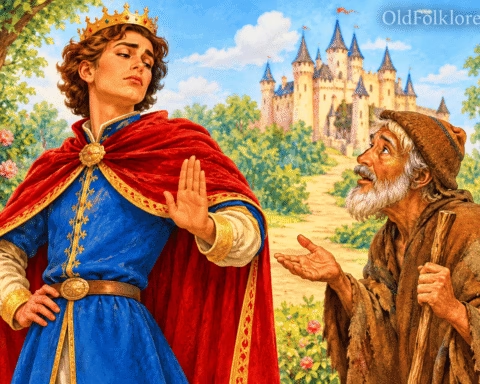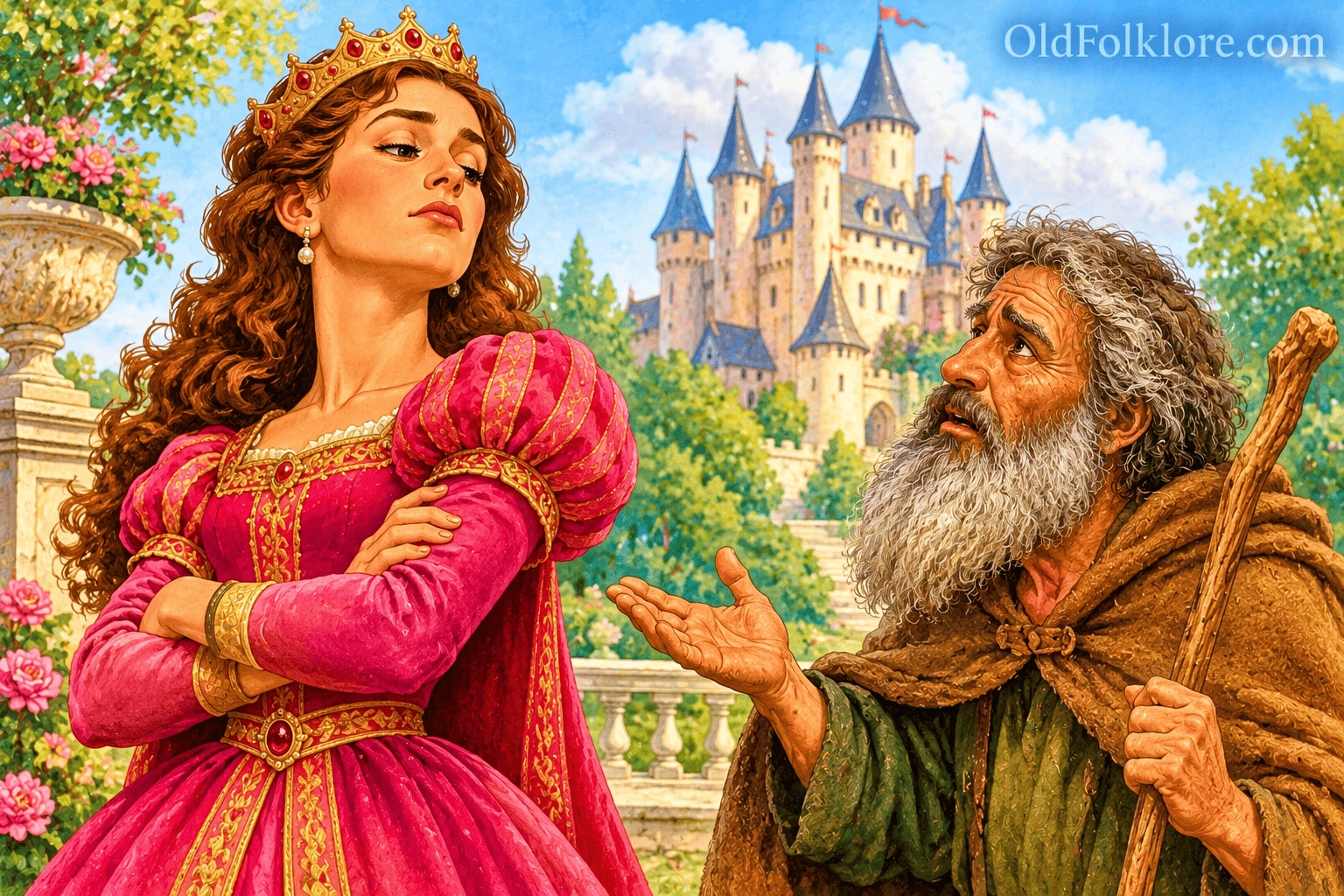
Once upon a time, there lived a beautiful princess whose pride was greater than her beauty. She considered every man who came to seek her hand unworthy of her, and she took particular pleasure in embarrassing her suitors. One after another, they left the palace disappointed, but her reputation did little to discourage others from trying their luck.
One day, a prince named Hacon Grizzlebeard arrived to ask for her hand in marriage. Unfortunately, he soon discovered that the princess had no intention of treating him with respect.
During his first night at the palace, she instructed the king’s fool to mutilate his horses. One had its ears cut off, while the other’s mouth was slashed open towards its ears.
Explore more stories from our Asbjørnsen & Moe’s Norwegian Folk Tales collection.
The following morning, when Hacon prepared to leave, the princess stood at the entrance and burst into laughter at the sight of his injured animals.
‘What a strange thing!’ she exclaimed. ‘The fierce northern wind must have blown the ears off one of your horses. And the other must have opened its mouth so widely to watch that its jaws have split all the way to its ears!’
She laughed loudly, hurried inside, and slammed the door behind her.
Hacon drove away, humiliated but determined not to forget the insult. He resolved that the princess would one day learn what it meant to be treated with contempt.
Some time later, he returned to the kingdom in disguise. He covered his face with a thick beard made of moss, wrapped himself in a large fur cloak, and dressed like a poor beggar.
He also visited a goldsmith and obtained a beautiful golden spinning wheel. Carrying it to the palace, he sat beneath the princess’s window, pretending to repair it.
When the princess noticed the glittering object, she immediately became interested.
‘Would you sell me that golden spinning wheel?’ she called down.
‘It is not for sale,’ Hacon replied. ‘But if you allow me to sleep outside your bedroom door tonight, you may have it.’
The princess considered the arrangement harmless. After all, he was only a beggar, and sleeping outside her door seemed a small price to pay for such a beautiful possession.
That night, Hacon lay outside her bedroom. However, as the hours passed, the cold became unbearable.
‘Hutetutetutetu! It is terribly cold! Please let me come inside,’ he cried.
The princess was horrified by his noise. She warned him to remain quiet, explaining that her father would be furious if he discovered a man inside the palace.
But Hacon continued shivering and begging until she finally allowed him into the room. He lay on the floor and soon fell asleep.
Some time later, he returned with another valuable object: the stand for the golden spinning wheel. Once again, he sat beneath her window, filing away at the object as though it needed a little more work.
The princess recognised him and asked what he was doing.
‘This is the stand for the spinning wheel you bought from me,’ he explained. ‘I thought you might like to have the complete set.’
She asked what he wanted in exchange.
‘You may have it if you allow me to sleep on the floor of your bedroom tonight.’
The princess agreed, but warned him not to make the dreadful noise he had made before.
Hacon promised to behave himself. Yet, as the night grew colder, he began shivering again. This time, he begged to move closer and sleep beside her bed.
Afraid that his complaints might wake her father, the princess reluctantly agreed.
He settled down beside her bed and slept peacefully.
The Golden Wool-Winder
After a considerable interval, Hacon appeared beneath the princess’s window for a third time. On this occasion, he had brought a golden wool-winder, which he busied himself repairing.
The princess soon noticed it and asked whether he would sell it.
‘Not for money,’ Hacon answered. ‘But if you allow me to sleep in your bedroom tonight, with my head resting against your bedstead, you may have it.’
The princess agreed, provided he promised to remain quiet.
Hacon gave his word, but when night came, the familiar complaints began. He shivered violently, his teeth chattered, and he begged the princess to let him climb into her bed and warm himself.
‘Get into my bed?’ she exclaimed. ‘Have you completely lost your senses?’
But Hacon continued making such a commotion that she feared her father would discover him. Eventually, she gave in and allowed him into her bed.
He slept comfortably, but the consequences of that night were far more serious than the princess could have imagined. Some time afterwards, she gave birth to a child.
When the king discovered what had happened, he was overcome with fury. He was so enraged that he nearly ordered both his daughter and the baby to be killed.
The princess was now terrified. The man she had once humiliated had brought her into a situation that threatened her very life.
The Princess Becomes a Beggar’s Wife
Not long after the birth, Hacon returned to the palace, still disguised as a beggar. He sat quietly in the kitchen, looking like an ordinary poor traveller.
When the princess saw him, she hurried over in desperation.
‘May God have mercy on me!’ she cried. ‘You have brought terrible misfortune upon me. My father is so angry that he may kill me. Please, let me go with you to your home.’
Hacon pretended to be surprised.
‘You are surely too well brought up to follow a beggar like me,’ he replied. ‘I have nothing but a miserable hut to live in, and I barely manage to find enough food for myself. How could I possibly provide for you?’
The princess was beyond caring about such difficulties.
‘It makes no difference to me whether we have food or how we obtain it. I only want to escape. If I remain here, my father will certainly take my life.’
Eventually, she was permitted to leave with the beggar.
They travelled a long distance, and the princess, who had never been accustomed to walking far, struggled with the journey.
At one point, they crossed the boundary of her father’s kingdom. Curious about the land they had entered, she asked the beggar whose territory it was.
‘This is Hacon Grizzlebeard’s country,’ he answered.
The princess was startled.
‘Really? I could have married Hacon Grizzlebeard if I had wanted to. Then I would not have been forced to wander about like a beggar’s wife.’
They continued travelling. Whenever they passed magnificent castles, extensive forests, or beautiful parks, the princess asked who owned them.
The answer was always the same.
‘They belong to Hacon Grizzlebeard.’
With every passing mile, the princess became more regretful. She began to understand that the prince she had once mocked possessed wealth and property far beyond anything she had imagined. Had she accepted his marriage proposal, she might have been living in comfort rather than struggling along the road.
Eventually, they reached another kingdom and came to a magnificent palace. Hacon explained that he was known there and believed he could find work for them.
He built a small cabin beside the woods, where they settled with their baby.
Every day, the beggar went to the palace, claiming to work for the royal kitchen by chopping wood and fetching water. In the evenings, he returned with a few scraps of meat, which barely provided enough food for the little family.
A Lesson in the Palace Kitchen
One evening, Hacon announced that he would remain at home the following day to look after the baby. The princess, however, was to go to the palace.
‘The prince has ordered you to help with the baking,’ he told her.
The princess was astonished.
‘Me? Bake? I have never baked anything in my life!’
Hacon told her not to worry. She only needed to watch the other women and follow their example. He also instructed her to steal some bread before leaving.
The princess protested that she had never stolen anything.
‘You can learn,’ Hacon replied. ‘We have very little to eat, and we need the food. Just be careful that the prince does not catch you. He has eyes at the back of his head.’
The next morning, the princess set off for the palace.
Unknown to her, Hacon took a shortcut and arrived there long before she did. Once inside, he removed his beggar’s disguise and dressed himself in his royal clothes.
The princess joined the other workers in the bakehouse. She watched them carefully, learned what she could, and, following Hacon’s instructions, began filling her pockets with bread.
When the day’s work was finished, she prepared to leave.
But the prince stopped her.
‘This old woman, Hacon Grizzlebeard’s wife, has already shown herself to be rather light-fingered,’ he said. ‘We had better make certain she has not taken anything.’
He searched her pockets and discovered the stolen bread.
The prince became furious, and the princess began to weep.
‘Please forgive me, Your Highness! The beggar made me do it. I could not help myself.’
The prince scolded her for stealing but eventually announced that, for the beggar’s sake, he would forgive her on this occasion.
Once she had left, Hacon changed back into his beggar’s clothes and hurried home by another shortcut.
When the princess arrived, she found him looking after the baby. She told him everything that had happened.
‘You have made me do something I have never done before,’ she complained. ‘Stealing! I felt so ashamed. I shall never do it again.’
The Sausage-Making Incident
A few days later, Hacon returned from the palace with another instruction.
The following day, a pig was to be slaughtered, and the princess had been ordered to help prepare sausages.
‘You must go to the palace and join the others,’ he told her. ‘I will remain here and look after the baby.’
The princess protested once more.
‘I cannot make sausages! I have eaten them often enough, but I have never prepared them.’
Hacon insisted that she could learn by watching the other workers. He then gave her another instruction: she must steal some sausages and bring them home.
The princess was reluctant.
‘You know what happened the last time. I was nearly disgraced!’
But Hacon encouraged her to try again, suggesting that she might have better luck.
When she had gone, he took the shortcut to the palace, removed his disguise, and appeared in his royal clothes.
The princess joined the others in preparing the sausages. She followed their example and, remembering her husband’s instructions, secretly filled her pockets with as many sausages as she could carry.
When she was ready to leave, the prince stopped her again.
‘This woman was caught stealing bread the last time she visited. We had better check her pockets before she goes.’
He searched her and discovered the sausages.
Once again, he flew into a rage and threatened to summon the constable and have her locked in the cage.
The princess burst into tears.
‘Please, Your Highness! Have mercy on me. The beggar made me do it!’
The prince eventually relented.
‘You deserve to be punished, but for the beggar’s sake, I shall forgive you.’
When the princess returned to the cabin, she found Hacon already there. She recounted the entire incident and firmly declared that she would never steal for him again.
The Tailor and the Wedding Dress
Some time passed before Hacon brought another message from the palace.
The prince, he explained, was preparing to marry, but his bride had fallen ill. Since the tailor could not take her measurements, the prince had ordered the princess to stand in her place.
According to Hacon, she was so similar in height and figure to the bride that the tailor could use her measurements without difficulty.
But Hacon had another request.
Once the tailor began cutting the wedding dress, she was to collect the largest pieces of leftover material and bring them home. He wanted to use them to make himself a waistcoat.
The princess immediately objected.
‘I cannot steal again! You remember what happened with the bread and the sausages.’
Hacon simply told her that she could learn and perhaps succeed this time.
Although she disliked the idea, the princess went to the palace.
The tailor took her measurements and began cutting the material for the bride’s gown. While everyone was occupied, the princess quietly gathered the largest scraps and pushed them into her pockets.
When she attempted to leave, the prince once again intervened.
‘Let us see whether this woman has been stealing from us again,’ he announced.
He searched her pockets and discovered the pieces of cloth.
His anger was immediate. He scolded her loudly and threatened her with punishment.
The princess wept and begged for forgiveness.
‘Please, Your Highness! The beggar ordered me to take them. I did not know what else to do!’
The prince eventually forgave her once more, claiming that he was doing so for the beggar’s sake.
When she returned to the cabin, she was utterly miserable.
‘You will be the death of me one day!’ she told Hacon. ‘You keep making me do wicked things. The prince was so angry that he threatened to send for the constable and put me in the cage.’
Hacon listened without revealing his true identity.
The Princess Becomes a Bride
Not long afterwards, Hacon returned home with what seemed to be his strangest instruction yet.
The prince, he said, had decided that the princess must stand in for the bride during the wedding ceremony itself. The bride was still ill and confined to her bed, but the prince had no intention of postponing the marriage.
The princess could hardly believe what she was hearing.
‘Have you and the prince both lost your senses?’ she exclaimed. ‘Look at me! Do you honestly think someone dressed like a beggar’s wife can stand in for a royal bride?’
Hacon insisted that the prince had specifically requested her and that she must obey.
There was little choice, so the princess went to the palace the following day.
To her amazement, the royal attendants dressed her in magnificent clothes and adorned her so beautifully that she looked every bit a princess.
The wedding procession made its way to the church, where she stood in place of the sick bride. After the ceremony, everyone returned to the palace, where a grand celebration began.
Music filled the rooms, and the guests danced and rejoiced.
The princess found herself dancing with the prince when something outside caught her attention. Through the window, she saw a bright glow in the distance.
Looking more closely, she realised that the little cabin beside the woods was on fire.
The flames were consuming the place where she believed her husband and baby were living.
Overcome with horror, she cried out:
‘Oh! The beggar! The baby! The cabin!’
She was so distressed that she nearly fainted.
But the prince held her attention with a startling reply.
‘Here is the beggar, and there is the baby. Let the cabin burn!’
At that moment, the princess finally recognised him.
The beggar was none other than Hacon Grizzlebeard, the prince she had once humiliated and rejected.
He had arranged everything, from the golden gifts to the humiliating lessons in the palace kitchen, and had watched her gradually experience the difficulties she had once made others endure.
The princess now understood the truth behind the journey, the cabin, and the strange instructions.
Her former suitor had returned, not as a helpless beggar, but as the man she had once refused to marry.
And so the celebrations continued, this time with the princess knowing exactly who her bridegroom was. The old tale ends by telling us that the merriment began in earnest, though no further account of their lives was ever heard.
Explore our complete Historic Folklore & Fairy-Tale Collections archive.
Moral
Pride can make people blind to the worth of others. Treating people with contempt because of their appearance, wealth, or social position can have lasting consequences.
The story also invites readers to consider the difference between genuine humility and humiliation. Learning to respect others is valuable, but cruelty and manipulation should not be mistaken for good character.
Knowledge Check
1. Why did Hacon Grizzlebeard disguise himself as a beggar?
He wanted to take revenge on the princess after she humiliated him and mutilated his horses.
2. What did Hacon offer the princess in exchange for permission to sleep in her room?
He offered her three golden objects: a spinning wheel, its stand, and a wool-winder.
3. Why did the princess leave her father’s kingdom?
She feared that her father would kill her and her baby after discovering the child’s birth.
4. What tasks did the princess perform at the palace?
She helped with baking, sausage-making, and preparing material for a wedding dress.
5. Why did the prince repeatedly search her pockets?
He wanted to expose her thefts, which Hacon had instructed her to commit.
6. What happened at the wedding celebration?
The princess discovered that the cabin was burning and feared that her husband and baby were inside. Hacon then revealed that he was the prince she had once rejected.
7. Which traditional tale type is associated with Hacon Grizzlebeard?
ATU 900, commonly called King Thrushbeard, a tale type involving a proud princess who is humbled after rejecting a suitor.
Source
Peter Christen Asbjørnsen and Jørgen Moe, “Hacon Grizzlebeard,” in Popular Tales from the Norse, translated by Sir George Webbe Dasent (Edinburgh: Edmonston and Douglas, 1859), pp. 45–55.
Explore More Asbjørnsen & Moe’s Norwegian Folk Tales