Wealth can bring comfort and security, but the desire for more can sometimes make people forget the value of what they already possess. When greed takes control, even a fortunate person may make decisions that destroy their blessings. The desire to become wealthy quickly can also lead to unnecessary risks and lasting regret.
In The Goose with the Golden Eggs, a countryman discovers that his goose produces an extraordinary egg of pure gold every morning. The discovery gradually makes him rich, but his growing fortune does not satisfy him. Instead of appreciating the steady supply of golden eggs, he becomes impatient and decides to obtain all the gold at once. His decision costs him the goose and the wealth it could have continued to provide.
An Unexpected Discovery
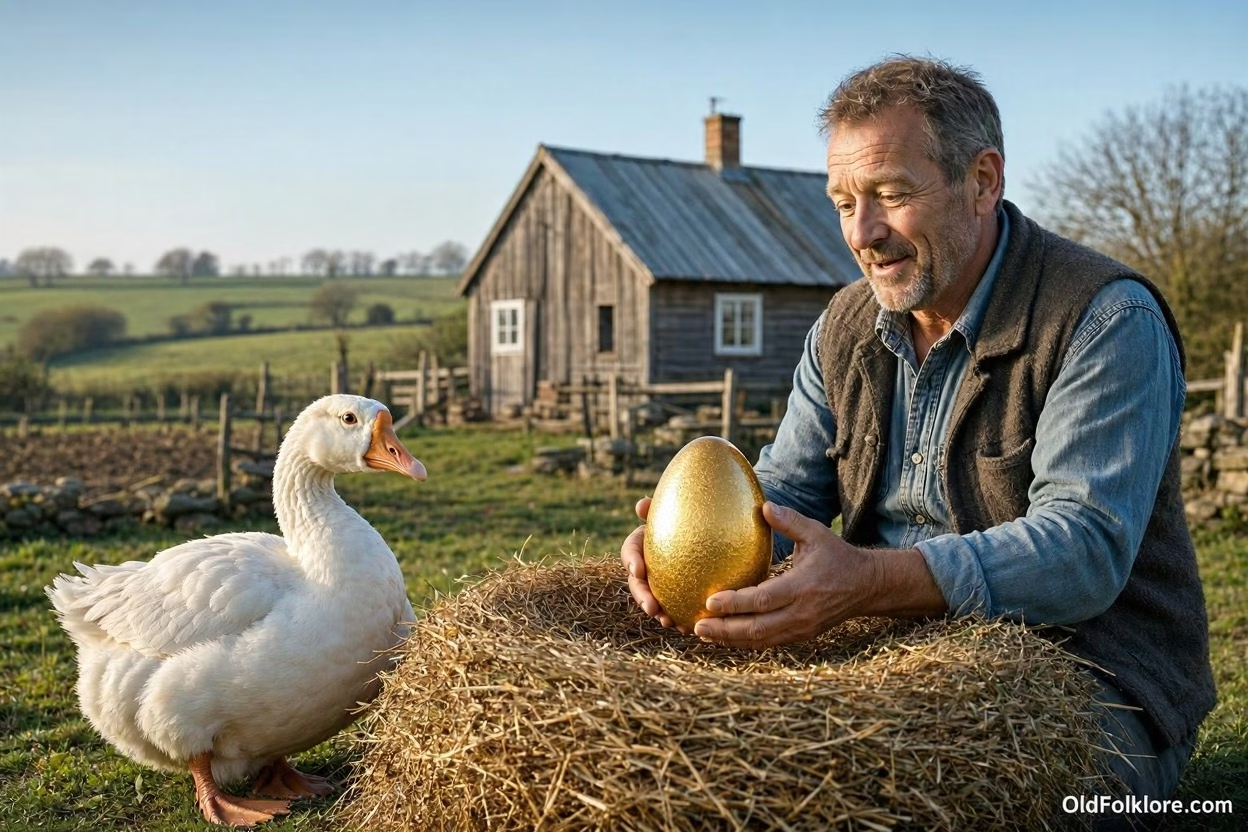
One day, a countryman went to the nest of his goose and discovered an egg that was yellow and glittering. When he picked it up, he noticed that it was unusually heavy, almost like lead.
At first, he suspected that someone had played a trick on him. He even considered throwing the strange egg away. However, he changed his mind and took it home.
To his great delight, he discovered that the egg was made of pure gold.
The Goose Brings Daily Wealth
The following morning, the countryman returned to the nest and discovered another golden egg. The same thing happened every day. His goose continued producing one egg of pure gold each morning.
The countryman began selling the eggs and gradually became wealthy. What had started as an unexpected discovery became a dependable source of riches.
Explore more stories from our Aesop’s Fables collection.
However, his growing fortune did not bring lasting satisfaction. As his wealth increased, his greed also increased. He became impatient with receiving only one golden egg each day and began thinking about how much more he could gain.
Greed Leads to Destruction
The countryman imagined that the goose must contain a large quantity of gold. He thought that by killing it and opening its body, he could obtain everything at once.
Convinced that this would make him richer immediately, he killed the goose and opened it. Unfortunately, he found nothing inside.
His plan had failed completely. By destroying the goose, he had also destroyed the source of his daily wealth. His greed had caused him to lose the very thing that had made him prosperous.
Understanding the History of Aesop’s Fables
Aesop’s fables belong to a long tradition of storytelling in which animals, human beings and other characters are used to communicate lessons about human behaviour. Rather than presenting every lesson through direct instruction, these stories use simple incidents to reveal qualities such as greed, dishonesty, pride, kindness, courage and wisdom.
The tradition associated with Aesop became particularly influential in European storytelling. The fables were collected, translated, adapted and retold across different periods. As they passed between writers and languages, some stories appeared in several forms, with variations in their wording, characters and details.
This history is important when reading The Goose with the Golden Eggs. Although the tale is commonly associated with Aesop, the exact wording of every Aesopic fable cannot always be traced to one original text. Joseph Jacobs acknowledged this difficulty in his 1894 collection. He explained that many stories associated with Aesop could be connected with earlier writers, including Phaedrus and Babrius.
Jacobs therefore selected familiar versions and retold them in language he considered suitable for his readers. His collection was not simply a reproduction of one fixed ancient manuscript. It represented his editorial selection and retelling of stories that had travelled through a long literary tradition.
Why Aesop’s Fables Use Animals
One of the most recognisable features of Aesop’s fables is the use of animals to represent human qualities. Animals allow storytellers to present familiar situations in an imaginative way while encouraging readers to think about human conduct.
In different fables, a fox may represent cunning, a lion may represent authority, and a tortoise may demonstrate patience. These characters help readers understand complicated behaviour through simple and memorable situations.
In this particular story, the goose is not presented as a talking animal or a character with human intentions. Its extraordinary ability to produce golden eggs is the central element of the tale. The countryman’s response to this discovery reveals the human weakness that the story intends to examine.
The Importance of a Short Fable
Unlike lengthy traditional narratives, a fable often concentrates on one main incident. It introduces a situation, shows the consequences of a character’s decision and ends with a moral lesson.
The shortness of The Goose with the Golden Eggs is therefore an important part of its structure. The discovery of the golden egg introduces the countryman’s good fortune. The repeated production of eggs establishes his growing wealth, while his decision to kill the goose brings the conflict to its conclusion.
There is no need for additional characters or complicated adventures. The countryman’s behaviour alone carries the message.
Understanding the Story’s Central Message
The Difference Between Wealth and Greed
The countryman does not become wealthy through dishonest dealings or by taking something from another person. His fortune comes from an extraordinary discovery that provides him with a regular source of income.
His problem begins when he stops appreciating what he has. Instead of recognising the value of receiving one golden egg every morning, he becomes focused on the possibility of obtaining a larger amount immediately.
The story therefore makes an important distinction between being wealthy and being greedy. Having possessions or wanting to improve one’s financial position is not necessarily wrong. The danger arises when the desire for more becomes so strong that a person can no longer make sensible decisions.
The Danger of Impatience
The countryman’s decision also demonstrates the consequences of impatience. His goose provides him with a golden egg regularly, but he does not want to wait for the next one.
He chooses immediate gain over continued prosperity. Unfortunately, his decision destroys the arrangement that had been providing him with wealth.
This lesson remains relevant in everyday life. People sometimes abandon worthwhile opportunities because they want immediate results. They may take unnecessary risks, neglect gradual progress or make decisions without considering what they stand to lose.
The fable encourages readers to recognise that lasting success often requires patience and careful judgement.
Appreciating What We Already Have
Another important message concerns gratitude and contentment. The countryman has something extraordinary, yet he fails to appreciate it.
His dissatisfaction grows alongside his wealth. Instead of becoming more grateful, he becomes more demanding. This shows that having more possessions does not automatically make someone content.
The story encourages readers to recognise the value of their existing opportunities, relationships and resources. Appreciation does not mean refusing to improve one’s circumstances. It means making progress without destroying what is already valuable.
Explore our complete Historic Folklore & Fairy-Tale Collections archive.
Moral Lessons
The story teaches that greed can destroy the very opportunities that bring success. The countryman already had a dependable source of wealth, but his impatience made him lose everything.
It also reminds us to practise patience, contentment and good judgement. Rather than risking what we have in the pursuit of immediate rewards, we should appreciate gradual progress and consider the consequences of our decisions.
Knowledge Check
1. What did the countryman discover in his goose’s nest?
An egg made of pure gold.
2. Why did he initially consider throwing the egg away?
He thought someone had played a trick on him because the egg was unusually heavy.
3. What happened every morning?
The goose produced another golden egg.
4. How did the countryman become wealthy?
He sold the golden eggs.
5. Why did the countryman kill the goose?
He wanted to obtain all the gold at once.
6. What happened after he opened the goose?
He found nothing inside its body and lost his source of golden eggs.
Source
Aesop’s Fables, selected and retold by Joseph Jacobs, with illustrations by Richard Heighway, published by Macmillan & Co., London and New York, 1894. Fable: “The Goose With the Golden Eggs.”
Explore More Aesop’s Fables
- The Dog and the Shadow: An Aesop Fable
- The Hare and the Tortoise
- The Fox and the Crow
- The Wolf and the Crane: An Aesop Fable
- The Wind and the Sun: An Aesop’s Fable
- The Fox and the Grapes