Truth and sound judgement are essential when people face difficult decisions. A convincing promise may sometimes conceal danger, while a cautious mind can recognise the difference between what appears attractive and what is genuinely safe. This lesson lies at the heart of Holding to the Truth, a Buddhist Jataka tale about two merchants whose journeys through a dangerous desert end in very different ways.
The story begins with a group of followers who abandon their faith when their teacher leaves. To explain the danger of placing trust in unreliable beliefs, the Buddha tells of two merchants who once travelled across a wilderness with their caravans. One accepts the words of a deceptive stranger and loses everything, while the other questions what he sees, protects his supplies and leads his people safely to their destination.
The Merchant and His Five Hundred Friends
The story begins at Jetavana Monastery, near Sāvatthi, where the Buddha was teaching. One day, the wealthy merchant Anātha Piṇḍika brought five hundred friends who followed other religious beliefs to visit him.
He carried garlands, perfumes, ointments, oil, honey, molasses and clothing as offerings. After arriving at the monastery, he respectfully greeted the Buddha, presented his gifts and provided medicines and clothing for the community of monks.
His companions also greeted the Teacher and sat nearby. As they looked upon the Buddha, they were impressed by his appearance and the brightness surrounding him. He then delivered a discourse in a powerful yet gentle voice, offering them many teachings and counsels.
The visitors listened attentively and were pleased by what they heard. They bowed before the Buddha, abandoned their former beliefs and took refuge in the Buddha, the Truth and the Order. From that time, they regularly accompanied Anātha Piṇḍika to the monastery, bringing offerings, listening to the teachings and observing the religious precepts.
The Followers Abandon Their New Faith
After some time, the Buddha left Sāvatthi and returned to Rājagaha. Once he had departed, the five hundred followers gradually abandoned the faith they had accepted. They returned to their former beliefs and resumed their previous practices.
Seven or eight months later, the Buddha returned to Jetavana. Anātha Piṇḍika again brought his companions to the monastery and presented offerings to the Teacher.
After greeting him, the merchant explained what had happened. He told the Buddha that his friends had abandoned the faith they previously accepted as soon as the Teacher left.
The Buddha asked the five hundred men whether they had truly given up the Three Refuges and returned to other teachings. They could not deny it and admitted that they had done so.
Explore more stories from our Jataka Tales collection
The Teacher then explained the qualities of the Three Gems: the Buddha, the Truth and the Order. He reminded them that these were worthy refuges and warned them against abandoning a source of spiritual guidance for beliefs that could not offer the same assurance.
He also explained that meditation on the Buddha, the Truth and the Order could lead to spiritual understanding and the stages of the path towards liberation.
The Buddha Reveals an Earlier Lesson
After explaining the importance of remaining faithful to the truth, the Buddha told his listeners that people in former times had also made the mistake of trusting what was unreliable.
He explained that some travellers had accepted false promises in a dangerous wilderness and suffered a terrible fate. Others, however, had remained firm in their judgement and escaped the danger.
Anātha Piṇḍika listened carefully. He understood why his companions had acted foolishly, but he wanted to know how the travellers in the wilderness had been deceived and how the others had survived.
The merchant therefore asked the Buddha to explain the earlier events. The Teacher agreed and began telling the story of two merchants who had travelled through a dangerous desert long ago.
Two Merchants Prepare for a Journey
In the country of Kāsi, in the city of Benares, there once lived a king named Brahma-datta. During his reign, the Bodisat was born into a merchant’s family.
When he grew older, he became a travelling merchant who traded goods using five hundred bullock-carts. He regularly journeyed between different regions, carrying valuable merchandise to distant markets.
Another young merchant also lived in Benares. He was foolish, inexperienced and poor in judgement.
On one occasion, the Bodisat gathered valuable merchandise, loaded it into five hundred carts and prepared for a long journey. The foolish merchant also collected goods and arranged five hundred carts for the same journey.
Since both merchants intended to travel along the same road, the Bodisat recognised a possible problem. A thousand carts travelling together would place considerable pressure on the available supplies of water, grass and firewood. Their workers and animals might struggle to find enough provisions.
He therefore sent for the other merchant and suggested that one caravan should travel ahead while the other followed later. He allowed the foolish merchant to choose which position he preferred.
The Foolish Merchant Chooses to Travel First
The foolish merchant considered the advantages of travelling ahead. He believed that the road would be untouched, the grass would be fresh and the water supplies would remain undisturbed. He also expected his workers to find food and other provisions more easily.
He thought that arriving first would allow him to sell his merchandise at whatever prices he wanted because no other trader would have reached the market before him.
Convinced that travelling first would bring him greater advantages, he chose to lead the journey.
The Bodisat did not argue with him. Instead, he recognised several benefits in allowing the other caravan to travel ahead.
The first caravan would clear difficult sections of the road, allowing the second to travel more easily. Its oxen would eat the older grass, leaving fresh shoots for the animals that followed. The first travellers would also discover water sources and dig wells where necessary.
Furthermore, the Bodisat understood that following another merchant would help him know the market prices before selling his own goods. He therefore agreed to travel second.
The foolish merchant gathered his men, yoked the bullocks and departed with his five hundred carts.
The Dangerous Desert
After travelling beyond the inhabited regions, the foolish merchant reached the entrance to a vast wilderness. The desert was sixty leagues across and was known for its lack of water and the presence of demons.
Understanding that the journey would be difficult, the merchant filled large water vessels and loaded them onto his carts. With his supplies prepared, he led his caravan into the desert.
As the travellers moved deeper into the wilderness, a demon living there noticed their arrival. He devised a plan to make the men throw away their drinking water so that they would become helpless and easy to attack.
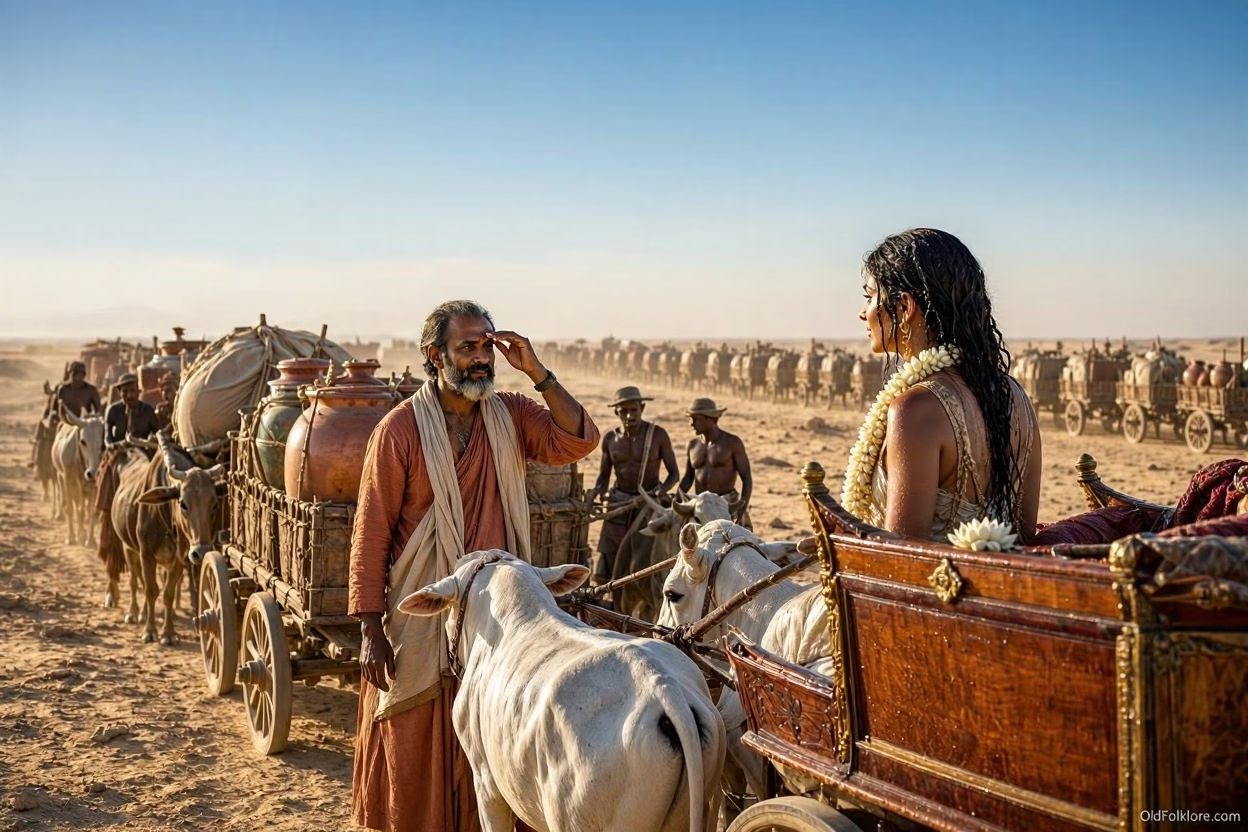
The demon created the appearance of a beautiful carriage drawn by white bulls. He dressed himself as a respectable traveller and surrounded himself with attendants carrying weapons.
To make the deception convincing, he and his companions wore garlands of water-lilies and lotuses. Their clothes and hair appeared wet, and mud covered their bodies and carriage wheels. They also carried and ate the stalks of water plants, making it seem as though they had recently travelled through a region filled with water.
The Demon Deceives the First Caravan
When the demon approached the foolish merchant, he greeted him pleasantly and asked where he was travelling.
The merchant made room for the carriage and stopped to speak with him. Noticing the flowers, wet clothing and water plants carried by the strangers, he became curious.
He asked whether the road ahead contained rain and whether there were ponds filled with water plants.
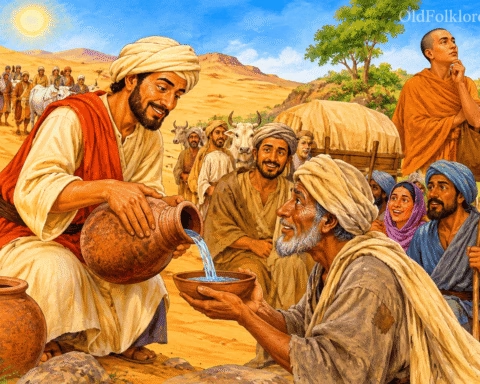
The demon immediately confirmed his suspicion. He claimed that the land beyond the green forest was filled with water and that rain fell there constantly. He described ponds covered with lotuses and assured the merchant that water was plentiful.
As the carts passed, the demon asked what they carried. When he discovered that the final cart contained water, he advised the merchant to break the vessels and pour the water away.
He explained that there was no longer any need to carry such heavy supplies because water could easily be found ahead. He then continued along the road and disappeared from sight.
The foolish merchant believed everything he had been told. Without questioning the stranger’s claims, he ordered his men to break the water vessels and empty them completely.
The caravan continued its journey with lighter carts, but the promised water never appeared.
The First Caravan Meets Disaster
As the sun began to set, the travellers became exhausted and thirsty. They had journeyed throughout the day without finding a single source of water.
When they finally stopped, they arranged their carts in a circle and tied the oxen to the wheels. The men had no water for themselves or their animals, and they could not even prepare their evening meal.
Weak from thirst and exhaustion, they lay down and fell asleep.
During the night, the demons emerged from their dwelling place. They attacked the helpless travellers, killing the men and oxen before consuming their flesh.
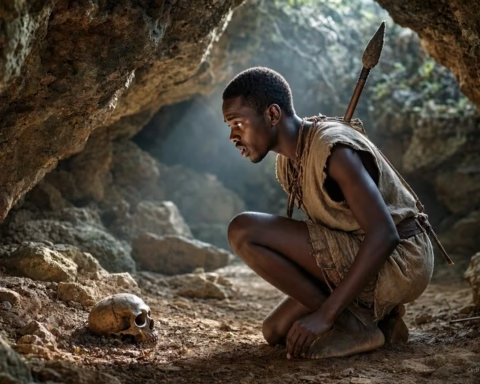
By morning, the entire caravan had been destroyed. The five hundred carts remained loaded with merchandise, while the bones of the men and animals lay scattered across the desert.
The foolish merchant’s decision had brought disaster not only upon himself but also upon everyone who depended on him.
The Wise Merchant Begins His Journey
The Bodisat remained in Benares for a month and a half after the foolish merchant had departed. He then gathered his own caravan and prepared to cross the same wilderness.
Before entering the desert, he filled his water vessels and made sure his people had an abundant supply. He also ordered his men to gather for an important warning.
He instructed them not to use even a small quantity of water without his permission. He further warned them against eating unfamiliar leaves, flowers or fruits because poisonous plants could be found in the wilderness.
Having given these instructions, he led his five hundred carts into the desert.
The Demon Tries the Same Trick Again
When the Bodisat’s caravan reached the middle of the desert, the demon prepared to deceive him in the same way.
He appeared in the beautiful carriage, surrounded by his attendants. Once again, their clothing and hair looked wet, and they carried flowers and water plants to create the impression that they had come from a place filled with water.
However, the Bodisat did not accept the appearance as proof.
As soon as he saw the stranger, he noticed something suspicious. The desert was known to be dry, yet the traveller claimed to have come from a place where water was abundant.
He also observed that the stranger had red eyes, behaved boldly and cast no shadow. These signs made the Bodisat suspect that the visitor was not an ordinary human being.
He reasoned that the foolish merchant who had travelled ahead might already have been deceived by this same creature. He therefore refused to accept the stranger’s advice.
When the demon approached and asked about his destination, the Bodisat answered firmly. He explained that he would not throw away his water until he had found another reliable source.
The demon eventually moved away and disappeared, returning to his dwelling place.
The Bodisat Tests the Demon’s Claims
After the stranger had gone, some of the Bodisat’s men approached him. They explained that the travellers they had just encountered claimed that the desert ahead was filled with water and that rain fell constantly.
They also pointed out the flowers, wet clothes and water plants carried by the strangers. Convinced by what they had seen, they suggested that the caravan should empty its water vessels and continue with lighter carts.
The Bodisat refused to make such a decision without examining the evidence.
He gathered his men and asked whether anyone had ever heard that the desert contained lakes or ponds. They admitted that they had not.
He then asked how far the wind carrying rain could be felt and whether anyone could feel such a wind. His men answered that they could not.
He also questioned them about the visibility of rain clouds and lightning. None of them had seen clouds or flashes of lightning in the distance. When he asked whether anyone had heard thunder, they answered that they had heard nothing.
The Bodisat used their answers to expose the deception. If rain truly fell in the region ahead, there should have been signs of approaching weather. The absence of these signs proved that the strangers’ claims were unreliable.
He explained that the visitors were demons attempting to make the caravan abandon its water so that they could destroy them.
He also reasoned that the previous merchant had probably fallen into the same trap. His caravan and merchandise might still be waiting somewhere in the wilderness.
The Bodisat ordered his men to continue the journey without throwing away even a small quantity of water.
The Wise Caravan Finds the Remains
Following the Bodisat’s instructions, the caravan continued through the desert. Before long, they discovered the five hundred carts belonging to the foolish merchant.
The carts stood exactly as they had been loaded, but the men and animals were dead. Their bones lay scattered across the ground, confirming the terrible fate that had overtaken the earlier travellers.
The Bodisat immediately organised his own camp. He arranged the carts in a strong circle and made sure that the men and oxen received food and rest.
He also instructed the workers to look after the animals and keep the camp secure. During the night, he and the overseers remained on guard with drawn swords, watching for danger.
By the following morning, the caravan was ready to continue. The Bodisat examined the carts and decided to leave behind those that were weak. He also discarded goods of little value and used the stronger carts to carry merchandise worth more.
The Journey Ends in Success
With his people and animals properly prepared, the Bodisat led the caravan out of the dangerous wilderness.
They eventually reached their intended market, where he sold his merchandise for two or three times its original cost. Having completed their business successfully, the entire company returned safely to Benares.
The wise merchant had protected his people because he did not allow a stranger’s convincing appearance to replace careful judgement. Unlike the foolish merchant, he examined the situation, questioned the claims made before him and remained faithful to what he knew to be true.
The Buddha Reveals the Meaning of the Story
After completing the account, the Buddha explained that the events of the past illustrated the lesson he had been teaching at Jetavana.
He reminded Anātha Piṇḍika that those who trusted unreliable claims had met destruction, while those who held firmly to the truth had escaped danger and returned safely home.
The Buddha then uttered a verse about truth and wisdom:
Some speak that which none can question;
Mere logicians speak not so.
The wise man knows that this is so,
And takes for true what is the truth!
He explained that a life guided by truth leads towards spiritual well-being and liberation, while a life guided by falsehood leads to suffering.
At the conclusion of the teaching, the five hundred followers attained the Fruit of Conversion.
The Buddha then identified the characters from the earlier life. The foolish young merchant was Devadatta, and his men were Devadatta’s followers. The wise merchant’s men were the Buddha’s attendants, while the wise merchant himself was the Buddha in a previous birth.
Thus, the story ended with a reminder that truth, wisdom and sound judgement are essential when deciding what to believe and how to act.
Explore our complete Historic Folklore & Fairy-Tale Collections archive.
Moral Lessons
The story teaches the importance of holding firmly to the truth, especially when faced with convincing deception. The wise merchant survived because he questioned the stranger’s claims instead of accepting them without evidence.
It also reminds us that careless decisions can affect the lives of others. A good leader must exercise sound judgement, protect those under their care and consider the consequences of every decision.
Knowledge Check
1. Who brought the five hundred followers to meet the Buddha?
Anātha Piṇḍika, the wealthy merchant.
2. Why did the foolish merchant choose to travel first?
He believed he would enjoy an untouched road, fresh supplies and better opportunities to sell his merchandise.
3. How did the demon deceive the foolish merchant?
He pretended to come from a region filled with water and persuaded the merchant to throw away his drinking water.
4. What happened to the first caravan?
The travellers and their oxen died after losing their water supplies and were attacked by demons during the night.
5. How did the Bodisat recognise the stranger’s deception?
He questioned the stranger’s claims and observed that there were no signs of rain, clouds, lightning or thunder.
6. Who was the wise merchant in his previous birth, according to the Buddha?
The wise merchant was the Buddha himself, while the foolish merchant was Devadatta.
Source
Buddhist Birth Stories; or, Jātaka Tales, Volume I, edited in the original Pāli by V. Fausbøll and translated into English by T. W. Rhys Davids, published by Trübner & Co., London, 1880. Book I, No. 1: “Holding to the Truth” (Apaṇṇaka Jātaka), beginning on page 134.
Explore More Jataka Tales