Curiosity can encourage people to discover new things, but it can also lead them into trouble when they act without thinking. Sometimes, the wisest decision is to leave an unfamiliar matter alone, especially when interfering could bring unexpected consequences.
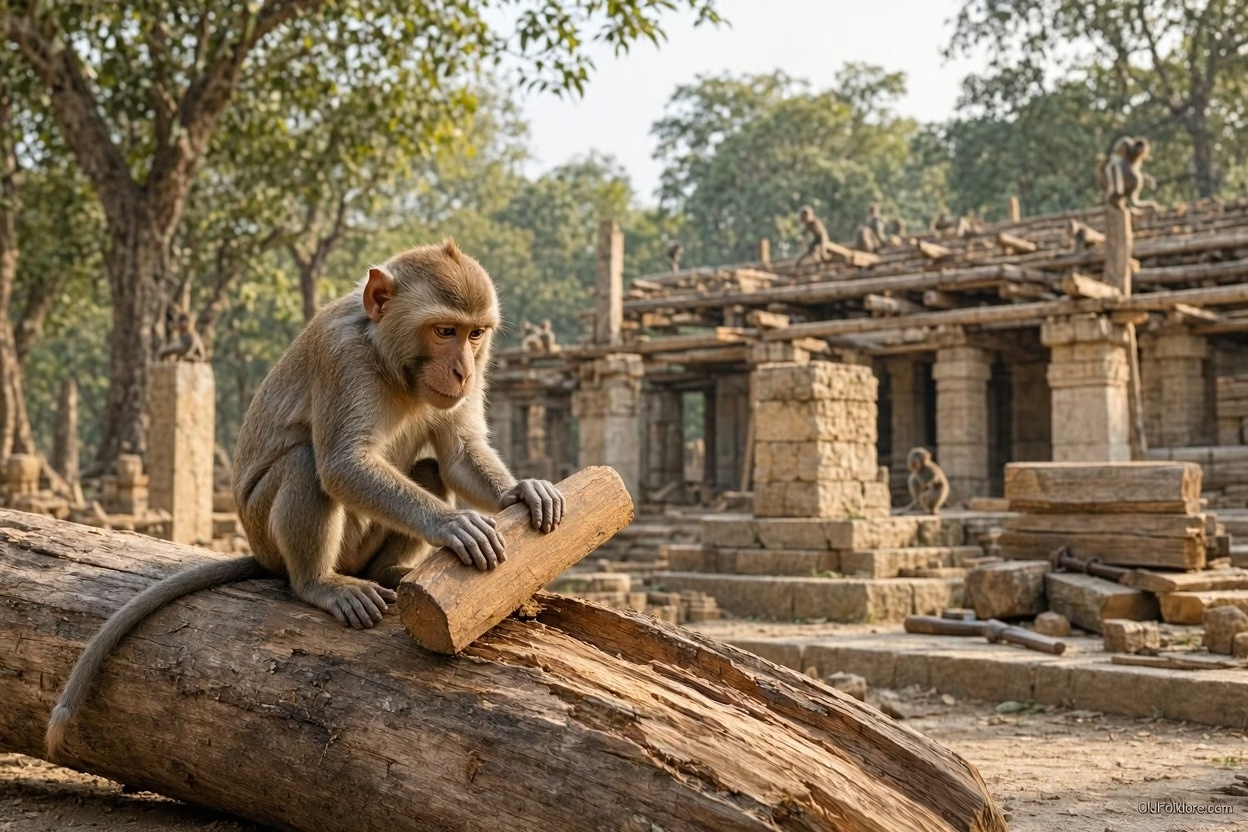
In this Panchatantra tale, a troop of monkeys discovers a half-built temple where workmen have left a large wooden log with a wedge driven into it. While the other monkeys play around the building materials, one monkey becomes fascinated by the wedge and decides to pull it out. He does not understand why it was placed there or what might happen if he removes it.
The incident becomes a warning about unnecessary interference. Through the conversation surrounding the tale, the story also explores the difference between acting with good judgement and involving oneself in matters for personal advantage.
A Merchant’s Temple Construction
There was once a city in a certain region. In a nearby grove, a merchant was having a temple built. Workmen came to the site each day to carry out the construction, bringing their tools and materials to complete the building.
At midday, the foreman and the workers usually left the construction site and returned to the city for lunch. They temporarily abandoned their work, leaving the unfinished temple and its building materials behind until they returned.
Explore more stories from our The Panchatantra collection.
One day, during their absence, a troop of monkeys arrived at the site. They discovered the half-built temple and began exploring the surroundings. The unfinished building, nearby trees and piles of timber provided plenty of opportunities for their usual playful activities.
The Log and the Wooden Wedge
Among the construction materials lay a tremendous anjana log that a mechanic had begun to split. To keep the opening in the wood apart, he had driven a wedge made of acacia wood into its upper end.
The wedge served a practical purpose. It held the split log open while the mechanic worked on it. Without the wedge, the two sides of the wood could close together again.
The monkeys paid little attention to the reason the log had been prepared in that manner. They continued their playful activities among the treetops, the lofty roof and the woodpile.
However, one monkey noticed the unusual arrangement of the log and the wedge. Instead of continuing to play with the others, he became interested in the wooden object lodged inside the timber.
The Monkey’s Dangerous Curiosity
The curious monkey wondered who had placed the wedge in such an unusual position. He did not understand the purpose it served, but he wanted to investigate it.
Without considering the possible danger, he climbed onto the log and sat astride it. He then took hold of the wedge with both hands and began pulling it loose.
The monkey continued working at it until the wedge finally gave way. The moment it came out, the split log closed around the opening.
Unfortunately, the monkey was sitting directly over the part of the log that closed. His body became trapped in the narrowing gap, and the incident resulted in his death.
The other monkeys had been playing around the construction site, but this particular monkey had allowed curiosity to lead him into a dangerous situation. He had interfered with something he neither understood nor needed to touch.
Cheek Explains the Danger of Meddling
After telling the story, Cheek explained the reason for using the monkey as an example. He wanted to show that intelligent people should avoid meddling in matters that do not concern them.
He connected the monkey’s fate with the danger of interfering in another person’s affairs without understanding the situation. Just as the monkey suffered because he removed the wedge without knowing its purpose, people could bring trouble upon themselves by involving themselves unnecessarily in matters beyond their responsibility.
Cheek also reminded Victor that the two of them earned a comfortable living from what their master left behind. He questioned why they should involve themselves in matters that could put their position and security at risk.
Victor Disagrees with Cheek
Victor did not entirely accept Cheek’s argument. Although he understood the warning, he believed that serving a master should involve more than simply receiving food and enjoying the benefits of another person’s position.
He argued that a wise servant should contribute meaningfully by helping friends and opposing enemies when necessary. He supported his position with several traditional verses about service, responsibility and the value of helping others.
Victor’s response introduced another side of the discussion. While Cheek emphasised the danger of unnecessary interference, Victor believed that people should not avoid every responsibility simply because taking action involves some risk.
Their disagreement showed that the lesson was not simply about refusing to act. It was about knowing when action was necessary and when interference could cause harm.
The Meaning Behind the Tale
The monkey’s death provides the central warning in this story. He did not suffer because he was playing with the other monkeys or exploring the construction site. His mistake was deciding to remove something without understanding its purpose or considering the consequences.
Cheek uses the incident to caution against unnecessary involvement in matters that do not concern a person. Victor’s response, however, introduces the importance of responsible service and meaningful action.
Together, their conversation encourages readers to distinguish between thoughtful involvement and careless interference. It is important to help when there is a genuine need, but it is equally important to recognise situations where remaining uninvolved is the wiser choice.
Explore our complete Historic Folklore & Fairy-Tale Collections archive.
Moral Lessons
The story teaches that curiosity should be guided by wisdom and good judgement. The monkey’s failure to consider the purpose of the wedge leads to his death, reminding readers to think carefully before interfering with unfamiliar things.
It also highlights the importance of understanding boundaries. Not every situation requires our involvement, and acting without sufficient knowledge can create problems that could have been avoided. At the same time, the conversation between Cheek and Victor reminds us that responsible service involves knowing when to act and when to exercise restraint.
Knowledge Check
1. Where was the merchant having a temple built?
In a grove near a certain city.
2. Why did the workmen leave the construction site at midday?
They returned to the city for lunch.
3. What was placed inside the wooden log?
A wedge made of acacia wood.
4. Why did the monkey try to remove the wedge?
He became curious about its purpose and wanted to investigate it.
5. What happened when the monkey removed the wedge?
The split log closed around him, trapping him and causing his death.
6. What is the main lesson of the story?
People should avoid careless interference and think about the consequences of their actions.
Source
The Panchatantra, translated by Arthur W. Ryder and published by the University of Chicago Press in 1925. Book I, The Loss of Friends, Story 2: “The Wedge-Pulling Monkey,” pages 25–41.
Explore More On The Panchatantra Tales